
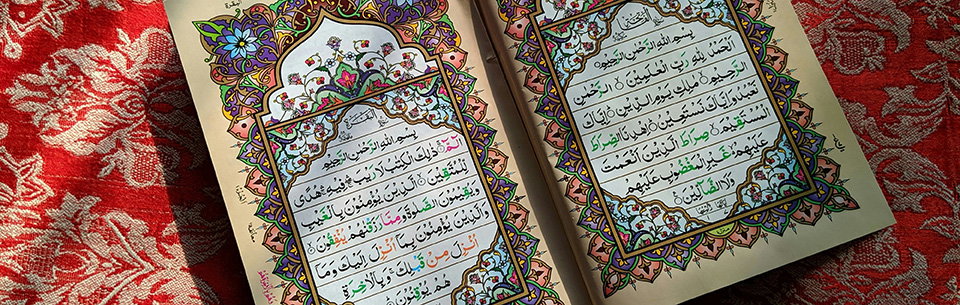
Photo by Abdullah Faraz on Unsplash
What Every Christian Should Know About the Quran
Part 2 of “What Every Christian Should Know About Islam”
Christians, Jews, and Muslims are often called “people of the book” because each religion follows a sacred text they believe to be authoritative. Christians acknowledge the inspiration of the Hebrew Scriptures along with Jews, but many do not know much about the Quran. When we take a look at this text, we see that unlike the Hebrew Scriptures and the New Testament, the Quran is not divinely inspired, contradicts itself at many points, and teaches many errors and an evil ethic.
The Quran
Portions of this article have been adapted from Simon Turpin, Engaging Islam (Hebron, KY: Answers in Genesis, 2021).
Muslims believe the Quran is the final and greatest revelation of Allah as revealed to the prophet Muhammad. Although Muslims differ over the exact details of the revelation of the Quran, most believe that the Quran was “sent down” from the Preserved Tablet (al-Lawh al-Mahfuz) to the first heaven on the Night of Power (Laylat al-Qadr) all at once. Then it was “sent down” in stages over 23 years (Surah 25:32) during Muhammad’s time both in Mecca and Medina (AD 610–632). The Quran is said to have been revealed (or dictated) to Muhammad through the angel Gabriel (Jibril) in the Arabic language (Surah 12:1–2) and is considered to be the eternal and uncreated word of Allah (Surah 85:21–22).1 Muslims believe the Quran is the direct word of Allah and not the words of Muhammad as he was merely the passive vessel of divine revelation.2
No, the textual history of the Quran is problematic.
It was not until Muhammad died and was succeeded by the caliphs—Abu Bakr (AD 632–AD 634), Umar ibn al-Khattab (AD 634–644), and then eventually during the ruling of Uthman ibn Affan (AD 644–656)—that the Quranic material was compiled. The claim from Islamic scholars and apologists today is that the Uthmanic tradition of the Quran is perfectly preserved and has not changed in 1,400 years (Surah 15:9). Is this true? Has the Quran been perfectly preserved throughout the ages? No, the textual history of the Quran is problematic. This can be seen in the Hadith. The third caliph of the Islamic Empire, Uthman ibn Affan, was so concerned about the differences in Quranic manuscripts that he had an official copy made and the others burned (Sahih al-Bukhari 4987).3 If there has only ever been one perfectly preserved Quran, why did Uthman order the burning of different Qurans? The reason Uthman decided to standardize the Quran was so that there would only be one version of the Quran.
Today, scholars have found numerous textual variants (words and phrases) in different Quranic manuscripts.
| Differences Between Quranic Texts4 | |
|---|---|
| Topkapi (mid-eighth century) | Cairene text (1924 canon) |
| “You know what we conceal and what he revealed.” (Surah 14:38) | “You certainly know what we conceal and what we reveal.” (Surah 14:38) |
| “If you should die or be slain, you shall not be gathered.” (Surah 3:158) | “If you should die or be slain, before Him you shall undoubtedly be gathered.” (Surah 3:158) |
In the Topkapi text of Surah 14:38, the pronoun is in the singular, but in the Cairene text of Surah 14:38, it is in the plural. The Cairene text of Surah 3:158 completely changes the theological meaning of the text. The claim that the Quran is eternal (Surah 85:21–22) and unable to be changed by men (Surah 6:114; 10:15) because it is protected by Allah himself (Surah 15:9) does not fit with the historical evidence.
In its original context, the revelations of the Quran are really a call to monotheism in a pagan polytheistic society. The Quran contains 114 Surahs (chapters) and is arranged in order of the length of its chapters, with the longest coming first (Surah 2) and the shortest last (Surah 108). This is in contrast with the Bible, which is largely arranged chronologically. The Surahs are also divided into the Meccan and Medinan period. After Muhammad was expelled from Mecca (because his message of monotheism condemned the polytheism of the Meccans), the revelations in the Medina period took place. A significant difference between the Meccan and Medinan revelations is the attitude toward the Jewish and Christian people who did not accept Muhammad’s revelations (see Deuteronomy 13:1–3; Galatians 1:8–9).
Errors in the Quran
The Quran, unlike the Bible, contains many errors, including of biology. For instance, the Quran claims that the male contribution to fertilization is the basis for the body of the baby developing in the womb (Surah 77:20–22). It also says that the early embryo is a blood clot (Surah 23:14; 96:2). It further says that determination of sex of the embryo happens at the clot stage (Surah 75:37–39).
The Quran also contains theological errors, indicating misunderstandings about Christian theology. The Quran includes Mary in the Trinity (5:72–75; 116) and also confuses her with Miriam, the sister of Moses and Aaron (19:27–28). It is not surprising that a book written at that time did not have the biological knowledge that we have today or that someone with limited interaction with Christians did not understand their theology. However, that these misunderstandings made their way into the Quran means that it is not inspired by the God who cannot err.
The Islamic Dilemma
A popular Muslim claim is that the Bible Christians have today has been altered and corrupted from the original used by the followers of Jesus. However, unlike Muslims today, the Quran does not actually teach that the Bible has been corrupted. The Quran affirms the inspiration, preservation, and authority of the Torah and the Gospels (Surah 3:3–4; 7:157; 5:46–47). It also emphatically states that no one can change Allah’s words (Surah 6:114–115; 10:64; 18:27).5 Yet the Quran also contradicts the Gospels on fundamental doctrines: It denies the deity of Christ (Surah 5:73; 116); it denies the crucifixion of Christ (Surah 4:157); and it denies the doctrine of the Trinity (Surah 4:171). This places Muslims in a dilemma as there are only really two options for them:
- The Torah and the Gospels are the inspired, preserved, and authoritative Word of God.
- The Torah and the Gospels are not the inspired, preserved, and authoritative Word of God.
If Christians have the Word of God, Islam is false, and if Christians don’t have the Word of God, Islam is still false.
If the Torah and the Gospels are the inspired, preserved, and authoritative Word of God, then Islam is false because Islam contradicts them on fundamental Christian doctrines. On the other hand, if the Torah and the Gospels are not the inspired, preserved, and authoritative Word of God, then Islam is still false as the Quran affirms the inspiration, preservation, and authority of the Torah and the Gospels. If Christians have the Word of God, Islam is false, and if Christians don’t have the Word of God, Islam is still false.
Did the Bible Prophesy About Muhammad?
The Muslim ultimately views the Bible through the lens of the Quran, and therefore, it determines what is and what is not true in the Bible. For example, the claim by the Quran is that Muhammad is prophesied in the Torah and the Gospels (Surah 7:157). Yet neither the Torah nor the Gospels prophesy this at all. The classical passage that Muslims use to identify Muhammad in the Old Testament is Deuteronomy 18:18. The context makes clear, however, that the “prophet” must come from among the 12 tribes of Israel (Deuteronomy 18:2, 5, 15), he must prophesy “in the name of the Lord” (Deuteronomy 18:22), and that he would be like Moses (Deuteronomy 18:18)—someone who spoke with God face to face and did signs, wonders, and miracles (Deuteronomy 34:10–11). The prophet of Deuteronomy 18:18 is ultimately fulfilled in the person of Jesus Christ (John 1:45; Acts 3:22–23, 7:37). Jesus had an intimate communion with God the Father (Matthew 11:27, 26:36–42; John 10:15); for three years performed signs, wonders, and miracles, the likes of which Israel had never seen (Matthew 8:1–4; Mark 4:35–4; John 2:1–11, 11:38–44); and functioned prophetically, warning his disciples of his death and resurrection (Mark 10:32–34) and of the coming destruction of Jerusalem (Matthew 24:2). Muhammad is clearly not being prophesied in Deuteronomy 18 because he is not an Israelite, he did not prophesy in the name of the Lord, he did not know God face to face, and he did not do any signs, wonders, or miracles.
The passage that Muslims go to in the New Testament is John 14:16 where Jesus speaks of a coming “helper” (paraklētos). For Muslims, this is supposedly Muhammad. In context, however, Jesus is speaking of the Holy Spirit, who is described as the “Spirit of truth” who will be with the disciples forever (John 14:16–17). Of course, Muhammad was not with the disciples forever nor was he truthful. John 14:17 also says the comforter will not be seen by the world and that he will dwell in believers, but Muhammad was seen by the world and, of course, does not dwell in believers. The role of the Helper is also to bear witness about Jesus (John 15:26), but Muhammad said Jesus was just a prophet, whereas the Gospel of John specifically states that Jesus is the divine Son of God (John 1:1, 5:18, 8:58, 10:33, 20:28). If Muslims believe the Helper is referring to Muhammad, then it poses a huge theological problem for them. As Jesus said, “Nevertheless, I tell you the truth: it is to your advantage that I go away, for if I do not go away, the Helper will not come to you. But if I go, I will send him to you” (John 16:7).
Jesus is the one who will send the Helper into the world, but according to the Quran, Muhammad was sent by Allah. So if Muhammad is sent by Allah and the Helper is sent by Jesus, and if Muhammad is meant to be the Helper, then for Muslims this would make Jesus Allah—a position that would be inconsistent with Islamic theology. The criteria for a true prophet laid out in the Bible rules out Muhammad being a prophet sent by God:
- Muhammad is said to come from the line of Ishmael, but the covenantal line is established through Isaac and not Ishmael (Genesis 17:7, 18–21, 22:2).
- Muhammad did not do anything (prophecy or miracles) to show he was a prophet (Deuteronomy 13:1–3, 18:22, 34:10–11).
- Muhammad said nothing that was in line with the previous prophetic revelation.
- The author of the book of Hebrews tells us that God has spoken finally through the person of his Son, Jesus (Hebrews 1:1–2).
- Muhammad followed the wrong God; he followed Allah not Yahweh (Deuteronomy 6:4; 1 Corinthians 8:6).
The only Bible verse that is quoted in the Quran is the lex talionis (an “eye for eye” in Leviticus 24:20, see Surah 5:45), but nothing from the New Testament is ever quoted. Although the Quran does not mention Adam, Noah, Abraham, Moses, and several other biblical figures, the author was familiar with oral traditions and not the text of the Bible. The difference in the accounts shows that the author of the Quran is getting his information from an oral, not a literary, source.
Even though the Quran does have words from Jesus and accounts of his life, they are not from the Bible. Jesus speaks from a physical location only in two places in the Quran. He speaks from his cradle (Surah 3:46; 19:28–34), a scene from the Arabic Infancy Gospel written in the fifth century. Jesus also forms birds (Surah 3:49) and breathes upon them so they come alive, a scene taken from the Infancy Gospel of Thomas (a gnostic text)6 from the second century. Neither of these sources are canonical gospels. From these and many other stories in the Quran, it seems that Muhammad took the stories that were popular in and before his lifetime and gave them an Islamic twist and included them in the Quran. Interestingly, even the pagans in Mecca recognized that the stories in the Quran were known legends:
There are some of them who pretend to listen to your recitation of the Quran, but We have cast veils over their hearts—leaving them unable to comprehend it—and deafness in their ears. Even if they were to see every sign, they still would not believe in them. The disbelievers would even come to argue with you, saying, “This Quran is nothing but ancient fables!” (Surah 6:25).
This is all evidence that the author of the Quran had no idea what was contained within the Bible as they show no interaction with the theology of the Bible.
In the final article in this three-part series, we’ll examine what Muslims believe about Allah, sin, and salvation.
Footnotes
- Shia Muslims generally believe the Quran was created, but the orthodox Sunni position asserts its uncreated and eternal in nature.
- Christians not only believe that the Bible (66 books of the Old and New Testaments) came from God (2 Timothy 3:16) but that he used to the write the Bible was by men under the influence of the Holy Spirit (2 Peter 1:21).
- Sahih Al-Bukhari 4987 states, “Uthman sent to every Muslim province one copy of what they had copied, and ordered that all the other Qur'anic materials, whether written in fragmentary manuscripts or whole copies, be burnt.”
- Dr. Jay Smith, “The Qur’an’s Many Problems,” Horizons International, YouTube, September 8, 2018, https://www.youtube.com/watch?v=bhvusVmuARU.
- Some Muslims argue that Allah’s words only apply to the Quran. However, those verses don’t say that no one can change the Quran, they specifically state that no one can change Allah’s words. The Quran states that the Torah and the Gospels are Allah’s words (Surah 5:47).
- Gnosticism taught salvation was not from sin but a quest for secret knowledge (given to the enlightened), and this was marked by the view that matter is evil and that spirit is good. Gnostics denied the humanity of Jesus (1 John 1:1–3, 4:1–3).
Support the creation/gospel message by donating or getting involved!

Answers in Genesis is an apologetics ministry, dedicated to helping Christians defend their faith and proclaim the good news of Jesus Christ.
- Customer Service 800.778.3390
- Available Monday–Friday | 9 AM–5 PM ET
- © 2026 Answers in Genesis