

The Surprising Effects of the Scopes Trial—100 Years Later
A newly discovered omen from the famous “monkey trial”
One hundred years ago, the Scopes trial began a historical cycle—a cycle that is now repeating and that eventually included high stakes gambling, billions of dollars, and explosive implications for creation science.
The Cycle Begins
In March of 1925, the state of Tennessee passed the Butler Act, which stated that:
It shall be unlawful for any teacher in any of the Universities, normals and all other public schools of the State which are supported in whole or in part by the public school funds of the state, to teach any theory that denies the story of the Divine Creation of man as taught in the Bible, and to teach instead that man has descended from a lower order of animals.1
Four months later, the evolutionary community responded. But not in ways that you might expect.
You might be inclined to think that the evolutionists immediately repealed the Butler Act. But they didn’t. The Butler Act stayed on the books for another 42 years.2
Apparently, public opinion wasn’t on the side of evolution. So the evolutionary community sought to change it.
Why? Courts tend to follow public opinion.3 Apparently, public opinion wasn’t on the side of evolution.4 So the evolutionary community sought to change it.
By mocking the Butler Act.
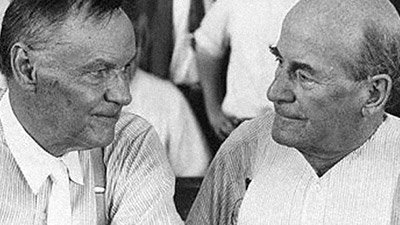
The Scopes trial of July 1925 was the venue. The most famous scene from the trial, which was broadcast nationally via radio,5 was the contentious exchange between the attorney for the teacher accused of teaching evolution and the attorney for the prosecution. The former, Clarence Darrow, put the latter, William Jennings Bryan, on the witness stand.
For what purpose? Bryan found out the hard way:
These gentlemen . . . they did not come here to try this case. They came here to try revealed religion.6
Darrow agreed, excoriating Bryan in the process:
You insult every man of science and learning in the world because he does not believe in your fool religion.7
Darrow didn’t even try to fight the conviction; after publicly shaming Bryan on the stand, Darrow asked for a guilty verdict.
The Slow and Gradual Phase
One consequence of the verdict was a short-term loss for evolution:
The legal controversy finally cooled into a quiet standoff by 1930, but only after textbook publishers bowed to the demands of anti-evolutionists by de-emphasizing the offending theory in most high-school texts.8
In the wake of the trial, textbook publishers, afraid of losing sales, quietly reduced or eliminated any coverage of evolution in high school textbooks, and by 1942, less than half the high school science teachers in the country were teaching anything about evolution.9
But the long-term consequences for evolution were all gain. As a result of the trial,
The creationist revival of the 1920s was all but stopped dead in its tracks. . . . One of the most disappointing aspects . . . was its intimidating effect on Christians. Multitudes of nominal Christians capitulated to theistic evolution, and even those who retained their belief in creation retreated from the arena of conflict.10
In the decades that followed, the legal underpinnings for the Tennessee law began to erode, bit by bit. The main planks to be ripped up were in the arena of the relationship between church and state. In 1947 in Everson v. Board of Education, the Supreme Court extended the reach of the “establishment clause” control to state law.11 The Butler Act was, of course, state-level legislation.
In 1962 in Engel v. Vitale, the Supreme Court took prayer out of public schools.12 The Butler Act, overtly grounded in religious language, was all but ready for repeal.
-
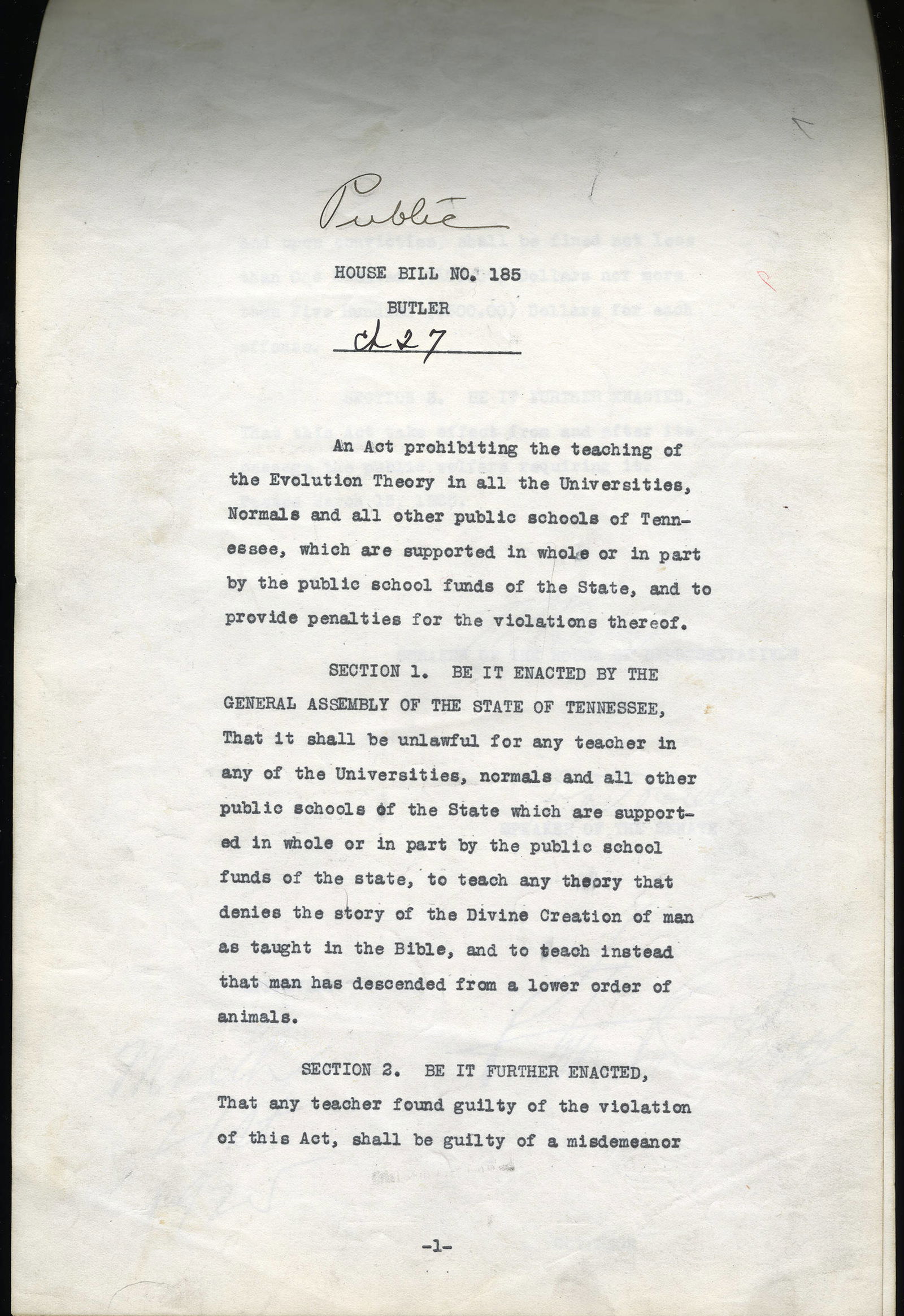
The Butler Act. Public Domain via Tennessee Virtual Archive.
-
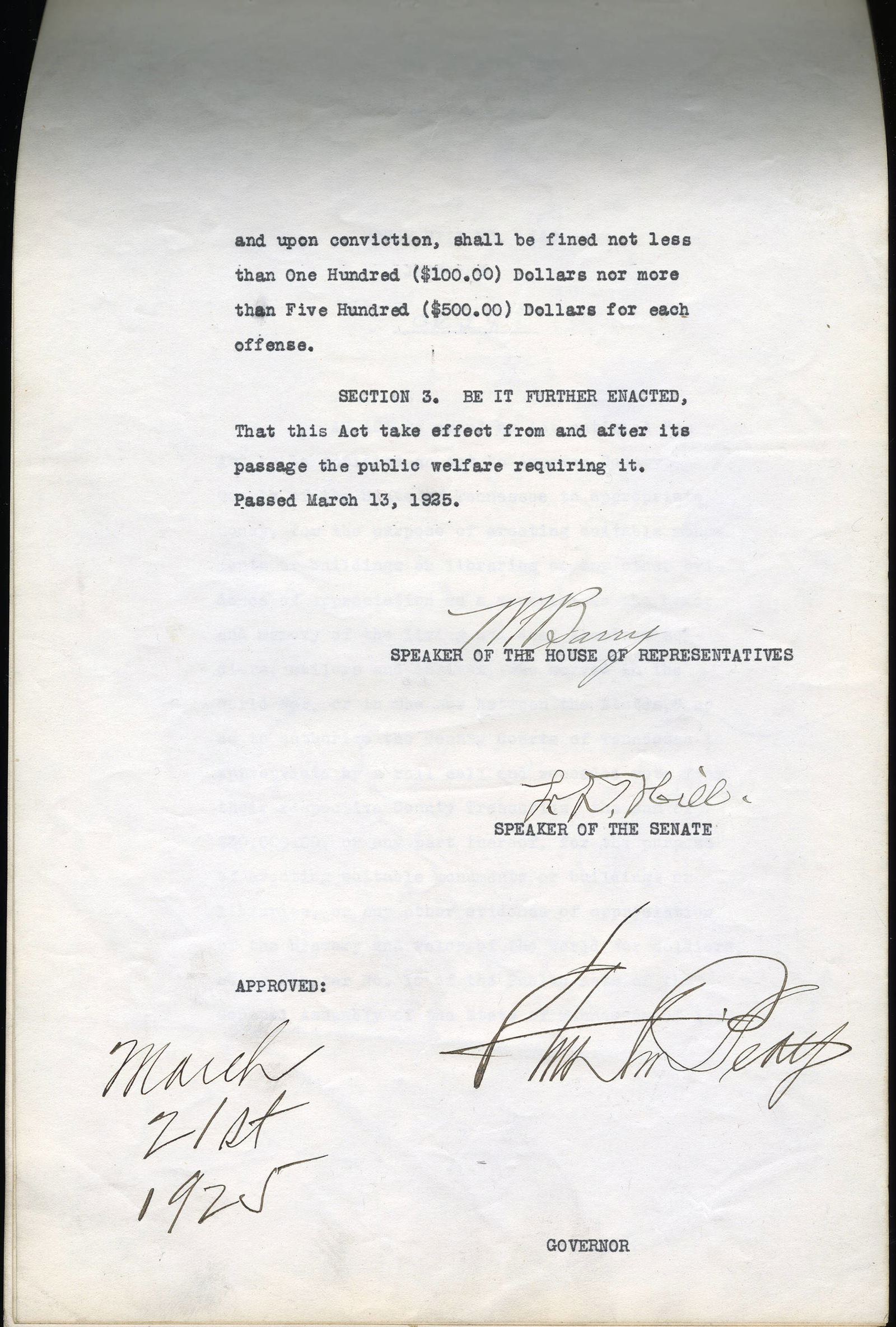
The Butler Act. Public Domain via Tennessee Virtual Archive.
The Cycle Completes
It wasn’t until 1968 that the Supreme Court overturned state-level law banning the teaching of evolution. In this case, it wasn’t the Tennessee law; it was an Arkansas one (see Epperson v. Arkansas13). Perhaps seeing the writing on the wall, the Tennessee legislature repealed the Butler Act one year prior.14
Thus, the evolutionary counteroffensive, which began at the Scopes trial, was ultimately a success. Evolution returned to the public schools with a vengeance. Skillful use of mockery, followed by slow-and-gradual chipping away at the legal foundations, culminating in a final, decisive blow proved a winning strategy.
This should be the end of the Scopes story. Except that, several years prior to Epperson v. Arkansas, the wheels of another battle cycle had already been set in motion. This time, however, roles would be reversed.
A New Cycle Begins
Seven years before Epperson v. Arkansas, PhD hydrologist Henry Morris and theologian John Whitcomb published the book, The Genesis Flood. Panned by the mainstream scientific community, it was received enthusiastically by the Christian community. A professional cadre of young-earth creation scientists quickly sprung up. In 1963, the Creation Research Society was founded.15 In 1970, the Institute for Creation Research was born.16 And then the movement took off.
The 1970s witnessed the first, massive, decisive step in a new cycle of origins conflict. For example, in 1976, the Institute for Creation Research reported:
One of the most exciting developments of the past few years has been the re-introduction of creationism to the nation’s college and university campuses. Less than a decade ago, a formal lecture or debate defending creationism as a scientific concept would have been impossible on a university campus. The doors were shut and, with rare exceptions, there were no creationist scientists who were willing and able to give such lectures anyhow. The situation today is altogether different. . . .
During 1975 alone, for example, Dr. Duane Gish and Dr. Henry Morris have spoken or debated on over 60 college and university campuses, not to mention numerous public schools, scientific organizations, and teachers’ associations. It is estimated that over 30,000 college students have heard one or more of these creationist messages during 1975. The majority of these students, of course, were non-Christians.
Some of the nation’s leading universities—University of California (Berkeley, Los Angeles, San Diego, etc.), Louisiana State University, University of Kansas, University of Wisconsin, (Madison, Milwaukee, Oshkosh), University of North Carolina, Tulane University, Oregon University, Texas Tech, University of Missouri, Kansas State, University of Minnesota, Virginia Tech, Colorado State, University of Texas, University of Tennessee, Auburn University, University of Florida, Penn State, and many others—have been reached through lectures of this sort in the past three years, not to mention numerous colleges and universities in Canada, Australia, and New Zealand.17
This new wave of young-earth creation advocates were so effective that even vitriolic anti-creationists were forced to pay them backhanded compliments. For example, PhD evolutionist Douglas Futuyma, who has complained that “creationists are assaulting the entire mode of scientific thought”18 and that “the fundamental conflict, then, is between two incompatible ways to knowledge,”19 still conceded that:
Gish is a tireless, glib speaker who has debated some eminent evolutionists with considerable success.20
Why were Morris and Gish so successful? Morris described his debate strategy:
We are always careful to stick strictly to scientific arguments, especially using the fossil record to show that macro-evolution has not occurred in the past, the characteristics of mutation and natural selection to show that it is not occurring in the present, and the laws of thermodynamics to show that it could not occur at all. Also the principles of probability are used to show that complex functioning systems could never have arisen by chance.21
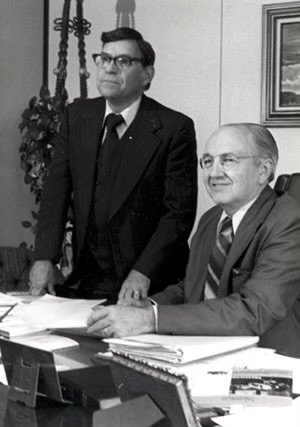
Dr. Duane Gish and Dr. Henry Morris
These criticisms were a damning blow to the supposed scientific coherence of evolutionary thought.
In other words, creationists were successful because they professionally and ruthlessly mocked evolution in public.
In other words, creationists were successful because they professionally and ruthlessly mocked evolution in public.
“Scopes II” happened in the 1970s. But this time, the setting for the public mockery wasn’t a courtroom; it was a university auditorium. Well, it was many university auditoriums. Also, this time, it wasn’t anti-evolutionary laws and biblical ideas on trial. Instead, evolutionary claims were cross-examined. In short, more than five decades after the Scopes trial, creationists took a page from the evolutionists and used their own strategy against them.
Recall that, after the 1925 Scopes trial mockery, creationists pulled back from the debate (see quotation in earlier section). After the 1970s, evolutionists did the pulling back. In 2008, then-president of ICR, John Morris, observed:
In the 1970s, debates became major events on university campuses and were often the first time students were exposed to a credible case for creation. . . . But now the debates have pretty much ceased. Several leading evolutionists cautioned their colleagues to avoid them, and with good reason. The creationists seemed to always win.22
A New Slow and Gradual Phase
The wave of creationist enthusiasm crested with the reintroduction of creation science into the public schools, causing panic in the evolutionary camp. Writing in 1983, Futuyma lamented:
[Science] is under more serious attack now than it has been for half a century. The threat is not trivial. By November 1981, two states had passed laws requiring creation to be given equal time with evolutionary science in public school science classes, and similar bills were under consideration in more than twenty other states. Creationist groups have drafted bills that they are circulating widely among the other state legislatures. Similar initiatives are under way in countless local school districts where boards of education are yielding, or resisting only with difficulty. Museums have come under attack for presenting displays of evolution. Some members of Congress have considered introducing a bill that would mandate federal support for creationist “research.”23
In 1925, the creationists “won” the lawsuit but, eventually, lost the longer war. After the 1970s, the evolutionists “won” the ensuing legal battles.
In 1981, the National Center for Science Education was founded, whose goal was to forcefully push back against the creationist gains in the public school system. Opponents of creation science scored their first legal victory in 1982 at the federal court level (see McLean v. Arkansas Bd. of Ed.24). The Supreme Court ruled in their favor in 1987 (see Edwards v. Aguillard25).
What, exactly, did the evolutionists demand of creation science? What was so dangerous about creation science that the courts kicked it out of the science classroom? In the 1982 decision, Judge Overton wrote:
The creationists’ methods do not take data, weigh it against the opposing scientific data, and thereafter reach the conclusions. . . . Instead, they take the literal wording of the Book of Genesis and attempt to find scientific support for it. . . . While anybody is free to approach a scientific inquiry in any fashion they choose, they cannot properly describe the methodology used as scientific, if they start with a conclusion and refuse to change it regardless of the evidence developed during the course of the investigation.26
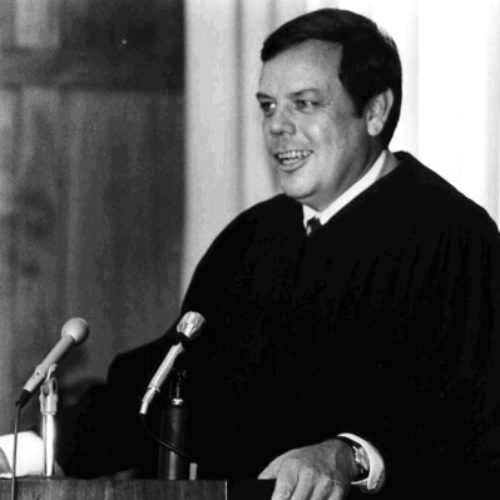
Judge William Overton. Public Domain via Wikimedia Commons.
According to Overton, what should creationists have done instead? What were the criteria for science that creationists had to meet? He wrote:
The essential characteristics of science are:
(1) It is guided by natural law;
(2) It has to be explanatory by reference to natural law;
(3) It is testable against the empirical world;
(4) Its conclusions are tentative, i.e., are not necessarily the final word; and
(5) It is falsifiable.27
He then concluded that “Creation science . . . fails to meet these essential characteristics.”28
I suspect that, when the evolutionists argued their case in 1982 and 1987, they never expected the creationists to effectively strike back or progressively erode the legal foundation for their case. After all, evolutionists owned a monopoly on the billions of dollars of annual government research money. They owned the academic research facilities. They gatekept the technical journals where research findings were published. How could creationists make and fulfill testable predictions?
Yet moving the conflict away from the realm of mockery and into the dry academic realm of testable predictions was a gamble for the evolutionists. In theory, it was possible for the creationists to succeed. Creationists *could* eventually make and fulfill testable predictions.
Did they? I’ve already traced this history for two fundamental biological questions—which happen to have been Darwin’s two central questions. His most famous book, first published in 1859, sought to explain the origin of species.29 On this front, creationists have tested—and fulfilled—scientific predictions.30 Darwin’s second volume on this front, first published in 1871, sought to explain the origin of man.31 On the human origins front, creationists have also tested—and fulfilled—scientific predictions.32
In other words, over the last 40 years, and especially the last 15 years, creationists have been chipping away at the legal foundation for evolution from the 1980s. Creationists have been turning the evolutionary legal gamble on its head—by meeting a standard that evolutionists wagered would be unattainable.
Inherit the Win
Recall that the courts tend to follow public opinion.33 Where does public opinion sit today on the creation-evolution question? Perhaps more importantly, can public opinion be swayed? Events just this year suggest an answer and portend a new era for creation science.
When evolutionists settled on testable predictions as an arena for the origins battle, I don’t think they realized the full scope of their wager. It’s not just that evolutionists set themselves up for eventual loss. It’s that one particular outcome had the potential to send the risk factor into the stratosphere.
Consider: Science is accomplished via making and fulfilling testable predictions. But fulfilling a prediction represents a scientific discovery—something new about the world that we didn’t know before. If creationists make and fulfill testable predictions, they’re going to be making scientific discoveries.
Scientific discoveries make news. They write headlines that garner attention. If creationists meet the legal standard of the 1980s, there’s a real possibility that their successes begin to make news and shape public opinion.
I’ve already seen the early signs of this. My current research—involving testing and making predictions—revolves around the question of the pre-European history of the Americas. We just broke news about new discoveries for pre-Pilgrim North America.34 The view counts on YouTube suggest that we’ve struck a nerve.35
Will we see a repeat of 1968—i.e., a repeal of the 1980s anti-creationist court decisions—in our lifetimes? The current historical cycle that we’re on—a cycle that mirrors the Scopes trial cycle from the past century—suggests that the answer is yes.

Footnotes
- Butler Act, Tennessee State Library & Archives, accessed June 26, 2025, https://teva.contentdm.oclc.org/digital/collection/scopes/id/168.
- Repeal of the Butler Act, Tennessee State Library & Archives, accessed June 26, 2025, https://teva.contentdm.oclc.org/digital/collection/scopes/id/175.
- E. J. Larson, Trial and Error: The American Controversy over Creation and Evolution (New York: Oxford University Press, Inc., 1985), 4–5.
- Larson, Trial and Error.
- D. Masci, “The Social and Legal Dimensions of the Evolution Debate in the U.S.,” Pew Research Center, February 4, 2009, https://www.pewresearch.org/religion/2009/02/04/the-social-and-legal-dimensions-of-the-evolution-debate-in-the-us/.
- Page 288 of court transcript.
- Page 288 of court transcript.
- Larson, Trial and Error, 3.
- D. J. Futuyma, Science on Trial: The Case for Evolution (New York: Pantheon Books, 1983), 6.
- H. M. Morris, History of Modern Creationism (Santee, CA: Institute for Creation Research, 1993), 74.
- Masci, “Social and Legal Dimensions of the Evolution Debate.”
- Engel v. Vitale, 370 U.S. 421 (1962), https://supreme.justia.com/cases/federal/us/370/421/.
- Epperson v. Arkansas, 393 U.S. 97 (1968), https://supreme.justia.com/cases/federal/us/393/97/.
- Repeal of the Butler Act, https://teva.contentdm.oclc.org/digital/collection/scopes/id/175.
- Creation Research Society, “History and Aims,” accessed June 26, 2025, https://www.creationresearch.org/history-and-aims.
- Morris, History of Modern Creationism, 271.
- H. M. Morris and D. T. Gish, “Creation on the Campus!,” in The Battle for Creation (San Diego, CA: Creation Life Publishers, 1976), 68–69.
- Futuyma, Science on Trial, 9.
- Futuyma, Science on Trial, 18.
- Futuyma, Science on Trial, 9.
- Morris, History of Modern Creationism, 308.
- J. D. Morris, “Reflections on the Debate,” Institute for Creation Research, March 1, 2008, https://www.icr.org/article/reflections-debate.
- Futuyma, Science on Trial, 4–5.
- McLean v. Arkansas Bd. of Ed., 529 F. Supp. 1255 (E.D. Ark. 1982), https://law.justia.com/cases/federal/district-courts/FSupp/529/1255/2354824/.
- Edwards v. Aguillard, 482 U.S. 578 (1987), https://supreme.justia.com/cases/federal/us/482/578/.
- McLean v. Arkansas Bd. of Ed., https://law.justia.com/cases/federal/district-courts/FSupp/529/1255/2354824/.
- McLean v. Arkansas Bd. of Ed., https://law.justia.com/cases/federal/district-courts/FSupp/529/1255/2354824/.
- McLean v. Arkansas Bd. of Ed., https://law.justia.com/cases/federal/district-courts/FSupp/529/1255/2354824/.
- C. Darwin, On the Origin of Species by Means of Natural Selection, or the Preservation of Favoured Races in the Struggle for Life, 1st ed. (London: Murray, 1859), https://darwin-online.org.uk/contents.html#origin.
- See N. T. Jeanson, “An Unexpectedly Strong Argument for a Young Earth,” Answers in Genesis, May 28, 2025, https://answersingenesis.org/genetics/unexpectedly-strong-argument-young-earth/.
- C. Darwin, The Descent of Man, and Selection in Relation to Sex, 1st ed. (London: Murray, 1871), https://darwin-online.org.uk/contents.html#descent.
- See N. T. Jeanson, “From Adam to You: Genetics Supports a Young Earth,” Answers in Genesis, June 10, 2025, https://answersingenesis.org/genetics/genetics-supports-young-earth/.
- In fact, one lawyer, writing in 1985, observed that: “Based on an examination of all statutory and judicial actions arising out of the controversy, it emerges that the creation-evolution legal actions primarily represented efforts to reconcile public science—that is, publicly supported science teaching and related activities—with popular opinion. This process was reflected in legal actions during the twenties banning evolutionary teaching in response to strong public opposition to Darwinism, in the Supreme Court’s overturning such bans after the public seemed to display a marked deference to scientific opinion, and finally in increasing activity toward granting equal time for creationism where public opinion favored such fairness for competing ‘scientific’ ideas.” Larson, Trial and Error, 4–5.
- N. T. Jeanson, They Had Names: Tracing the History of the North American Indigenous People (Green Forest, AR: Master Books, 2025).
- For example, see the following playlists:
https://www.youtube.com/playlist?list=PL1v9pqs4w1mzCLWAyzc3Kz_vw0RQPmqa_ and https://www.youtube.com/playlist?list=PL1v9pqs4w1my30v5Y5T8eJ5VHMSZD4DjG.


Support the creation/gospel message by donating or getting involved!

Answers in Genesis is an apologetics ministry, dedicated to helping Christians defend their faith and proclaim the good news of Jesus Christ.
- Customer Service 800.778.3390
- Available Monday–Friday | 9 AM–5 PM ET
- © 2026 Answers in Genesis