
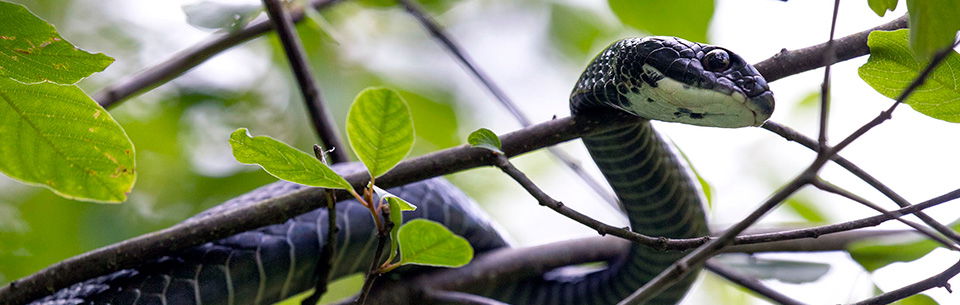
Snakes of Northern Kentucky
As the weather warms up, reptiles begin to emerge from their winter hiding places. That makes them much more likely to come across the path of humans. In the case of snakes, that also generally includes frightening humans due to the perceived risk that the snake is venomous. If you come to visit us in the Northern Kentucky region, you may see some of these reptilian slitherers moving around either your hotel property or our properties. The most important thing to remember is that snakes are not aggressive and just want to be left alone. Here are a few of the most likely snakes for you to see in Northern Kentucky.1
1. The Eastern Garter Snake
The most commonly identified snake in the region surrounding the attractions is the eastern garter snake (Thamnophis sirtalis sirtalis).2 These snakes are utterly harmless to people and are most commonly seen in spring and fall. They are live-bearing, social snakes, preferentially living in groups and reassembling with their friends, even when placed in other groups.3 They will hibernate in these groups and mate shortly after emerging from their winter slumber.4 They will eat nearly anything they can catch from insects to small mammals.5 They are happy to go into the water after fish and frogs as well.6
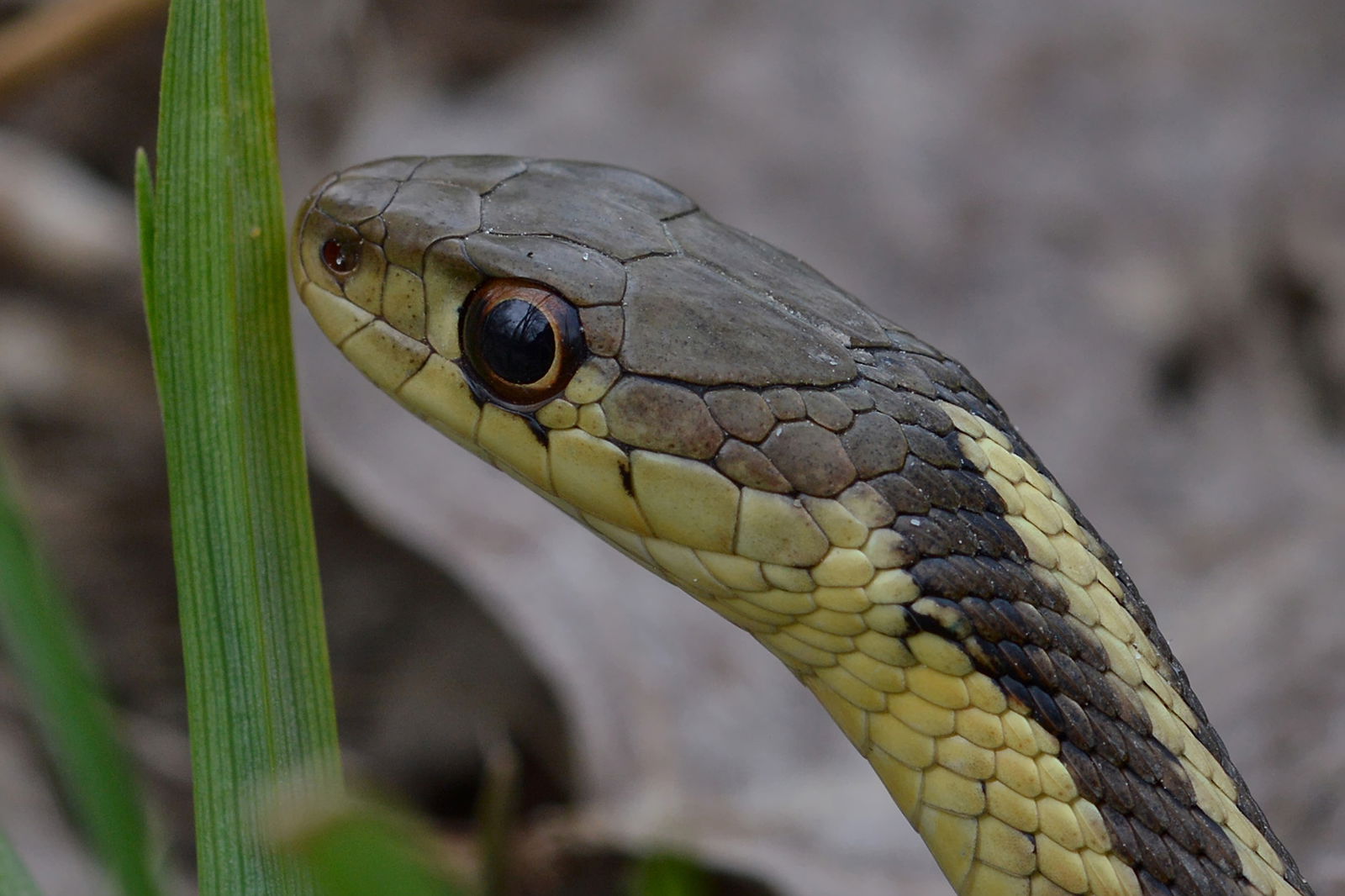
Ryan Hodnett, CC BY-SA 4.0, via Wikimedia Commons
2. Northern Water Snake
Another commonly seen snake in the Northern Kentucky region that likes to spend time in the water is the northern water snake (Nerodia sipedon sipedon). Because some of their color morphs look similar to copperheads or cottonmouths, they are frequently mistaken for venomous snakes. However, others color morphs look nothing like venomous snakes, with bright red banding or saddling. As their name implies, they spend a lot of time in the water. Females are larger and grow faster than males7 due to physiological costs of producing babies. The species mates in aggregations, often with multiple males competing to mate with a single female.8 Males appear to track females using her pheromone secretions.9 Once a female is pregnant, she is able to regulate her body temperature to help her babies develop.10 Like the garter snakes, the common water snake is completely harmless to humans, though they will defend themselves if bothered. If they do bite, they have a mild anticoagulant in their saliva that causes the wound to bleed.11 The bleeding, combined with the superficial similarity to venomous snakes, may cause people to believe they have been bitten by a venomous snake.
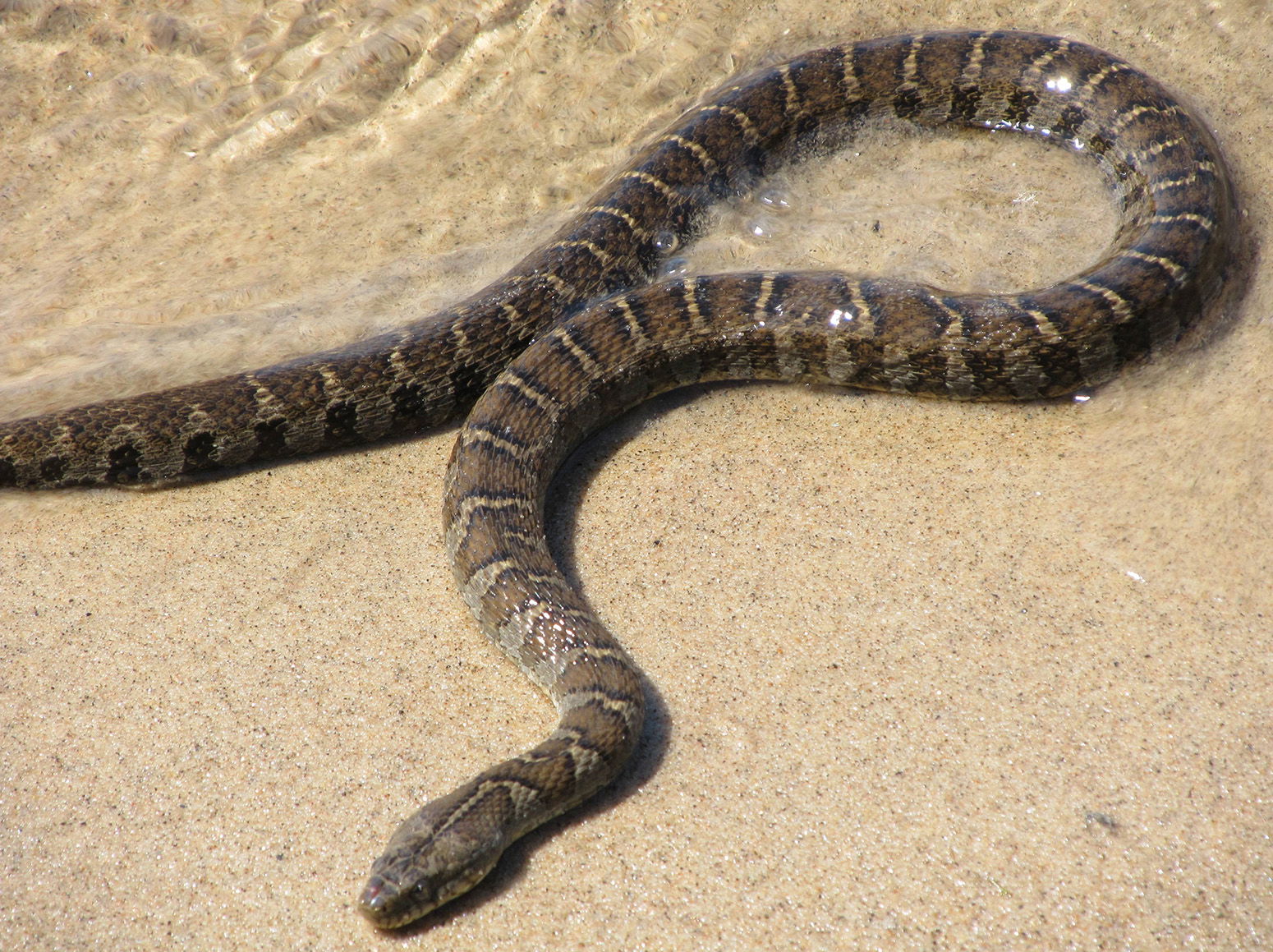
Big iron, CC BY-SA 3.0, via Wikimedia Commons
3. Eastern Rat Snake
Perhaps the most common snake seen around the attractions is the eastern rat snake (Pantherophis alleghaniensis). The juveniles have unique coloring patterns, but the adult coloration fades to a dull gray-black. These are quite large snakes that like to bask in areas where sun is readily available. This makes them very easy to spot. However, they also like to frequent water-filled tree cavities, particularly females when they are carrying eggs.12 They will eat nearly anything they can fit in their mouths, including golf balls due to their resemblance to eggs!13 They will effectively ignore humans unless bothered and, even then, will seldom bite. My brother once picked up a four-foot rat snake by the tail, and it made no effort to bite him or even get away. The most it showed was mild annoyance that a preteenager was so interested in its life.
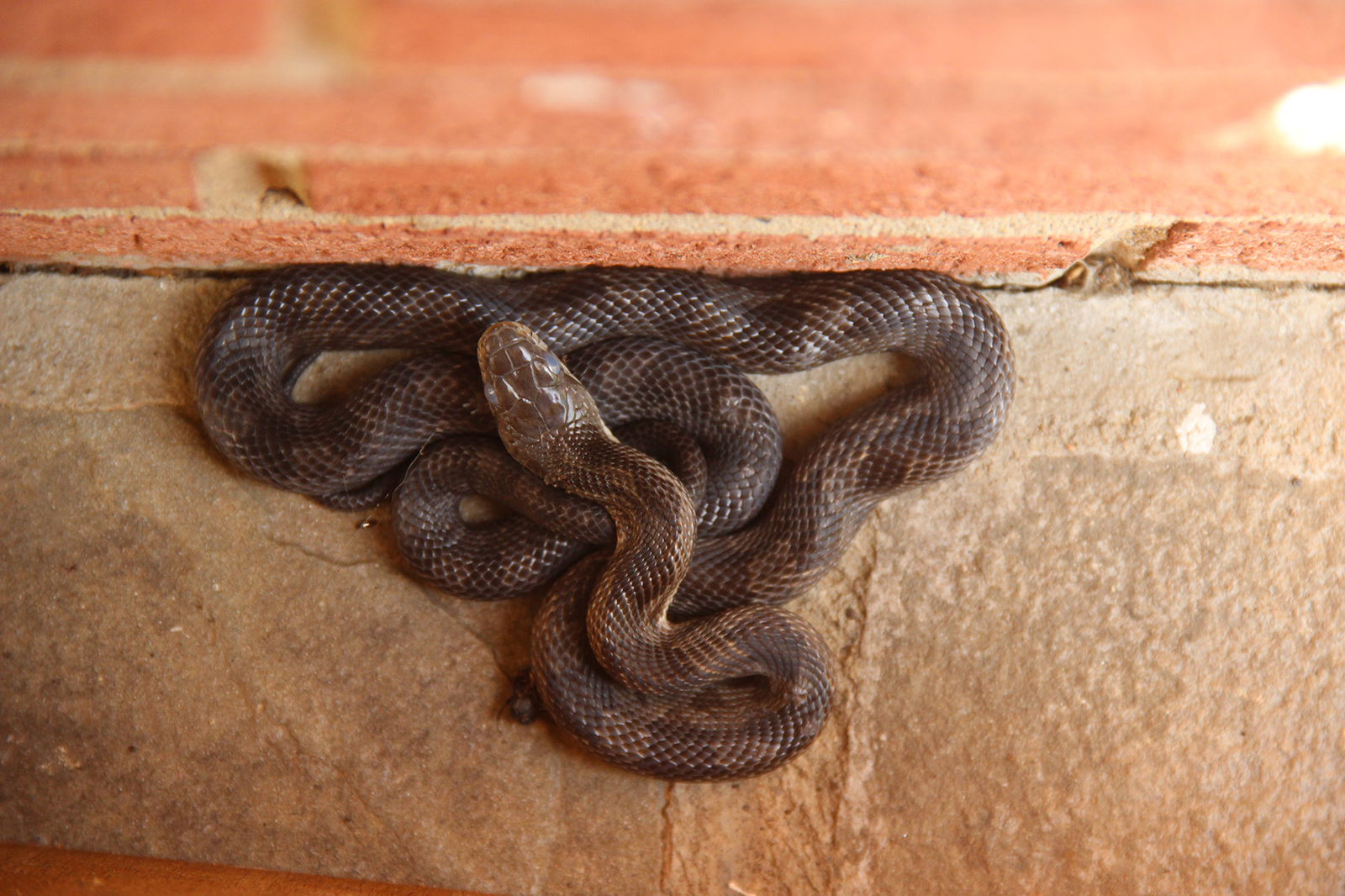
John Mikesell, CC BY-SA 3.0, via Wikimedia Commons
4. Northern Black Racer
Another snake commonly seen in the Northern Kentucky region is the northern black racer (Coluber constrictor constrictor), which lives up to its name. It’s an incredibly quick-moving snake and would much more readily run away from people than bite or fight, though younger racers are a bit more likely to stand and fight.14 They can reach speeds of 20.8 cm s-1, or about two-thirds of a foot per second.15 Racers will eat almost anything they can find, with insects being top of the list,16 followed by mammals, then amphibians.17 They have excellent eyesight, frequently raising their heads above the ground to survey the area.18
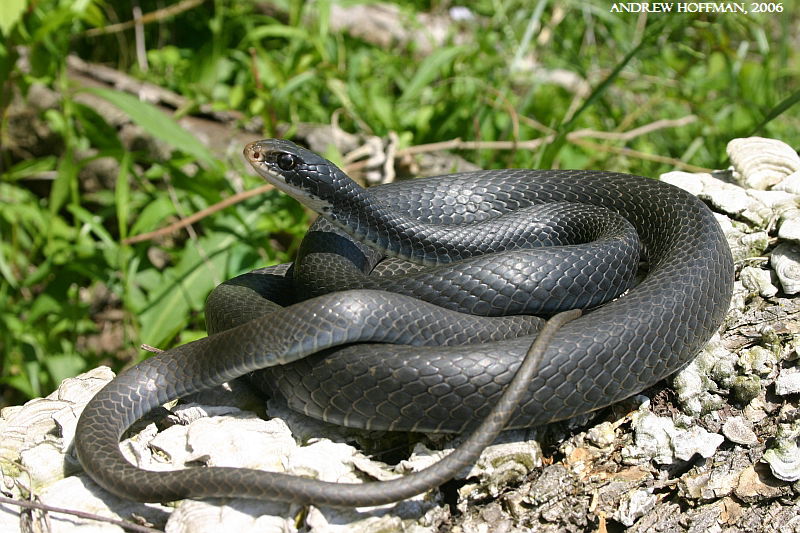
Andrew Hoffman, CC BY-NC-ND 2.0, via Flickr
5. Eastern Milk Snake
Another common snake in Northern Kentucky is the eastern milk snake (Lampropeltis triangulum triangulum). These snakes are secretive and docile, doing their best to avoid people, and even when bothered, don’t tend to bite. They have a distinctive red, black, and white–striped pattern meant to deter predators. They are predators themselves, with a diet mostly of lizards and small mammals.19 They lay anywhere from four to seven eggs, which are incubated for approximately 60 (max 66) days before the eggs hatch.20
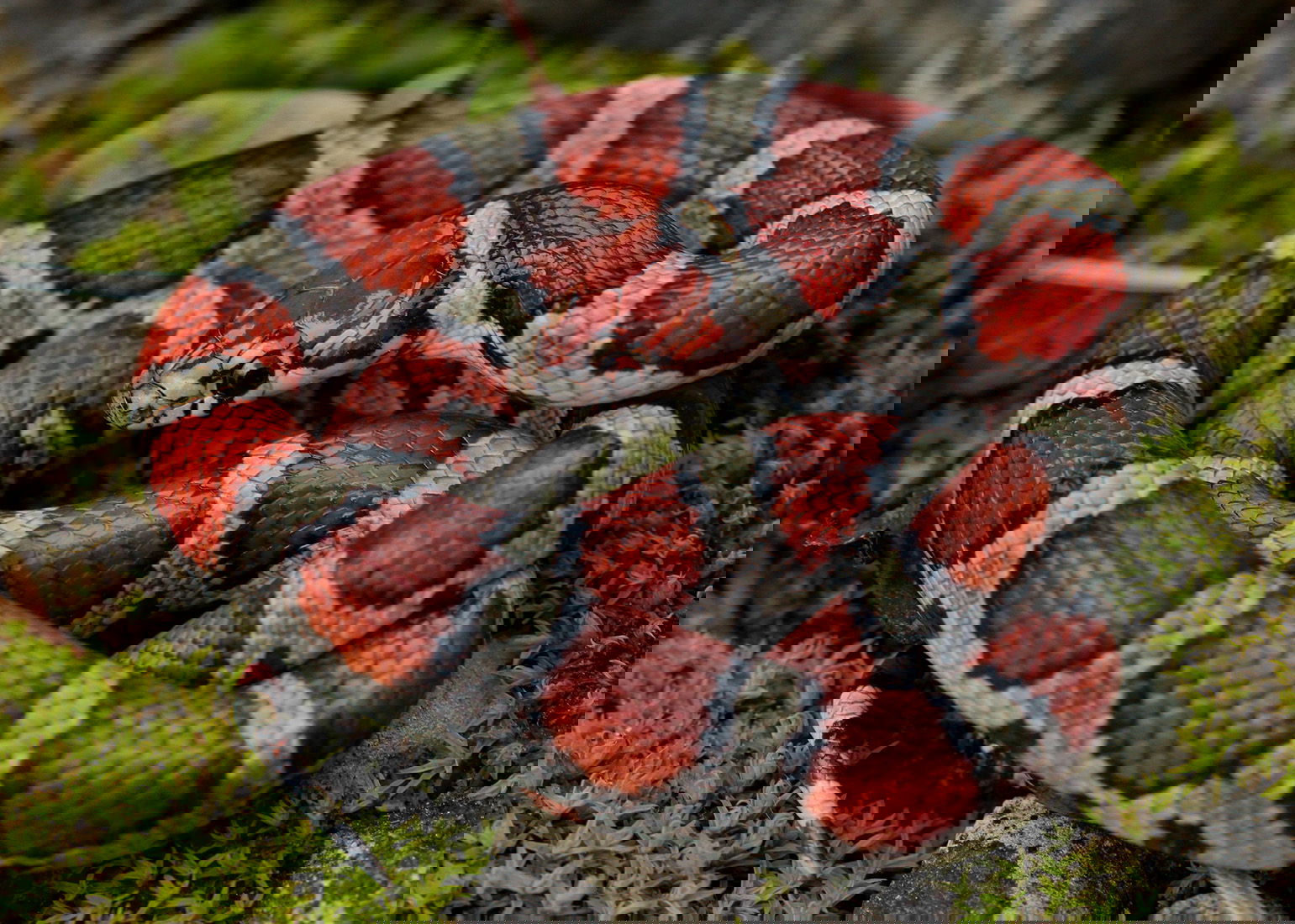
Peter Paplanus from St. Louis, Missouri, CC BY 2.0, via Wikimedia Commons
6. Others
There are a handful of other snakes that may be seen in the Northern Kentucky region. The northern ringneck snake (Diadophis punctatus edwardsii) is moderately common and is easily identified by the yellow-orange ring around its neck and its orange belly. Another easily identified species is the northern rough green snake (Opheodrys aestivus aestivus), which is bright green and easy to pick out if it’s outside the grass and trees. A few other species pop up from time to time.
-
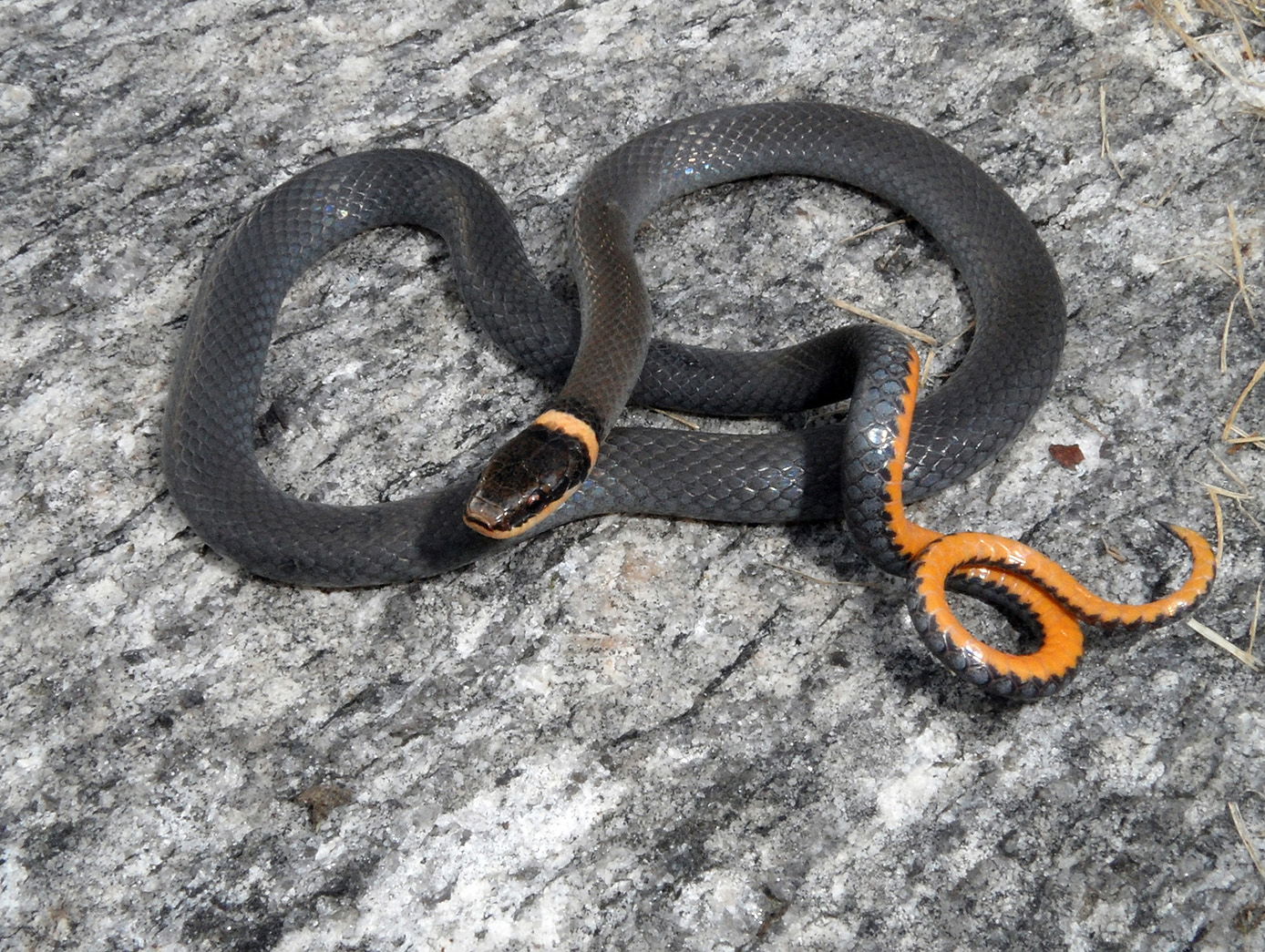
Misenus1, CC BY-NC-SA 2.0, via Flickr
-
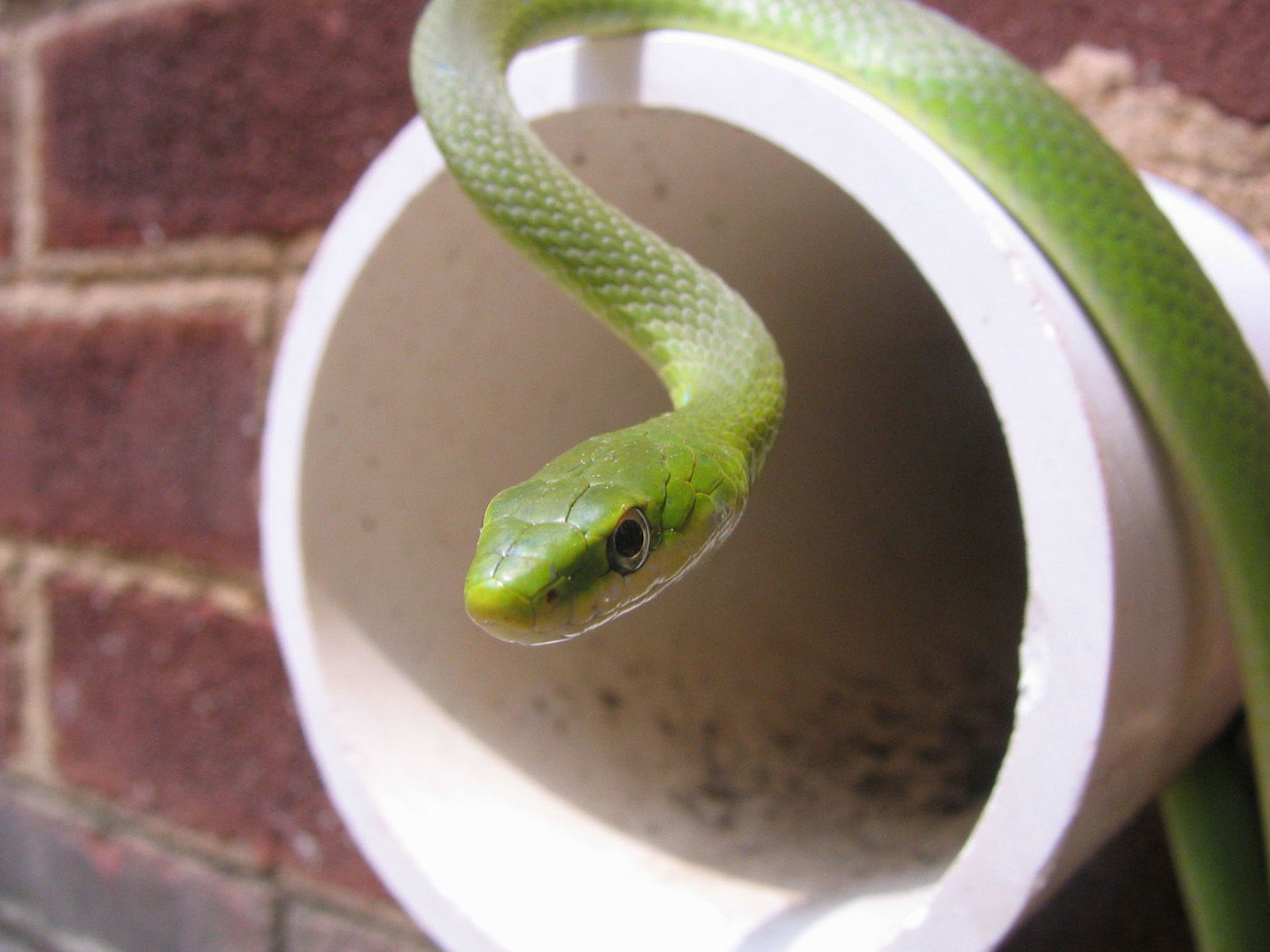
Phyzome is Tim McCormack, CC BY-SA 3.0, via Wikimedia Commons
There are only two possible venomous snakes you might find in Northern Kentucky, the northern copperhead (Agkistrodon contortrix moccasin) and the timber rattlesnake (Crotalus horridus). Neither is common. The timber rattler does not appear once in the list of snakes from iNaturalist, and the copperhead has only been confirmed to be spotted twice since 2011.21
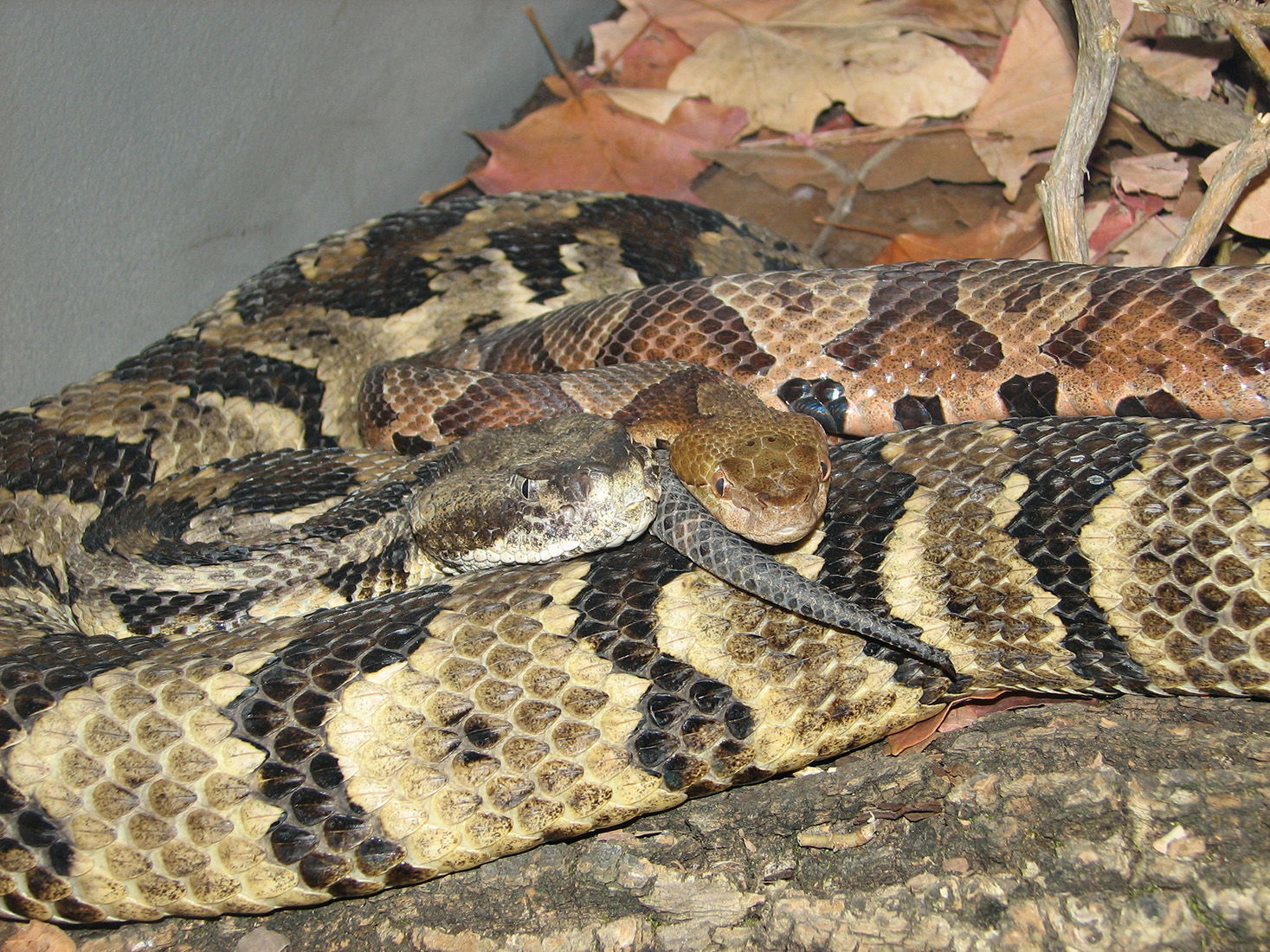
Ltshears, CC BY-SA 3.0, via Wikimedia Commons
While snakes may be scary to many people, they were designed very good from the beginning.
While snakes may be scary to many people, they were designed very good from the beginning. Even today in our fallen world, most of them would much rather avoid humans and the potential for conflict. If you come to visit us and run across one of our serpent friends, take some pictures and leave them alone. In return, they’ll almost certainly leave you alone.
Footnotes
- You can check out the kids’ version of this article at KidsAnswers.org/snakes-in-northern-kentucky.
- iNaturalist, Observation, accessed March 2026, https://www.inaturalist.org/observations?iconic_taxa=Reptilia&lat=38.89458907280307&lng=-84.64553100654547&order=asc&quality_grade=research&radius=37.37792627199501&subview=table&taxon_id=85553&view=species.
- M. Skinner and N. Miller, “Aggregation and Social Interaction in Garter Snakes (Thamnophis sirtalis sirtalis),” Behavioral Ecology and Sociobiology 74, no. 51 (2020).
- M. Aleksiuk and P. T. Gregory, “Regulation of Seasonal Mating Behavior in Thamnophis sirtalis parietalis,” Copeia no. 3 (1974): 681–689.
- C. Kelehear and S. P. Graham, “Thamnophis sirtalis (Common Gartersnake),” Herpetology Review 46, no. 2 (2015): 277–278.
- G. M. Burghardt and M. A. Krause, “Plasticity of Foraging Behavior in Garter Snakes (Thamnophis sirtalis) Reared on Different Diets,” Journal of Comparative Psychology 113, no. 3 (1999): 277–285.
- R. B. King, “Population Ecology of the Lake Erie Water Snake, Nerodia sipedon insularum,” Copeia 1986, no. 3 (1986): 757–772.
- H. R. Mushinsky, “Mating Behavior of the Common Water Snake, Nerodia sipedon sipedon, in Eastern Pennsylvania (Reptilia, Serpentes, Colubridae),” Journal of Herpetology 13, no. 1 (1979): 127–129.
- R. D. Aldridge, A. P. Bufalino, and A. Reeves, “Pheromone Communication in the Watersnake, Nerodia sipedon: A Mechanistic Difference Between Semi-Aquatic and Terrestrial Species,” The American Midland Naturalist 154, no. 2 (2005): 412–422.
- G. P. Brown and P. J. Weatherhead, “Thermal Ecology and Sexual Size Dimorphism in Northern Water Snakes, Nerodia sipedon,” Ecological Monographs 70, no. 2 (2000): 311–3330.
- D. J. Ranayhossaini, “An Investigation of the Hemotoxicity of the Duvernoy’s Gland Secretion of the Northern Water Snake (Nerodia sipedon)” (thesis, Pennsylvania State University, 2010), https://honors.libraries.psu.edu/files/final_submissions/272.
- B. A. Degregorio, J. H. Sperry, and P. J. Weatherhead, “Factors Influencing the Use of Water-Filled Tree Cavities by Eastern Ratsnakes (Pantherophis alleghaniensis),” Herpetological Conservation and Biology 16, no. 1 (2020): 173–182.
- G. Scott, B. J. Waffa, R. S. DeVoe, C. A. Harms, and G. A Lewbart, “Successful and Unsuccessful Nonsurgical Removal of Ingested Golf Balls and an Artificial Egg in Four Rat Snakes (Pantherophis alleghaniensis),” Journal of the American Veterinary Medical Association (2021).
- D. A. Creer, “Correlations Between Ontogenetic Change in Color Pattern and Antipredator Behavior in the Racer, Coluber constrictor,” Ethology 111 (2005): 287–300.
- B. C. Jayne and J. D. Davis, “Kinematics and Performance Capacity for the Concertina Locomotion of a Snake (Coluber constrictor),” Journal of Experimental Biology 156, no. 1 (1991): 539–556.
- C. H. Shewchuk and J. D. Austin, “Food Habits of the Racer (Coluber constrictor mormon) in the Northern Part of Its Range,” Herpetological Journal 11 (2001): 151–155.
- W. D. Klimstra, “Foods of the Racer, Coluber constrictor, in Southern Illinois,” Copeia 1959, no. 3 (1959): 210–214.
- H. B. Lillywhite, “Trailing Movements and Sexual Behavior in Coluber constrictor,” Journal of Herpetology 19, no. 2 (1985): 308–311.
- B. T. Hamilton, R. Hart, and J. W. Sites, “Feeding Ecology of the Milksnake (Lampropeltis triangulum, Colubridae) in the Western United States,” Journal of Herpetology 46, no. 4 (2012): 515–522.
- B. W. Tryon and J. B. Murphy, “Miscellaneous Notes on the Reproductive Biology of Reptiles. 5. Thirteen Varieties of the Genus Lempropeltis, Species mexicana, triangulum and zonata,” Transactions of the Kansas Academy of Sciences 85, no. 2 (1982): 96–119.
- iNaturalist, Observation.

_-_London,_Ontario_2015-04-19_(01).jpg)

,_residential,_Montgomery_County_Maryland.jpg)
_-_Flickr_-_2ndPeter.jpg)


Support the creation/gospel message by donating or getting involved!

Answers in Genesis is an apologetics ministry, dedicated to helping Christians defend their faith and proclaim the good news of Jesus Christ.
- Customer Service 800.778.3390
- Available Monday–Friday | 9 AM–5 PM ET
- © 2026 Answers in Genesis