
Have Anteaters Evolved 12 Times?
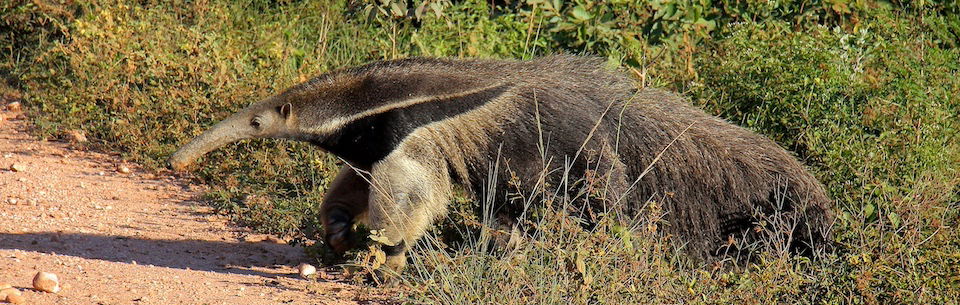
In our world, a wide variety of mammals eat ants and termites, such as the giant anteaters we have in our zoos at the Ark Encounterr and Creation Museum. Well, according to a new study, this specialized ability to primarily dine on ants and termites has evolved “at least 12 times since the Cenozoic era began, roughly 66 million years ago.”
The specialized adaptations required to be a “true myrmecophage” (the scientific name for a creature that eats primarily ants and termites), include:
- Long sticky tongues
- Specialized claws
- Specialized stomachs
- And “reduced” or “missing” teeth
And how did species “across diverse [evolutionary] lineages” all manage to evolve the same or similar features? Well, of course, the researchers appeal to convergent evolution, saying the same evolutionary pressures and increased availability of ants and termites led to similar evolutionary adaptations in vastly different mammal groups twelve times—and all in a very short amount of time by evolutionary standards!
Now, similarities across species (like the classic example: the vertebrate forearm) are always given as proof of evolution because similar features are assumed to come from shared ancestry. So what’s called homology is evidence for evolution . . . except when it’s not.
It’s just another example of the plasticity of the evolutionary model—it explains everything, so it really explains nothing.
There are plenty of examples like these myrmecophages where species that evolutionists do not believe share a close ancestry have similar features. In that case, similarity doesn’t mean shared ancestry simply because it doesn’t match the tree that evolutionists have drawn. In those cases, they’ll say it’s evidence of convergent evolution. It’s just another example of the plasticity of the evolutionary model—it explains everything, so it really explains nothing. And it can change when needed.
And, of course, the study is completely based on evolutionary assumptions about the past. There’s little observational science (beyond observing what creatures eat) involved in the study. Rather, the results come from “mapp[ing] these groups onto a time-calibrated mammal family tree and us[ing] statistical models to reconstruct ancestral diets.” It assumes evolution to prove evolution.
The study’s corresponding author said this about the study results,
[The number of carnivore lineages that evolved to eat ants and termites] was a surprise. Making the leap from eating other vertebrates to consuming thousands of tiny insects daily is a major shift. . . . . Part of the predisposition may lie in certain physiological features or dentition that are more malleable for handling a social insect diet.
In other words, it’s a big transition to go to a diet made of primarily tiny insects. It strains the imagination to assume this happened once, let alone 12 times—and in less than 66 million years!
Evolution is nothing more than a fairytale.
Thanks for stopping by and thanks for praying,
Ken
This item was written with the assistance of AiG’s research team.
Support the creation/gospel message by donating or getting involved!

Answers in Genesis is an apologetics ministry, dedicated to helping Christians defend their faith and proclaim the good news of Jesus Christ.
- Customer Service 800.778.3390
- Available Monday–Friday | 9 AM–5 PM ET
- © 2026 Answers in Genesis