
The Tonto Deformation: Responding Again to “Peaceful Science” Critics
Part 3 of “A Detailed Response to ‘Examining Young Earth Creation Claims About the Grand Canyon’”
A website called Peaceful Science (editor Dr. Josh Swamidass) published a three-part article series titled “Examining Young Earth Creation Claims About the Grand Canyon” in 2024.1 Stephen Mitchell and Dr. Kennen Tillman wrote this series to critique three of my Answers Research Journal papers, which were published to give results of the initial stage of my research on four folds in the Tapeats Sandstone, Bright Angel Shale, and Muav Limestone of the Grand Canyon’s Tonto Group.2 This is the last of my three-part response to their articles.
In their Part 1 web article, they provided an overview of their critique of the case presented in those three Answers Research Journal papers. This included their brief assessment of the Tonto depositional processes and rates and the Tonto deformation. However, they never introduced themselves. Therefore, in my Part 1 response article, I mentioned their biographic details and analyzed their worldview assumptions by which they interpret the observational data of the Tonto Group strata. The authors Stephen Mitchell and Kennen Tillman state that they are both retired geologists and active Christians. However, they embrace the conventional uniformitarian geological consensus and admit that “all of the evidence can be comfortably interpreted within an Old Earth framework.”3
To understand what that statement means, in my Part 1 response article, I briefly examined the recent history of geological thought that led to the conventional uniformitarian geological consensus and documented that “the heart and soul of [modern] geology”4 are the assertions that “the past history of our globe must be explained by what we can see happening now”5 and that “all phenomena that are related to the past history of the earth are dependent upon the principle of uniformity in nature’s processes through time for their interpretation.”6 In other words, God was never involved, and since we have never observed a global flood cataclysm, then one never happened. However, Mitchell and Tillman are Christian geologists who should thus affirm the authority of the Bible. But they obviously reject Genesis 6–8 as God’s eyewitness account of a recent literal flood that covered the earth globally, as affirmed by Jesus (Matthew 24:37–39) and the Apostle Peter (2 Peter 3:1–7). Instead, Mitchell claims the Flood was only local to Mesopotamia.7 But does not the authority of the Bible derive from the character of the author? If the Bible is God-breathed (2 Timothy 3:16), then all of it is infallible truth, as God never tells lies (Titus 1:2). And whereas Mitchell and Tillman adhere to “the modern understanding of the vast majority of geologists . . . that the rocks were formed over many millions of years,”8 Jesus, who is the truth (John 14:6), made it clear that truth is never determined by any majority consensus (Matthew 7:13–14).
Their Part 2 article discussed the Tonto depositional processes and rates, so in my Part 2 response, it was critical to make it clearly understood how their bias of uniformitarian assumptions—which they bring to the observational evidence before they examine it—affects their interpretation of the observed field data. Like their conventional non-Christian colleagues, Mitchell and Tillman fail to recognize the fundamental difference between observations of the features in the outcrops and the interpretation of those features. Did Mitchell and Tillman observe these sediment layers being deposited? Absolutely not! Instead, they observed features in these sedimentary layers, which they interpreted as being due to slow processes over millions of years. This is because they had already assumed sedimentation took millions of years before they observed these features, due to their uniformitarian belief in slow-and-gradual geological processes as the assumed way to explain the formation of these layers and the features in them. You can read a brief summary of my Part 2 response here.
Their Part 3 web article dealt with the deformation of the Tonto Group. My research focused on four folds within the Tonto Group. While the third Mitchell and Tillman web article critiques details in these four folds using only photos of them taken by others (because they have never been into the Grand Canyon to visit and study these folds in person), they only reference one of my subsequent Answers Research Journal papers, the one on the Carbon Canyon fold.9 They completely missed referring to and using the information and discussion of my results in the three other papers on the Monument, Whitmore Helipad, and Matkatamiba folds,10 all of which were published online months before Mitchell and Tillman’s articles were posted. However, they did analyze their “interpretative” drawings of a minor selection of cherry-picked relevant microscope thin-section images from the earlier published papers (because they did not have thin sections of their own samples to study).
Contents
Contrasting Views on the Tonto Folding
All geologists recognize that rocks can be deformed by brittle mechanisms, such as faulting and fracturing, or by ductile mechanisms that produce folds. Mitchell and Tillman helpfully explain the difference by using a simple thought experiment. A ball of soft clay dropped from a few feet up onto a concrete floor. It can be slightly cracked by the impact, which is important to note in the context of these folds but which Mitchell and Tillman conveniently ignore. However, much of the change will be ductile, that is, the ball will have changed shape. On the other hand, a fine porcelain plate dropped onto the same concrete floor will shatter or brittlely deform. The Tonto units show evidence of both outcomes. All agree that the Tonto layers in the folds in question were bent (deformed) by ductile mechanisms, but the difference of view is over the specific mechanisms involved and how much time was required for the folding.
The consensus uniformitarian view is that folding of the Tonto layers took place over thousands to millions of years and occurred hundreds of millions of years after the sediment layers were deposited and cemented (hardened or lithified). Supposedly, according to Mitchell and Tillman,
Rocks that are folded over long periods of time do not simply flow like a viscous fluid, but other mechanisms allowed the folding to take place.
The mechanisms by which unlithified [soft, damp] and lithified [hard, cemented] sediments fold at low pressures and temperatures are very different at both grain scale and bed scale, and also typically produce folds with different geometries. Moreover, folding of these two different types of sediments (soft versus hard) occurs at very different rates. Folding of soft sediments can happen as quickly as hours to days or years. Folding of lithified sediments, in contrast, takes hundreds of thousands to millions of years.11
The long timescale has only been inferred based on uniformitarian assumptions.
They make this claim although no geologist has observed such claimed long-timescale folding. The long timescale has only been inferred based on uniformitarian assumptions. On the other hand, it should be emphasized that the folding of soft sediments has been observed in laboratory experiments, and those experiments demonstrate that fracturing can occur in soft-sediment deformation.12
As described in Mitchell and Tillman’s article,
“Soft” [unlithified] sediments deform at the grain scale primarily by a mechanism known as grain boundary sliding, where the uncemented individual grains can “slide” past one another as they rigidly translate and rotate, typically resulting in compaction, dewatering, and reduced porosity.13 Fractures that cut across layers or multiple grains are uncommon because of the lack of coherency. Although some fracturing of grains can occur at point-to-point grain contacts, fracturing of grains is typically infrequent or absent.
In contrast, in strongly lithified sediments, individual grains are not free to move relative to one another due to the cementation. As a result, in order for the sediments to deform, the grains and/or the cements have to deform.14 As the degree of cementation increases, grains are less and less able to rotate freely and they are broken and shattered. In contrast to soft sediment deformation, fractures can cut across multiple grains or even multiple layers. Fractures with shear (displacement along a zone) typically exhibit cataclasis, the crushing of rock that is typified by fracturing of grains, grain-size reduction, and compaction.15
However, such fractures and fractured grains when observed in an outcrop and/or at the microscope scale can easily be confused with jointing and/or more recent compaction or ground movements subsequent to the folding event, an outcome not acknowledged by Mitchell and Tillman but documented in the literature.16
In the Tonto Group folds, Mitchell and Tillman admitted they expected not to see evidence of ubiquitous grain-scale deformation, even though they had already stated that in order for lithified sediment layers to deform, their grains are less able to rotate freely, so they are broken and shattered.17 So which is it—no ubiquitous grain-scale deformation or broken and shattered grains? By declaring both options up front, they guaranteed that no matter what they observed in my published microscope images of the Tapeats Sandstone, it would support their case for slow-and-gradual, millions-of-years bending of this now lithified (cemented) sandstone. That is hardly unbiased, objective, good science!
Mitchell and Tillman also claim, “At the bed scale, there are also significant differences in the deformation of unlithified and lithified sediments.”18 It is true that lithification not only increases the coherency of the sediment layers so that they behave as integrated rock layers, but it “also enhances and localizes mechanical discontinuities at bed boundaries, especially between beds with significant differences in grain size and composition” (for example, sandstone and shale).19 Thus, “flexural slip (i.e., slip localized along bedding planes; like the pages of a book sliding past each other when the book is bent) commonly occurs during folding of more lithified sediments at relatively low pressure/temperature conditions,”20 as referenced by Mitchell and Tillman.21
Furthermore, because of the increased bed coherency due to lithification, the more competent [harder] beds (typically sandstones) tend to maintain bedding thickness and accommodate stretching by fracturing perpendicular to bedding, while the less competent [softer] beds (like mudstones) will exhibit more ductile deformation, allowing changes in bedding thickness, particularly in fold hinges.
In contrast, unlithified [uncemented and soft] beds are relatively incoherent and the mechanical differences between beds and at bedding contacts are diminished. Muds and sands will behave similarly. As a result, the deformation is more uniformly distributed, slickensides are unlikely to form, and bedding thickness changes [may sometimes] occur in all lithologies.22
Brittle faults are absent, but fracturing as joints may result in the hinges particularly due to subsequent shrinkage occurring because of dewatering and the release of overburden pressure, which Mitchell and Tillman fail to acknowledge.
Thus, Mitchell and Tillman claim to have identified the criteria they used to “differentiate between folding of soft (unlithified) sediments, which can occur very rapidly, and folding of lithified sediments, which can only occur over a very long period of time.”23 However, they have ignored that numerous
rock deformation laboratory studies have demonstrated that solid rock deforms in a ductile manner slowly under stress,24 but mechanical crowding and thinning of sandstone beds at the macroscopic scale is not definitive proof that the folding occurred slowly under stress as the lithified sandstone beds were deformed in a ductile manner. It is also readily demonstrated in such laboratory studies that beds of soft sand will similarly be crowded and thinned mechanically when deformed while still soft due to the confining pressures in the hinges of the folds.25 Only if thin section examination of the sandstone reveals deformation lamellae and undulose extinction in the quartz grains under cross-polarized light due to deformation stress26 will it have been demonstrated that the mechanical crowding of the sandstone beds in these folds has been due to slow [ductile] deformation under stress of solid [cemented] sandstone.27
Furthermore, Mitchell and Tillman have ignored the many simulation experiments of soft-sediment deformation that replicate many of the macroscopic features they claim are definitive of only slow ductile deformation of lithified sandstone beds.28 Thus, the only definitive method for distinguishing between slow ductile deformation of lithified sandstone layers and soft-sediment deformation of unlithified sandstone layers is microscopic examination of the minerals and textures within those sandstone layers, which is exactly what was done in my investigations.29
However, before Mitchell and Tillman examined these particular folds (remotely, and not by their own field and microscope work), they discussed the regional context of the folds.
The Regional Context
What they really mean by “all investigators” is uniformitarian geologists who already believed in slow-and-gradual processes before they observed these folds and rock layers.
As Mitchell and Tillman state, “The Colorado Plateau has numerous monoclinal folds (step-like folds each consisting of a zone of steeper dip within an otherwise horizontal or gently-dipping interval; Figure 10).”30 They claim, “Geologists have extensively studied (mapped, described, and modeled) these features,”31 but not all the geologists they listed, like Mitchell and Tillman (by their own admission), have actually visited these folds in question in the field.32 Mitchell and Tillman claim that “many observations are clear and recognized by all investigators.”33 But what they really mean by “all investigators” is uniformitarian geologists who already believed in slow-and-gradual processes before they observed these folds and rock layers. Certainly, these
monoclinal folds are associated with deep-seated faults that began as normal faults in the Precambrian era [rocks]. They were reactivated as compressional faults, associated with the Laramide orogeny. . . . This is the same overall mountain building event that formed the Rocky Mountains. . . . These faults [usually] cut through the Tonto Group and deformation associated with them includes the folds.34
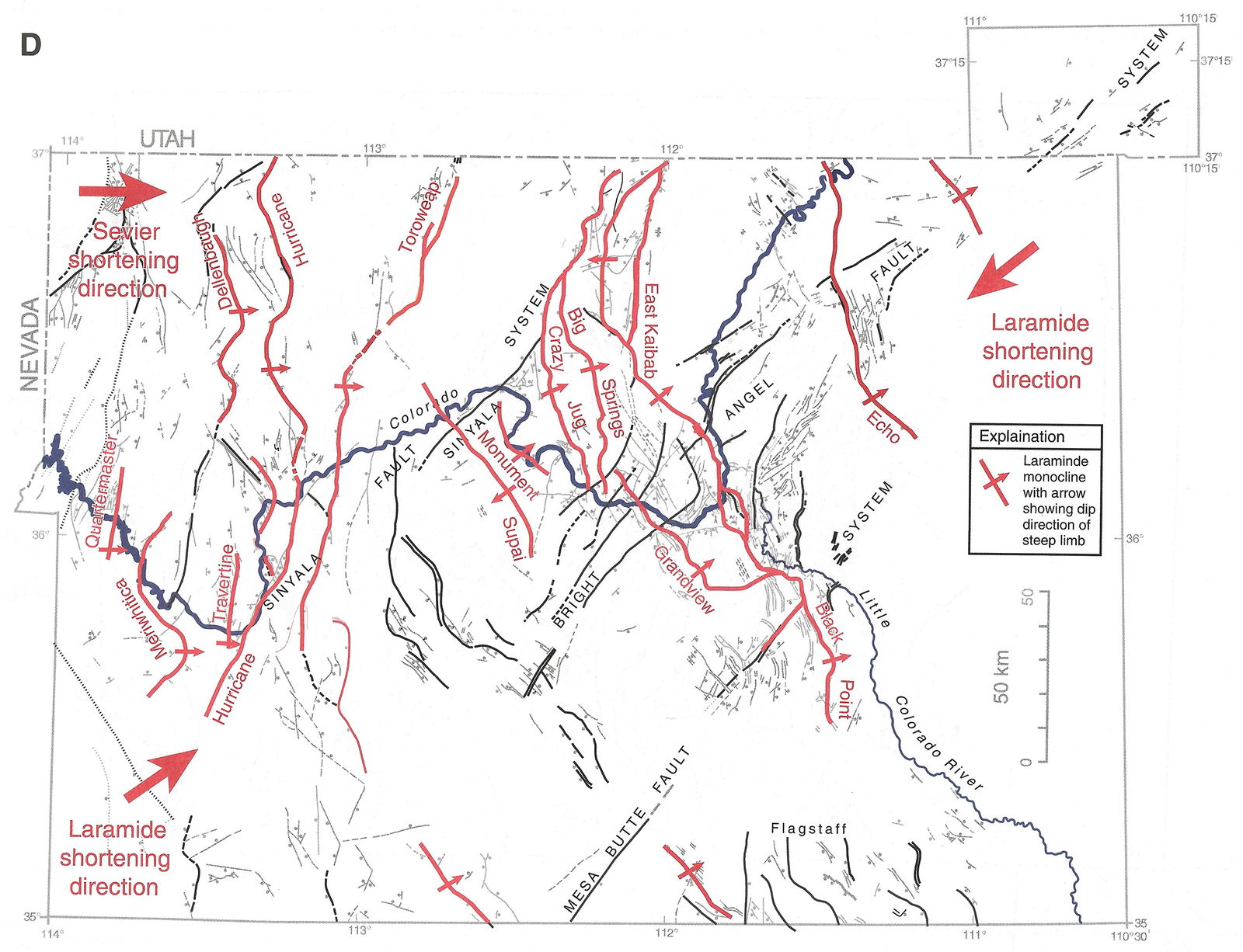
Fig. 1. Laramide compressional deformation of the Grand Canyon region that caused earlier normal faults in the Precambrian basement rocks to be inverted as a result of that reactivation into reverse faults and to be linked together into complex, segmented, and bifurcating monoclinal uplifts of the Paleozoic sedimentary strata draped over them (after Karlstrom and Timmons35).
Numerous cross-sections have been published of the folds in the Colorado Plateau. Fig. 2 shows a realistic cross-section of the East Kaibab Monocline and associated Butte Fault and depicts the history of its development. Tight synclinal folding of the Cambrian Tapeats Sandstone is illustrated on the downthrown side of the fault (Fig. 2F). The dip of bedding is very steep to overturned at the deepest levels adjacent to the fault and decreases upward in the section, and the fault offsets the Proterozoic rocks and at least the base of the Cambrian section.
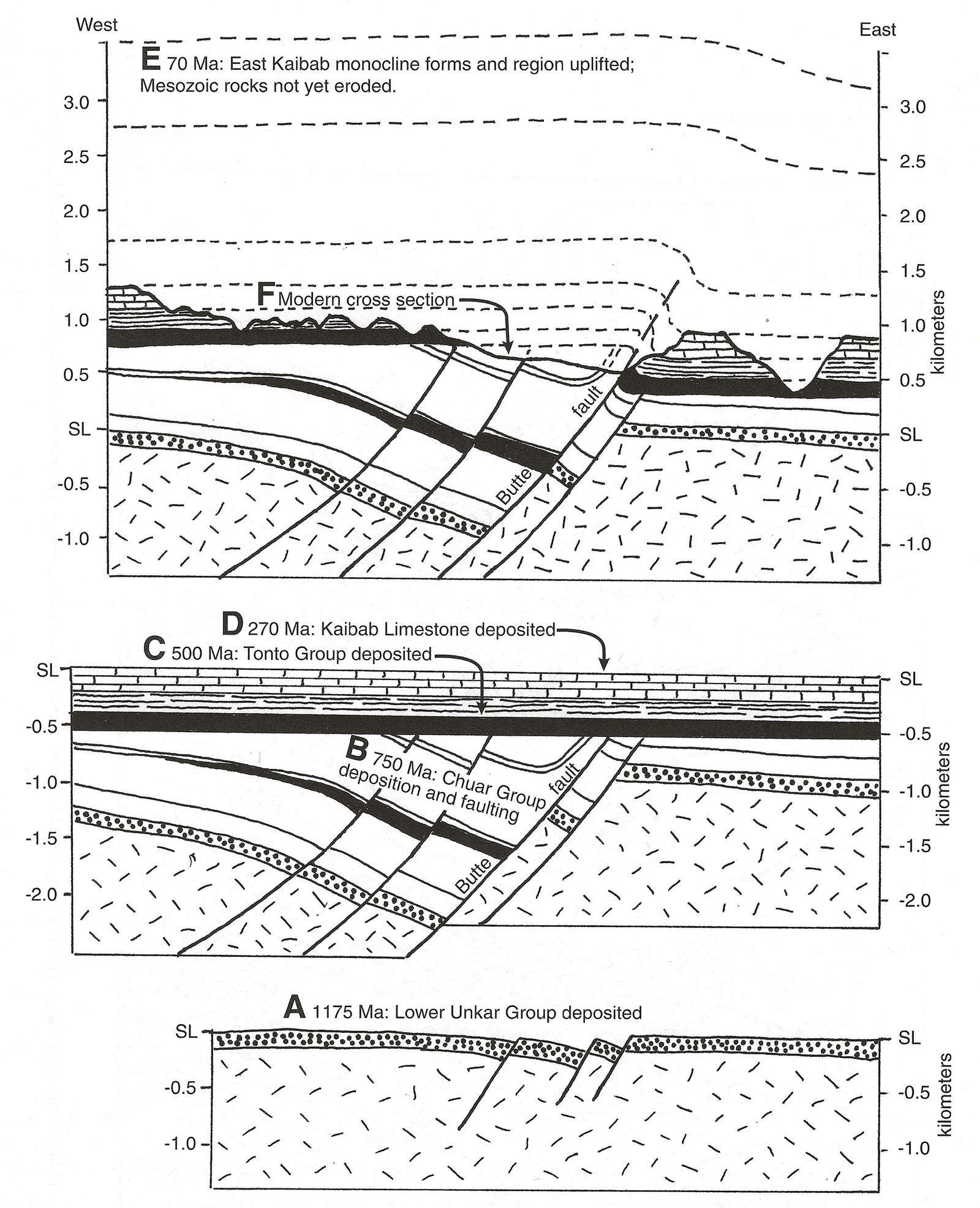
Fig. 2. The history of the Butte Fault, eastern Grand Canyon, illustrating the fault reactivation that produced the Carbon Canyon and other related folds along its length (after Karlstrom and Timmons36). (A) According to conventional uniformitarian dating, between 1200 and 1100 Ma, lower Unkar Group sedimentary strata (dot pattern) were deposited and tilted owing to normal faulting of them and the underlying Paleoproterozoic crystalline basement rocks on northwest-striking faults like the Palisades Fault, a branch of the Butte Fault. (B) By 742 Ma, Chuar Group sedimentary strata had been deposited, folded, and faulted owing to west-side downward movement on the Butte Fault. (C) Deposition of the Cambrian Tonto Group sedimentary strata (black band) took place by 500 Ma on top of the Great Unconformity over the tilted Grand Canyon Supergroup strata. (D) The region remained near sea level throughout the deposition of the Paleozoic strata, ending c. 270 Ma with deposition of the Kaibab Limestone (brick pattern). (E) By 70 Ma, the region was compressed and uplifted, and the Butte Fault was reactivated with west-side upward slip to create the East Kaibab Monocline, with the ~2 km (~6,560 feet) of Mesozoic strata that once covered the region (dashed lines). (F) Present topographic profile shows the west-side downward net displacement of the Proterozoic rocks of the Butte Fault and the west-side upward displacement of the Paleozoic strata.
Reches and Matthews37 published a composite cross-section of the East Kaibab Monocline (reproduced by Mitchell and Tillman as their Fig. 13), “which is based on [their] extensive work and it illustrates smaller-scale features from a number of locations along the monocline.”38 They determined that the deformation could be divided into lower, intermediate, and upper structural levels, as summarized by Orofino.39 “In general, the amount of deformation decreases upwards.”40 However, what Mitchell and Tillman neglect to point out is that the work done by Reches, Matthews, and Orofino was all with respect to features associated with the Palisades Fault and not with respect to the Butte Fault, which was responsible for the Carbon Canyon fold on the East Kaibab Monocline. Thus, it is direct observations of features related to the Butte Fault that are solely relevant to the Carbon Canyon fold and not features pertaining to the Palisades Fault supposedly applied to the Butte Fault. That is akin to applying features of apples to oranges!
Mitchell and Tillman conclude by claiming that together their Figs. 12 and 13 “provide a useful summary of the structural geometries of the monoclines in the Grand Canyon region and their associated subsidiary structures.”41 In other words, field observations of one fault and one of its branches can be applied to all the faults of the Grand Canyon region, which is an unjustified highly sweeping claim. However, it is obviously true that together with the map view, they allow us to understand when the folding developed in a relative time sense, not the absolute time according to the uniformitarian timescale. It can thus be agreed that “the folding developed when the sediments were deeply buried”42 and that the folds were exposed subsequently by extensive erosion. But again, this only occurred in a relative time sense, not the absolute time according to the uniformitarian timescale as claimed by Mitchell and Tillman.
Outcrop-Scale Observations
Mitchell and Tillman next invite us to “take a closer look at some of the actual smaller scaled folding associated with monoclinal folds in the Tonto Group.”43 They chose six examples (their Figs. 14–20):
- The Carbon Canyon fold
- The Palisades Creek fold associated with the East Kaibab Monocline
- The Monument fold
- A nearby kink fold associated with the Monument Monocline (these first four all being in the Tapeats Sandstone)
- The Whitmore Helipad fold
- The Matkatamiba fold
These were obviously chosen because four of them were the ones I studied and reported in my four published technical papers (cited earlier). But Mitchell and Tillman only referred to one of those papers.
Mitchell and Tillman then have the audacity to accuse me of not providing cross-sections of any of the particular folds that I sampled, schematic or measured. However, even though they should have annotated structural measurements on the folds, cross-sections are interpretations of the actual folds, whereas I provided detailed images of what was actually observed in the field (my Figs. 3–6). It is thus rather ironic that Mitchell and Tillman admit that no cross-sections of those folds are available in the literature, which is an admission that no one has previously studied those folds in detail! So what did Mitchell and Tillman do? They admitted that they would “have to infer the setting for the sampled horizons based on photographs [published by me and others] and a general understanding of the regional geology” (emphasis added).44 And to make matters worse, they inverted my published photograph of the Carbon Canyon fold so that it is oriented incorrectly compared to how the fold is oriented in the field, a very telling indication that their critique lacks observational credibility. They then drew their own interpretative cross-sections of each of these folds overlaid on others’ photographs without doing any fieldwork to verify the truth or accuracy of their interpretations! Such an arbitrary approach is hardly a justifiable basis for critiquing the detailed fieldwork of others.
Mitchell and Tillman audaciously insist that “a complete structural analysis at the outcrop-scale requires multiple measured sections at different locations across the folds, abundant bedding orientation measurements to define the fold orientations and geometries, and measurements of the orientations of associated deformation features like fractures and faults.”45 Furthermore, they state,
A complete structural analysis at the microscopic scale requires oriented samples from representative locations across the structure to document how microstructures vary as a function of structural position and lithology. Ideally one would use multiple samples from each lithology at multiple locations across the structure (even tracing individual beds across the structure if possible), [which I did, see my Fig. 3—they should have noted this if they really read all four of my papers] as well as samples representing the various structural levels. Then one would examine oriented thin sections (in plane-polarized and cross-polarized light at a minimum) to document the types and orientations of microstructures [which I did—they should have noted this if they really read all four of my long technical papers].46
“Typically,” Mitchell and Tillman claim, “three mutually perpendicular thin sections are used that are oriented parallel to bedding, perpendicular to bedding and parallel to the fold axis, and perpendicular to bedding and perpendicular to the fold axis.”47
This pontificating by Mitchell and Tillman merely begs the question as to why they did not follow this procedure themselves. After all, they tout this procedure as being the ideal for a complete structural analysis. Why not then undertake such a procedure to critique my work, if (as they claim) my published work is not complete enough to allow a thorough analysis? Instead, they only reference one of my four freely available technical papers (on one of the folds) and then, using the armchair geology method, critiqued my work on all four folds (undertaken with fieldwork and copious detailed microscope observations)!
As if such pontificating is not enough, Mitchell and Tillman then condescendingly concede that “Snelling48 shows that he is examining the [sample thin-section] slides that he has in appropriate ways.”49 Yet they still claim that “there just are some limitations in the data”50 that I collected. This is nothing but an excuse to justify their armchair geology procedure. They then state, “In the absence of this detailed data however, observations can still be gleaned from photographs, photomicrographs, and other publications. What we can do is use the data available to see what they tell us about the deformation.”51 But really, whose data are limited? I submit that it is instead their purported critique in their web article that is extremely limited because they failed to do their homework thoroughly with their own “hands-on” fieldwork, structural analyses, oriented sampling, and detailed microscope observations, which they claim as “best practice.” In contrast, my seven long technical papers are very detailed and extensive in their reported in-person observations and analyses.
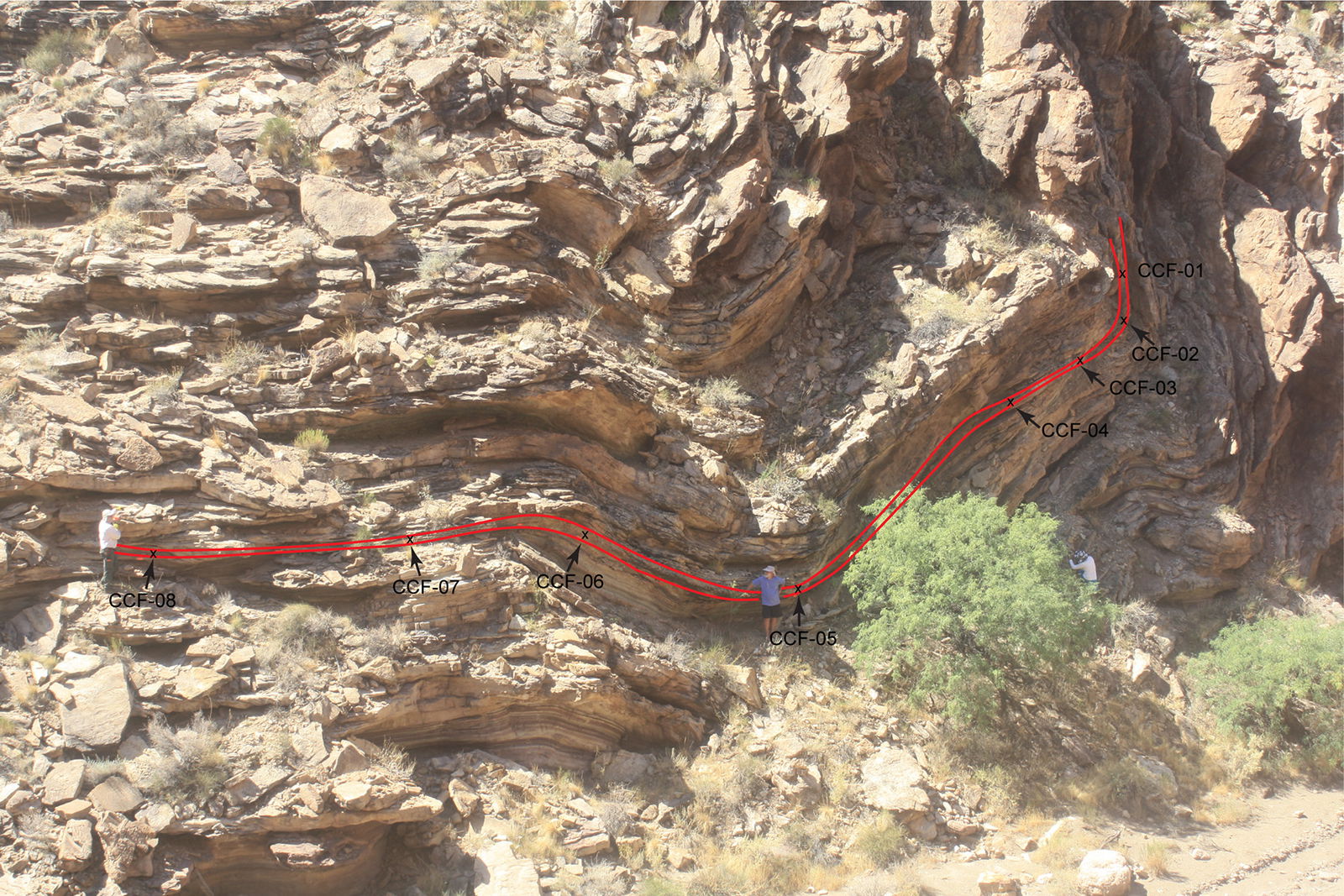
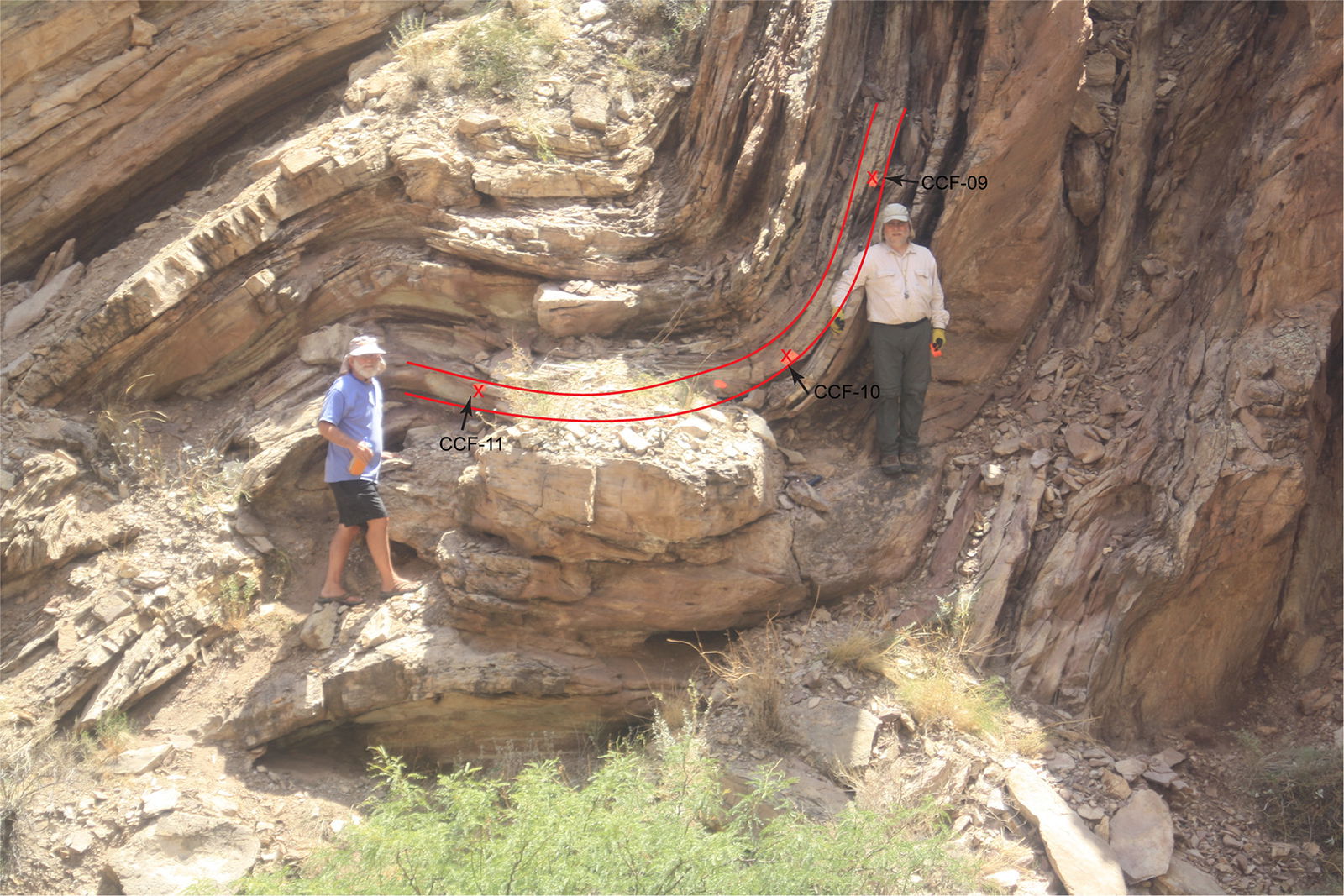
Fig. 3. The Carbon Canyon fold showing where I collected samples along selected beds.52 Top: A larger view of the fold. Bottom: Sampling of a bed in a hinge zone.
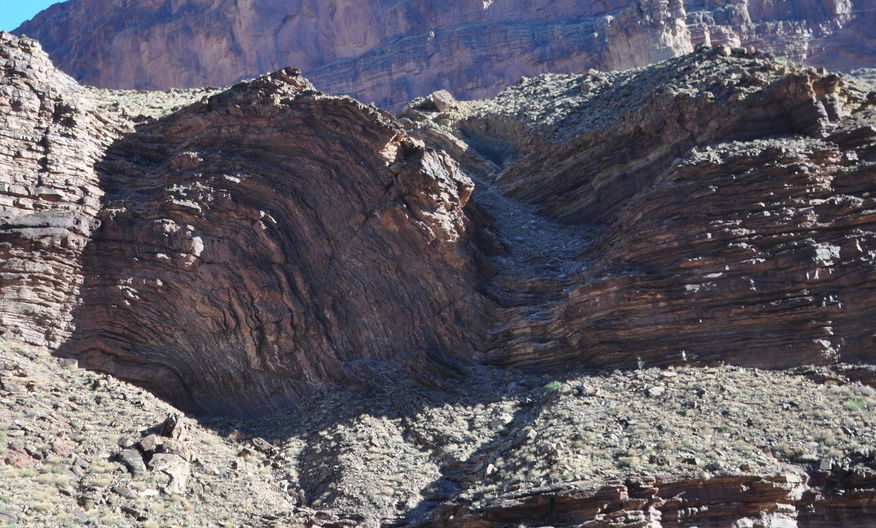
Fig. 4. The Monument fold photograph in my published paper.53 The sampling locations are shown in additional diagrams in the paper.
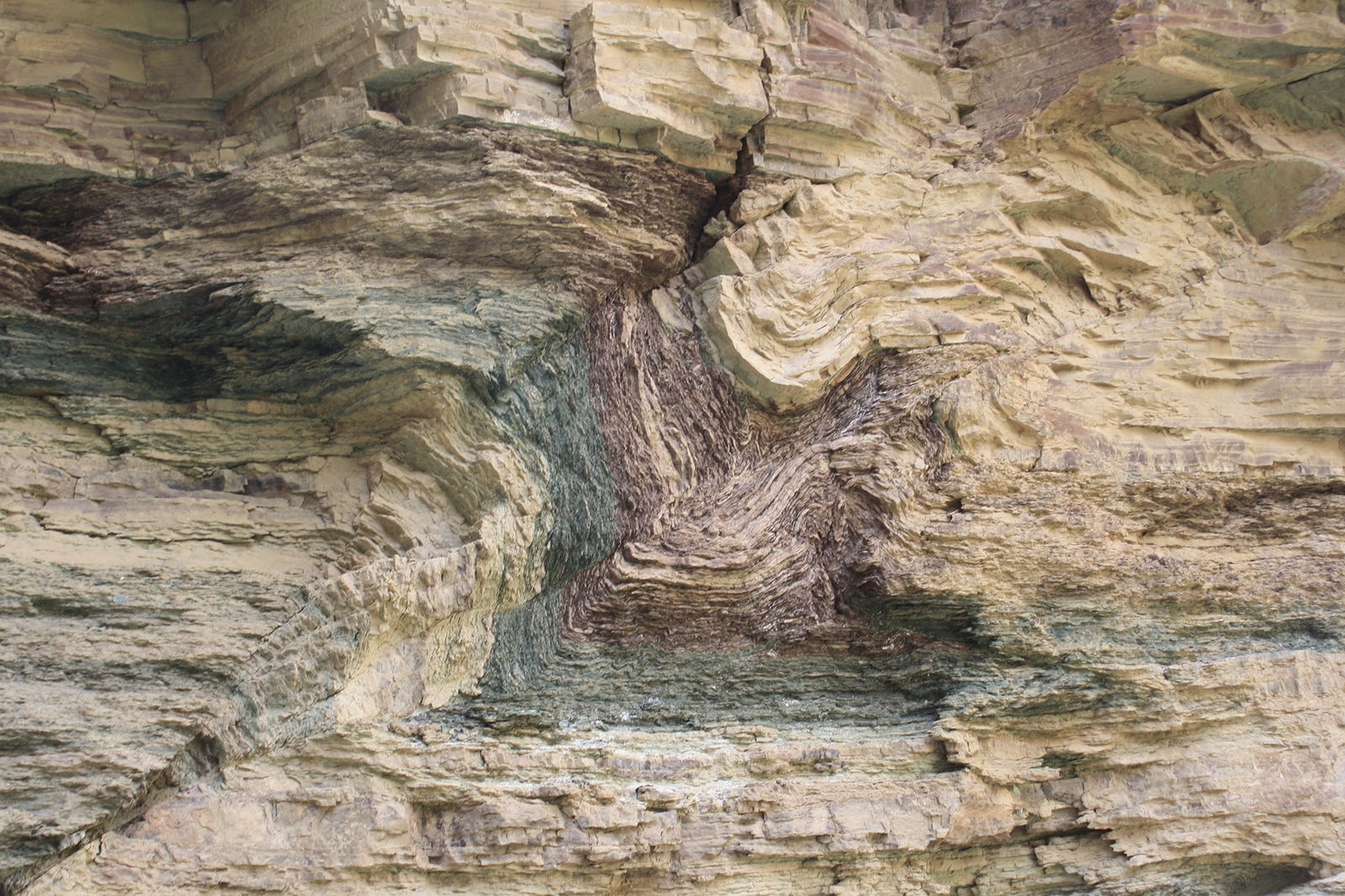
Fig. 5. The Whitmore Helipad fold photograph published in my paper.54 The sampling locations are shown in a subsequent annotated image in the paper.
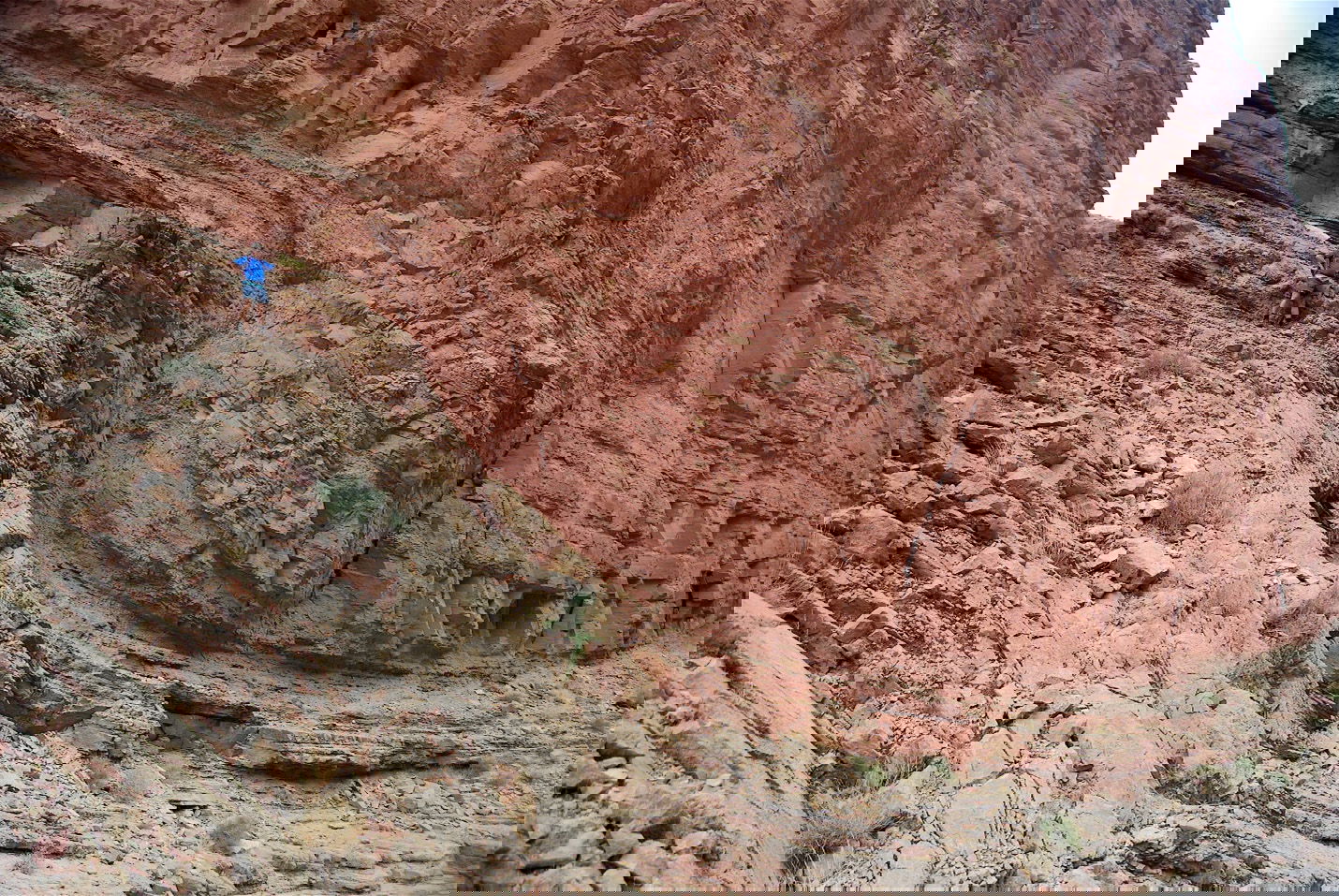
Fig. 6. The Matkatamiba fold photograph published in my paper.55 The sampling locations are shown in a subsequent annotated image in the paper.
Mitchell and Tillman then make a few general observations, which are rather obvious. In four of their chosen examples, “The fold limbs dip steeply (in some cases the limbs are overturned), and the folds are relatively narrow, with bedding returning to sub-horizontal within a distance ranging from a few 10s of meters to a few 100s of meters.”56 However, because they did not observe these folds in the field but relied only on photographs of them, Mitchell and Tillman are blithely unaware that the overall fold geometries of the Whitmore Helipad and Matkatamiba folds are fully included in the photographs, the bedding in each returning to subhorizontal within the distances embraced by the photographs (my Figs. 5–6). Thus, in all folds, the sedimentary rock layers were deformed similarly, consistent with having developed as the monoclines deformed and with the inherent space problems caused within each of these local folds.
Mitchell and Tillman next ask, “What should we look for to tell if the folding took place as soft sediment deformation vs lithified rocks?”57 However, they set up for comparison with these folds a straw man example of soft-sediment deformation in which the rocks obviously behaved as “soupy” soft sediments (their Fig. 9). There are two glaring problems with their manufactured straw man example. First, the scale of that soft-sediment deformation is confined to a narrow-restricted section within a larger formation in which the overlying and underlying beds of alternating shale and sandstone are not deformed. This is definitely not comparable to these Grand Canyon folds in which all the internal beds in multiple formations are all similarly folded on a much larger scale, as careful field observations (even by their secular colleagues) have established. And second, their example does not match the morphology and features produced in the many small-scale, laboratory-experimental simulations of folding of soft, damp sand and mud layers, as documented and illustrated in the literature (as previously cited). It is disingenuous to use for comparison an example (their Fig. 9) that is so different from observed soft-sediment deformation folding of multiple layers similar in scale to these Grand Canyon folds in order to critique my work that based its conclusions only in part on the field-scale morphology and features of these Grand Canyon folds.
Contrary to what Mitchell and Tillman noted from their figures, the rock layers today in these folds are not all faulted, nor are they quite fractured.
Contrary to what Mitchell and Tillman noted from their figures (including my photographs they reproduced), the rock layers today in these folds are not all faulted, nor are they quite fractured. To be sure, “We can look for clues that tell us that the fractures were related to the folding vs. later joint development.”58 Yet having said that, Mitchell and Tillman subsequently do not even discuss the mechanics of joint development due to shrinkage because of dewatering and release of overburden pressure, thus ensuring their interpretation of the rock layers as being fractured brittlely without any consideration that their interpreted fractures may actually be joints. Similarly, they claim they looked at evidence to determine the timing of the lithification using other clues. But what do they mean by “evidence”? As their annotated images and drawings of the folds indicate, by “evidence,” they mean their interpretations of the field observations (for example, the photographs), which do not qualify as objective (unbiased) scientific investigation.
Then once again, Mitchell and Tillman repeat their criteria for using “bedding-scale observations that can be used to distinguish between folding of lithified and unlithified sediments include: the presence or absence of fold-related fractures and faults, the presence or absence of flexural slip, and the nature of fold-related bedding thickness changes.”59 Yet again, they do not discuss how these same features have been demonstrated to be produced by soft-sediment deformation of sand and mud layers in the many laboratory-scale simulation experiments documented in the literature. These include fractures, flexural slip, and changes in bedding thickness—features that Mitchell and Tillman claim (wrongly) to be only diagnostic of deformation of lithified rocks over long periods of time.
So, as asked in Mitchell and Tillman’s article, “Do the outcrop observations indicate that the sediments [these sediment layers] were deformed as weak, unlithified rocks or as lithified rocks?”60
Mitchell and Tillman then look at a series of questions they constructed to determine which model fits the data. However, they have predetermined the outcome by pitting their straw man, soupy-sediment, soft-sediment deformation “model” against what they call the “data,” which are in fact their interpretations of the field observations.
1. “Do the folds have an overall ‘soupy’ appearance or is their morphology more consistent with some degree of lithification?”
Their Fig. 9 is a straw man “model” for soft-sediment deformation that is not at the multi-formation scale of the folding in these Tonto Group folds. So an unfair comparison is guaranteed by Mitchell and Tillman. Of course, the sediment layers in these Grand Canyon folds obviously do not have a “soupy” appearance. But their morphology instead does match the features observed in laboratory-scale, experimental, soft-sediment-deformation simulations, including the relatively planar limbs and fairly sharp hinges seen in all four folds documented in my papers. Then contrary to their prior claim that the published photographs do not allow a definitive conclusion as to the lateral disposition, Mitchell and Tillman declare that “although perhaps not quite as distinct, the Matkatamiba Fold in the Moab [sic, Muav] Formation also has similar planar portions”61 separated by supposed (or interpreted) fractures. They then claim without supporting documentation that “planar portions separated by kinks would not be found in sands folded by soft sediment deformation.”62 Yet such “kinks” have been reported in laboratory-scale experiments simulating soft-sediment deformation of soft, damp sand layers.63 Contrary to Mitchell and Tillman’s claim, the observed features in these folds are not “clear indications that these sediments were behaving as coherent sets of rock beds with some degree of lithification.”64 Instead, they are still consistent with soft-sediment deformation of soft, damp, unlithified sediment layers, which in the context of the Grand Canyon strata sequence and the Laramide uplift of the Colorado Plateau had to be soon after their deposition.
2. “Is the faulting present associated with the folding?”
Yes, it is agreed that “lithified sediments deform commonly by faulting.”65 Yet Mitchell and Tillman finally admit that “faulting is possible in softer sediments”66 because they cannot deny both field observations and documented experimental simulations. Is faulting common in the Tonto Group in deformation associated with the monoclines? Yes, of course, it is spatially associated with these folds. Faulting associated with the Laramide event reactivated Precambrian faults that cut through the overlying Paleozoic sedimentary rocks. However, those faults are not within these folds.
Yet Mitchell and Tillman again discuss a well-documented example of a fault associated with a fold along the East Kaibab Monocline, namely, the Palisades fold on the Palisades Creek Branch of the Butte Fault (their Fig. 20).67 Reches and Matthews selected this location “because of the excellent 3D exposure of the monocline in a 1200-m-deep canyon showing strata from the Precambrian (Dox Fm) to the Permian (Kaibab Fm)” and the presence of breccia in the fault zone.68 However, as I emphasized previously, what happened on the Palisades Fault is not relevant to the Carbon Canyon fold adjacent to the Butte Fault. In any case, the issue even with respect to the Palisades Fault is not the fault itself, but what happened adjacent to it.
How do they know since geologists were not present during the supposed millions of years to observe the supposed brittle behavior?
Indeed, in their Fig. 20, the Tapeats Sandstone and Bright Angel Shale are overturned in a smooth fold. Yet Mitchell and Tillman do not detail the features in that fold. Instead, Mitchell and Tillman mention their interpreted faulting on smaller scales in their other chosen examples (including the four folds I studied) and concede that the faulting is not as intense as that on the Palisades Fault (which ignores the adjacent Palisades fold itself). They then claim that “this scale of faulting and [supposed] brittle behavior is to be expected in the deformation of lithified sediments over long periods of time.”69 How do they know since geologists were not present during the supposed millions of years to observe the supposed brittle behavior? In any case, one should compare their Figs. 15, 16, 18, and 19 with their annotated interpreted faults with my Figs. 3–6 above and note how subjective their interpretations are in most instances. They acknowledge that “if faulting were rare, it would support the soft sediment deformation model.”70 But then they claim that is not the case here based on their subjectively interpreted faulting, chosen to ostensibly support their case. Instead, the rare faulting in these folds does support soft-sediment deformation consistent with the occasional faulting in laboratory-scale experimental simulations.
3. “Is there significant fracture development associated with the folding?”
Mitchell and Tillman state, “All of the included folds appear to show many fractures at the outcrop scale.”71 But then they admit that “many of these have been interpreted on the photographs and interpretive line drawings” (emphasis added; their Figs. 15, 16, 18, and 19). Again, compare those interpretations with the outcrop photographs of the folds (my Figs. 3–6 above). While fractures are evident, it is simply unclear from examining photographs whether they are fractures or joints.
Mitchell and Tillman claim that “fractures that cut across layers or multiple grains do not form in unlithified sediments because of the lack of coherency in them.”72 But they provide no documentation from the literature to support that claim. Instead, they blithely assert, “We can be confident that the degree of fracturing evident in these sedimentary layers formed after they had been buried long enough to have become stone” (lithified).73 Of course, the key question here is whether some or perhaps most of their interpreted fractures in these folds developed in association with the deformation.
As Mitchell and Tillman state, and it is agreed, “If the Tonto Group was once buried deeply and then uplifted and unroofed (exposed by the erosion of the rocks that originally overlaid them), this would have resulted in joints and fracturing.”74 However, they then claim,
Late fractures associated with the unroofing are not necessarily expected to be aligned with the fold axis or fold limbs (their orientation is controlled by the regional stress field at the time of unroofing), but those [fractures] that form during folding are expected to be geometrically related to the orientation of the fold. In addition, unroofing fractures are expected to be relatively uniformly distributed across the region, whereas syn-folding fractures [that is, fractures produced during the folding] are expected to be concentrated or more numerous within the folds than outside the folds.75
In this alternative (biblical global Flood cataclysm) scenario, shrinkage—which produced joints and fractures—would have occurred because of dewatering and lithification as the uplift, folding, and unroofing occurred and thereafter.
However, Mitchell and Tillman’s assertions about the development of fractures are based on already assuming that deposition, deep burial, and lithification all supposedly occurred more than 400 million years before uplift and unroofing. And then they use the developed fractures to claim that their timeline assumptions are correct. Thus, Mitchell and Tillman have already ruled out by arbitrary choice the alternative (biblical global Flood cataclysm) scenario; namely, that the uplift and unroofing occurred soon (about a year) after deposition and deep burial so that these sedimentary layers were still soft and damp. In this alternative (biblical global Flood cataclysm) scenario, shrinkage—which produced joints and fractures—would have occurred because of dewatering and lithification as the uplift, folding, and unroofing occurred and thereafter. Indeed, most of what Mitchell and Tillman have interpreted as fractures based on their millions-of-years uniformitarian assumptions would instead be joints developed during uplift, folding, unroofing, and dewatering, including those that cross more than one bed or layer. This powerfully illustrates how the same observational data (evidence) can be interpreted in two different ways based on two different starting assumptions.
Thus, Mitchell and Tillman have attempted to promote their assertions as proven based on their interpretation of the observational data using their millions-of-years assumptions to at the same time declare the biblical global Flood cataclysm scenario as disproven. However, as already emphasized, the observed fracturing and jointing of the layers bent in these folds is compatible with the biblical global Flood cataclysm scenario of the uplift and unroofing occurring soon (about a year) after deposition and deep burial. These sedimentary layers would have been still soft and damp when bent, the fracturing and jointing developing due to dewatering and lithification after the uplift, folding, and unroofing occurred. Indeed, as Mitchell and Tillman admit, fractures commonly form at a high angle to bedding due to the mechanical contrast between the layers. So this is expected in either case, that is, both in the uniformitarian millions-of-years scenario and in the biblical global Flood cataclysm scenario. Therefore, the fractures cannot be used to adjudicate between the two views.
Mitchell and Tillman lament that the required orientation data of their interpreted fractures are unfortunately not available.76 Thus, they suggest “this data gap should be addressed in future studies.”77 In so saying, they admit the deficiency in their own armchair study (these three online articles) and reveal that they also entirely misunderstand, and/or misrepresent, the goal of my research effort and my lengthy published, peer-reviewed, technical papers. That goal was to investigate samples of these bent rock layers from within these folds and elsewhere distant from the folds under microscopes, thus documenting the mineralogy and textures of their grains and cements. If the mineralogy and textures of the grains and cements of the samples from the folds were no different in the hinges and limbs, and in the samples distant from the folds, with no indications of any low-grade metamorphic changes in the folds, then that would imply uniform conditions throughout these rock layers during folding. Such was found to be the case and thoroughly documented. Those observations are only consistent with the sediment layers still being soft and damp when folded, which is the biblical global Flood cataclysm scenario.
However, Mitchell and Tillman are so obsessed with their millions-of-years uniformitarian assumptions that they have to try to bamboozle readers with their blustering about faulting and fracturing, while essentially ignoring jointing. So they go back to asking, “What do we observe in the photographs?” (that is, their Figs. 15, 16, 18, and 19 displaying their annotations of interpreted faults and fractures).78 Well, of course, “We see fractures in every case that seem to be related to the folds. In the Carbon Canyon fold ([their] Fig. 15), fractures are present approximately along the axial plane” (emphasis added).79 Mitchell and Tillman parrot the claim that “the orientation of the axial plane for this overall fold changed as the fold developed,”80 attributing this “to changes that developed due to flexural slippage during the folding.”81, 82 But that claim is exaggerated.83 Then Mitchell and Tillman claim that “perhaps the clearest examples of fractures associated with the folding are in the Kink Fold”84 in their Fig. 17, which is a few hundred meters upstream from the Monument fold. They claim that the fractures in this small fold that they interpreted from a photograph are “definitively associated with the development of the fold” (emphasis added).85 How can they be so emphatic when they have merely examined a photograph? What about the detailed structural analysis they insist must first be done? And then finally, they claim that we “should notice that no significant fractures [that is, interpreted fractures] are identified away from the fold” (emphasis added).86 Such a claim is emphatically false, as field observations of these rock units throughout the Grand Canyon would easily demonstrate had Mitchell and Tillman undertaken a field trip through the canyon.
4. “Is there evidence of flexural flow/slip?”
Mitchell and Tillman claim,
If the sediments [layers] were unlithified, then there would have been little difference in the competency between beds composed of sand, lime mud, silts, and muds. In this case, we would expect to find bedding thickness changes in all lithologies and little to no evidence of slip along bedding planes (i.e., flexural slip). If however, the beds were lithified, then one should expect to see thickness changes in the less competent units (e.g., muds) and evidence of flexural slip.87
However, Mitchell and Tillman cite no documentation in the literature to substantiate these claims. To the contrary, in laboratory-scale experimental simulations of soft-sediment deformation, bedding thickness changes are observed to occur only sometimes in less competent lithologies such as muds, while bedding-plane (flexural) slip is sometimes observed between sediment layers.88 So the criteria Mitchell and Tillman claim can distinguish between the folding of layers of unlithified and lithified sediments are simply not valid.
Of course, we do find evidence of minor thickening of less competent beds in the Whitmore Helipad fold (their Fig. 18 and my Fig. 5 here). However, comparison of their interpretative drawing of that fold (their Fig. 18) with the field photograph (my Fig. 5 here) clearly demonstrates how wrong their interpretations are because the sandstone bedding in the upper right is folded just as intensely as the less competent beds beneath, contrary to what Mitchell and Tillman claim. Certainly, the less competent units (brown and green mudstones and siltstones) are intensely folded to fill the space created as the more rigid sandstones folded. This kind of slight bed thickening in the hinge zone (and also minimal bedding plane or flexural slip) is exactly the behavior one would expect during soft-sediment deformation, as the laboratory-scale simulation experiments demonstrate. Thus, these features were not just caused by flexural flow deformation as Mitchell and Tillman claim. They predicted there should be “bed thickening associated with the fold, including intense folding of less competent beds in the axis of folds.”89 However, field observations of the folds (my Figs. 3–6) do not substantiate their predictions but are consistent with soft-sediment deformation of these sedimentary layers.
Mitchell and Tillman also predicted that there should be evidence of bedding parallel slickensides in the folds if the layers were lithified when folded. At least Mitchell and Tillman then acknowledge that I reported that “one surface of slickensides was noted near a sampled bed in the Carbon Canyon fold”90 (emphasis added) and that I wrote that “slickensides on bedding plane surfaces in the Carbon Canyon fold are not prolific.”91 Mitchell and Tillman then comment, “It is not clear how extensively the workers [my field team] looked for evidence of this or other evidence in the area.”92 However, I can respond that we were thorough in how extensively we examined the exposed bed surfaces throughout the fold and found no other examples of slickensides. If we had, I would have reported them in my paper. Thus, it is disingenuous of Mitchell and Tillman to make this insinuating claim. Even if others have observed slickensides on fold-related faults in other folds elsewhere,93 those are irrelevant to the Carbon Canyon fold and these other studied and sampled folds. In any case, coherent beds that are still soft and damp can rub against one another if moved relative to one another, leaving occasional slickensides. On the other hand, if these layers were already lithified, they should have left prolific slickensides, but such are not observed in any of these folds. This strongly favors the biblical global Flood cataclysm view.
There is some slight flexural slip within the Carbon Canyon fold, but it is so trivial to not be significant. I reported this in my paper, as have others.94 However, again, insignificant flexural (bedding plane) slip is not unexpected during soft-sediment deformation as observed in laboratory-scale simulation experiments.
5. “Is [there] other evidence that the sediments were lithified, such as calcite twinning?”
It is true that fractures and faults are sometimes filled with calcite. Furthermore, “Twinning in calcite crystals [often] reflects internal distortion of the crystal lattice due to stress and can be used to determine the orientations of the principal stresses that caused the distortion.”95, 96 It might thus be argued, as Mitchell and Tillman do, that “calcite twinning would have developed only during the deformation of at least moderately lithified sediments.”97 However, it is irrelevant that abundant twinning of calcite grains has been documented in the Muav and Redwall Limestones at the Palisades Fault.98 Calcite twins may well be used to determine the shortening direction, and these calcite twins may indicate shortening perpendicular to the fold axis of the Palisades fold. Mitchell and Tillman claim that “the calcite twins are not only spatially associated with the fold, but they most likely formed at the same time as the folding.”99 Furthermore, they claim, “This supports the position that the units were lithified prior to deformation and is difficult to reconcile with a soft-sediment scenario.”100
However, no calcite crystals were found in any fractures or joints within the layers bent in the Carbon Canyon fold or in any way associated with that fold, so Mitchell and Tillman’s claims here are irrelevant. And even their whole line of argument regarding the calcite crystals found in the limestones affected by the Palisades Fault is based on assumptions and suppositions. Furthermore, the ubiquitous calcite in these same limestones elsewhere well away from any of these folds is also observed to have occasionally recrystallized, but such occurrences are rare, as none of the published studies document them.101 In any case, this argument does not discount the soft-sediment deformation scenario for the Carbon Canyon and other folds, as calcite crystals are precipitated from groundwater percolating through fractures and joints well after folding, even in the exposed outcrops today.
Summary at the outcrop scale
All the outcrop observations may be consistent with these folds having developed after the rock layers were lithified, as claimed by Mitchell and Tillman. But they are all just as consistent with deformation of the layers in these folds when the sediments were still soft and damp.
- “The folds tend to have planar limbs and relatively sharp kinks,”102 which also occurs in soft-sediment deformation, as observed in laboratory-scale simulation experiments and in field occurrences of agreed soft-sediment deformation. The “soupy appearance” argument touted by Mitchell and Tillman is an irrelevant straw man based on only some field occurrences of soft-sediment deformation.
- They say, “The more competent beds maintain thickness across the fold, whereas the less competent beds display thickening in the fold hinges.”103 But this is a gross exaggeration by Mitchell and Tillman. Careful observations in the field, which Mitchell and Tillman have not done, reveal that almost all beds maintain their thicknesses across and through these folds and there is only trivial thickening of very few beds in some of these folds. These observations are consistent with laboratory-scale soft-sediment deformation simulation experiments and field occurrences of agreed soft-sediment deformation.
- “Faulting and fracturing are associated with these folds,”104 which is also observed in laboratory-scale simulation experiments and in field occurrences of agreed soft-sediment deformation. In any case, many of the fractures interpreted by Mitchell and Tillman are instead joints that developed due to shrinkage during dewatering, lithification, unroofing, and exposure.
- There is only trivial evidence for isolated flexural (bedding plane) slip, indicating very few layers with different competencies slid past each other during the folding. This is again totally consistent with soft-sediment deformation.
- “Calcite crystals are twinned [in another fold that is irrelevant to the folds I studied] and [may] indicate shortening perpendicular to the fold axes”105 in that fold. In any case, no calcite crystals are found in any of the relevant folds, whereas calcite can be deposited from groundwater in joints and fractures after folding, even today.
All these observations are easily reconciled and are consistent with soft-sediment deformation within the Flood geology model.
Microscope-Scale Observations
Next, Mitchell and Tillman moved in closer to the microscopic scale of my published thin sections, which they redrew in order to annotate them with their interpretations. They wanted to see if their observations from their interpreted redrawings would indicate that these sediment layers were deformed as weak, unlithified (soft) rocks or as lithified (hard) rocks.
During my August 2017 field trip through the Grand Canyon, 53 samples were collected. We sampled both folded and unfolded sediment layers in order to investigate deformation at this scale and to compare the mineralogy and textures of both deformed and undeformed Tonto Group sedimentary layers. As a result of these investigations, it was stated that “there is no obvious evidence of grain-boundary sliding or rotation of grains and little to no evidence of any ductile deformation.”106, 107 Mitchell and Tillman thus claim, “If this is the case, then we have run out of deformation mechanisms and these rocks have not experienced any penetrative strain”108 (that is, deformation that is pervasive throughout the rocks and not just localized in certain zones, like faults). This is a straw man argument. The observational evidence in the field is that these sedimentary layers have experienced no pervasive penetrative strain through almost all of their lateral extent through the Grand Canyon, only experiencing very localized deformation in these few folds. To argue otherwise is to completely ignore this verifiable observational field evidence. It would seem that neither Mitchell nor Tillman has taken a field trip through the canyon, which significantly disqualifies them from making such statements. They get it so wrong when they next state that if their argument just stated above is the case, “Then the beds should be planar and segmented by zones of localized deformation (i.e., faults), which is clearly not the case.”109 Actually, the observational field evidence is that the beds are planar for nearly all their lateral extent through the Grand Canyon, and they are segmented by just a few comparatively narrow and restricted zones of localized deformation by faults and folds. Mitchell and Tillman assert that “the fact” that the beds are sinuously folded demonstrates that penetrative strains were involved, although they admit the amount of penetrative strain required is rather small. However, it is not a “fact” that the beds are sinuously folded. “Sinuously folded” implies repetitive folding through a sinuous pattern. Where is the observational evidence for that? At each location, there is a single open fold, as can be readily seen in my Figs. 3–6. Again, Mitchell and Tillman have built another straw man argument to make readers think these folds are more significant than they are across the lateral extent of these sedimentary layers.
Mitchell and Tillman are correct when they say,
The primary microscopic-scale deformation mechanism in unlithified sediments will be grain boundary sliding. In contrast, deformation mechanisms in lithified sediments potentially include: fracturing and faulting (of individual grains and across layers), internal distortion of grains, and dissolution and reprecipitation of minerals in response to stress (i.e., pressure solution).110
However, Mitchell and Tillman neglected to add that features observable under the microscope in mineral grains in lithified sediments that suffered ductile deformation should also include deformation lamellae, kink bands, and undulose extinction.111 But the grains in the sedimentary layers in these Grand Canyon folds do not exhibit those characteristics.
In any case, Mitchell and Tillman next looked to see indications of their listed features in my published photomicrographs. They then claimed that my published photomicrographs “show tightly packed grains and significant micro-fracturing, indicating the grains have been deformed under relatively low-grade deformational conditions.”112 However, as will be demonstrated below, Mitchell and Tillman redrew cherry-picked photomicrographs that they annotated with their interpreted micro-fracturing, when a careful examination of all the actual photomicrographs overwhelmingly indicates any claimed micro-fracturing is very rare. Besides, there are other plausible explanations in those instances, such as internal fracturing of grains during sediment transport and deposition. Furthermore, the grains are not always tightly packed, as evidenced by the many surviving pore spaces (my Fig. 7).
Mitchell and Tillman then attempt to bolster their claims by asking some questions and providing their answers that help guide readers’ understanding of their interpretations that they want the readers to see in their few selected thin-section microscope slides from my paper.
1. “Is there evidence of metamorphism or high temperature/pressure deformation?”
Mitchell and Tillman acknowledge that all my technical papers make the point that these Tonto Group sedimentary layers show no evidence of metamorphism or high-temperature/pressure (T/P) deformation. And they agree with me that “the thin sections confirm that these remained sedimentary rocks that have been changed from loose sediment to rock by burial and the precipitation of cements and were lithified and deformed at relatively low (T/P) conditions,”113 although I have argued and demonstrated lithification occurred after these sediment layers were deformed while the sediments were still soft and damp. Certainly, we agree that “under these conditions, we do not expect extensive formation of sub-grains, deformation lamellae, kink bands or undulose extinction. Such features would reflect deformation at higher T/P conditions.”114
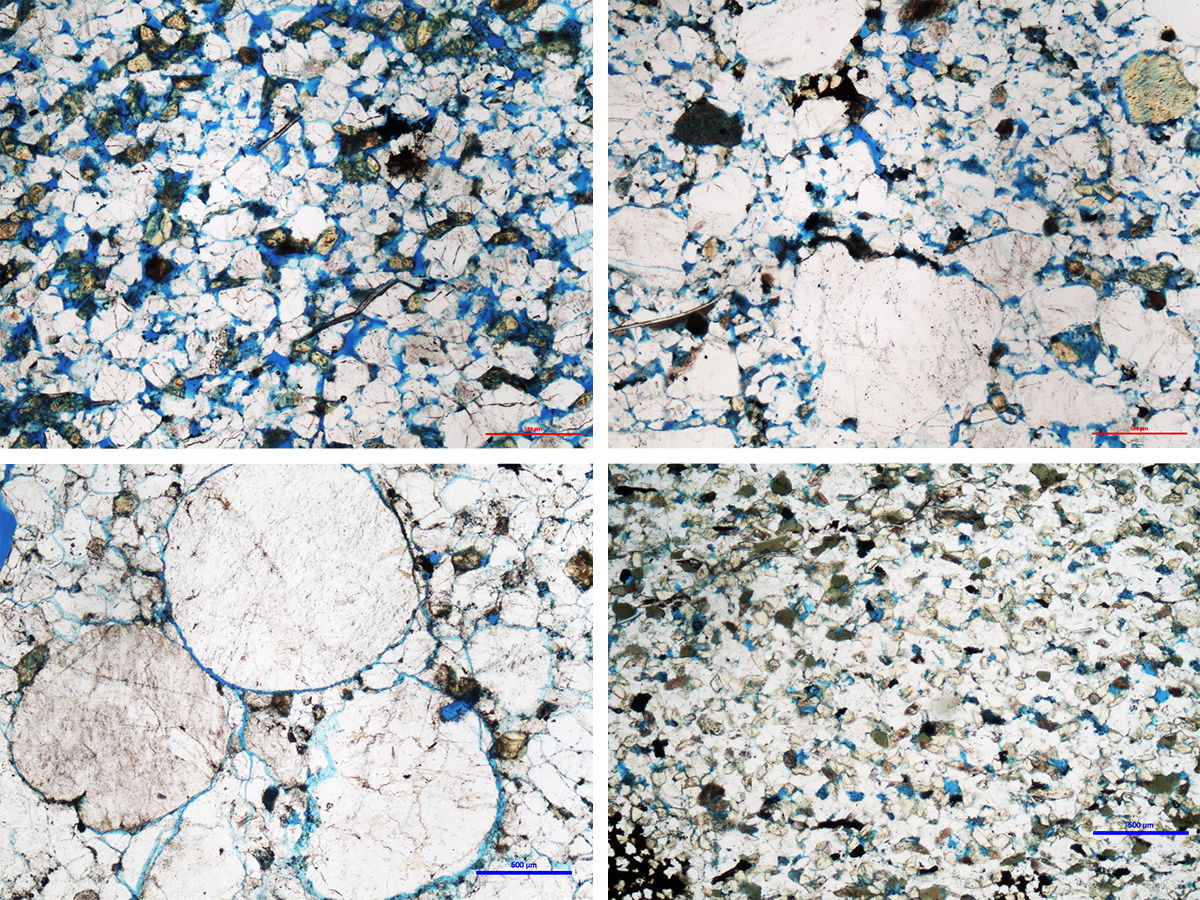
Fig. 7. Photomicrographs of sample textures showing the packing of (mostly quartz) grains with the blue representing unfilled pore spaces between grains (due to the dye in the binding epoxy). Top left: Regional Tapeats Sandstone sample TSS-01. Top right: Tapeats Sandstone sample CCF-05 from the Carbon Canyon fold. Bottom left: Tapeats Sandstone sample MF-08 from the Monument fold. Bottom right: Bright Angel Formation sandstone sample HF-08 from the Whitmore Helipad fold.
2. “Are units cut by fractures or faults?”
Mitchell and Tillman claim, “Most of the thin sections show evidence of fracturing” (emphasis added). Such a claim can easily be refuted by examination of all 53 thin sections in the published papers and not just the five they cherry-picked.
Mitchell and Tillman then claim that some, such as the example in their Fig. 21 (which they admit in the caption is an interpretation of a photograph), are intensely fractured at the scale of a few millimeters, which is a gross exaggeration, as can be seen when the actual photomicrograph is placed alongside their Fig. 21. They claim, “The rock more resembles finely shattered porcelain than soft sands that were deformed,”115 which is a gross exaggeration, given the rock is a coarse sandstone. “This particular sample was taken in a tighter synclinal portion of the Monument fold”116 (Fig. 22 in my Monument fold paper117). In their caption, they claim many grains are fractured and that most fractures are original, both of which are exaggerations based on their annotated interpretation. At least they acknowledge that “some fractures may have been induced during impregnation,”118 as evidenced by the blue dye in the impregnating resin that infills such induced fractures. But I would argue that one cannot discount additional fracturing of grains and the rock fabric during sample collection with a sledgehammer, during sample transport, and during cutting of the samples with a diamond saw. Thus, it is possible that most fractures (which are difficult to discern in the actual photomicrograph in my Fig. 8) were induced in the samples and are not original, including where they claim the rock fabric has supposedly been offset by fractures. Mitchell and Tillman also admit in their caption that in many cases it is difficult to recognize the difference between original quartz grains and the quartz cement and that this makes it difficult to demonstrate the relationship between their interpreted fractures and the cement.119 Thus, their claims of fractures and fractured grains on their annotated interpretation of their redrawn photomicrograph fail when compared to the actual photomicrograph (my Fig. 8) and to all the factors mentioned above that interacted with these samples when and after they were collected in the field. Mitchell and Tillman then admit, “In the absence of detailed orientation and timing data it is not possible to definitively determine the timing of these deformation features relative to the timing of the monoclinal folding.”120 Quite so, and the microscope evidence does not support their claims. Yet they still conclude: “Nonetheless, all the evidence at this fold is consistent with folding of previously lithified sediments.”121 This conclusion is driven not by the evidence but by their a priori commitment to the uniformitarian belief that these sediment layers were deposited and lithified hundreds of millions of years before the folding.
It is possible that most fractures (which are difficult to discern in the actual photomicrograph in my Fig. 8) were induced in the samples and are not original, including where they claim the rock fabric has supposedly been offset by fractures.
Mitchell and Tillman conveniently ignore the definitive observational evidence provided by the SEM images in my Carbon Canyon fold paper (which their citing of it indicates they had read) and in my Monument fold paper (which they did not cite, so apparently have not read, even though it was published well before they published their web article). A few of these SEM images are provided in my Fig. 9 below. They provide three-dimensional views of the fabrics of sandstone samples from those two folds. They clearly show the quartz cement that has grown over the detrital quartz grains within the pore spaces. In some images, such as Figs. 9f and 9g, the imaged surfaces were produced by breaking open the samples through the quartz cement, so in places, the cement surfaces are fractured because of that sample preparation method. But elsewhere, there are pristine quartz cement crystal terminations, which demonstrate conclusively that the quartz cement grew after these sandstone layers were folded, which thus had to be due to soft-sediment deformation because otherwise these quartz cement crystals would have been damaged. This evidence rules out Mitchell and Tillman’s claim that deformation occurred after the sandstone was lithified, that is, after these quartz cement crystals had grown. Full descriptions and details are discussed in my two papers.
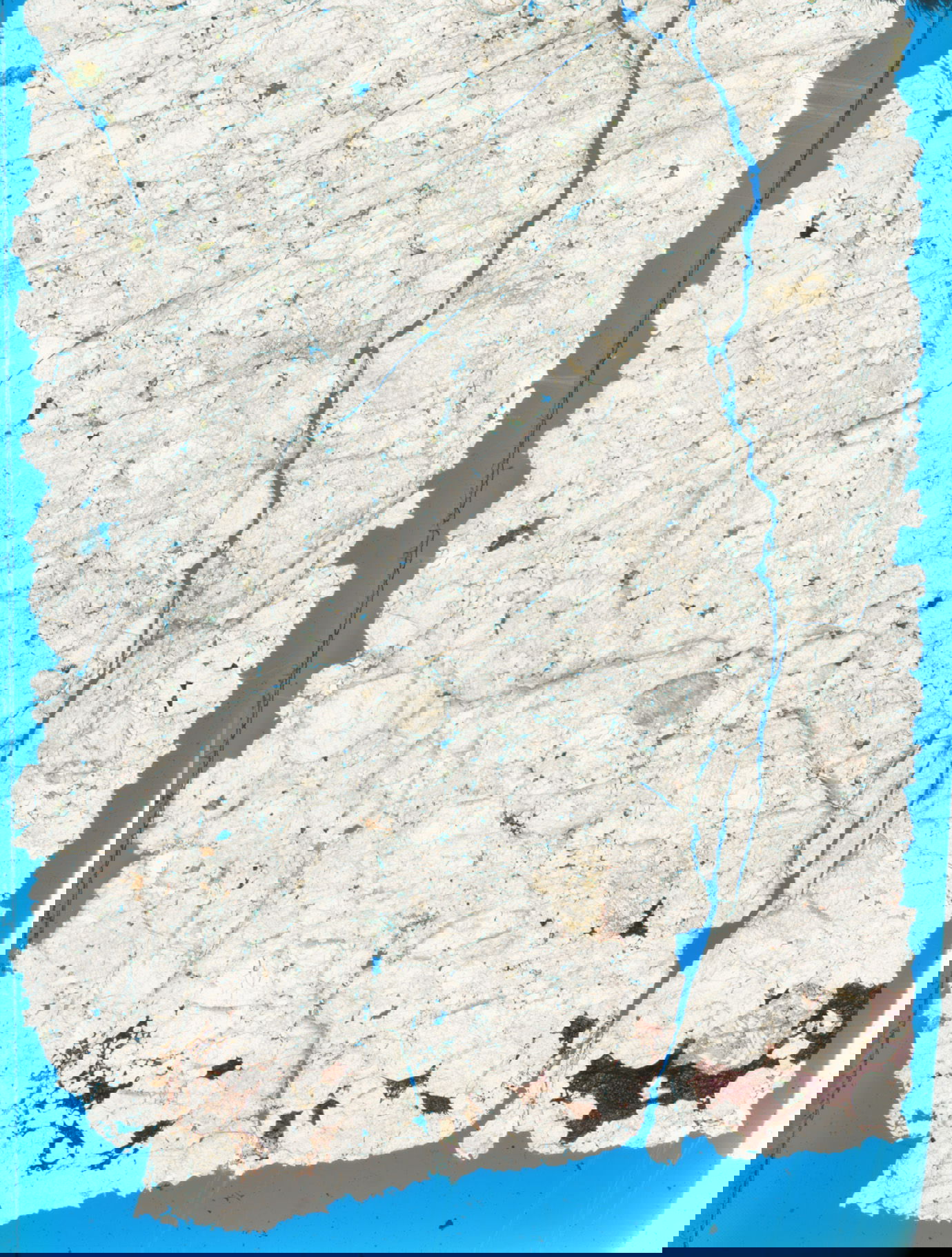
Fig. 8. Tapeats Sandstone sample MF-06 from the Monument fold. Pictured here is the actual photomicrograph as published in my papers. Compare this with Mitchell and Tillman’s annotated interpretive drawing.
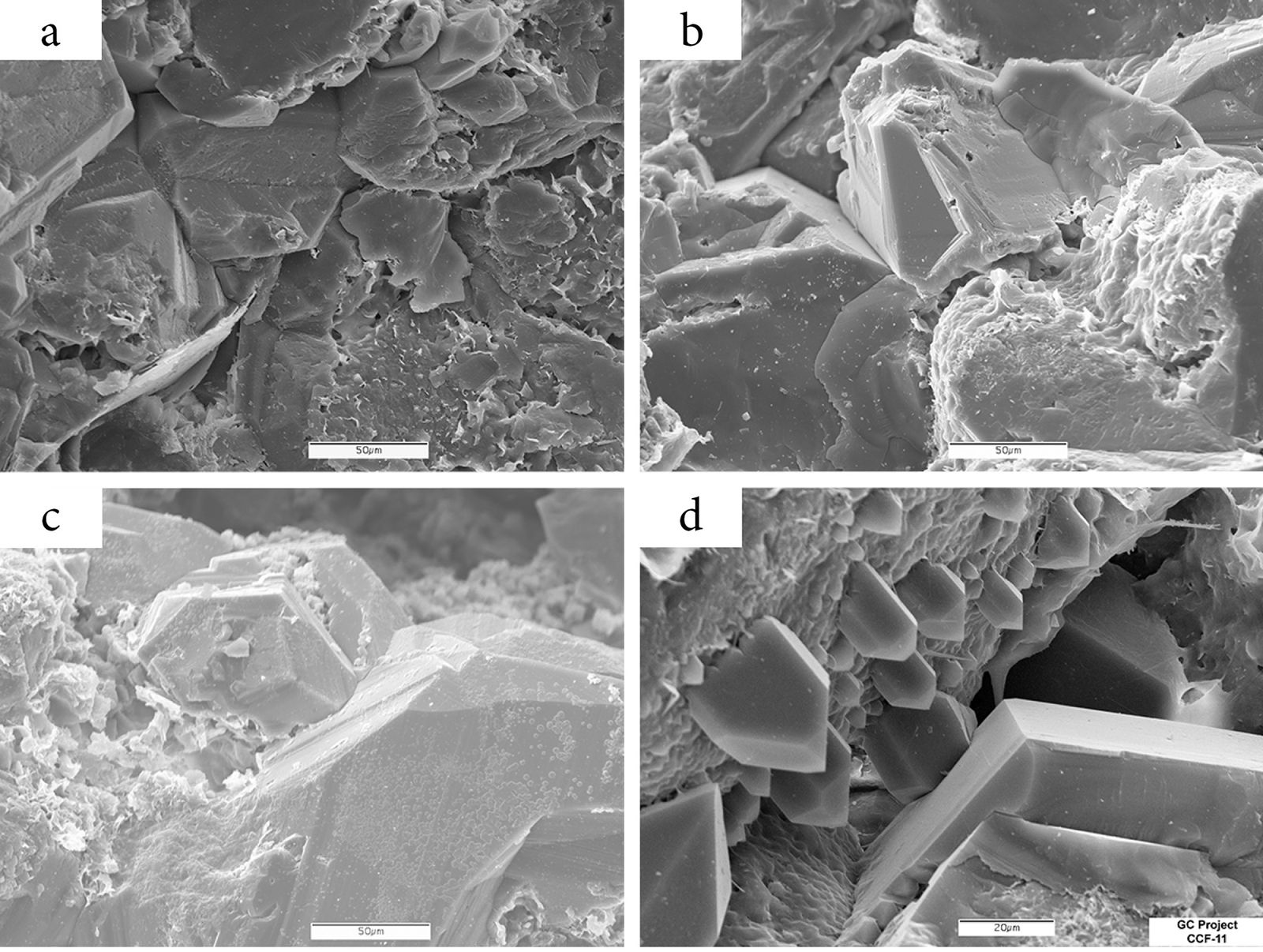
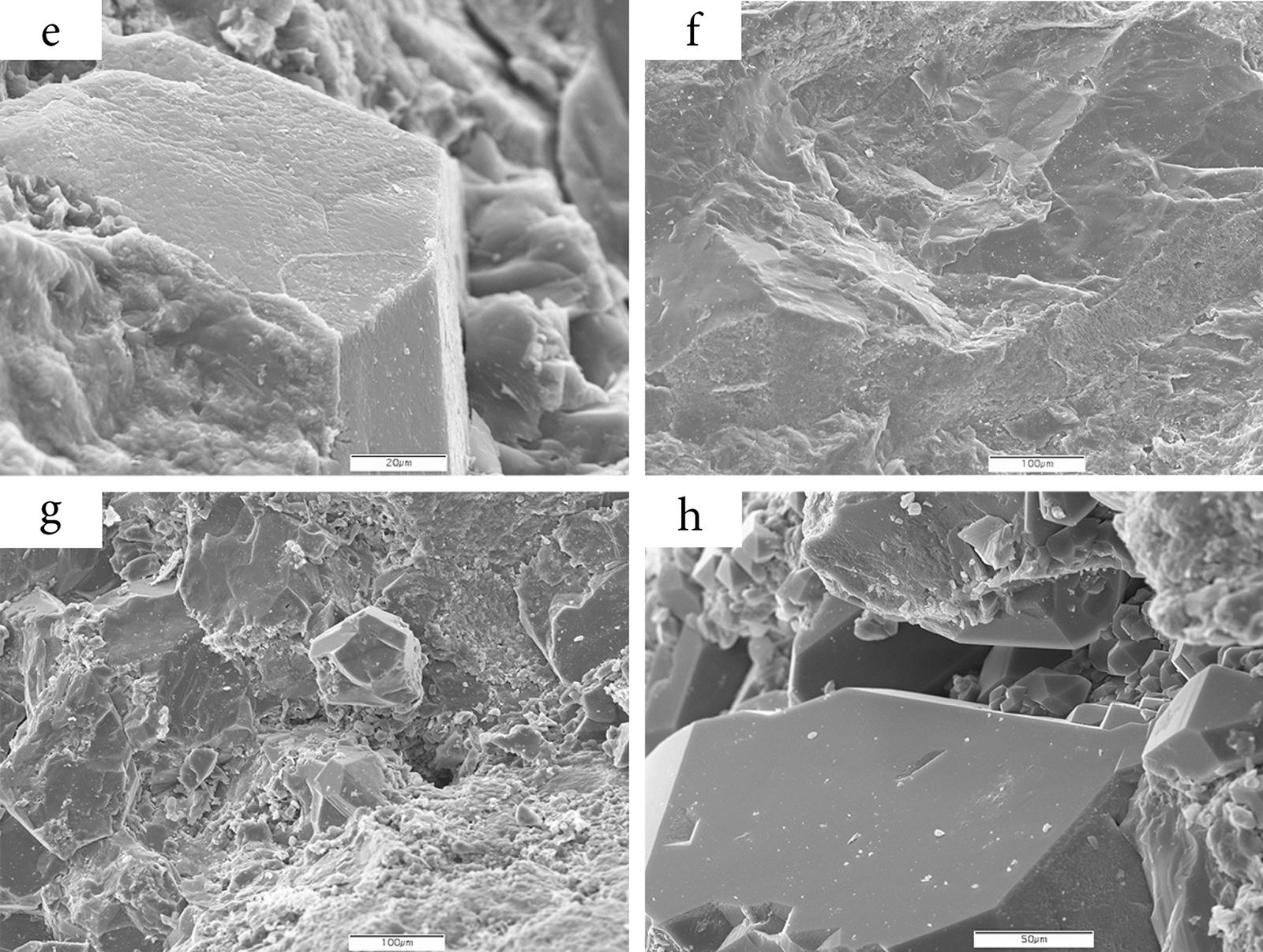
Fig. 9. SEM images of quartz cement crystals overgrowing detrital quartz grains with pristine terminations because they have grown into the pore spaces. These are all Tapeats Sandstone samples from the Carbon Canyon and Monument folds. Locations are indicated on Figs. 21 and 22 of my respective papers.122 The bars indicate the scales. (a) CCF-01 (b) CCF-02 (c) CCF-08 (d) CCF-11 (e) MF-01 (f) MF-05 (g) MF-07 (h) MF-10.
Mitchell and Tillman then claim that “another example from the Matkatamiba Fold shows multiple generations of fractures”123 in their Fig. 22, which is “an interpretative line drawing” of my actual photomicrograph shown here in my Fig. 10. In this case, we do see that this silty limestone is fractured, but it is hypothetical for Mitchell and Tillman to claim, “Possibly including pressure dissolution.” Clearly, the fractures are filled with iron oxides and calcite. However, just because some of the fractures are filled with both iron oxides and calcite, to suggest (as they do) a sequence in the timing of the fracturing is conjectural. Thus, the fractures filled with calcite are not necessarily later than the fractures filled with iron oxides, nor are the fractures necessarily due to the claimed ductile deformation after lithification of the limestone beds in this fold.
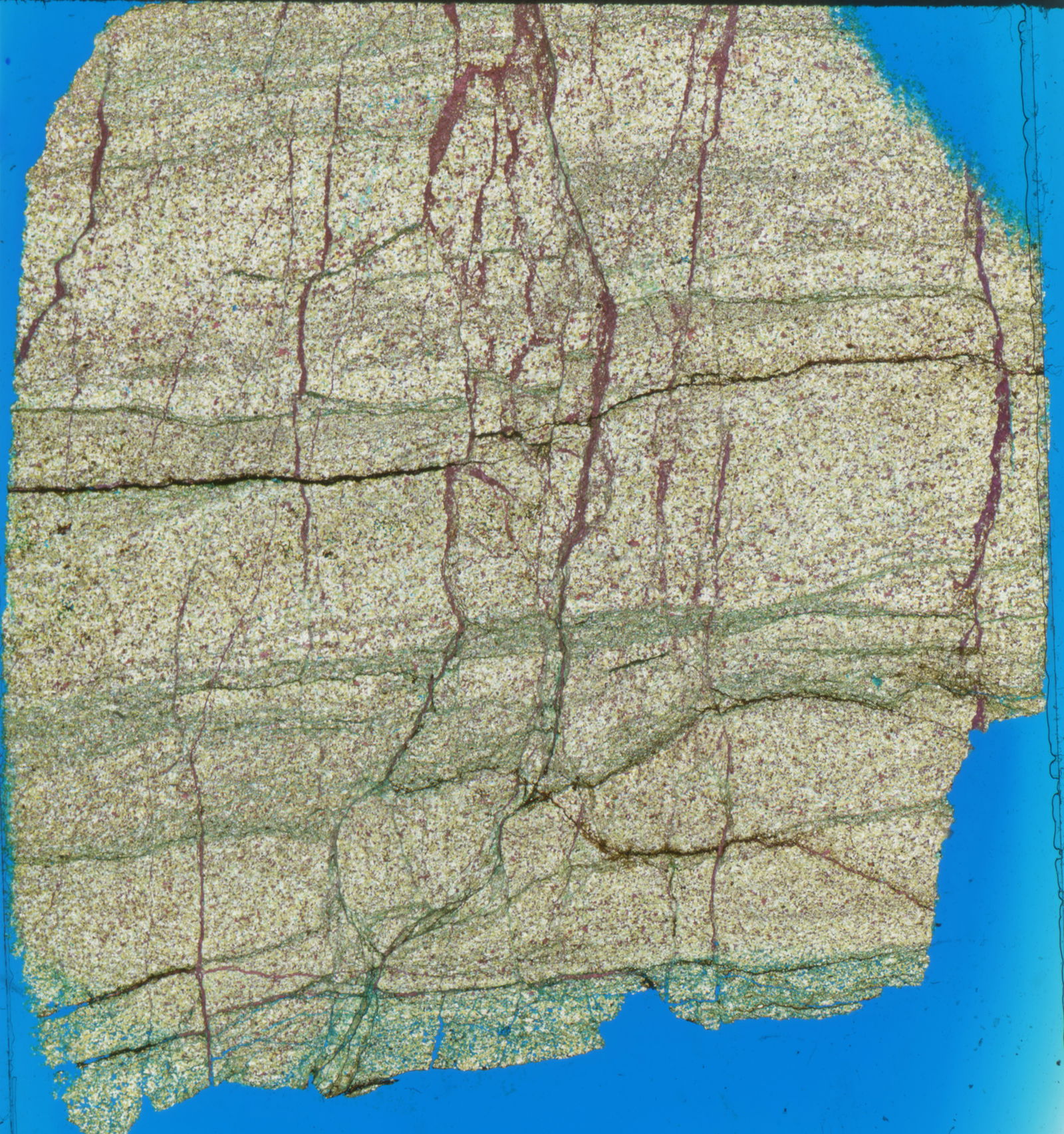
Fig. 10. Silty Muav limestone sample MFML-05 from the Matkatamiba fold. Pictured here is the actual photomicrograph as published in my papers. Compare this with Mitchell and Tillman’s annotated interpretive drawing.
SEM images of samples from this fold provide definitive observational evidence on the timing of cementation of these silty limestone beds (my Fig. 11). They provide three-dimensional views of the fabrics of these silty limestone samples from this fold. Detailed descriptions are provided and discussed in my Matkatamiba fold paper. It should again be noted that the imaged surfaces were produced by breaking open the samples through the calcite cement during sample preparation so the cement surfaces appear fractured because of that method, although some pristine calcite cement crystals with their characteristic form are still evident. This indicates the calcite cement grew after the folding because otherwise those crystals would have been fractured by the deformation. Also clearly seen are edge-on muscovite flakes in my Fig. 11 top left, bottom left and right, wedged tightly between likely detrital quartz grains. The observational evidence here is entirely consistent with folding of these limestone beds by soft-sediment deformation before lithification, that is, before growth of the calcite cement. Thus, since the fractures noted above in my Fig. 10 would appear to have been produced after cementation, they must also have been post-folding, with the iron oxides and calcite filling them subsequently. Mitchell and Tillman’s arguments are thus destroyed by the observational evidence.
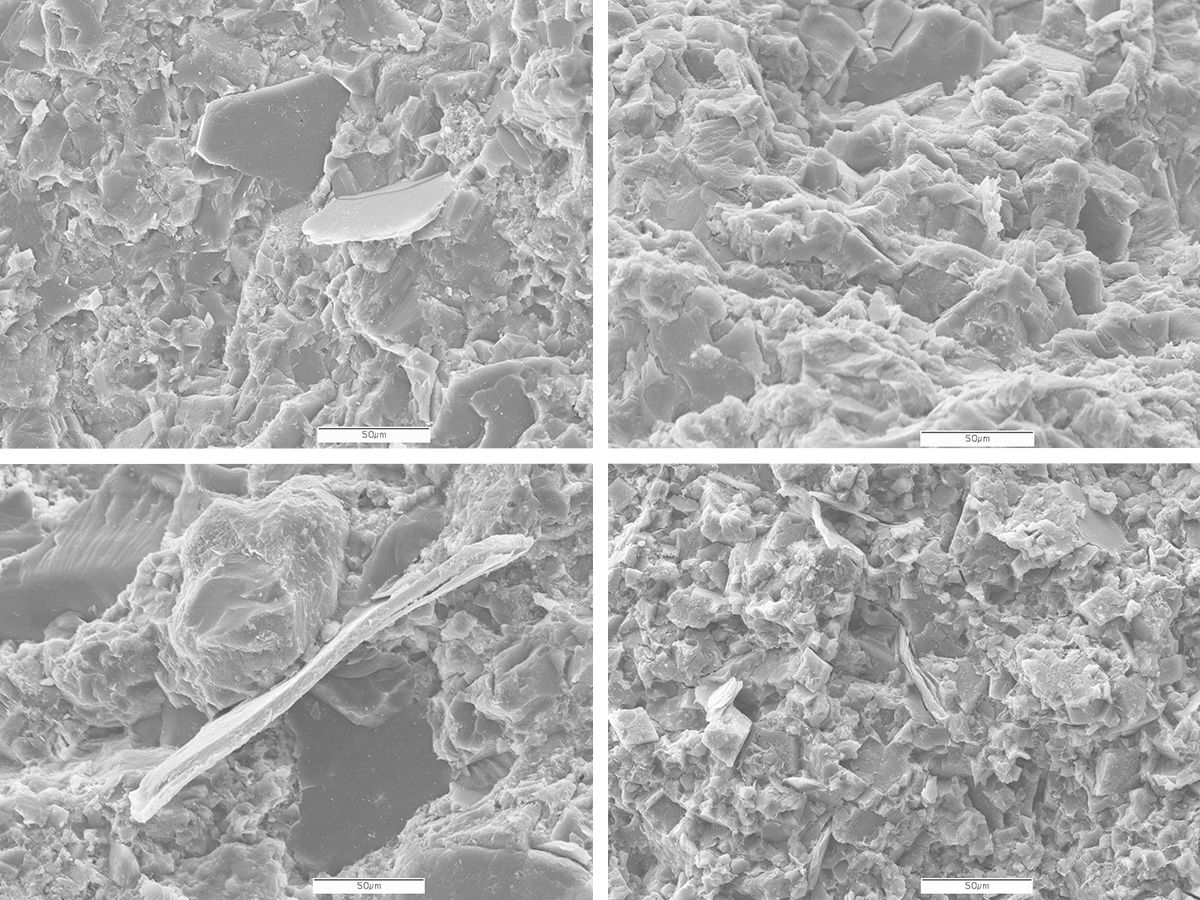
Fig. 11. SEM images of silty Muav Limestone samples from the Matkatamiba fold. Locations are indicated on Fig. 22 of my paper.124 The bars indicate the scales. Top left: MFML-04 Top right: MFML-05 Bottom left: MFML-06 Bottom right: MFTB-06
3. “Is there evidence of internal destruction of grains?”
We agree that “when soft sediments [layers] are folded, the [detrital] grains are able to shift and thus are not [usually] fractured,” the soft-sediment deformation being facilitated by grain-boundary sliding.125 However, “The more strongly lithified the rock was prior to folding the less grain boundary sliding would have been possible and the more fracturing of grains and cement occurs.”126 But that is where agreement with Mitchell and Tillman ends.
Mitchell and Tillman claim that we can see “abundant evidence” of fractured grains in their Fig. 21, an “interpretative line drawing,” which they have heavily annotated to enhance what they have interpreted as fractures, including across grains. However, as discussed above, their annotated interpretative accentuated lines do not make them fractures, as can be seen when compared to the actual photomicrograph in my Fig. 8. Furthermore, as noted above, fracturing of samples can be induced during sample collection with a sledgehammer, during sample transport, during cutting of the samples with a diamond saw, and during impregnation with blue-dye-colored epoxy resin. Indeed, the blue-dye-colored fracture that extends prominently through the thin section vertically on the right-hand side of my Fig. 8 is very clearly a fracture due to sample preparation because the resin “glues” that right-hand-side section of the rock sample to the rest of the sample. Yet Mitchell and Tillman have made so much of that fracture in their exaggerated annotated interpretation in their Fig. 21 as though that fracture was due to the folding deformation. It clearly was not. Similarly, some fracturing of grains occurred during sample preparation, as is evident with the blue-dye-colored fracture through the prominent quartz grain just above center in my Fig. 8, which is not offset in any way, as would be expected if the fracturing was due to the folding deformation. Again, Mitchell and Tillman have made so much of that fractured grain in their exaggerated annotated interpretation in their Fig. 21 as though that fracture was due to the folding deformation. Thus, Mitchell and Tillman’s annotated interpretation simply cannot be trusted as they have exaggerated it according to their agenda and not objectively.
Their Fig. 23 is the thin section of sample CCF-01 from the Carbon Canyon fold, which in their caption Mitchell and Tillman acknowledge is “an interpretative drawing of a portion” enlarged from my actual photomicrograph (my Fig. 12). In it, they purport to show evidence of a prominent fracture extending through original grains. Indeed, in the enlarged area shown by my Fig. 12 left, there is a large quartz grain (bottom center) through which a blue-dye-colored prominent fracture is very evident, being the resin that impregnated the sample. This emphatically demonstrates that such fractures were induced by epoxy resin impregnation under pressure during preparation of this sample for thin sectioning, as this quartz grain is not offset in any way, which would be the case if the fracturing was due to the folding deformation. Yet Mitchell and Tillman have exaggerated this fracture as the only fracture in their annotated interpretation of this thin section (compare their Fig. 23 with my Fig. 12 left). Furthermore, in their annotated Fig. 23, they exaggerate the thickness and extent of this fracture above that fractured prominent quartz grain, even labeling their annotated, interpreted-wider fracture with “possible crushed grains along fracture trend.” Yet one is hard-pressed to even imagine their scenario when one looks at the same enlarged area of the original photomicrograph (my Fig. 12 left). Such is the exaggeration of Mitchell and Tillman to even suggest “possible” crushed grains, clearly clutching at straws in trying to establish their agenda of ductile deformation over millions of years and to convince unsuspecting readers, rather than objectively assessing the thin section and considering the many ways fractures and fractured grains were likely derived.
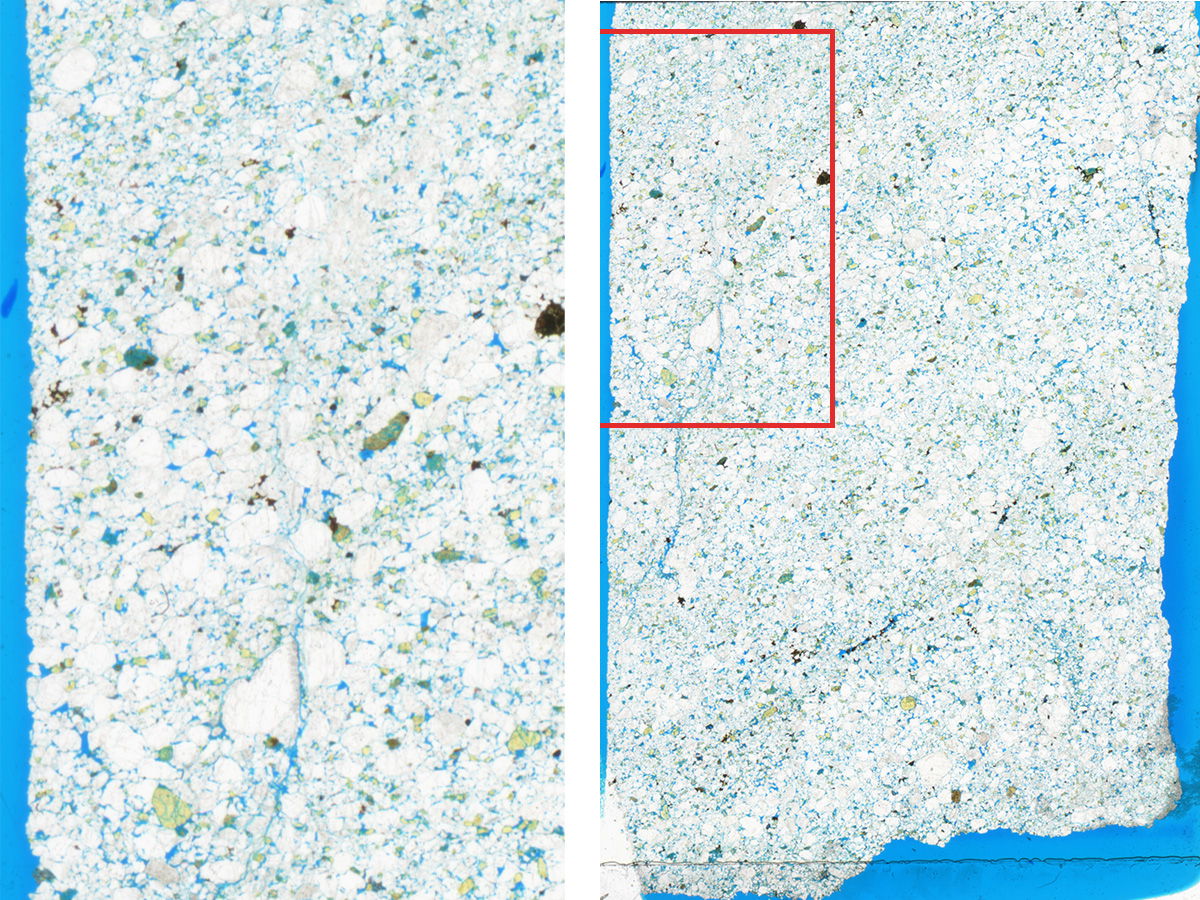
Fig. 12. Tapeats Sandstone sample CCF-01 from the Carbon Canyon fold. Pictured here is the actual photomicrograph as published in my papers. Compare this with Mitchell and Tillman’s annotated interpretive drawing. Left: The enlarged area of the actual photomicrograph of the thin section matching their Figure 21. Right: The original photmicrograph with the red lines marking the area enlarged (left).
However, Mitchell and Tillman persist with their claims that “in some cases, the same fractures [supposedly] cut across multiple grains” in these featured (cherry-picked) samples, and “it appears that the fractures include fragments of shattered grains and cut through cement.”127 But they finally admit that “to be sure of this, one would need to examine the actual slides” (emphasis added).128 Exactly! But why did they not admit this before presenting their exaggerated annotated interpretations of redrawn photomicrographs? To do so would have undermined their subjective biased agenda and would have alerted their readers to look more closely.
The degree to which fractures cut through grains is also particularly difficult to observe in fine-grained rocks. Even so, Mitchell and Tillman feature the thin section shown in their Fig. 24, in which they highlight the dark rounded areas that they claim “were cemented before being cut by fractures with small amounts of offset.”129 However, the prominent offset along an interpreted fracture in their Fig. 24 was manufactured deceitfully by Mitchell and Tillman, as unsuspecting readers did not have my original photomicrograph of the actual thin section for comparison. So it is presented in my Fig. 13 here, which conclusively shows absolutely no offset of the sample along a fracture. If the fracture were there, it would be highlighted by the same blue-dye-colored epoxy resin that is evident in fractures in other photomicrographs, such as in my Fig. 12 (left) above and in the sample-preparation-induced wide fracture near the top of the photomicrograph in my Fig. 13. How can any of Mitchell and Tillman’s claims be trusted when such deceit is plainly evident?
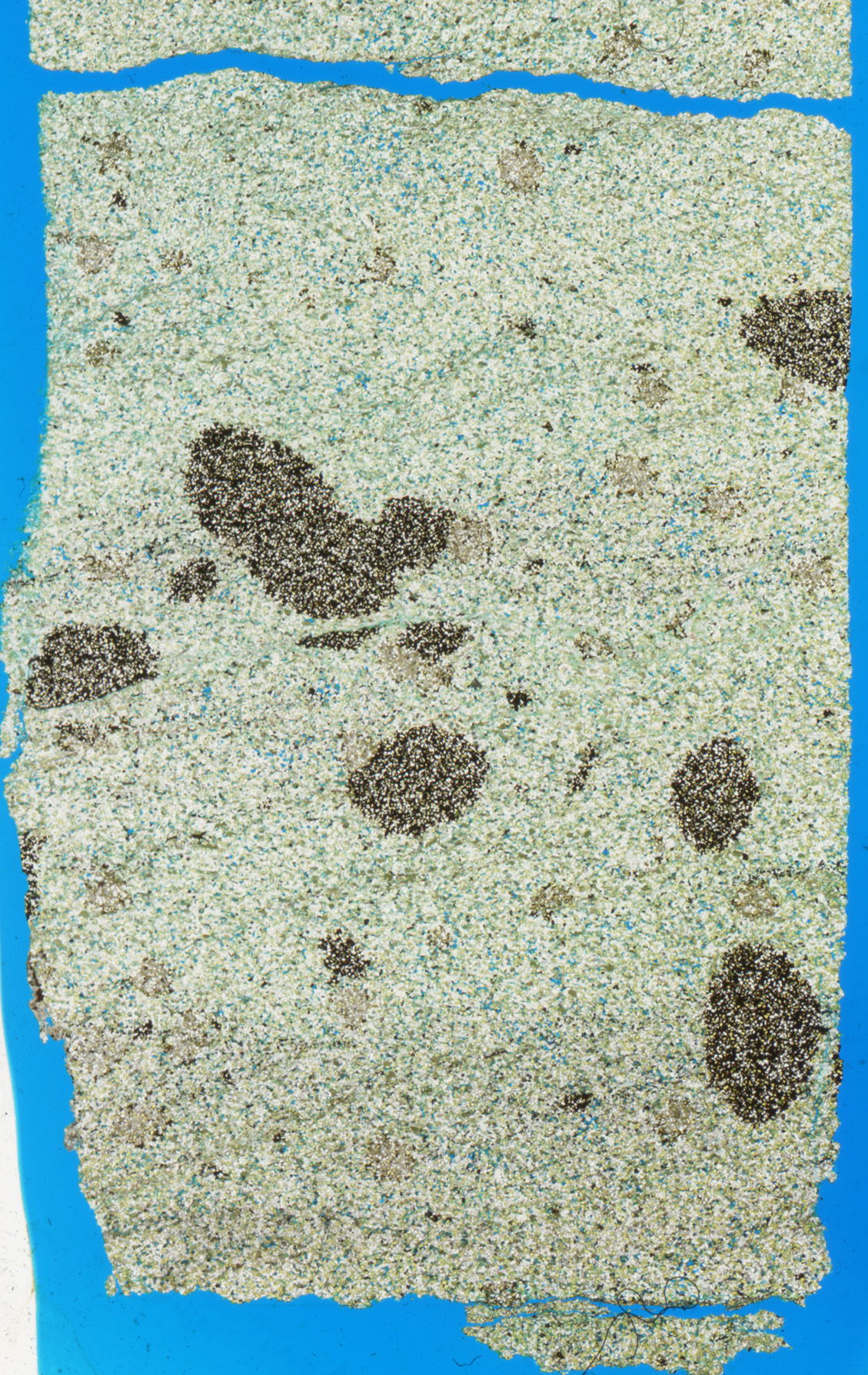
Fig. 13. Bright Angel Formation siltstone sample HF-08 from the Whitmore Helipad fold. Pictured here is the actual photomicrograph of the thin section as published in my papers. Compare this with Mitchell and Tillman’s annotated interpretive drawing.
Furthermore, Mitchell and Tillman dispute my suggestion that the dark brown rounded areas could have been detrital carbonate clasts by claiming that the “cross-bedding appears to extend through them, suggesting that these are concretions.”130, 131, 132 However, one is hard-pressed to discern whether the faint cross-bedding in the sample actually does go through the dark brown rounded areas as they claim. Mitchell and Tillman then admit, “In either case, these features would have formed early, perhaps soon after deposition and hardened as iron oxides in solution concentrated in local areas.”133 But then Mitchell and Tillman persist with their manufactured evidence by stating that “brittle fractures through such features [the dark brown rounded areas] would be difficult to reconcile with soft sediment deformation.”134 However, where are the brittle fractures cutting through the dark brown rounded areas in the actual photomicrograph in Fig. 13? There are none! There is a small elongated fragment left of center just below the largest dark brown rounded area, but that fragment does not fit with the shape of any nearby dark brown rounded area. Thus, it could not have been fractured off one of them but must be a primary fragment, which is consistent with my suggestion that these could have been detrital carbonate clasts, most being rounded but this one being an angular fragment.
4. “Are more heavily deformed areas more heavily fractured?”
Mitchell and Tillman next note that I also collected samples away from the folds to compare these “relatively undeformed” rock layers with the same rock layers in the folds. Once again, they choose their words to suit their agenda. These rock layers are simply not deformed elsewhere distant from the folds, that is, they are undeformed, which is why they were sampled for comparison with the same rock layers deformed in the folds. For Mitchell and Tillman to claim they are “relatively undeformed” is to imply they are still potentially deformed, which they are not, as anyone who has observed and examined these layers in person in the Grand Canyon would know.
Mitchell and Tillman then claim that these “less deformed” (in reality, undeformed) samples are fractured but not as extensively. If Mitchell and Tillman had actually examined these undeformed rock layers in person in the Grand Canyon, they would have recognized them primarily as joints due to dewatering and unloading of the overburden pressure and not as fractures. To the contrary, the samples from the deformed rock layers in the folds are generally no more fractured than samples from the same rock layers distant from the folds where they are undeformed. Mitchell and Tillman have again exaggerated the fracturing of these rock layers by their annotated interpretations on redrawn photomicrographs of thin sections of selected (cherry-picked) samples, focusing on samples only from the folds. They should have also featured some of the samples collected distant from the folds in the undeformed same layers for a more accurate comparison. Had they done so, readers could have seen for themselves that those samples are no more fractured than the “cherry-picked” samples from the folds, minus their annotated interpretations. Obviously, to have done so would have undermined their agenda and refuted their claims.
However, not to be deterred, Mitchell and Tillman again claim, “If the fractures are concentrated or more numerous within the folds than outside the folds, and if the orientations of the fractures are geometrically related to the orientation of the fold (e.g., strike parallel and perpendicular to the fold axis), then it is highly likely that the fractures formed during folding.”135 But this is not definitive evidence for the ductile deformation they claim produced these folds, as such fracturing occurs in outcrops distant from these folds. They go on to also claim that “while our information is incomplete, it is significant that the slides [thin sections] with the highest degree of fracturing are all in highly deformed parts of the folds.”136
Well, of course, their information is incomplete because they failed to feature thin sections of samples in the same rock layers distant to the folds. They did this to ensure readers could not check their assertion that the samples from the folds were more fractured than those distant from the folds. Mitchell and Tillman highlight their claim by referring again to their exaggerated annotated interpretations in their Figs. 21 and 22, which I have refuted in detail already. They then harp on their claimed possible concretions in their Fig. 24, showing their deceitfully manufactured horizontal offset. But even though that sample HF-08 is from near the fold axis, the actual photomicrograph (Fig. 13) shows no evidence of that or any other claimed fractures. This refutes their claim that sample HF-08, as well as others such as thin sections HF-04 and HF-05 also from near the fold axes in the Whitmore Helipad fold (which they did not show but are shown here in my Fig. 14), displays more fractures than in samples distant from the fold. To the contrary, samples HF-04, HF-05, and HF-08 show no more possible fractures than in samples distant from that fold.
A careful examination of all the actual photomicrographs demonstrates that the lack of fracturing in the fold axes is similar to that in samples distant from the folds.
Thus, Mitchell and Tillman are adamant that “while the dataset has its limitations, the data available indicate that much of the fracturing of lithified rock was associated with the folding.”137 However, the reality is that a careful examination of all the actual photomicrographs (not simply their cherry-picked redrawn photomicrographs with their exaggerated annotated interpretations) demonstrates that the lack of fracturing in the fold axes is similar to that in samples distant from the folds. Interested readers can always check out for themselves all the actual photomicrographs in my published papers (as referenced earlier) that are freely available online (links provided to my papers).
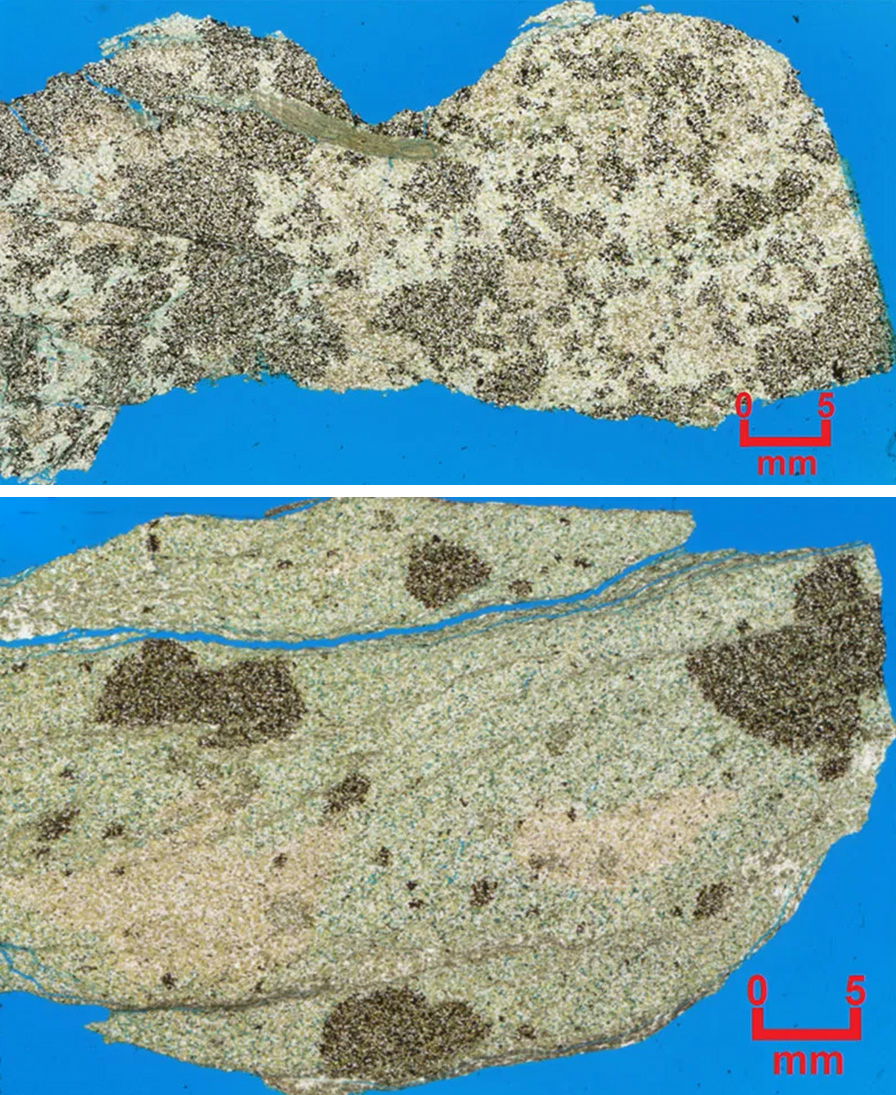
Fig. 14. Photomicrographs of samples from the Whitmore Helipad fold as published in my papers. Top: HF-04. Bottom: HF-05.
Instead, this is actually powerful evidence of soft-sediment deformation, that is, the folding occurred while the sediment layers were still soft and damp, which would have to have been very soon after deposition of the whole sequence of horizontal sedimentary layers in Grand Canyon, thus eliminating more than 400 million years of alleged geologic time. But Mitchell and Tillman cannot allow for readers to reach that conclusion because it demolishes their a priori uniformitarian belief in slow-and-gradual geologic processes supposedly over hundreds of millions of years, contrary to the God’s eyewitness biblical account of earth history.
5. “Is there evidence of cataclasis and shearing?”
Mitchell and Tillman next claim they have one final piece of evidence to include. It is true that “fractures with shear . . . typically exhibit cataclasis, the crushing of the rock that is typified by the fracturing of grains, grain-size reduction, and compaction. Such might often be difficult to sample as the [affected] bands [in the rock layers] might well be eroded out or crumbly.”138
Thus, it is significant then that Tapeats Sandstone sample MF-02 was able to be collected from the nose of the Monument fold, suggesting it should not exhibit the described cataclasis effects. Yet Mitchell and Tillman claim this sample shows good evidence of shear and cataclasis in their attempted “interpretative line drawing” of my photomicrograph in their Fig. 25 with their annotated interpretation. It is true that “shear in soft sediment would not have crushed grains,”139 but the claimed crushed grains are not evident in their Fig. 25, especially when compared with the actual photomicrograph in my Fig. 15 here.
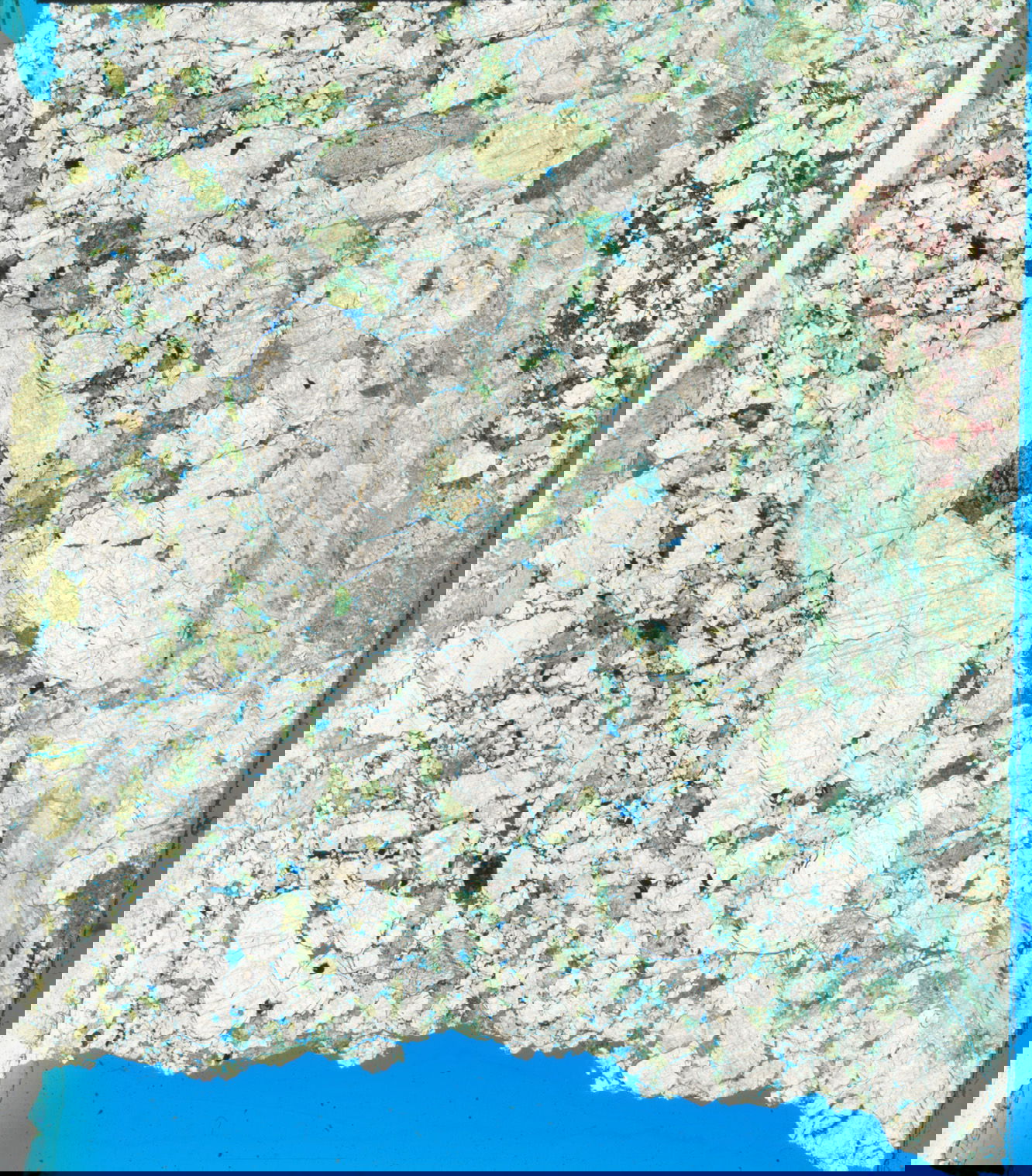
Fig. 15. Thin section of Tapeats Sandstone sample MF-02 from the Monument fold. Pictured here is the actual photomicrograph as published in my papers. Compare this with Mitchell and Tillman’s annotated interpretive drawing.
Mitchell and Tillman annotated their Fig. 25, attempting to show a “deformed zone that resulted from tectonic shearing,” and they claimed that “many fractures are present,”140 as traced in red by them. Furthermore, they claim “grains are also fractured outside of the sheared zone and the shear faulting [goes] through both quartz and K-feldspar clasts.”141 However, when the actual photomicrograph without interpretative annotations is carefully examined in my Fig. 15, the zone they have highlighted in their Fig. 25 as mylonite deformed by the shear is actually nothing more than a zone of staining by the blue-dye coloring of the epoxy resin used to impregnate the sample under pressure during thin-section preparation. Their annotations cover up crucial details that their line drawing has falsely accentuated. Instead, in that blue-dye-colored zone, many of the quartz clasts bordering that zone continue into that zone without evidence of being crushed, while within that zone, quartz and K-feldspar clasts are actually intact. To be sure, the large quartz clasts display internal cracking, which Mitchell and Tillman’s red traces accentuate. But such cracks are tight and not offset and do not continue as though they are fractures that cut across neighboring grains, as their red traces have attempted to portray. Some large quartz clasts in undeformed samples distant from the folds are similarly cracked, which is consistent with the cracking due to sediment transport, deposition, and overburden pressure. Furthermore, Mitchell and Tillman are overlooking the likelihood that rather than being due to fracturing, the angular shapes of some of the quartz clasts in most samples are due to their transport and deposition being so rapid that there was insufficient time for them to be rounded.142 So once again, Mitchell and Tillman’s exaggerated interpretative annotations have been designed to manufacture their case according to their a priori uniformitarian agenda, thus misleading their unsuspecting readers.
“Summary at Microscopic Scale”
Mitchell and Tillman make the concluding claim that the observations of the thin-section photos provided in my published papers are supposedly exactly what one would expect from moderate deformation of lithified (hardened) sediments at relatively low temperature and pressure conditions over a long period of time. They claim their observations are inconsistent with soft-sediment deformation. However, as has been repeatedly demonstrated by comparing their interpretative line drawings of photomicrographs (which they “cherry-picked”) with the actual photomicrographs, Mitchell and Tillman’s interpretative annotations are deceptively exaggerated to often manufacture evidence for their case where there is none. Because of their a priori uniformitarian bias, they see what they want to see and ignore valid, viable explanations for the features in the actual photomicrographs that are far more subtle than portrayed by their interpretative annotations.
Because of their a priori uniformitarian bias, they see what they want to see and ignore valid, viable explanations for the features in the actual photomicrographs.
Their case utterly fails. Purported fractures are often not there or have been likely induced during sample collection and preparation, including during the impregnation of the samples with epoxy resin under pressure before thin-section preparation. The few cracked grains were either that way due to sediment transport, deposition, and overburden pressure or induced during sample collection and preparation. Furthermore, samples collected from the same layers distant from the folds that are undeformed exhibit the same features as the samples collected in the folds, even from within the fold axes. The microscopic observations are overwhelmingly consistent with soft-sediment deformation, that is, these layers having been deformed when the sediments were still soft and damp. This would have to have occurred very soon after deposition of the whole sequence of sedimentary layers, thus eliminating more than 400 million years of alleged geologic time. But Mitchell and Tillman cannot allow for readers to reach that conclusion because it demolishes their a priori uniformitarian belief in slow-and-gradual geologic processes supposedly over hundreds of millions of years, contrary to God’s eyewitness biblical account of earth history.
“Implications of Observations of Deformation”
Mitchell and Tillman next try to coerce readers who may not have the necessary background to assess their purported case and see through their a priori uniformitarian smoke screen. They assert, “Taken together, the observations of the fold morphologies, the subsidiary fractures and faults, and the microscopic-scale features at the four locations all strongly suggest that the Paleozoic sediments, including the Tonto Group, were lithified at the time of folding.”143 I have painstakingly refuted every one of these and other claims above. Indeed, Mitchell and Tillman have ignored the valid identification of joints due to dewatering and unloading of overburden pressure for most of their claimed fracturing within the folds, which is similar to what is also observed in the same sedimentary layers distant from the folds. They have also ignored that the occasional internal fracturing of sediment grains in all samples is most likely due to sediment transport and deposition, the overburden pressure, and also due to sampling with a sledgehammer and sample preparation for thin sectioning. Furthermore, their annotated interpretative drawings of a few selected photomicrographs exaggerate the observed features to postulate fractures and even to manufacture fractures where there are none. Thus, the above detailed examination of their claims demonstrates that they have no case against the observational data being consistent with soft-sediment deformation, that is, these Tonto Group layers bent in these folds were still soft and damp when deformed. Their claims are incorrect, and thus, their conclusion is incorrect and does not pose a major challenge to the creation/Flood geology model. To the contrary, the observational data confirm the creation/Flood model for these Grand Canyon rock layers, which poses a devastating blow to Mitchell and Tillman’s uniformitarian millions-of-years model. However, Mitchell and Tillman fail to concede that the identical microscopic-scale evidence in the same sedimentary layers in the folds and distant from them, including that of the three-dimensional SEM images of the pristine cement crystals, is devastating to their case. Instead, due to their a priori uniformitarian faith commitment, Mitchell and Tillman have to maintain that a thorough structural analysis of additional orientation and distribution data on the folds, subsidiary outcrop-scale structures, and microscopic-scale deformation is required to confirm their conclusion. However, no such structural analysis can “trump” such definitive microscopic-scale evidence.
But not to be outdone, Mitchell and Tillman attempt to broaden their argument geographically with this assertion:
This is not the only challenge to the YEC [young-earth creationist] claim that the monoclinal folds in the Grand Canyon region formed by soft-sediment deformation. Other sedimentary units, both older and younger than the Tonto Group, appear to have been lithified during the Laramide folding. The documented Laramide-age folding of the Precambrian sediments144 is also inconsistent with the young-earth creationist model. In order for this folding to have occurred at the strain rates required by the YEC model, the Precambrian sediments would also have had to been unlithified.145 (emphasis added)
However, that is a proverbial red herring because no creationist geologist claims the Precambrian sedimentary layers were unlithified at the time of Laramide folding. If Mitchell and Tillman had read my paper on the Tapeats Sandstone,146 they would know that creationist geologists agree the Precambrian sedimentary layers were lithified when they were eroded before the Tapeats Sandstone was unconformably deposited on them, well before the Laramide folding. Furthermore, creationist geologists agree with the fact that these Precambrian sediment layers formed erosional paleotopographic highs under the Great Unconformity and have been brecciated in the faults that underlie and created the monoclines, clearly demonstrating that these sediments were lithified by Laramide time, just as I explained in my Tapeats Sandstone paper. So since Mitchell and Tillman claim to have read my Tapeats Sandstone paper, as they cite it in their web articles, it is deceitful for them to raise this issue of the Precambrian sedimentary layers being already lithified when they know creationist geologists agree with them. Obviously, in what is ultimately a worldview conflict, any strategy to wrongly accuse and lampoon one’s young-earth creationist opponents is acceptable, even for uniformitarian professing-Christian geologists.
In addition, Mitchell and Tillman next claim that further north along the East Kaibab Monocline in Utah, “The occurrence of joints related to fold curvature and flexural slip (‘dune boundary slip’) in the Navajo Formation” has been documented.147, 148 To them, “This indicates that the Jurassic Navajo Formation, which is much higher in the [regional stratigraphic] section [than the Grand Canyon strata], was lithified at the time of folding.”149 However, that the Navajo Formation was deposited by desert dunes is only an interpretation of the supposed sedimentary environment based on the formation’s cross-beds. The deposition of the formation was never observed, whereas the cross-bed angles and recumbent folding of cross-beds are instead consistent with water deposition, as are the occurrences of carbonate units within the formation.150 Thus, “dune boundary slip” is an interpretation of the observed folds, so the fold curvature could still be due to damp, soft-sediment deformation.
Mitchell and Tillman also cite the work by Tindall and Davis who studied the structural geology of the East Kaibab Monocline along a ~50 km stretch from the Arizona-Utah border northward.151 Tindall and Davis documented “the presence of a suite of fold-related brittle faults exposed in all stratigraphic intervals from Proterozoic through Cretaceous,” interpreted by them as “indicating that the entire stratigraphic column up to at least the Cretaceous was lithified at the time of folding.”152 However, these workers have never studied samples from those folds under microscopes to ascertain the timing of those faults in relation to the folding of the layers. After all, those faults are associated with the folds, but their relationship to them needs to be determined by detailed microscopic analyses of the folded layers, which has not been done. As we have seen, while the fracturing and faulting associated with the four folds in Grand Canyon would seem to indicate ductile deformation when the layers were lithified, the detailed microscopic analyses reported in my technical papers and discussed above demonstrate that the sediment layers were still soft and damp (unlithified) when folded.
Then Mitchell and Tillman raise another red herring by claiming that “even more problematic for the FG [Flood geology] model, is the fact that the faults that are related to the folds cut deeper into the Precambrian rocks.”153 They argue that soft-sediment deformation related to the catastrophic biblical Flood should be restricted to the overlying sediment layers and supposedly should not cause deformation in the deeply seated underlying Precambrian rocks. However, their claim “falls flat” when a careful investigation of the Flood geology literature indicates that Flood geologists always accept that the Precambrian rocks were lithified by the time they were eroded to form the Great Unconformity on which the Phanerozoic sediment layers were deposited. They also acknowledge that it was movements on those reactivated Precambrian faults that resulted in the folding to form the East Kaibab Monocline and other monoclines. Once again, Mitchell and Tillman are exposed for their willful misrepresentation of the Flood geology model.
But Mitchell and Tillman are not yet finished with their supposed critique. Instead, they add that “even this is only the proverbial tip-of-the-iceberg of the challenges to the YEC cataclysmic flood model posed by deformation of rocks categorized as syn- or post-flood in the flood model.”154 Of course, they are right that the Flood geology model “requires all folding of rocks everywhere in the world that occurred during the flood or in [early] post-flood interval to have happened quickly, including folding of igneous and metamorphic rocks.”155 However, while it is true that “Paleozoic, Mesozoic, and Cenozoic rocks of many types have been deformed in many places around the world,” it is not “a given” that, in many cases, it has apparently been “well documented that the rocks were lithified at the time of deformation.”156 However, rarely have microscopic analyses of the folded rock layers been undertaken to ascertain the condition of those rock units when they were folded, although it would be expected that the igneous and metamorphic rocks had first crystallized. Furthermore, due to the a priori uniformitarian bias of most geologists, some research questions are never asked and thus never investigated, for example, experiments to investigate how rapidly such rock units may have been deformed under the cataclysmic conditions operating during the biblical global Flood catastrophe.
Additionally, Mitchell and Tillman then state that “there are many cases where Phanerozoic rocks have been metamorphosed as well as deformed,”157 and they claim that “it is [supposedly] difficult for FG to account for both.”158 Have they not read the Flood geology and secular literature? If they have, they would not have raised this issue and made this claim, as even secular geologists have proposed rapid metamorphism in line with Flood geologists’ expectations.159 Yet Mitchell and Tillman comment that in “the more detailed report,” they “cite particular evidence from southeastern Arizona where late Mesozoic rocks are metamorphosed and highly folded.”160 But they provide no reference citation to that report, which makes it impossible to discuss it here. Nevertheless, they assert correctly that this means, “In Snelling’s age model, in the last stages of Noah’s flood, rocks were deeply buried, hardened, metamorphosed, and highly folded. Later they were later exhumed to the Earth’s surface.”161 They also cited an example of a study of the deformation of Eocene and Oligocene sediments in the Taiwan fold-and-thrust Slate Belt.162 Thus, they state correctly that in “Snelling’s age model” these sediments “would have been deposited about 4000 years ago over a period of at most a few hundred years”163 (actually, I would say over just a few decades). Yet in that Taiwan study, Tillman and Byrne supposedly documented that the sediments were lithified and metamorphosed as “lower greenschist facies” at relatively high temperatures, now demonstrated to have ranged from ~300–500°C.164 Of course, young-earth creationists agree that at those temperatures the rocks become plastic and are able to be readily deformed by ductile processes, which is also the case for the deformation observed in metamorphic rocks all around the globe. Thus, “This deposition, burial, metamorphism, and erosion had to take place at incredible rates in any YEC model.”165 Precisely! But have they not read the young-earth creationist literature that provides the details of how these processes happened rapidly during the biblical global Flood cataclysm and its catastrophic aftermath, with supporting documentation from the secular uniformitarian literature that Tillman and Mitchell are so fond of citing? Some of those technical papers have already been cited earlier. There is no excuse for Mitchell and Tillman not having first done their homework to read the young-earth creationist literature they claim to have critiqued and supposedly found it wanting, when that literature is also supported by published secular uniformitarian research!
In summary, Mitchell and Tillman yet again claim that “the morphologies of the monoclinal folds in the Tonto Group sedimentary rocks in the Grand Canyon, the orientations and distributions of subsidiary faults and folds, and the observations of outcrop-scale and grain-scale deformation mechanisms suggest that the sediments were lithified (i.e., they were not soft sediments) at the time of folding.”166 Mitchell and Tillman are obviously utilizing the idea that if you repeat a claim often enough people will believe that it is a proven fact, even when it is not. Ironically, it is rather telling that in that repeated summary statement, they use the word “suggest,” which indicates their claim is potentially doubtful and is thus far from proven. Exactly! In fact, as repeatedly emphasized above, every claim they make, including that one, can be and has been refuted. But Mitchell and Tillman then still persist in claiming that the young-earth creationist catastrophic biblical Flood model “not only has to explain the monoclinal folding in the Grand Canyon, but also all deformation of rocks categorized as syn- or post-flood around the world. The Catalina MCC [metamorphic complex] and the Taiwan fold-and-thrust belt are just two examples that exhibit deformation processes,”167 but they are not inconsistent with the young-earth creationist model and do not exhibit complex geologic histories that are exceedingly difficult for the young-earth creationist Flood geology model to explain. As repeatedly demonstrated above, Mitchell and Tillman have not done their homework and fully consulted the young-earth creationist Flood geology literature that provides fuller details, often supported by cited uniformitarian geological research, of every challenge uniformitarian geologists like Mitchell and Tillman raise against young-earth creationist Flood geology. In fact, not only can young-earth creationist Flood geology respond to all such claims, but it can also explain geological phenomena and outcomes that uniformitarian geological stories cannot! So in conclusion, rather than all these observations being “consistently and coherently explained using accepted [that is, assumed uniformitarian] geologic principles acting over deep geologic time,” as Mitchell and Tillman repeatedly claim, the actual observations (that is, stripped of interpretations based on a priori uniformitarian assumptions) are overwhelmingly consistent with young-earth creationist Flood geology. This includes the folding of the Tonto Group sedimentary layers while they were still soft and damp (unlithified) about a year after their rapid deposition early in the biblical global Flood cataclysm.
The actual observations are overwhelmingly consistent with young-earth creationist Flood geology.
“Tonto Diagenesis”
It is agreed that “the Tonto Group was deposited as loose sands, muds and lime muds” and that “today they are hardened sandstones, mudstones and limestones. The processes that turned them into lithified rocks are collectively known as diagenesis.”168 All geologists agree that these Cambrian Tonto Group sedimentary rocks became deeply buried under many other sedimentary layers because that is exactly what we observe in the walls of the Grand Canyon. However, old-earth uniformitarian geologists such as Mitchell and Tillman insist that this burial process occurred over the course of ~425 million years. They then claim the folding of those layers subsequently “took place over the course of ~20 million years.”169 Such timing, of course, allows plenty of opportunity for diagenesis to have hardened those rocks. Yet in the Flood geology model, these rock layers had to have been still soft and unlithified during the deformation, which is feasible because the folding would have taken place only about a year after deposition of the Tonto Group sedimentary layers at the bottom of the strata sequence. So of course, Flood geologists also need to account for when and how the lithification (or diagenesis) took place. It is agreed that two key diagenetic effects are recognized, namely, quartz and calcite cementation.
Mitchell and Tillman claim, “Overall it is not often easy for us to evaluate the timing of quartz cementation relative to the fracturing on the available thin section photographs.”170 Well because, as they earlier admitted, they do not have the original thin sections to study for themselves, nor have they collected their own samples and had their own thin sections made. Yet they claim that slides like MF-03 and MF-04 “indicate that calcite cement is cut by fracturing.”171 However, they make that claim without even providing interpretative line drawings of those slides to substantiate their claim. So I have provided the actual photomicrographs in my Fig. 16. Where is the calcite cement (reddish brown) cut by fractures? In MF-03, there is a blue-dye-colored epoxy resin veinlet that cuts undulatingly across the slide, but that was likely induced by the process of impregnation under pressure during sample preparation. Similar very thin blue-dye-colored epoxy resin veinlets can be seen in MF-04. As has been repeatedly pointed out above, Mitchell and Tillman make exaggerated claims that are not supported by careful reasoned observations. They also claim it “appears” that the “quartz cement was cut by fractures in slides such as MF-02”172 (Fig. 15). That claim has already been refuted above. So their claims do not indicate “that significant cementation took place prior to the fracturing.”173 The fractures may be “both spatially and geometrically associated with the folds,” but it is not necessarily “likely that the cementation predates the folding,”174 as has been explained repeatedly above.
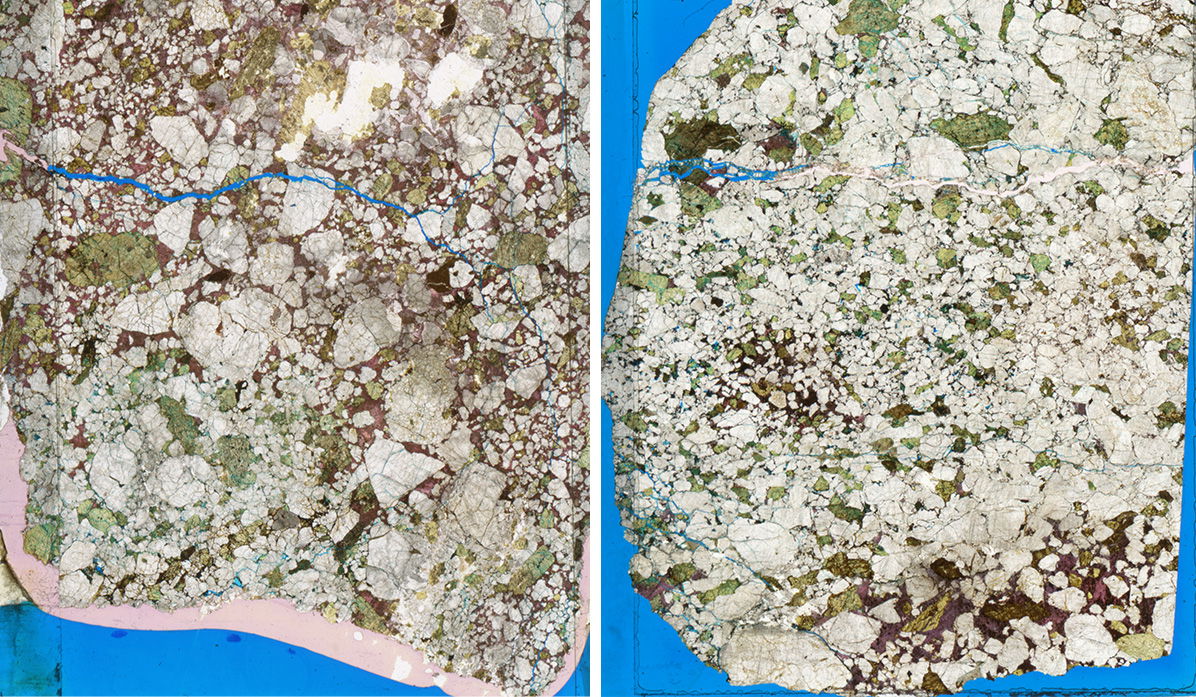
Fig. 16. The actual photomicrographs of Tapeats Sandstone samples MF-03 (left) and MF-04 (right) from the Monument fold.
Mitchell and Tillman next diagrammatically outline the time available in the young-earth creationist model that includes all of geologic history, compared with the conventional uniformitarian model. In “Snelling’s model,” they show correctly that the “Laramide folding in the Grand Canyon, beginning in the late Cretaceous period, and continuing into the Paleocene epoch, would have been late in the flood and continued into the early post-flood period.”175 As illustrated in their Fig. 26, that late Cretaceous-Paleocene timespan would have been a few years long in “Snelling’s model, given that all of the Paleocene, Eocene, Oligocene, Miocene and Pliocene and at least part of the Pleistocene would have lasted just 350 – 450 [sic] years.”176 At least they do not misrepresent the young-earth creationist model on this point. Of course, this leaves a relatively short time for diagenesis to have occurred.
Mitchell and Tillman then suggest that “additional complications for the FG model result from the fact that much rock had to be eroded away in order to expose the folds in the Grand Canyon today.”177 So they ask, “Do they believe that the canyon was carved while the sediments were unlithified as well?”178 Of course, that would seem to present even more supposed problems. But the answer is no! Yet Mitchell and Tillman persist with presenting some perceived observations that they say “would need to be reconciled for any FG model to be viable:”179
- Originally, the sands and muds would have been highly porous and uncemented.
- The Tonto Group is now well lithified over a broad area of hundreds of square miles. [Mitchell and Tillman provide two references for that area measurement but do not provide any citation details, which again is sloppy.] The process of lithification had to work over this entire area.
- Today the sandstones are dominantly cemented by quartz, though locally, calcite, dolomite and iron oxide cements are found. The limestones of the Muav Limestone are also well lithified.
- The Colorado River carved the present-day Grand Canyon through the hard lithified strata. [Actually, there are also secular uniformitarian geologists who agree with Flood geologists that the Colorado River did not carve the Grand Canyon. Instead, the uplifted Kaibab Plateau impounded a system of huge lakes that catastrophically breached that dam and rapidly carved the canyon within days.180 After all, the rapids along the Colorado River through the Grand Canyon result from flash floods in the side canyons dumping debris into the channel of the Colorado River. Yet the Colorado River, even during its most massive floods, has not been able to clear out that debris from its channel. Indeed, many rapids have not changed since Powell’s 1869 expedition. So if the Colorado River is incapable of cleaning out the debris in its channel even in massive floods today, how could it possibly have carved the Grand Canyon, even in supposed 6 or 17 million years?] a. If the sands were unlithified when the canyon was carved, the canyon walls would have collapsed very quickly and never developed the steep canyon walls that we observe today. [True.] b. If the sands were unlithified when the canyon was carved and then somehow quickly hardened afterward [no one has suggested that], sands in well penetrations away from the canyon would have been different, presumably remaining unlithified or lithified by some different process. [But presumably, those well penetrations are today, thousands of years later, so there was time for lithification. Mitchell and Tillman, perhaps deliberately, ignore a third possibility; namely, the sands were unlithified when the folding occurred but then became lithified in the decades to hundreds of years later before the canyon was carved through lithified sandstone. This is the view of many Flood geologists,181 so by ignoring this possibility, Mitchell and Tillman yet again misrepresent Flood geologists.]
- Many lava flows flowed over the edge of the canyon and down the walls. Several lava dams formed, temporarily blocking the river, and created ancient lakes in the canyon. These have been supposedly dated to the Miocene to Pleistocene era. [These dates were obtained by demonstrably flawed K-Ar dating, and yet Rb-Sr dating of these same basalt lava flows yielded an isochron age of 1.1 billion years, which is the same Rb-Sr isochron age as the Precambrian Cardenas Basalt in the bottom of the eastern Grand Canyon!182]
- About 4000 years ago, early Native Americans began living in caves in the canyon, telling us the canyon was present at that time in essentially the same form as we see it today.183 [That date is based on radiocarbon dating, which even secular archaeologists agree is flawed back beyond about 3,000 years ago.]184
Together, these observations do constrain the time available in the Flood geology model for the regionally extensive diagenesis to occur. Diagenesis would have to occur within a few decades to a few hundred years.
Flood Geology Explanations
Mitchell and Tillman finally do not misrepresent me when they state that “Snelling does not propose that the sands were unlithified when the Grand Canyon was carved.”185 However, they are wrong when they state that “his model leaves very little time for this erosion.”186 As indicated above, Flood geologists do not agree with most uniformitarians that the Colorado River carved the canyon. Instead, many Flood geologists believe it was carved within days by a massive post-Flood dam breach. Mitchell and Tillman next state that Snelling “asserts two key points:”
- Diagenesis can take place very quickly.
- Erosion of hardened rocks can take place very rapidly.187
It is agreed that the time frame of the biblical global Flood cataclysm and its aftermath constrains these two steps to a short period. As Mitchell and Tillman note, I have stated this about diagenesis:
Nevertheless, all sedimentary strata do become lithified, hard, and brittle, because under normal conditions sediments lithify relatively quickly, often in a matter of years, but at most, perhaps hundreds of years. Given ideal conditions, lithification can happen within days.188
However, in order to make the claim that few if any petrologists would support the time frame reported in my quoted comments, Mitchell and Tillman ignore the context of that quotation with its stated supporting evidence, and that there is further discussion of the subject of lithification with further stated supporting evidence later in that book.189 So it is what Mitchell and Tillman do not say that is crucially important. But then, they do not want their readers to know of the supporting evidence for my comments that lithification can happen within days to centuries. That time frame fits with the Flood geology model (the lithification of the Grand Canyon strata within a few centuries of the plateau uplift and folding of the strata), and the subsequent catastrophic carving of the canyon through those lithified strata.
Mitchell and Tillman next admit that “there are a few types of lithification that can take place quickly” but then claim that this “does not fit what we typically observe in sedimentary rocks.”190 They then ask: How does Snelling propose that such rapid lithification rates occurred? Their answer is to assert that
Snelling basically claims that hypothetically, Noah’s flood had lots of chemicals, [so] diagenesis would have acted at exceptionally rapid rates. This is a hypothesis that is consistent with his interpretation, but it lacks supporting data. Remember that the cementation to be explained took place over an area of hundreds of square miles, just considering the Tapeats.191
However, in their abbreviated version of my hypothesis, they neglected to explain the Flood geology model in which much of the waters for the biblical global Flood cataclysm were expelled from the upper mantle as mineral-laden superheated steam (when “the fountains of the great deep burst forth” [Genesis 7:11]). Then, during subsequent deposition of the sediment layers right across the continents over thousands of square miles, those mineral-laden hot waters would have become trapped in the pore spaces within the sediments where the minerals would have precipitated as the pore waters rapidly cooled, thus achieving lithification rapidly. Furthermore, many observational data have been presented to support this Flood geology model, including support from the secular uniformitarian literature.192
It is agreed that “the dominant process of lithification in the clastic beds of the Tonto group was silica cementation, in the form of quartz overgrowths.”193 And yes, the thin-section photos included in my published technical papers “show significant amounts of silica cementation and apparent modification of grains as they were compacted.”194 However, Mitchell and Tillman claim that “silica cementation in natural settings takes place very slowly. As water moved through the pore spaces carrying silica, some was precipitated.”195 They claim, “This had to take place over and over again to cement the rock.”196 However, this claim ignores that during deposition, even of extensive sediment layers, water is trapped within the pore spaces between the grains where it is involved in the cementation process, so repeated groundwaters moving over time are not necessarily required. Yet Mitchell and Tillman persist by asking how long did their claimed process of repeated movement of groundwaters take? They claim, “We understand controls that affect the rate” of silica precipitation, and that “temperature is one major control on the rate of diagenesis of all forms, including quartz overgrowths.”197 They quote Walderhaug, who said,
On the other hand, for the sandstones where the present temperature is below 100°C, it must also be kept in mind that at these low temperatures, it may take several million years to precipitate enough quartz cement to close a fluid inclusion large enough to permit measurement of homogenization temperature.198
Mitchell and Tillman correctly state that “as the Tonto Group rocks were buried, they did heat up.”199 Although they were not subject to extreme heat or pressure, it has been reliably estimated from numerous studies that the Tonto Group layers were buried under ~3,300–4,500 m (~10,825–14,750 ft.) of overlying strata and thus would have been subjected to burial temperatures of 110–130°C and pressures of ~0.3–0.4 kbar (~4,300–5,900 psi).200 This fits exactly with Mitchell and Tillman’s statement that “quartz cementation may well have taken place when the rocks were heated to 80–150°C.”201 Yet they persist in claiming without justification that “these temperatures will not allow noticeable cementation in a few hundred years.”202 This claim is entirely refuted by observational and experimental evidence.203 Furthermore, Mitchell and Tillman ask, perhaps in jest, “Were the floodwaters boiling?” No! However, they would have been hot at >80°C and heavily mineral-laden due to being catastrophically expelled from the upper mantle and then trapped in the sediment pore spaces. Thus, as they cooled rapidly, silica cementation would have been rapid through these layers throughout their areal extent. Mitchell and Tillman’s a priori uniformitarian bias does not enable them to concede that their extended time scenario is wrong.
Mitchell and Tillman’s a priori uniformitarian bias does not enable them to concede that their extended time scenario is wrong.
Not to be deterred, Mitchell and Tillman next claim that “different processes acted in the limestones and siltstones of the Muav Formation.”204 In an attempt to justify that statement, they claim without substantiation that “the Muav slide descriptions205 show that the following processes occurred in this order: 1. silica cementation; 2. calcite cementation; 3. dolomitization; 4. calcite-filling of fractures; 5. iron oxide deposition along fractures; 6. additional calcite filling of fractures.”206 While they concede that “we may not be able to document the time involved in each stage,” they insist that “the chemical processes did not take place all at once, but acted in a distinct order.”207 However, the limestones are not silica-cemented, nor are all these features observed in every sample, as Mitchell and Tillman seem to be implying. Instead, at most, one or two of these features may be present apart from the calcite cement. And it is incorrect to claim several of these processes could not take place at virtually the same time. Since they did not observe their proposed sequence, they cannot be certain. They then claim that other events are also evident, such as the alteration of feldspars and micas. However, whereas most of the muscovite flakes are unaltered, these alteration processes could have, and likely, occurred concurrently with the cementation. And whereas such events were not localized to the canyon walls but occurred over broad regions, it does not imply as claimed by Mitchell and Tillman, time frames of millions of years. To the contrary, only their a priori uniformitarian bias blinds them to the evidence, supported by observational and experimental data, that is consistent with the young-earth creationist Flood geology model.
Erosion
Lastly, Mitchell and Tillman focus on my second assertion above that “the erosion of hardened rocks can take place very rapidly.”208 They claim that “recognizing that the rocks in the canyons of the Colorado Plateau were lithified when the rivers cut through them, given his timeline, he [Snelling] must consider the erosion involved to have been catastrophic.”209 However, they have misrepresented me because nowhere do I claim the rivers cut through the Colorado Plateau to carve the canyons. They provide no reference for that claim because they cannot. Thus, once again, they are knowingly deceitful in making such a claim.
Mitchell and Tillman do then refer to an article of mine titled “When and How Did the Grand Canyon Form?”210 They are correct in pointing to “three undisputed observations” I made in that article:
1. “Enormous scale of erosion.” This is quite true. 2. “The Grand Canyon Was Cut Through the Plateau.” No problem. 3. “Uplift of This Plateau Occurred Before Erosion of the Grand Canyon.” Here we would need to modify this observation. Certainly, much erosion took place after the uplift. However, much erosion in the Grand Canyon and in all of the canyons of the Colorado Plateau took place as the plateau was being uplifted.211
They provide supposed justification for that claim.212 However, all of the cited studies start with uniformitarian assumptions, and the dating and other methods are dubious at best, given that the underlying uniformitarian assumptions are unproven. Yet even if some erosion started as the plateau was being uplifted, which is to be expected, it merely provided the initial channels that would then be subsequently exploited by the catastrophic outburst from the breaching of the impounded lakes.213
Mitchell and Tillman cite a “spectacular example” supposedly documenting their scenario, namely, the Goosenecks of the San Juan River. They claim that “in this location, the river valley has a very anomalous form.”214 However, it is only anomalous because of the uniformitarian assumption that rivers have always flowed with the same amounts of water at the same rates that we observe today. Thus, Mitchell and Tillman maintain that “in the upper parts of rivers, they tend to cut down through rock with patterns that branch like a tree,” whereas “in the middle course of the river, the gradient is gentle.”215 Certainly, as they say, “High volumes of water and energy make rivers migrate laterally in loops known as meanders.”216 So they claim,
The Goosenecks are anomalous because the river has the meandering form of a river flowing on a low relief surface, but it downcut 1000 feet down into Paleozoic limestones and sandstones, as the Colorado Plateau was gradually uplifted. In other words, the meanders were already present when the river was on relatively flat ground and then supposedly cut down into the bedrock as the plateau was uplifted. Such “entrenched” meanders show that the uplift had to be gradual in order to preserve the meandering form. This contradicts the FG models.217
To the contrary, the Goosenecks do not contradict the Flood geology model. As already explained above, the Colorado Plateau was rapidly uplifted at the end of the biblical global Flood cataclysm. With catastrophic plate tectonics slowing down, water draining off the emerging plateau surface would have commenced the erosion of that flat-lying surface, the high volumes of water and energy making the eroding channels migrate laterally in meanders. Then centuries later, when the waters in the huge lakes impounded behind the plateau breached that dam wall, the catastrophic outburst of such a high volume of water would have exploited the existing channels to downcut them rapidly, including the meanders. So rather than the Grand Canyon being carved by the veritable trickle of water in the Colorado River, a massive amount of water first carved the canyon catastrophically, and the Colorado River now occupies that canyon. Mitchell and Tillman would have already known this is the Flood geology model if they really had first read the Flood geology literature, including the cited references, and known this dam breach model is supported even by some uniformitarian geologists. After all, most uniformitarian geologists now hold to the breached dam model for the catastrophic carving of the Channeled Scablands of the Pacific Northwest, including their meandering canyons.218
Conclusions
Mitchell and Tillman claim that young-earth creationists “base their interpretation of geology on their interpretation of Genesis, despite the fact that the Bible does not say how old the earth is or what the geologic results of Noah’s flood were.”219 However, young-earth creationists build their understanding on a straightforward plain reading of Genesis, which for centuries since the time of the Apostles was the standard accepted way to read the Scriptures until the rise of uniformitarianism in the late eighteenth century. And the Bible does say how old the earth is. It is five literal days older than Adam, whose literal father-son genealogy to Jesus Christ, the second Adam and thus our kinsman redeemer, is provided several times for us in the biblical books of Genesis, Matthew, and Luke. Furthermore, the Bible does tell us the geologic results of the global Flood cataclysm. God said He was going the destroy the earth with man and all flesh. Otherwise, there would have been no need to take birds aboard the ark. Mitchell and Tillman need to read and believe their Bibles, which they claim to follow as Christians.
Young-earth creationists build their understanding on a straightforward plain reading of Genesis.
Yes, young-earth creationists do maintain that the scientific data are consistent with the biblical global Flood cataclysm. However, Mitchell and Tillman claim that the young-earth creationist “reading of Genesis drives them to force much of the geologic record into the one-year-long global catastrophe” (emphasis added).220 That claim is demonstrably false. If they honestly reported the Flood geology books they claim to have read,221 then they would know that the vast Precambrian rocks, which represent the bulk of the geologic record, are not included in the biblical global Flood cataclysm by those Flood geologists but are relegated to the creation week and roughly 1,600 years of the pre-Flood era.
And yes, “The spectacular exposures of the Grand Canyon have drawn much attention from YEC geologists. They have made a number of efforts to demonstrate that FG can provide options for the formation of the Grand Canyon rock record that are viable, if not better than old Earth interpretations accepted by most geologists,”222 who are all uniformitarians. I did receive permission (but only after filing and winning a lawsuit against the Grand Canyon National Park and the National Park Service for worldview discrimination) and sampled the Tapeats Sandstone, Bright Angel Shale, and Muav Formation.223 The results as reported in seven technical papers (all published online and freely available before Mitchell and Tillman wrote their inaccurate and misleading critique). These published research results demonstrate that the consensus uniformitarian geologic models are not supported by the details in those sedimentary layers and the four folds. However, Mitchell and Tillman still insist that they have documented in their three web articles that, instead, they have found my published research results support their uniformitarian case. My three response web articles have emphatically refuted their claims. My conclusions in my published research papers have not changed. The Tonto Group sedimentary layers were deposited early in the biblical global Flood cataclysm and were still soft and damp (unlithified) when at the end of that Flood cataclysm they were folded during plateau uplift. Then in the following few centuries they were lithified, before water in the huge lake system impounded by the plateau breached that dam wall and catastrophically carved the Grand Canyon within days. All the observational macroscopic and microscopic evidence is consistent with that model, which is based on God’s eyewitness account in His Word.
Mitchell and Tillman, in closing, reiterate that they began their critique by pointing out that Flood geology “explanations for the Tonto Group, at a minimum, need to answer four questions, rephrased here.”224
- Could the sediments have been deposited in a few days?
- Could the sediments have been deposited by catastrophic flood processes?
- Could the rocks have been folded by rapid soft sediment deformation over days?
- Is there scientific support for the deposits having been deposited less than 10,000 years ago?225
Mitchell and Tillman, yet again, claim that they “presented evidence that makes each of these difficult or impossible to answer with a yes or maybe.”226 They summarized this at the beginning in their first web article with a table with stoplight signals that explained their purported findings. In all cases, it must be recognized that we are all viewing the same observational data. But I also pointed out that one’s interpretation of that observational data depends on one’s starting assumptions. So the reason Mitchell and Tillman have the same interpretation as our secular geologist colleagues is that they start with the same unbiblical uniformitarian (geological processes have always been slow-and-gradual like we observe today) assumptions, although no geologists (who are fallible) were ever eyewitnesses of those geological processes in the earth’s past history. Thus, viewing the observational data with my assumptions based on God’s infallible eyewitness account of the earth history, I maintain unapologetically that there are viable alternative explanations that can be applied to the Tonto Group.
I maintain unapologetically that there are viable alternative explanations that can be applied to the Tonto Group.
Mitchell and Tillman have pointed out that if the Tonto Group strata were deposited by a global catastrophic event, “then it must be able to explain other global examples as well.”227 Yet again, Mitchell and Tillman still claim that this biblical global Flood cataclysm encompasses most of the geologic record, in spite of the fact that the young-earth creationist literature they claim to have read does not say that. Instead, most Flood geologists relegate the vast Precambrian rocks that encompass most of the geologic record to creation week and the pre-Flood era. If Mitchell and Tillman cannot be trusted to report correctly such a simple fact, how can any of their assertions be trusted? Yet Mitchell and Tillman still claim that many of those entries in their opening table include other details that supposedly make the evidence even more difficult to reconcile with the young-earth creationist model. To the contrary, in my responses, I have demonstrated that, when stripped of the uniformitarian interpretative assumptions back to the actual observational data, the same evidence proclaimed by Mitchell and Tillman as a difficulty for the Flood geology model is in fact overwhelmingly consistent with it.
In conclusion, Mitchell and Tillman state that in this report (their three short web articles), they have not tried to answer every line of reasoning presented in my seven published, peer-reviewed, long and detailed, technical papers.228 Most of the characteristics that I reported in those papers were not addressed by Mitchell and Tillman, “such as radiometric dating, glauconite pellets, rates of deposition of shales, detailed review of catastrophic tectonics, etc.”229 How could they deal with them when I have already in those long papers dealt with these topics and refuted the uniformitarian interpretations? After all, how would Mitchell and Tillman explain the detrital zircon U-Pb radiometric dates for the Tapeats Sandstone that are considerably younger than its supposed uniformitarian depositional age? And I cited in those papers the sedimentation experiments reported in the secular literature that demonstrate that shales and limestones can be deposited rapidly, which Mitchell and Tillman have ignored. None of those issues thus point to deep time. Emphatically not! I encourage readers of Mitchell and Tillman’s three critique articles to thoroughly read my seven freely available technical papers to see for themselves that all the claims made by Mitchell and Tillman are unsubstantiated and many are false.
This report is long, as it was necessary to respond to Mitchell and Tillman’s claims and assertions line-by-line, lest readers of their supposed critique thought their case was solid and convincing. If they also read in-depth the extensive young-earth creationist literature, they would see that, as I have demonstrated here, Mitchell and Tillman have obviously failed to do that because they repeatedly misrepresented the Flood geology model. Instead, young-earth creationists “have made sincere efforts to present a scientifically plausible case that the entire geologic history (post the Great Unconformity) of the Grand Canyon occurred in less than”230 5,000 years, during the biblical global Flood cataclysm and its aftermath. Young-earth creationists’ overall Flood geology model is not fraught with problems. Yes, some observational data need to be explained within their overall model, but the Flood geology model explains more observational data than the secular uniformitarian model, which still has many unsolved problems. The observational data strongly indicate that the Grand Canyon and the rest of the earth are not incredibly old as fallible uniformitarians like Mitchell and Tillman believe, in spite of claiming they also believe God’s Word. Instead, the Grand Canyon and the earth are young, and today, we observe the results of God’s global cataclysmic Flood judgment on rebellious man’s sin, as recorded in God’s infallible Word.
Answers in Depth
2026 Volume 21
Answers in Depth explores the biblical worldview in addressing modern scientific research, history, current events, popular media, theology, and much more.
Browse VolumeFootnotes
- Mitchell, Stephen, and Kennen Tillman, “Examining Young Earth Creation Claims About the Grand Canyon,” Peaceful Science Series, August 15, 2024, https://peacefulscience.org/series/tonto/.
- Snelling, Andrew A., “The Petrology of the Tapeats Sandstone, Tonto Group, Grand Canyon, Arizona,” Answers Research Journal 14 (June 23, 2021): 159–254, https://answersresearchjournal.org/petrology-tapeats-sandstone-tonto-group; Andrew A. Snelling, “The Petrology of the Bright Angel Formation, Tonto Group, Grand Canyon, Arizona,” Answers Research Journal 14 (September 8, 2021): 303–415, https://answersresearchjournal.org/petrology-bright-angel-tonto-group; Andrew A. Snelling, “The Petrology of the Muav Formation, Tonto Group, Grand Canyon, Arizona,” Answers Research Journal 15 (August 10, 2022): 139–262, https://answersresearchjournal.org/geology/petrology-muav-formation-tonto-group.
- Mitchell, Stephen, and Kennen Tillman, “Examining Young Earth Creation Claims About the Grand Canyon,” Peaceful Science, August 15, 2024, https://peacefulscience.org/articles/examining-yec-claims-tonto-group-cambrian-1/.
- Berry, William B. N., Growth of a Prehistoric Timescale Based on Organic Evolution (San Francisco: W. H. Freeman and Company, 1968), 22–23.
- Holmes, Arthur, Principles of Physical Geology, new and fully revised edition (London: Thomas Nelson, 1965), 142.
- Berry, Growth of a Prehistoric Timescale, 22–23.
- Mitchell, Stephen, A Texas-Sized Challenge to Young Earth Creation and Flood Geology: A Christian Geologist Looks for Answers (Meadville, PA: Christian Faith Publishing, Inc., 2018), 262.
- Mitchell and Tillman, “Examining Young Earth Creation Claims.”
- Snelling, Andrew A., “The Carbon Canyon Fold, Eastern Grand Canyon, Arizona,” Answers Research Journal 16 (February 22, 2023): 1–124, https://answersresearchjournal.org/geology/carbon-canyon-fold-arizona/.
- Snelling, Andrew A., “The Monument Fold, Central Grand Canyon, Arizona,” Answers Research Journal 16 (August 9, 2023): 301–432, https://answersresearchjournal.org/geology/monument-fold-grand-canyon/; Andrew A. Snelling, “The Whitmore Helipad Fold, Western Grand Canyon, Arizona,” Answers Research Journal 17 (February 28, 2024): 63–192, https://answersresearchjournal.org/geology/whitmore-helipad-fold/; Andrew A. Snelling, “The Matkatamiba Fold, Central Grand Canyon, Arizona,” Answers Research Journal 17 (September 4, 2024): 479–611, https://answersresearchjournal.org/geology/matkatamiba-fold.
- Mitchell, Stephen, and Kennen Tillman, “The Tonto Deformation,” Peaceful Science, August 15, 2024, https://peacefulscience.org/articles/examining-yec-claims-tonto-group-cambrian-3/.
- Nabavi, Seyed Tohid, and Haakon Fossen, “Fold Geometry and Folding—A Review,” Earth-Science Reviews 222 (November 2021): 103812, https://doi.org/10.1016/j.earscirev.2021.103812.
- Fossen, Haakon, Structural Geology, 2nd ed. (Cambridge, UK: Cambridge University Press, 2016); Steven Wojtal, Tom Blenkinsop, and Basil Tikoff, An Integrated Framework for Structural Geology: Kinematics, Dynamics, and Rheology of Deformed Rocks (Hoboken, NJ: John Wiley & Sons, 2022).
- Fossen, Structural Geology.
- Mitchell and Tillman, “The Tonto Deformation.”
- Schultz, Richard A., Geologic Fracture Mechanics (Cambridge, UK: Cambridge University Press, 2019).
- Mitchell and Tillman, “The Tonto Deformation.”
- Mitchell and Tillman, “The Tonto Deformation.”
- Mitchell and Tillman, “The Tonto Deformation.”
- Mitchell and Tillman, “The Tonto Deformation.”
- Burg, Jean-Pierre, “Script to Structural Geology,” ETH Zurich’s Research Collection, 177–206, 2016, https://doi.org/10.3929/ETHZ-B-000279493.
- Mitchell and Tillman, “The Tonto Deformation.”
- Mitchell and Tillman, “The Tonto Deformation.”
- Davis, George H., and Stephen J. Reynolds, Structural Geology of Rocks and Regions, 2nd ed. (New York: John Wiley & Sons, 1996); M. Friedman, J. Handin, J. M. Logan, K. D. Min, and D. W. Stearns, “Experimental Folding of Rocks Under Confining Pressure: Part III. Faulted Drape Folds in Multilithologic Layered Specimens,” Geological Society of America Bulletin 87, no. 7 (July 1976): 1049–1066; H. Friedman, R. H. H. Hugman III, and J. Handin, “Experimental Folding of Rocks Under Confining Pressure, Part VIII—Forced Folding of Unconsolidated Sand and of Lubricated Layers of Limestone and Sandstone,” Geological Society of America Bulletin 91, no. 5 (May 1980): 307–312; Anthony F. Gangi, Kyung D. Min, and John M. Logan, “Experimental Folding of Rocks Under Confining Pressure: Part IV—Theoretical Analysis of Faulted Drape-Folds,” Tectonophysics 42, nos. 2–4 (October 20, 1977): 227–260; Subir Kumar Ghosh, “Experiments of Buckling of Multilayers Which Permit Interlayering Glide,” Tectonophysics 6, no. 3 (September 1968): 207–249; David T. Griggs, “Deformation of Rocks Under High Confining Pressures I. Experiments at Room Temperature,” The Journal of Geology 44, no. 5 (July–August 1936): 541–577; David T. Griggs, “Creep of Rocks,” The Journal of Geology 47, no. 3 (April–May 1939): 225–251; J. Handin, M. Friedman, Kyung D. Min, and L. J. Pattison, “Experimental Folding of Rocks Under Confining Pressure: Part II—Buckling of Multi-Layered Rock Beams,” Geological Society of America Bulletin 87, no. 7 (July 1976): 1035–1048; David M. Weinberg, “Experimental Folding of Rocks Under Confining Pressure: Part VII. Partially Scaled Models of Drape Folds,” Tectonophysics 54, nos. 1–2 (April 10, 1979); 1–24.
- Borg, Iris Y., and John C. Maxwell, “Interpretation of Fabrics of Experimentally Deformed Sands,” American Journal of Science 254, no. 2 (February 1956): 71–81.
- Bailey, S. W., R. A. Bell, and C. J. Pen, “Plastic Deformation of Quartz in Nature,” Geological Society of America Bulletin 69, no. 11 (1 November 1958): 1443–1466; Neville L. Carter, “Static Deformation of Silica and Silicates,” Journal of Geophysical Research 76, no. 23 (August 10, 1971): 5514–5540; Neville L. Carter, John M. Christie, and David T. Griggs, “Experimental Deformation and Recrystallization of Quartz,” The Journal of Geology 72, no. 6 (November 1964): 687–733; John M. Christie, David T. Griggs, and Neville L. Carter, “Experimental Evidence of Basal Slip in Quartz,” The Journal of Geology 72, no. 6 (November 1964): 734–756; John M. Christie and A. J. Ardell, “Substructures of Deformation Lamellae in Quartz,” Geology 2, no. 8 (August 1, 1974): 405–408; George H. Davis and Stephen J. Reynolds, Structural Geology of Rocks and Regions, 2nd ed. (New York: John Wiley & Sons, 1996); H. W. Fairbairn, “Correlation of Quartz Deformation with Its Crystal Structure,” American Mineralogist 24, no. 6 (June 1, 1939): 351–368; Richard H. Groshong, Jr., “Low-Temperature Deformation Mechanisms and Their Interpretation,” Geological Society of America Bulletin 100, no. 9 (September 1988): 1329–1360; Edward C. Hansen and Iris Y. Borg, “The Dynamic Significance of Deformation Lamellae in Quartz of a Calcite-Cemented Sandstone,” American Journal of Science 260, no. 5 (May 1, 1962): 321–336; Edward C. Hansen, Iris Y. Borg, and John C. Maxwell, “Dynamic Significance of Quartz Lamellae,” Journal of Geophysical Research 64, no. 8 (August 1959): 1104–1105; Shankar Mitra and Jan Tullis, “A Comparison of Intracrystalline Deformation in Naturally and Experimentally Deformed Quartzites,” Tectonophysics 53, nos. 1–2 (March 1, 1979): T21–T27; Jan Tullis, John M. Christie, and David T. Griggs, “Microstructures and Preferred Orientations of Experimentally Deformed Quartzites,” Geological Society of America Bulletin 84, no. 1 (January 1973): 297–314; Robert J. Twiss, “Structure and Significance of Planar Deformation Features in Synthetic Quartz,” Geology 2, no. 7 (July 1974): 329–332; Robert J. Twiss, “Some Planar Deformation Features, Slip Systems, and Submicroscopic Structures in Synthetic Quartz,” The Journal of Geology 84, no. 6 (November 1976): 701–724; Robert C. Whisonant, “Influence of Texture upon the Response of Detrital Quartz to Deformation of Sandstones,” Journal of Sedimentary Petrology 40, no. 3 (September 1, 1970): 1018–1025; S. White, “Syntectonic Recrystallization and Texture Development in Quartz,” Nature 244, no. 5414 (August 3, 1973): 276–278; S. White, “Deformation Lamellae in Naturally Deformed Quartz,” Nature 245 (September 10, 1973): 26–28.
- Snelling, “The Carbon Canyon Fold, Eastern Grand Canyon, Arizona,” 1–124.
- Rettger, R. E., “Experiments on Soft-Rock Deformation,” Bulletin of the American Association of Petroleum Geologists 19, no. 2 (February 1935): 271–292; Handin, Friedman, Min, and Pattison, “Experimental Folding of Rocks Under Confining Pressure,” 1035–1048; Friedman, Handin, Logan, Min, and Stearns, “Experimental Folding of Rocks Under Confining Pressure: Part III,” 1049–1066; Weinberg, “Experimental Folding of Rocks Under Confining Pressure: Part VII,” 1–24; Friedman, Hugman III, and Handin, “Experimental Folding of Rocks Under Confining Pressure, Part VIII,” 307–312; Nabavi and Fossen, “Fold Geometry and Folding,” 103812.
- Snelling, “The Carbon Canyon Fold, Eastern Grand Canyon, Arizona,” 1–124; Snelling, “The Monument Fold, Central Grand Canyon, Arizona,” 301–432; Snelling, “The Whitmore Helipad Fold, Western Grand Canyon, Arizona,” 63–192; Snelling, “The Matkatamiba Fold, Central Grand Canyon, Arizona,” 479–611.
- Mitchell and Tillman, “The Tonto Deformation.”
- Mitchell and Tillman, “The Tonto Deformation.”
- Reches, Ze’ev, and Vincent Matthews III, “Development of Monoclines: Part I. Structure of the Palisades Creek Branch of the East Kaibab Monocline, Grand Canyon, Arizona,” in Laramide Folding Associated with Basement Block Faulting in the Western United States, ed. Vincent Matthews III (Boulder, CO: Geological Society of America, 1978), Memoir 151, 235–271; Ze’ev Reches and Arvid M. Johnson, “Development of Monoclines: Part II. Theoretical Analysis of Monoclines,” in Laramide Folding Associated with Basement Block Faulting in the Western United States, ed. Vincent Matthews III (Boulder, CO: Geological Society of America, 1978), Memoir 151, 273–311; Peter W. Huntoon, “Phanerozoic Structural Geology of the Grand Canyon,” in Grand Canyon Geology, eds. Stanley S. Beus and Michael Morales (New York: Oxford University Press, 1990), 261–309; Michele Cooke, Pauline Mollema, David Pollard, and Ayet Şamil Aydın, “Interlayer Slip and Joint Localization in East Kaibab Monocline, Utah: Field Evidence and Results from Numerical Modeling,” in Forced Folds and Fractures, eds. J. W. Cosgrove and M. S. Ameen (London: The Geological Society, January 2000), Special Publication 169, 23–49; Sarah E. Tindall and G. H. Davis, “Monocline Development by Oblique-Slip Fault-Propagation Folding: The East Kaibab Monocline, Colorado Plateau, Utah,” Journal of Structural Geology 21, no. 10 (October 1999): 1303–1320; Sarah E. Tindall, “The Cockscomb Segment of the East Kaibab Monocline: Taking the Structural Plunge,” in Geology of Utah’s Parks and Monuments, eds. David A. Sprinkel, Thomas C. Chidsey, Jr., and Paul B. Anderson (Salt Lake City, UT: Utah Geological Association, 2000), Publication 28, 629–643; James Cory Orofino, “Structural Fabric of the Palisades Monocline: A Study of Positive Inversion, Grand Canyon, Arizona” (master’s thesis, Texas A&M University, 2005), unpublished; Carol A. Hill, “The Grand Canyon, Monument to an Ancient Earth: Can Noah’s Flood Explain the Grand Canyon?,” Perspectives on Science and Christian Faith 68, no. 4 (2016): 268–271; Karl E. Karlstrom and J. Michael Timmons, “Faulting and Uplift in the Grand Canyon Region,” in Grand Canyon Geology: Two Billion Years of Earth’s History, eds. J. Michael Timmons and Karl E. Karlstrom (Boulder, CO: Geological Society of America, 2012), Special Paper 489, 93–107; Bryan Tapp and Ken Wolgemuth, “Broken and Bent Rock: Fractures, Faults, and Folds,” in The Grand Canyon, Monument to an Ancient Earth; Can Noah’s Flood Explain the Grand Canyon? eds. Carol A. Hill, Gregg Davidson, Tim Helble, and Wayne Ranney (Grand Rapids, MI: Kregel Publications, 2016), 116–127.
- Mitchell and Tillman, “The Tonto Deformation.”
- Mitchell and Tillman, “The Tonto Deformation.”
- Karlstrom and Timmons, “Faulting and Uplift in the Grand Canyon Region,” 93–107.
- Karlstrom and Timmons, “Faulting and Uplift in the Grand Canyon Region,” 93–107.
- Reches and Matthews III, “Development of Monoclines: Part I,” 235–271.
- Mitchell and Tillman, “The Tonto Deformation.”
- Orofino, “Structural Fabric of the Palisades Monocline.”
- Mitchell and Tillman, “The Tonto Deformation.”
- Mitchell and Tillman, “The Tonto Deformation.”
- Mitchell and Tillman, “The Tonto Deformation.”
- Mitchell and Tillman, “The Tonto Deformation.”
- Mitchell and Tillman, “The Tonto Deformation.”
- Mitchell and Tillman, “The Tonto Deformation.”
- Mitchell and Tillman, “The Tonto Deformation.”
- Mitchell and Tillman, “The Tonto Deformation.”
- Snelling, “The Carbon Canyon Fold, Eastern Grand Canyon, Arizona,” 1–124.
- Mitchell and Tillman, “The Tonto Deformation.”
- Mitchell and Tillman, “The Tonto Deformation.”
- Mitchell and Tillman, “The Tonto Deformation.”
- Snelling, “The Carbon Canyon Fold, Eastern Grand Canyon, Arizona,” 1–124.
- Snelling, “The Monument Fold, Central Grand Canyon, Arizona,” 301–432.
- Snelling, “The Whitmore Helipad Fold, Western Grand Canyon, Arizona,” 63–192.
- Snelling, “The Matkatamiba Fold, Central Grand Canyon, Arizona,” 479–611.
- Mitchell and Tillman, “The Tonto Deformation.”
- Mitchell and Tillman, “The Tonto Deformation.”
- Mitchell and Tillman, “The Tonto Deformation.”
- Mitchell and Tillman, “The Tonto Deformation.”
- Mitchell and Tillman, “The Tonto Deformation.”
- Mitchell and Tillman, “The Tonto Deformation.”
- Mitchell and Tillman, “The Tonto Deformation.”
- For example, Friedman, Hugman III, and Handin, “Experimental Folding of Rocks Under Confining Pressure, Part VIII,” 307–312; Nabavi and Fossen, “Fold Geometry and Folding,” 103812.
- Mitchell and Tillman, “The Tonto Deformation.”
- Mitchell and Tillman, “The Tonto Deformation.”
- Mitchell and Tillman, “The Tonto Deformation.”
- Reches and Matthews III, “Development of Monoclines: Part I,” 235–271.
- Mitchell and Tillman, “The Tonto Deformation.”
- Mitchell and Tillman, “The Tonto Deformation.”
- Mitchell and Tillman, “The Tonto Deformation.”
- Mitchell and Tillman, “The Tonto Deformation.”
- Mitchell and Tillman, “The Tonto Deformation.”
- Mitchell and Tillman, “The Tonto Deformation.”
- Mitchell and Tillman, “The Tonto Deformation.”
- Mitchell and Tillman, “The Tonto Deformation.”
- Mitchell and Tillman, “The Tonto Deformation.”
- Mitchell and Tillman, “The Tonto Deformation.”
- Mitchell and Tillman, “The Tonto Deformation.”
- Mitchell and Tillman, “The Tonto Deformation.”
- Mitchell and Tillman, “The Tonto Deformation.”
- Tapp, Bryan, and Ken Wolgemuth, “Broken and Bent Rock, Fractures, Faults, and Folds,” in The Grand Canyon, Monument to an Ancient Earth; Can Noah’s Flood Explain the Grand Canyon? eds. Carol A. Hill, Gregg Davidson, Tim Helbe, and Wayne Ranney (Tulsa, OK: Solid Rock Lectures and Grand Rapids, MI: Kregel Publications, 2016), 116–127.
- Mitchell and Tillman, “The Tonto Deformation.”
- Snelling, “The Carbon Canyon Fold, Eastern Grand Canyon, Arizona,” 1–124.
- Mitchell and Tillman, “The Tonto Deformation.”
- Mitchell and Tillman, “The Tonto Deformation.”
- Mitchell and Tillman, “The Tonto Deformation.”
- Mitchell and Tillman, “The Tonto Deformation.”
- For example, Friedman, Hugman III, and Handin, “Experimental Folding of Rocks Under Confining Pressure, Part VIII,” 307–312; Nabavi and Fossen, “Fold Geometry and Folding,” 103812.
- Mitchell and Tillman, “The Tonto Deformation.”
- Mitchell and Tillman, “The Tonto Deformation.”
- Snelling, “The Carbon Canyon Fold, Eastern Grand Canyon, Arizona,” 1–124.
- Mitchell and Tillman, “The Tonto Deformation.”
- Reches and Matthews III, “Development of Monoclines: Part I,” 235–271.
- Tapp and Wolgemuth, “Broken and Bent Rock, Fractures, Faults, and Folds,” 116–127.
- Turner, Francis J., and Lionel Edward Weiss, Structural Analysis of Metamorphic Tectonites (New York: McGraw-Hill, 1963).
- Mitchell and Tillman, “The Tonto Deformation.”
- Mitchell and Tillman, “The Tonto Deformation.”
- Reches and Matthews III, “Development of Monoclines: Part I,” 235–271.
- Mitchell and Tillman, “The Tonto Deformation.”
- Mitchell and Tillman, “The Tonto Deformation.”
- Snelling, “The Petrology of the Muav Formation, Tonto Group, Grand Canyon, Arizona,” 139–262.
- Mitchell and Tillman, “The Tonto Deformation.”
- Mitchell and Tillman, “The Tonto Deformation.”
- Mitchell and Tillman, “The Tonto Deformation.” Emphasis added.
- Mitchell and Tillman, “The Tonto Deformation.”
- Snelling, “The Carbon Canyon Fold, Eastern Grand Canyon, Arizona,” 1–124.
- Mitchell and Tillman, “The Tonto Deformation.”
- Mitchell and Tillman, “The Tonto Deformation.”
- Mitchell and Tillman, “The Tonto Deformation.”
- Mitchell and Tillman, “The Tonto Deformation.”
- Vernon, Ron H., A Practical Guide to Rock Microstructure, 2nd ed. (Cambridge, UK: Cambridge University Press, 2018); Wojtal, Blenkinsop, and Tikoff, An Integrated Framework for Structural Geology.
- Mitchell and Tillman, “The Tonto Deformation.”
- Mitchell and Tillman, “The Tonto Deformation.”
- Mitchell and Tillman, “The Tonto Deformation.”
- Mitchell and Tillman, “The Tonto Deformation.”
- Mitchell and Tillman, “The Tonto Deformation.”
- Snelling, “The Monument Fold, Central Grand Canyon, Arizona,” 301–432.
- Mitchell and Tillman, “The Tonto Deformation.”
- Mitchell and Tillman, “The Tonto Deformation.”
- Mitchell and Tillman, “The Tonto Deformation.”
- Mitchell and Tillman, “The Tonto Deformation.”
- Snelling, “The Carbon Canyon Fold, Eastern Grand Canyon, Arizona,” 1–124; Snelling, “The Monument Fold, Central Grand Canyon, Arizona,” 301–432.
- Mitchell and Tillman, “The Tonto Deformation.”
- Snelling, “The Matkatamiba Fold, Central Grand Canyon, Arizona,” 479–611.
- Mitchell and Tillman, “The Tonto Deformation.”
- Mitchell and Tillman, “The Tonto Deformation.”
- Mitchell and Tillman, “The Tonto Deformation.”
- Mitchell and Tillman, “The Tonto Deformation.”
- Mitchell and Tillman, “The Tonto Deformation.”
- Snelling, “The Whitmore Helipad Fold, Western Grand Canyon, Arizona,” 63–192.
- As Mitchell and Tillman noted, a concretion is a hardened body that formed in a sedimentary rock when mineral cement concentrated in a local area. They are often round or ovoid, though many shapes are formed.
- Mitchell and Tillman, “The Tonto Deformation.”
- Mitchell and Tillman, “The Tonto Deformation.”
- Mitchell and Tillman, “The Tonto Deformation.”
- Mitchell and Tillman, “The Tonto Deformation.”
- Mitchell and Tillman, “The Tonto Deformation.”
- Mitchell and Tillman, “The Tonto Deformation.”
- Mitchell and Tillman, “The Tonto Deformation.”
- Mitchell and Tillman, “The Tonto Deformation.”
- Mitchell and Tillman, “The Tonto Deformation.”
- Mitchell and Tillman, “The Tonto Deformation.”
- Snelling, “The Petrology of the Tapeats Sandstone, Tonto Group, Grand Canyon, Arizona,” 159–254.
- Mitchell and Tillman, “The Tonto Deformation.”
- Huntoon, “Phanerozoic Structural Geology of the Grand Canyon,” 261–309.
- Mitchell and Tillman, “The Tonto Deformation.”
- Snelling, “The Petrology of the Tapeats Sandstone, Tonto Group, Grand Canyon, Arizona,” 159–254.
- Cooke, Mollema, Pollard, and Aydın, “Interlayer Slip and Joint Localization in East Kaibab Monocline, Utah,” 23–49.
- Mitchell and Tillman, “The Tonto Deformation.”
- Mitchell and Tillman, “The Tonto Deformation.”
- Toe, T. W., and Robert H. Dott, Jr., “Genetic Significance of Deformed Cross Bedding—with Examples from the Navajo and Weber Sandstones of Utah,” Journal of Sedimentary Petrology 50, no. 3 (September 1980): 793–812; Gerald Bryant and Andrew Miall, “Diverse Products of Near-Surface Sediment Mobilization in an Ancient Eolianite: Outcrop Features of the Early Jurassic Navajo Sandstone,” Basin Research 22 (2010): 578–590; Gerald Bryant, Giovanni Monegato, and Andrew Miall, “An Example of Liquefaction-Induced Interdune Sedimentation from the Early Jurassic Navajo Sandstone, USA,” Sedimentary Geology 297 (2013): 50–62; Judith T. Parrish, Stephen T. Hasiotis, and Marjorie A. Chan, “Carbonate Deposits in the Lower Jurassic Navajo Sandstone, Southern Utah and Northern Arizona,” Journal of Sedimentary Research 87 (2017): 740–762; Christopher L. Rupe, “Spatial-Textural Study of Siliciclastics in a Navajo Sandstone Carbonate Lens” (PhD diss., Loma Linda University, 2024), unpublished.
- Tindall and Davis, “Monocline Development by Oblique-Slip Fault-Propagation Folding,” 1303–1320.
- Mitchell and Tillman, “The Tonto Deformation.”
- Mitchell and Tillman, “The Tonto Deformation.”
- Mitchell and Tillman, “The Tonto Deformation.”
- Mitchell and Tillman, “The Tonto Deformation.”
- Mitchell and Tillman, “The Tonto Deformation.”
- Mitchell and Tillman, “The Tonto Deformation.”
- Mitchell and Tillman, “The Tonto Deformation.”
- Richard L. Stanton, “An Alternative to the Barrovian Interpretation? Evidence from Stratiform Ores,” Proceedings of the Australasian Institute of Mining and Metallurgy 282 (1982): 11–32; Richard L. Stanton, “On the Potential Significance of ‘Chemical’ Materials in the Elucidation of Regional Metamorphic Processes,” in Pathways in Geology: Essays in Honour of Edwin Sherbon Hills, ed. Roger W. Le Maître (Melbourne: Blackwell Scientific Publications, 1989), 425–438; Richard L. Stanton, “The Precursor Principle and the Possible Significance of Stratiform Ores and Related Chemical Sediments in the Elucidation of Processes of Regional Metamorphic Mineral Formation,” Philosophical Transactions of the Royal Society of London A328 (1989): 529–646; Andrew A. Snelling, “Towards a Creationist Explanation of Regional Metamorphism,” Creation Ex Nihilo Technical Journal 8, no.1 (1994): 51–77; Andrew A. Snelling, “Regional Metamorphism Within a Creationist Framework: What Garnet Compositions Reveal,” in Proceedings of the Third International Conference on Creationism, ed. Robert E. Walsh (Pittsburgh: Creation Science Fellowship, 1994), 485–496; Steven A. Austin, John R. Baumgardner, D. Russell Humphreys, Andrew A. Snelling, Larry Vardiman, and Kurt P. Wise, “Catastrophic Plate Tectonics: A Global Flood Model of Earth History,” in Proceedings of the Third International Conference on Creationism, ed. Robert E. Walsh (Pittsburgh: Creation Science Fellowship, 1994), 609–621; Andrew A. Snelling, “Confirmation of Rapid Metamorphism of Rocks,” Acts & Facts 35, no. 2 (2006): Impact Article #392; Andrew A. Snelling, “Testing the Hydrothermal Fluid Transport Model for Polonium Radiohalo Formation: The Thunderhead Sandstone, Great Smoky Mountains, Tennessee-North Carolina,” Answers Research Journal 1 (2008): 53–64; Andrew A. Snelling, “Radiohalos in the Cooma Metamorphic Complex, New South Wales, Australia: The Mode and Rate of Regional Metamorphism,” in Proceedings of the Sixth International Conference on Creationism, ed. Andrew A. Snelling (Pittsburgh: Creation Science Fellowship and Dallas: Institute for Creation Research, 2008), 371–387; Daniel R. Viete and Gordon S. Lister, “On the Significance of Short-Duration Regional Metamorphism,” Journal of the Geological Society 174 (2017): 377–392; Jia-Hui Liu et al., “Ultra-Fast Metamorphic Reaction During Regional Metamorphism,” Geochimica et Cosmochimica Acta 394 (2025): 106–125.
- Mitchell and Tillman, “The Tonto Deformation.”
- Mitchell and Tillman, “The Tonto Deformation.”
- Tillman, Kennen S., and Timothy B. Byrne, “Kinematic Analysis of the Taiwan Slate Belt,” Tectonics 14, no. 2 (1995): 322–341.
- Mitchell and Tillman, “The Tonto Deformation.”
- Beyssac, Olivier, Martine Simoes, Jean Philippe Avouac, Kenneth A. Farley, Yue-Gau Chen, Yu-Chang Chan, and Bruno Goffé, “Late Cenozoic Metamorphic Evolution and Exhumation of Taiwan,” Tectonics 26, no. 6 (2007): TC6001, https://doi.org/10.1029/2006TC002064.
- Mitchell and Tillman, “The Tonto Deformation.”
- Mitchell and Tillman, “The Tonto Deformation.”
- Mitchell and Tillman, “The Tonto Deformation.”
- Mitchell and Tillman, “The Tonto Deformation.”
- Mitchell and Tillman, “The Tonto Deformation.”
- Mitchell and Tillman, “The Tonto Deformation.”
- Mitchell and Tillman, “The Tonto Deformation.”
- Mitchell and Tillman, “The Tonto Deformation.”
- Mitchell and Tillman, “The Tonto Deformation.”
- Mitchell and Tillman, “The Tonto Deformation.”
- Mitchell and Tillman, “The Tonto Deformation.”
- Mitchell and Tillman, “The Tonto Deformation.”
- Mitchell and Tillman, “The Tonto Deformation.”
- Mitchell and Tillman, “The Tonto Deformation.”
- Mitchell and Tillman, “The Tonto Deformation.”
- Austin, Stevin A., Edmond W. Holroyd III, and David R. McQueen, “Remembering Spillover Erosion of Grand Canyon,” Answers Research Journal 13 (2020): 153–188.
- Austin, Holroyd III, and McQueen, “Remembering Spillover Erosion of Grand Canyon,” 153–188.
- Snelling, Andrew A., “The Fallacies of Radioactive Dating of Rocks: Basalt Lava Flows in Grand Canyon.” Answers 1, no. 1 (2006): 66–69, https://answersingenesis.org/geology/radiometric-dating/the-fallacies-of-radioactive-dating-of-rocks/.
- Emslie, Steven D., and Larry Coats, “Late Holocene Climate Change and the Origin of the ‘Figurine Complex’ in Grand Canyon, Arizona,” Journal of Ethnobiology 33, no. 2 (2013): 170–179.
- Mitchell and Tillman, “The Tonto Deformation.”
- Mitchell and Tillman, “The Tonto Deformation.”
- Mitchell and Tillman, “The Tonto Deformation.”
- Mitchell and Tillman, “The Tonto Deformation.”
- Snelling, Andrew A., Earth’s Catastrophic Past: Geology, Creation and the Flood (Dallas, TX: Institute for Creation Research, 2009), 598.
- Snelling, Earth’s Catastrophic Past, 909–915.
- Mitchell and Tillman, “The Tonto Deformation.”
- Mitchell and Tillman, “The Tonto Deformation.”
- Snelling, Earth’s Catastrophic Past.
- Mitchell and Tillman, “The Tonto Deformation.”
- Mitchell and Tillman, “The Tonto Deformation.”
- Mitchell and Tillman, “The Tonto Deformation.”
- Mitchell and Tillman, “Tonto Depositional Processes and Rates.”
- Mitchell and Tillman, “The Tonto Deformation.”
- Walderhaug, Olav, “Precipitation Rates for Quartz Cement in Sandstones Determined by Fluid–Inclusion Microthermometry and Temperature-History Modeling,” Journal of Sedimentary Research 64, no. 2a (1994): 324–333.
- Mitchell and Tillman, “The Tonto Deformation.”
- Snelling, “The Carbon Canyon Fold, Eastern Grand Canyon, Arizona,” 1–124.
- Mitchell and Tillman, “The Tonto Deformation.”
- Mitchell and Tillman, “The Tonto Deformation.”
- Akahane, H., T. Furuno, H. Miyajima, T. Yoshikawa, and S. Yamamoto, “Rapid Wood Silicification in Hot Spring Water: An Explanation of Silicification of Wood During the Earth’s History,” Sedimentary Geology 169 (2004): 219–228; Andrew A. Snelling, “‘Instant’ Petrified Wood,” Creation 17, no. 4 (1995): 38–40; Andrew A. Snelling, “Creating Opals: Opals in Months—Not Millions of Years!,” Creation 17, no. 1 (1994): 14–17.
- Mitchell and Tillman, “The Tonto Deformation.”
- Snelling, “The Petrology of the Muav Formation, Tonto Group, Grand Canyon, Arizona,” 139–262.
- Mitchell and Tillman, “The Tonto Deformation.”
- Mitchell and Tillman, “The Tonto Deformation.”
- Mitchell and Tillman, “The Tonto Deformation.”
- Mitchell and Tillman, “The Tonto Deformation.”
- Snelling, Andrew A., and Tom Vail, “When and How Did the Grand Canyon Form?,” in The New Answers Book 3, ed. Ken Ham (Green Forest, AR: Master Books, 2010), 173–185, https://answersingenesis.org/geology/grand-canyon-facts/when-and-how-did-the-grand-canyon-form.
- Mitchell and Tillman, “The Tonto Deformation.”
- Heitmann, Emma O., Ethan G. Hyland, Philip Schoettle-Greene, Cassandra A. P. Brigham, and Katharine W. Huntington, “Rise of the Colorado Plateau: A Synthesis of Paleoelevation Constraints from the Region and a Path Forward Using Temperature-Based Elevation Proxies,” Frontiers in Earth Science 9 (2021): https://doi.org/10.3389/feart.2021.648605; Carol A. Hill and Wayne Ranney, “A Proposed Laramide Proto-Grand Canyon,” Geomorphology 102, nos. 3–4 (December 2008): 482–495; Karl E. Karlstrom, Justin Wilgus, Jacob O. Thacker, Brandon Schmandt, David Coblentz, and Micael Albonico, “Tectonics of the Colorado Plateau and Its Margins,” Annual Review of Earth and Planetary Sciences 50 (2022): 295–322; G. G. Roberts, N. J. White, G. L. Martin-Brandis, and A. G. Crosby, “An Uplift History of the Colorado Plateau and Its Surroundings from Inverse Modeling of Longitudinal River Profiles,” Tectonics 31, no. 4 (2012): https://doi.org/10.1029/2012TC003107.
- Snelling and Vail, “When and How Did the Grand Canyon Form?,” 173–185; Austin, Holroyd III, and McQueen, “Remembering Spillover Erosion of Grand Canyon,” 153–188.
- Mitchell and Tillman, “The Tonto Deformation.”
- Mitchell and Tillman, “The Tonto Deformation.”
- Mitchell and Tillman, “The Tonto Deformation.”
- Mitchell and Tillman, “The Tonto Deformation.”
- For example, Victor R. Baker, “The Channeled Scabland: A Retrospective,” Annual Reviews of Earth and Planetary Sciences 37 (2009): 393–411.
- Mitchell and Tillman, “The Tonto Deformation.”
- Mitchell and Tillman, “The Tonto Deformation.”
- Snelling, Earth’s Catastrophic Past; Timothy L. Clarey, Carved in Stone (Dallas, TX: Institute for Creation Research, 2020).
- Mitchell and Tillman, “The Tonto Deformation.”
- Snelling, Andrew A., “The Fight for 53 Rocks,” Answers Magazine 17, no.1 (2022): 44–53, https://answersingenesis.org/geology/grand-canyon/fight-53-rocks/.
- Mitchell and Tillman, “The Tonto Deformation.”
- Mitchell and Tillman, “The Tonto Deformation.”
- Mitchell and Tillman, “The Tonto Deformation.”
- Mitchell and Tillman, “The Tonto Deformation.”
- Snelling, “The Petrology of the Tapeats Sandstone, Tonto Group, Grand Canyon, Arizona,” 159–254; Snelling, “The Petrology of the Bright Angel Formation, Tonto Group, Grand Canyon, Arizona,” 303–415; Snelling, “The Petrology of the Muav Formation, Tonto Group, Grand Canyon, Arizona,” 139–262; Snelling, “The Carbon Canyon Fold, Eastern Grand Canyon, Arizona,” 1–124; Snelling, “The Monument Fold, Central Grand Canyon, Arizona,” 301–432; Snelling, “The Whitmore Helipad Fold, Western Grand Canyon, Arizona,” 63–192; Snelling, “The Matkatamiba Fold, Central Grand Canyon, Arizona,” 479–611.
- Mitchell and Tillman, “The Tonto Deformation.”
- Mitchell and Tillman, “The Tonto Deformation.”

Support the creation/gospel message by donating or getting involved!

Answers in Genesis is an apologetics ministry, dedicated to helping Christians defend their faith and proclaim the good news of Jesus Christ.
- Customer Service 800.778.3390
- Available Monday–Friday | 9 AM–5 PM ET
- © 2026 Answers in Genesis