
Photo by Clay Banks on Unsplash
3 More Grand Canyon Evidences that Confirm God’s Word
Part 3 of “Flood Geology and the Grand Canyon: What the Evidence Really Does Say”*
In the preceding Part 1 article, we exposed the inconsistency of their professed faith compared to how they deal with young-earth global-flood geologists. In the Part 2 article of this series, we turned to a close examination of their purported refutations of the first two of five evidences for the global flood cataclysm. In this Part 3 article, we will deal with the last three of the five evidences. As these “refutations” are summarized from chapters in their book, The Grand Canyon, Monument to an Ancient Earth, Can Noah’s Flood Explain the Grand Canyon?, they make repeated references to that book’s contents.
Evidence #3: Rapid Deposition of Sand Carried Across Continents
These Christian geologist critics correctly state: global flood geologists argue that sediments found in regional-scale rock formations, like the Coconino Sandstone in the Grand Canyon, must have been eroded from distant sources, carried long distances, and rapidly deposited by fast-moving water. Furthermore, they correctly report that the global flood geologists’ argument states: “No known sediment transport system is capable of carrying sand across the entire North American continent during the required millions of years.”3 In response, these Christian uniformitarian opponents then claim, contrary to the global flood geologists’ argument, that there is a well-understood sediment transport mechanism—rivers—a modern example being the Mississippi River, which carries sediment from the eastern Rockies and western Appalachians to the Gulf of Mexico (now Gulf of America). However, they neglect to acknowledge that the Mississippi River, whose depositional reach is confined to its narrow valley, is absolutely not depositing a thick sand layer across the continent on a wide-scale commensurate with the Coconino Sandstone and its equivalents, which cover 2.4 million sq km.4 Thus, modern rivers like the Mississippi are not an analog for the depositional environment of the Coconino Sandstone.
Thus, modern rivers like the Mississippi are not an analog for the depositional environment of the Coconino Sandstone.
These Christian geologist critics then state that the Coconino Sandstone is distinguished by cross-bedding (fig. 1), which is parallel dipping layers within the formation that are seen within modern sand dunes. They also point out that conventional (evolutionary uniformitarian) geologists see the cross-bedding in these sandstones, along with other features such as trace fossils (animal footprints), as strong evidence for wind-driven deposition in a giant dune desert, such as in Namibia, Africa, today. Thus, they conclude that dry sand dunes do not fit in the middle of a yearlong global flood, and global flood geologists must argue that these cross-beds were formed through underwater processes such as migrating sand waves.
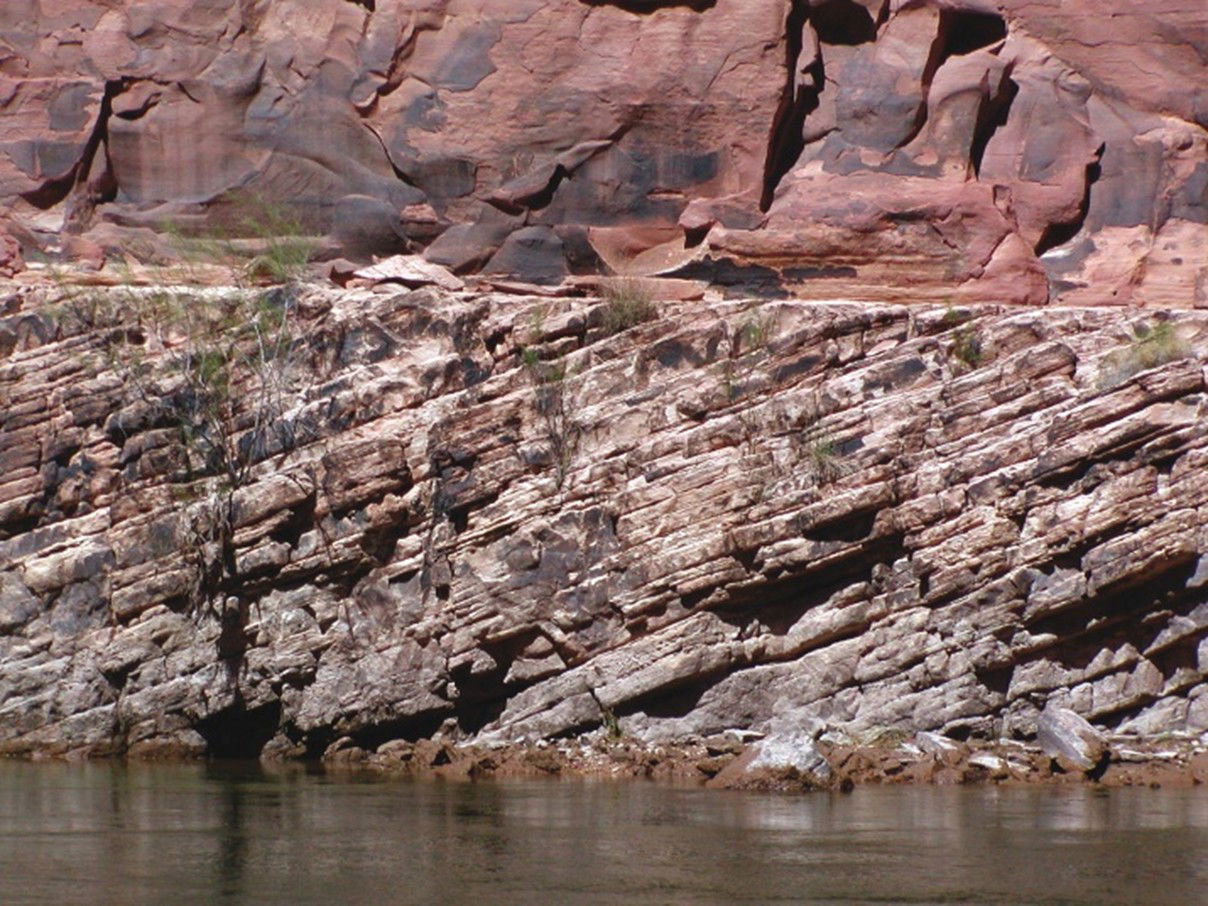
Fig. 1. Cross-beds in the Coconino Sandstone, thin parallel dipping beds within the thick horizontal sandstone layer.
It is true that global flood geologists argue for deposition of the Coconino Sandstone by underwater sand waves. However, they do so because that is consistent with the dip angles of the cross-beds and other evidence.5 Observationally and experimentally, it has been demonstrated that the dip angles of cross-beds in desert sand dunes generally are close to the angle of repose of falling dry sand in air, which is 30–34°. However, the majority of the dip angles for the cross-beds in the Coconino Sandstone is 20–25°, which is only consistent with underwater deposition of cross-beds in sand waves.6 And not only are the dip angles in the Coconino cross-beds demonstrably different from desert cross-beds, but the spread of cross-bed dip inclinations in many water-deposited sandstones like the Coconino Sandstone is the important criterion that distinguishes them from eolian (desert wind) deposits.7
What about the trace fossils in the Coconino Sandstone that are vertebrate footprint trackways? Surely it is obvious from observations in modern desert dunes that the loose dry sand cannot hold the sharp shape and outline of animal footprints for very long, as they soon become blurred. On the other hand, wet sand holds the sharp shapes and outlines of animal footprints for long enough for them to be covered up by further sand deposition so that they become preserved as fossil trackways. Thus, also based on additional observations of the Coconino trackways, it has been demonstrated that they must have formed underwater while the animal climbed up the dip slopes of the cross-beds struggling in the water against a crosscurrent.8 The continued gentle deposition of sand at the fronts of the dip slopes immediately buried the footprints very soon after they were made.
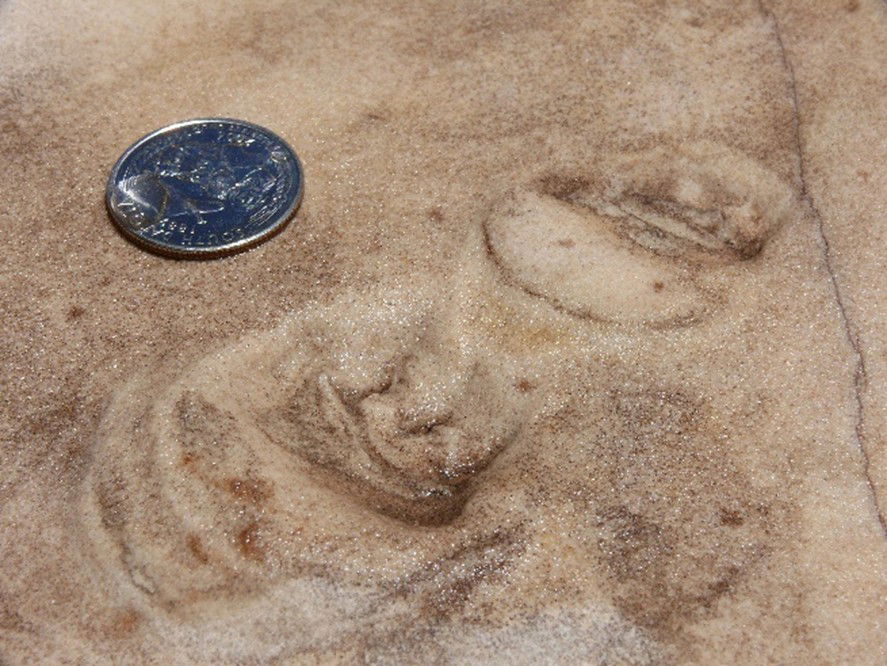
Fig. 2. Fossilized amphibian or reptile footprints on a cross-bed slope of the Coconino Sandstone.
But there is other evidence for the marine water deposition of the Coconino Sandstone. Fragile muscovite (white mica) flakes are ubiquitous within this sandstone, and it has been demonstrated conclusively by experiments and field observations that such mica flakes do not survive in windblown sands (such as those in Namibia today) but are only preserved by the cushioning of water during water deposition of sand.9
Furthermore, the quartz grains in desert sand dunes are well-rounded and well-sorted due to their abrasion and winnowing during wind transport. Yet the quartz grains in the Coconino Sandstone are not well-rounded and not well-sorted, both indicative of rapid water transport and rapid deposition.10 Then there are the dolomite ooids found in the Coconino Sandstone in a few locations. Everyone agrees that ooids are characteristic of a marine depositional environment and that dolomite requires very warm marine waters for precipitation. The latter is not possible under current marine environmental conditions but is consistent with the contribution of hot volcanic waters to the global floodwaters from the “fountains of the great deep” (Genesis 7:11).
Additionally, in the conventional literature, it has been long reported that using the U-Pb ages of the detrital zircon grains leads to the conclusion that the source of much of the sand for the Coconino Sandstone was the Appalachians.11 This required east-to-west, cross-continental transport from the Appalachians at a time when the dominant water currents were only moving across North America from east to west.12 So these Christian uniformitarian critics’ claimed refutation of the arguments of global flood geologists utterly fails. The sediments found in regional-scale rock formations like the Coconino Sandstone must have been eroded from distant sources, rapidly carried long distances, and rapidly deposited by fast-moving ocean water that flooded across North America from east (Appalachian source) to west (deposition site).
Finally, these Christian geologist opponents correctly report that one global flood geologist estimated that only a 2–4 mph (3.2–6.4 kph) current was needed to form migrating underwater sand waves as high as the Coconino cross-beds.13 But then they lampoon this estimate by postulating that to thus form the Coconino in a matter of days, by simple math it would not just need sand grains migrating over the tops of underwater sand dunes in a 4 mph (6.4 kph) current, but would need a wall of sand hundreds of feet high and hundreds of miles wide sliding laterally at this speed across thousands of square miles. Ironically, that is precisely an accurate picture of not only what must have happened, but what indeed did happen during the global Genesis flood cataclysm when earthquake-generated tsunamis and humungous tidal resonance on a global ocean eroded and swept sediments in high and long waves right across the North American continent.14
Evidence #4: No Slow and Gradual Erosion
Sadly, in their article, these Christian uniformitarian opponents misrepresent what global flood geologists claim about the boundaries between the rock layers in the Grand Canyon.
Sadly, in their article, these Christian uniformitarian opponents misrepresent what global flood geologists claim about the boundaries between the rock layers in the Grand Canyon. In claiming that the rock layers in the Grand Canyon are flat and show little evidence of erosion, global flood geologists are only referring to the Paleozoic flat-lying sedimentary layers making up the walls of the outer canyon (fig. 3). They are not referring to the tilted Precambrian sedimentary layers and interbedded lavas below the Great Unconformity. These critics deliberately make it seem that global flood geologists refer to the Great Unconformity as a flat, knife-edge boundary. Such a fabricated distortion is inexcusable, since global flood geologists repeatedly recognize the Great Unconformity as undulating and erratic as a result of massive erosion during a tectonic upheaval.15
But this is typical of the tactics of these Christian uniformitarian opponents in setting up erroneous straw men by misrepresentations so that they can make global flood geologists look stupid for being disconnected from observational realities. It is either deliberate, or they have not read the global flood geology literature, especially the technical papers, all of which are freely accessible online. Flood geologists are well aware of the observational field evidence in the Grand Canyon as they do frequent fieldwork in the canyon.
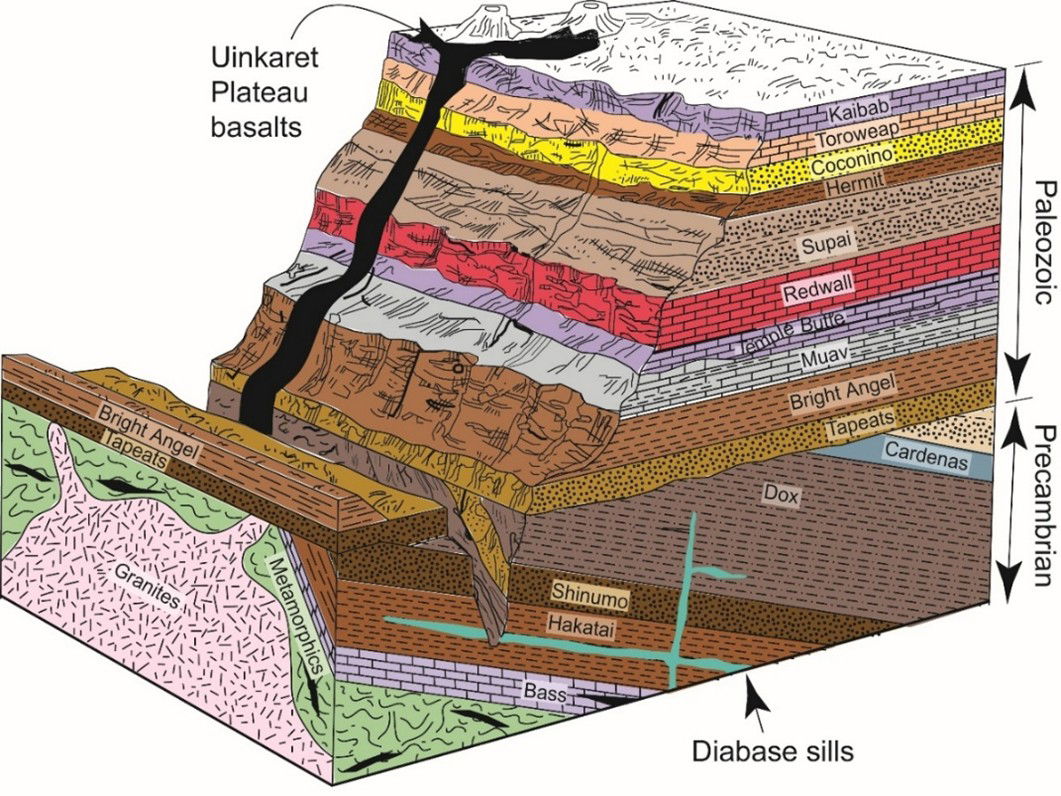
Fig. 3. A geological diagram showing the various rocks and layers, from the foundational metamorphic rocks intruded by granites (bottom left) through the variously named, overlying tilted layers of the Precambrian Grand Canyon Supergroup (bottom center and right). There is then an erosion “line” called the Great Unconformity at the base of the variously named, flat-lying Paleozoic sedimentary layers that make up the walls of the canyon.
So what about the boundaries between the flat-lying Paleozoic sedimentary layers in the walls of the Grand Canyon? Most of the boundaries between these formations are flat and “knife-edge” (that is, sharp). Consider, for example, the boundary between the Coconino Sandstone and the underlying Hermit Formation (fig. 4). According to the conventional biostratigraphic dating of these two rock units, there is a gap of 5–10 million years of missing elapsed geologic time at that boundary.16 Indeed, to the south and southeast of Grand Canyon, the Schnebly Hill Formation, which is up to 610 meters (2,000 feet) thick, is found between the Coconino Sandstone and Hermit Formation and thus represents that claimed significant duration in geologic time.17 Yet in the Grand Canyon, according to uniformitarian geologist Ron Blakey, the upper contact of the Hermit with the Coconino is “everywhere sharp and without gradation of any kind.”18 And according to Shelton in his textbook, “There is no evidence of prolonged weathering or erosion.”19 Furthermore, what about the claimed mud cracks in the upper surface of the Hermit that are filled with Coconino sand, thus, it is claimed, representing long elapsed time? On closer investigation, they have been definitively demonstrated to be sand injectites due to earthquakes occurring as the Coconino sand was being deposited as soon as Hermit deposition had ceased, not the result of sand slowly filling mud cracks over millions of years later.20
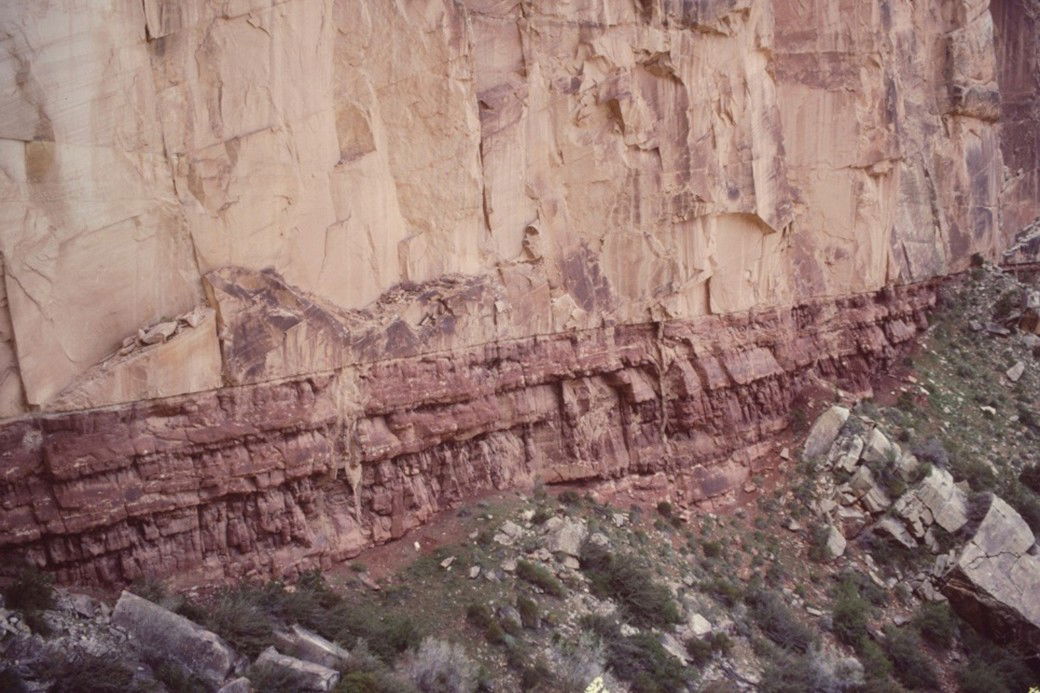
Fig. 4. The sharp, flat boundary between the buff-colored Coconino Sandstone (top) and red-brown Hermit Formation (bottom) at which it is conventionally claimed 5–10 million years of time and materials are missing.
Ignoring this evidence, these Christian uniformitarian critics point to the spectacular buried channels that were scoured into the top surface of the Muav Limestone and filled with the Temple Butte Formation. Further buried channels were also scoured into the top surface of the Redwall Limestone and filled with the Surprise Canyon Formation. They also point to the sinkholes and caves in the Redwall Limestone. They claim that all this evidence required millions of years of slow surficial processes between deposition of these rock units.
Flood geologists have not ignored these examples and are well aware of them because they are readily observed in field investigations. However, these examples are not necessarily representative of millions of years of elapsed geologic time with prolonged weathering and erosion followed by slow deposition. The reality is that the millions of years claimed by evolutionary uniformitarian geologists (with whom these Christian geologists agree) are only due to the biostratigraphic dating of these rock units (by the fossils in them) according to the geologic timescale.21
The conventional age of the Muav Limestone has been determined as ~499–502 Ma (million years, late Middle Cambrian),22 whereas the Temple Butte Formation is of Frasnian age (early Late Devonian) at ~380–382 Ma,23 which amounts to a supposed time gap of ~117 million years. However, if these supposed ages are ignored, the field observations do not preclude rapid sequential deposition of the Muav Limestone, erosion of channels into its upper surface, then deposition of the Temple Butte Formation within the eroded channels, all during the global flood.
Similarly, the conventional age of the uppermost member of the Redwall Limestone is early Late Mississippian at ~328–330 Ma, whereas the Surprise Canyon Formation is of latest Mississippian age at 323–325 Ma,24 which is a smaller supposed time gap of ~3-4 million years. However, if these supposed ages are again ignored, the field observations do not preclude rapid sequential deposition of the uppermost Redwall Limestone, erosion of channels into its upper surface, then deposition of the Surprise Canyon Formation within the eroded channels, again all during the global flood.
So what about the caves in the Redwall Limestone that these Christian geologist opponents insist require significant elapsed time to form after deposition of the Redwall Limestone? We need to note that water-deposited sediments invariably have depositional water trapped between their grains. If that intergranular water is slightly acidic (as it would be during the global Genesis flood cataclysm because of the acidic volcanic waters added to the ocean waters from the “fountains of the great deep”), then it would be fully capable of dissolving the adjacent carbonate (lime) grains almost immediately so that caves would form. Once formed in the uppermost Redwall Limestone, many of such caves would have collapsed under the weight of the rapidly accumulating Surprise Canyon Formation.
The lesson here is that just because conventional uniformitarian geologists assert that millions of years of elapsed time are necessary for a specified sequence of geological events to occur, it does not preclude a rapid scenario for the same events during the global flood cataclysm. The field observations are merely rock layers with eroded boundaries between them. These sequences of geological processes that deposited these sedimentary layers and then eroded into them was never witnessed. The time labels are imposed on these rock layers by imposing an evolutionary uniformitarian interpretation and timescale on them based on fossils. But this assumes catastrophic geological processes in a global flood cataclysm never happened because we have never seen a global flood, historically or today. But what these Christian geologist opponents should acknowledge as Christians is that God’s Word is God’s eyewitness account of earth and human history and thus is authoritative, including its account of the global flood cataclysm. Interpretations made by fallible, finite humans should never override God’s infallible Word.
Evidence #5: Flat Layers Made in Rapid Succession
These Christian uniformitarian critics acknowledge correctly, as do global flood geologists, that the Kaibab Monocline is an immensely broad downward bend of the entire vertical stack of flat-lying sedimentary layers in the walls of the Grand Canyon. Also, we all observe and thus agree that there are many examples of tilted, folded, and faulted rocks in the Grand Canyon and that along the length of the canyon the Colorado Plateau is broken by several prominent faults.
However, we strongly disagree that the severe, smaller scale folding we observe in the Tapeats Sandstone in the side canyon of Carbon Creek is riddled with fractures and contains evidence of brittle and flexural slip within and between the layers and that this is consistent with the old-earth view defended in these opponents’ book, which is promoted by their web article. In their book, they claim that more than 400 million years elapsed after those sandstone layers had been deposited and cemented to become hard (like concrete). Then they claim that over more millions of years the Tapeats Sandstone layers25 were slowly bent by brittle and flexural slip between the layers and by grain-boundary sliding and other microscopic scale ductile deformation processes within the layers, under the temperatures and pressures of deep burial. However, they provide no evidence from microscope examinations of grain-boundary sliding and other ductile deformation processes in these rocks, as well as no evidence of any effects from the deep burial temperatures and pressures.
These Christian uniformitarian critics made these assertions in their web article and in their book in response to the global flood geology explanation for the Carbon Canyon fold.26 In the global flood geology explanation, the Tapeats Sandstone layers were deposited in the first weeks of the yearlong global flood cataclysm, subsequently being buried by the sequentially deposited overlying ~3,650 meters (~12,000 feet) of sedimentary layers, before the bending of the layers in the Kaibab Monocline about 12 months later at the end of the global flood. Because the Tapeats Sandstone layers had not had time to dry and become cemented hard, they would still have been wet and soft. So the Tapeats Sandstone layers were bent smoothly in the Carbon Canyon fold, without being fractured and shattered brittlely, as is evident in the overall profile of the fold, especially in the hinge zone (fig. 5). Furthermore, the short deep burial time of about a year was insufficient for the elevated temperatures and pressures of deep burial to have changed the sandstone microscopically, especially in the hinge zone.
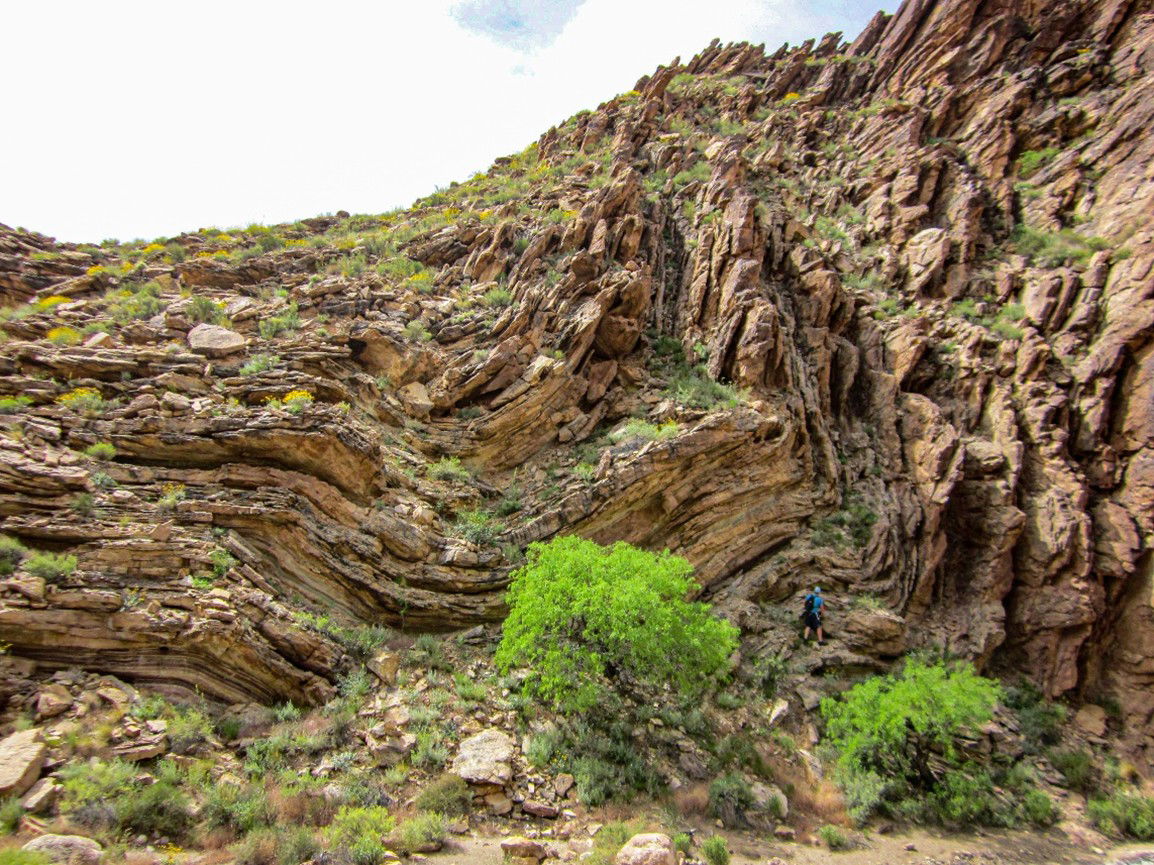
Fig. 5. The Carbon Canyon fold in which brittle layers of Tapeats Sandstone are bent 90° without shattering. Where the layers are bent is called the hinge zone, and the horizontal and vertical layers on either side respectively distant to the hinge are called the limbs.
So in order to resolve this disagreement about when and how long it took to make these folds, global flood geologists embarked on a field and laboratory research project to collect samples and examine them under microscopes.27 The strategy was to collect samples from the same sandstone layers within both the hinge and limbs of the Carbon Canyon fold, as well as samples from approximately the same level in the Tapeats Sandstone miles away from the fold. Of course, the macroscopic features of the Carbon Canyon fold were also examined in the field. Also, the Tapeats Sandstone and its macroscopic features (including its fossils and sedimentary structures) throughout the canyon were studied thoroughly in order to demonstrate that such evidence was consistent with rapid deposition of the sand layers during the global flood cataclysm.
If the conventional uniformitarian explanation were correct, the sandstone samples from the hinge zone (where the most intense bending occurred), when viewed under geological and scanning electron microscopes, should be different mineralogically and texturally from the sandstone samples from the limbs (fig. 5) and different again in the remote sandstone samples miles from the hinge. For example, the samples from the hinge zone should reveal grain-boundary sliding while the remote samples should not. In other words, in the conventional explanation, deposition of the sand layers occurred, followed by cementation and hardening into sandstone, and then more than 400 million years later, the hard brittle layers were folded and fractured.
On the other hand, if the global flood geology explanation is correct, all the sandstone samples should essentially be the same under the microscopes because all of the Tapeats Sandstone layers had been soft and wet at the same time and cemented and hardened at the same time, but only after the folding occurred. In other words, it would have been deposition of the sand layers, then folding of those still soft and wet layers only 12 months later, followed then by drying out, with cementation and hardening into sandstone.
The results of the research were definitive and unmistakably consistent with the global flood geology explanation for rapid deposition of the Tapeats Sandstone layers early in the global flood.
The results of the research were definitive and unmistakably consistent with the global flood geology explanation for rapid deposition of the Tapeats Sandstone layers early in the global flood, followed by their bending at the end of the global flood while they were still soft and wet, and then subsequent drying out, with cementing of the sand grains to harden the sand layers into sandstone.28
Boulders at the base of the Tapeats Sandstone and the layering structures within the Tapeats Sandstone indicate that the sand and boulders were rapidly transported and deposited by hurricane- and/or tsunami-driven water flows. The delicate tracks and burrows in the layers left behind by trilobites, worms, and other invertebrates that had scurried across or hurriedly burrowed into sand surfaces had to be buried rapidly to be preserved and fossilized.
Under the geological microscope, all samples of the sandstone were the same, consisting of different-sized grains mixed randomly, indicating that they were rapidly transported and deposited with no time for the grains to be sorted. Many of the grains of quartz and even the softer pink K-feldspar are not very rounded, also indicating that there was no time for the grains to be completely rounded during their transport. The sandstone also contains abundant soft, fragile muscovite (white mica) flakes wedged between quartz and K-feldspar grains, usually aligned approximately parallel to the rock’s layering. Some flakes have split ends where the mica’s thin sheets have been frayed and are even bent and/or broken (fig. 6). These observations mean they were detrital grains in the sandy sediment that was rapidly transported only a short distance and deposited rapidly before the soft flakes could be completely destroyed.
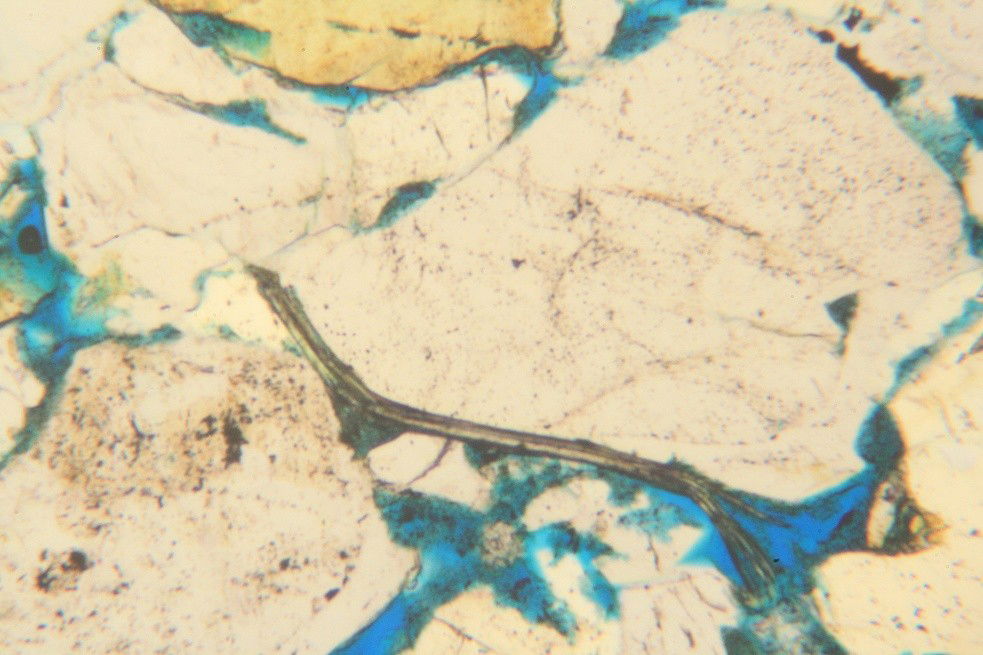
Fig. 6. Geological microscope view of a bent edge-on muscovite flake with a split end wedged between quartz grains of different sizes in a Tapeats Sandstone sample from the limb of the Carbon Canyon fold.
There are no deformation lamellae or deformation kink bands in the quartz grains, as should be the case if the conventional view espoused by these Christian critics were true. Those would have been evidence for ductile deformation, as demonstrated in experiments,29 so their complete absence rules out that ductile (brittle) deformation had occurred. The quartz grains display uniform extinction and generally show no signs of undulose extinction under cross-polarized light, as should be the case if the conventional view espoused by these Christian critics were true. These observations of no deformation lamellae or kink bands in the quartz grains are also contrary to the outcomes of experiments on ductile deformation of quartz grains and microscope observations of quartz grains in ductile deformed rocks. So the quartz grains in all the Tapeats Sandstone samples never suffered any ductile deformation.
Both the geological and scanning electron microscopes reveal the cement binding the grains together is primarily quartz. No matter whether the sample was from the hinge or limb zones of the fold or from miles away, the quartz cement is always intact as pristine crystals (fig. 7). They have not been disturbed or shattered since they grew in the pore spaces around the detrital quartz grains to cement them together to form the hard sandstone. Sometimes the rock fabric is a solid mass of tightly interlocking quartz with the cement indistinguishable from the grains. If the rock layers had been bent more than 400 million years after the quartz cement set, these masses of cemented quartz grains would show signs of having been shattered or broken, then recemented. But no such evidence was found, which is once again consistent with a global flood geology interpretation.
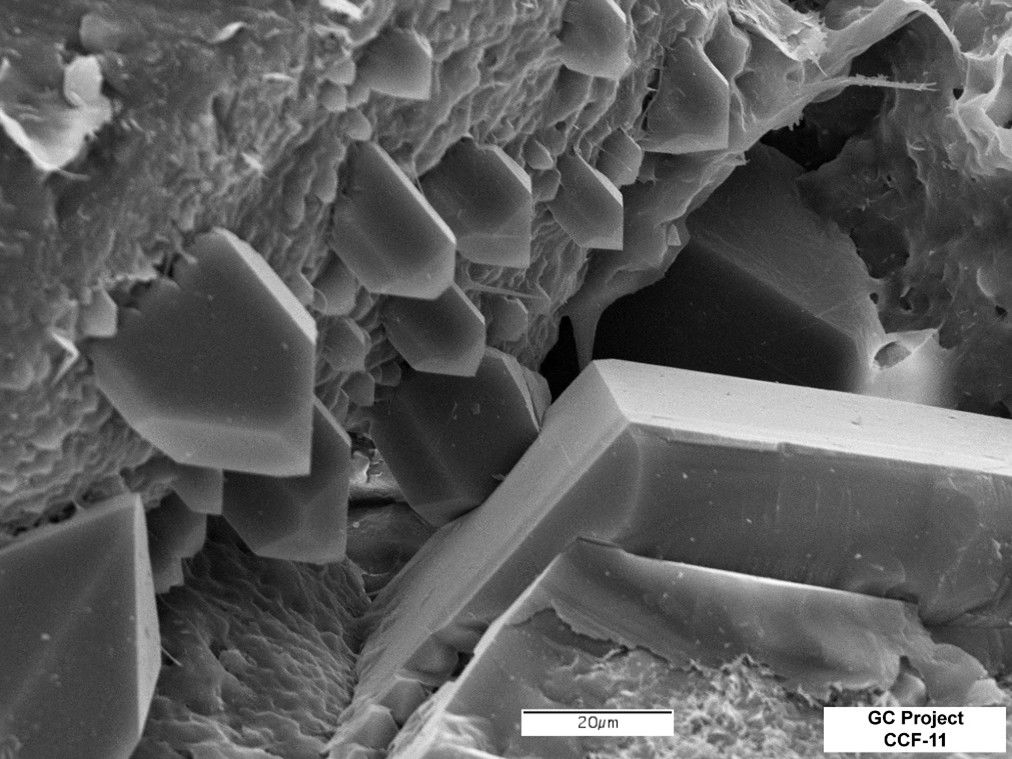
Fig. 7. Scanning electron microscope view of pristine quartz crystals that are the cement in the pore space between the quartz sediment grains in the same Tapeats Sandstone sample as in fig. 6 from the limb of the Carbon Canyon fold.
Neither the sandstone nor its constituent mineral grains, either in samples from the folds or in samples from miles away, showed signs of metamorphic change. The minerals in, and textures of, all samples were the same. For example, bent muscovite flakes wedged between quartz and K-feldspar grains were in all samples. Thus, the microscopic evidence unequivocally confirms the global flood geology explanation of rapid deposition of the sand layers early in the global flood cataclysm, folding of those layers only 12 months later at the end of the global flood, followed thereafter by drying out, cementation, and hardening into sandstone.
However, what of the claim by these Christian uniformitarian critics in their web article and their book chapter that the Carbon Canyon fold contains evidence of brittle and flexural slip within and between the Tapeats Sandstone layers? From field observations of the outcrop of the Tapeats Sandstone layers in the Carbon Canyon fold (fig. 5), it is quite clear that some minor bedding plane or flexural slip must have occurred to accommodate their folding. However, the hinge zones are open, without shattering of the rock fabric, and generally, there has been no thickening of the layers in most of the hinge zones, contrary to the claims of these critics. The hinge distances are also open, and there is no mechanical crowding or thinning of the sandstone layers in either the hinge zones or the limbs. Indeed, the thicknesses of the individual sandstone layers are very consistent along their lengths when traced from one limb through the hinge zone and out into the opposite limb (fig. 5).
There are no clusters of fractures in the hinge zones, as would be expected if hardened rock had suffered from brittle deformation. However, there are fractures that are regularly spaced and most of them are confined to individual sandstone layers. They also penetrate totally across, but are confined to, individual sandstone layers, including in the hinge zones. This is not what would be expected if these were fractures due to ductile deformation more than 400 million years after the sandstone was hard. Instead, these are joints that are fractures or cracks with minute openings, with little to no displacement along their sharp walls.30 They are produced by contraction of the rock fabric during drying and hardening, and then especially during unloading of the confining overburden pressure as the overlying strata were eroded away during erosion of the Grand Canyon and its side canyons.
These field observations are fully consistent with the Carbon Canyon fold being due to soft-sediment deformation before drying and hardening of the Tapeats Sandstone, rather than due to ductile and/or brittle deformation after its drying and hardening over hundreds of millions of years. Indeed, many experiments have replicated soft-sediment deformation.31 These experiments involved confining pressures (that is, the pressure of the huge overlying stack of layers). Yet the dampened sand layers when folded with compression faithfully simulated soft-sediment deformation to produce folds similar or identical to those observed and classified as being folded due to soft-sediment deformation, which we see in exposed outcrops of now hardened sedimentary layers, such as the Tapeats Sandstone layers in the Carbon Canyon fold.32
Three other Grand Canyon folds were also targeted in that global flood geology research project—the Monument fold in the Tapeats Sandstone, the Whitmore Helipad fold in the Bright Angel Shale, and the Matkatamiba fold in the Muav Limestone.33 All three folds were found to be due to soft-sediment bending, similar to the Carbon Canyon fold. This was confirmed by the same macroscopic evidence in the field, and the same evidence seen under the geological and scanning electron microscopes.
The only scenario that fits the evidence is the recent, yearlong, global Genesis flood cataclysm during which all the flat-lying sedimentary layers were deposited in rapid succession.
Thus, the claims of these Christian uniformitarian critics are refuted resoundingly. The evidence indicates the Tapeats Sandstone, Bright Angel Shale, and Muav Limestone were rapidly deposited, then their layers were bent into these folds while they were still damp and soft (figs. 8 and 9). The folding had to occur very soon after their deposition, not 400 or more million years later (by which time these layers would have become cemented and hardened and they would have been brittle and shattered when bent). Only after bending did these sediment layers in these folds dry out so the sediment layers became cemented and hardened. The only scenario that fits the evidence is the recent, yearlong, global Genesis flood cataclysm during which all the flat-lying sedimentary layers were deposited in rapid succession.
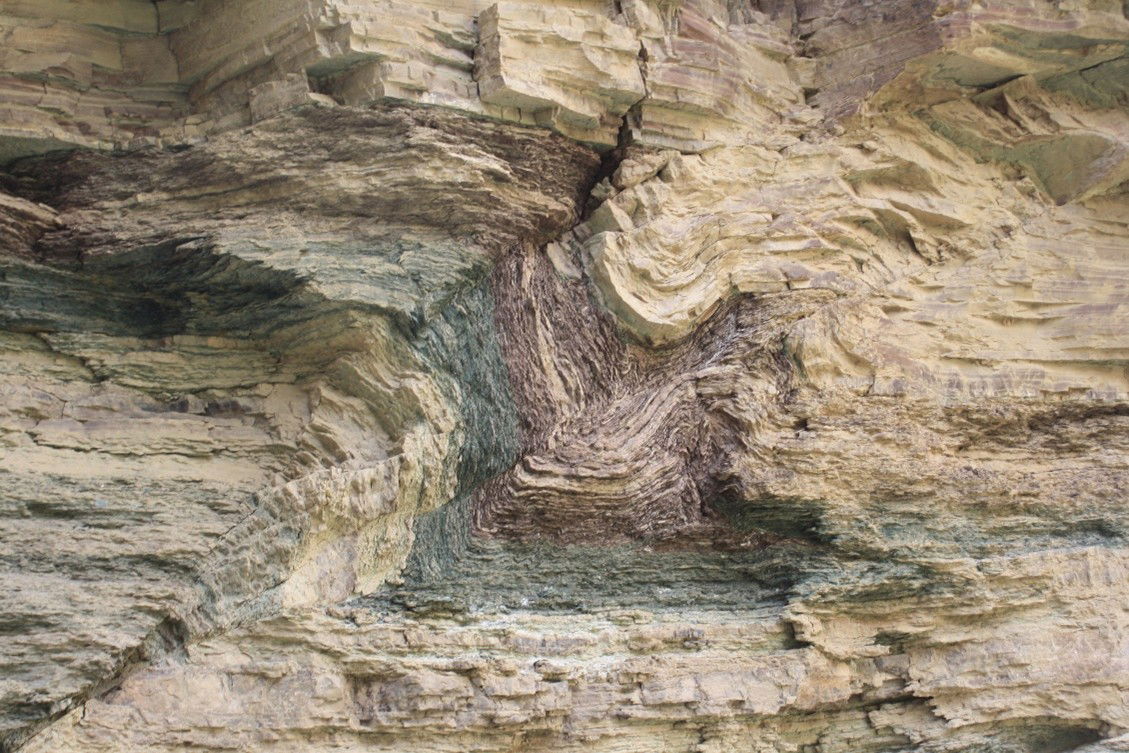
Fig. 8. The Whitmore helipad fold in which layers of Bright Angel Shale have been bent without shattering.
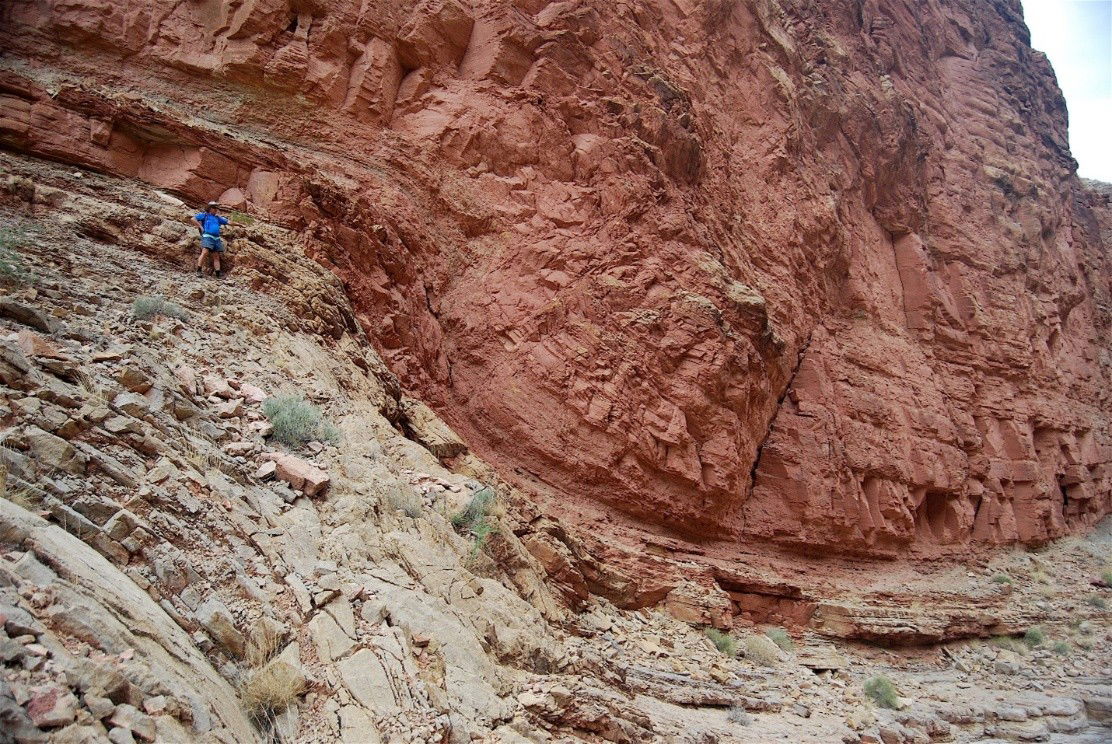
Fig. 9. The Matkatamiba fold in which layers of Muav Limestone have been bent without shattering.
Twelve Thousand Feet of Strata Flood Geologists Have Explained!
These Christian geologist opponents summarize their web article, as they do in a chapter in their book, by outlining their claimed case against young-earth flood geology. The critics correctly say that global flood geologists explain the tilted, 3,650 meters (12,000 feet) thick Grand Canyon Supergroup sedimentary layers and lavas exposed in the Grand Canyon beneath the Great Unconformity erosion surface as being deposited before the global flood cataclysm (fig. 3). However, the Supergroup sits on an eroded surface below, which is made up of metamorphic rocks intruded by granites (fig. 3). The Christian old-earth geologists claim that these Supergroup sedimentary layers and lavas must represent many cycles of formation, including time above water because of claimed mud cracks and raindrop impressions. Thus, the old-earth critics say, none of this fits the global flood geologists’ explanation of deposition before the global flood cataclysm. While not stated, the critics imply these metamorphic rocks, granites, sedimentary layers, and lavas must supposedly represent many hundreds of millions of years of postulated earlier geologic time. However, global flood geologists have repeatedly explained these metamorphic rocks, granites, sedimentary layers, and lavas beneath the Great Unconformity are creation week and pre-flood rocks.34
Then there are the overlying Paleozoic sedimentary rocks exposed in the walls of the Grand Canyon which are 4,000–5,000 feet (~1,220–1,525 meters) thick. These Christian uniformitarian critics state correctly that according to global flood geologists, these are supposed to represent early global flood deposits. Overlying them to the north in the Grand Staircase of the Colorado Plateau are another 5,000–10,000 feet (~1,525–3,050 meters) of Mesozoic sedimentary layers that global flood geologists say were deposited subsequently during the flood of Noah’s day. These critics then point out that these ~15,000 feet (~4,570 meters) of sedimentary layers required global flood geologists to claim that a titanic flood deposited them. Yet the critics ask, How were the underlying Supergroup layers that look so similar in thickness, character, and apparent history deposited when there was not an earlier flood?
Furthermore, as global flood geologists and these evolutionary geologists agree, the only substantive difference between the Supergroup (below the Great Unconformity) and the Paleozoic sedimentary layers (above the Great Unconformity) is fossils. These Christian geologist opponents then falsely claim that global flood geologists say all life as we know it was represented (at least in ancestral forms) during the time the Supergroup rocks were deposited. And yet, not a single fossil is found in them that is more complex than algae. No clams, fish bones, trilobites, twigs, or even windblown pollen made it into those Supergroup sediments. The critics’ conclusion is that the absence of complex life in the Supergroup only makes sense if complex life was not yet found on the earth; therefore, they say, the global flood geologists’ view is wrong.
Ironically, their last statement (the absence of complex life in the Supergroup only makes sense if complex life was not yet found on the earth) is exactly what global flood geologists maintain. The global flood geology comprehensive explanation of how all the Grand Canyon rocks formed starts with the foundational metamorphic rocks intruded by granites, and most of the Supergroup rocks overlying them being formed during the early creation week (fig. 3). Then the overlying Paleozoic and Mesozoic layers are rocks deposited by the global flood cataclysm.35 These Christian uniformitarian critics have simply not read the flood geology literature carefully, if at all. Flood geologists do not claim clams, fish, trilobites, trees, and pollen were around when the Supergroup sediments were deposited (which explains the absence of these fossils in them).
As professing Christians, these critics should know what God’s eyewitness account of creation in Genesis 1 describes. On creation days one and two, God supernaturally formed the foundation rocks of earth’s initial crust underneath the globe-encircling waters. In the Grand Canyon, those initial crustal rocks are the schists intruded by the granites at the bottom of the canyon (fig. 3). Then on creation day three, before God created any complex plant and animal life, God supernaturally created the dry land by raising some of those foundation rocks above the waters to make the dry land. As those rocks breached the waters’ surface, they would have been catastrophically eroded. The derived sediments would then have been deposited thickly on the flanks of the emerging dry land (which was composed of initial crustal metamorphic rocks intruded by granites). Those sedimentary rocks (of the Supergroup under the Great Unconformity) would not contain any fossils of complex life because God had not yet created it, just as these Christian uniformitarian critics stated!
After the Supergroup rocks had been deposited early on creation day three, then on creation days five and six, God supernaturally created complex life to inhabit the seas, the atmosphere, and the dry land that He had vegetated in the latter part of creation day three. It was then relatively quiet geologically from the end of the creation week until the onset of the global flood cataclysm. Complex life flourished on the luxuriant dry land. Then the global flood cataclysm started with the breaking up of the fountains of the great deep (Genesis 7:11). As the waters rose, all land life was swept away off the land that was eroded to form the Great Unconformity before the Paleozoic and Mesozoic sedimentary layers were deposited on it, burying first marine creatures and then also land creatures, often as the remnants of ecosystems that had been swept away from the seafloor and the land respectively.
This sequence of events by which global flood geologists have explained the 12,000 feet of strata has all been presented frequently and defended in the global flood geology literature. So why have these Christian uniformitarian opponents not acknowledged that literature? It is because they have an a priori commitment to the conventional evolutionary uniformitarian explanation of the formation of the rock and fossil records over billions of years. Consequently, they have rejected God’s eyewitness account of supernatural creation and the global flood cataclysm in Genesis, even though Jesus Christ spoke of creation and the flood as literal global events. No geologists were present during the earth’s history, but God was, and He has told us what happened. However, these Christian critics have chosen to interpret the earth’s rock layers and fossils, as well as the Genesis account, through the lens of the secular (really, atheistic), evolutionary, uniformitarian worldview, which the Apostle Peter warned against in his final words in 2 Peter 3:3–7.
Conclusion
The geology of the Grand Canyon is certainly known fairly well after 150 years of ongoing investigations. However, it needs to be emphasized repeatedly that careful field and laboratory studies only record and analyze observations of the rocks and landscape in the present. In asserting their presentation of multiple, sequential scenes in the history of the canyon, these old-earth Christian geologists (like their secular colleagues) fail to acknowledge that what they call “evidence” is in fact observations and analyses of rocks that have been interpreted through the lens of an a priori anti-biblical worldview.
Most modern geologists have already rejected the biblical account of the global Genesis flood cataclysm before they even look at the rock layers and their order and contents in any location.
Most modern geologists have already rejected the biblical account of the global Genesis flood cataclysm before they even look at the rock layers and their order and contents in any location. Their worldview (interpretative framework) is that presently observed geological processes, operating at presently observed rates, are all that is necessary to explain the formation of rock layers in the past. This worldview, otherwise known as uniformitarianism, is the belief in the uniformity of natural processes through time and space. It is a belief because the past was never observed by modern geologists, including these Christian critics who have chosen to adopt the same belief, rather than trusting God’s eyewitness account of the earth’s history in Genesis.
Contrary to the claims of these Christian uniformitarian critics, global flood geologists have successfully compiled and presented a coherent physical model for the catastrophic formation of the Grand Canyon’s rock layers during the creation week and the flood of Noah’s day that is consistent with the observed real geology of the canyon. And since we do not observe fossils forming today via present geological processes, the condition and distribution of fossils in the Grand Canyon strata do reflect the rapid burial of sea animals and then small land animals by the turbulent waters of the global flood cataclysm.
The stated goal of these Christian uniformitarians in their book as promoted by their web article was to provide a readable and well-illustrated overview of how modern geology succeeds in explaining its natural history. Of course, the grandeur of the Grand Canyon moves believers to worship the God who “laid the foundation of the earth” (Job 38:4) and who “make[s] springs to gush forth in the valleys” (Psalms 104:10). However, these old-earth geologists claim that as responsible earth scientists, they are motivated to give the public an honest accounting for the origins of a most glorious piece of creation! How sad that these Christians are promoting the conventional secular explanation for the beauty and grandeur in the Grand Canyon, an explanation that rejects God’s Word and ignores God as the Creator. Yet they think they are thus encouraging the public to worship the Creator God of the Bible, when the conventional secular explanation instead ultimately comes from a worship of “nature.”
In closing, at the foot of the endorsement page right at the beginning of the book, Proverbs 18:17 is quoted: “The one who states his case first seems right, until the other comes and examines him.” How sad it is that the theologians who endorsed that book on that same page have clearly not heeded that biblical instruction. Neither have the authors of that book and the BioLogos web article because it has been demonstrated that they have not even read the relevant creation/flood geology literature produced by the tiny number of PhD creation geologists with the help of the miniscule funding given by interested Christians. Instead, they have slavishly followed the legion of conventional evolutionary and uniformitarian scientists who are massively funded by secular governments and universities. However, as Jesus taught in Matthew 7:13–14, truth is not determined by the majority. God’s Word is true from the beginning (Psalms 119:160, KJV).
Answers in Depth
2025 Volume 20
Answers in Depth explores the biblical worldview in addressing modern scientific research, history, current events, popular media, theology, and much more.
Browse Volume
* In June 2016, an article was posted on the BioLogos website (which promotes old-earth evolutionary “creation”) titled “Flood Geology and the Grand Canyon: What Does the Evidence Really Say?”1 Written by four Christians who are science professionals, including three geologists, the article purports to dissect and respond succinctly to evidence for the global flood cataclysm as recorded in Genesis 6–8 and assembled and published by creationist geologists. They also totally ignore highlighting PhD geologist Snelling’s Earth Catastrophic Past: Geology, Creation and the Flood (2009),2 which is the most recent “textbook” on creationist and flood geology and discusses many aspects of Grand Canyon geology.
Footnotes
- Moshier, Stephen O., Gregg Davidson, Joel Duff, and Tim Helble, “Flood Geology and the Grand Canyon: What Does the Evidence Really Say?,” BioLogos, June 29, 2016, https://biologos.org/articles/flood-geology-and-the-grand-canyon-what-does-the-evidence-really-say.
- Now available as: Andrew A. Snelling, The Genesis Flood Revisited (Petersburg. KY: Answers in Genesis and Green Forest, AR: Master Books, 2022).
- Snelling, Andrew A., “Sand Transported Cross Country: Flood Evidence Number Four,” Answers Magazine 3, no. 4 (October–December 2008), 96–99, https://answersingenesis.org/geology/sedimentation/sand-transported-cross-country/?aigcb=3930.
- Whitmore, John H., and Paul A. Garner, “The Coconino Sandstone (Permian, Arizona, USA): Implications for the Origin of Ancient Cross-bedded Sandstones,” Proceedings of the Eighth International Conference on Creationism, ed. John H. Whitmore (Pittsburgh: Creation Science Fellowship, 2018), 581–627, https://doi.org/10.15385/jpicc.2018.8.1.42.
- Whitmore, John H., Raymond Strom, Stephen Cheung, and Paul A, Garner, “The Petrology of the Coconino Sandstone (Permian), Arizona, USA,” Answers Research Journal 7 (December 10, 2014), 499–532, https://answersresearchjournal.org/petrology-of-the-coconino-sandstone/;
John H. Whitmore, Guy Forsythe, and Paul A. Garner, “Intraformational Parabolic Recumbent Folds in the Coconino Sandstone (Permian) and Two Other Formations in Sedona, Arizona (USA),” Answers Research Journal 8 (January 21, 2015), 21–40, https://answersresearchjournal.org/intraformational-parabolic-recumbent-folds/;
John H. Whitmore, “Coconino Sandstone—The Most Powerful Argument Against the Flood?” Answers Magazine 10, no. 3 (July–September 2015), 30–35, https://answersingenesis.org/geology/grand-canyon/coconino-sandstone-most-powerful-argument-against-flood/;
K. Borsch, John H. Whitmore, Raymond Strom, and George Hartree, “The Significance of Micas in Ancient Cross-bedded Sandstones,” Proceedings of the Eighth International Conference on Creationism, ed. John H. Whitmore (Pittsburgh: Creation Science Fellowship, 2018), 306–326, https://doi.org/10.15385/jpicc.2018.8.1.30;
Whitmore and Garner, “Coconino Sandstone (Permian, Arizona, USA): Implications for the Origin of Ancient Cross-bedded Sandstones,” 581–627;
John H. Whitmore and Raymond Strom, “The Significance of Angular K-feldspar Grains in Ancient Sandstones,” Proceedings of the Eighth International Conference on Creationism, ed. John H. Whitmore (Pittsburgh: Creation Science Fellowship, 2018), 628–651, https://doi.org/10.15385/jpicc.2018.8.1.43;
John H. Whitmore, “Lithostratigraphic Correlation of the Coconino Sandstone and a Global Survey of Permian ‘Eolian’ Sandstones: Implications for Flood Geology,” Answers Research Journal 12 (October 23, 2019): 275–328, https://answersresearchjournal.org/coconino-permian-sandstones/;
John H. Whitmore, “Mica, Mica in the Sand, Tell Us Something Really Grand!,” Answers Magazine 14, no. 5 (September–October 2019), 26–29, https://answersingenesis.org/geology/mica-mica-sand-tell-us-something-really-grand/. - Snelling, Andrew A., and Steven A. Austin, “Startling Evidence for Noah’s Flood: Footprints and Sand ‘Dunes’ in a Grand Canyon Sandstone!” Creation 15, no. 1 (December 1992): 46–50, https://answersingenesis.org/geology/grand-canyon-facts/startling-evidence-for-noahs-flood/;
Glen S. Visher, Exploration Stratigraphy, 2nd edition (Tulsa, OK: Penn Well Publishing Co., 1990), 211–213;
C. L. Amos and E. L. King, “Bedforms of the Canadian Eastern Seaboard: A Comparison with Global Occurrences,” Marine Geology 57 (1984): 167–208. - Whitmore, John H., “Can Sandstone Cross-Bed Dip Inclinations Determine Depositional Environment,” Proceedings of the Ninth International Conference on Creationism, ed. John H. Whitmore (Cedarville, OH: Cedarville University International Conference on Creationism, 2023), 588–610, https://doi.org/10.15385/jpicc.2023.9.1.30.
- Brand, Leonard R., “Field and Laboratory Studies on the Coconino Sandstone (Permian) Vertebrate Footprints and Their Paleoecological Implications,” Palaeogreography, Palaeoclimatology, Palaeoecology 28 (1979): 25–38;
Leonard R. Brand, and T. Tang, “Fossil Vertebrate Footprints in the Coconino Sandstone (Permian) of Northern Arizona: Evidence for Underwater Origin,” Geology 19, no. 12 (December 1991): 1201–1204. - Anderson, Calvin J., M. S. Cheney, Alex Struble, and John H. Whitmore, “Muscovite Survival in Simulated (Turbulent) Eolian and Subaqueous Conditions,” Journal of Creation Theology and Science Series C: Earth Sciences 3 (2013): 1–3, https://www.coresci.org/jcts/index.php/jctsc/issue/view/10;
Calvin J. Anderson, Alex Struble, and John H. Whitmore, “Abrasion Resistance of Muscovite in Aeolian and Subaqueous Transport Experiments,” Aeolian Research 24 (2017): 33–37;
E. Garzanti, S. Andò, G. Vezzoli, M. Lustrino, M. Boni, and P. Vermeesch, “Petrology of the Namib Sand Sea: Long-Distance Transport and Compositional Variability in the Wind-Displaced Orange Delta” Earth-Science Reviews 112 (2012): 173–189;
E. Garzanti, A. Resentini, S. Andò, G. Vezzoli, A. Pereira, and P. Vermeesch, “Physical Controls on Sand Composition and Relative Durability of Detrital Minerals during Ultra-Long Distance Littoral and Aeolian Transport (Namibia and Southern Angola),” Sedimentology 62 (2015): 971–996;
Borsch, Whitmore, Strom, and Hartree, “Significance of Micas in Ancient Cross-bedded Sandstones,” 306–326. - Whitmore, Strom, Cheung, and Garner, “Petrology of the Coconino Sandstone (Permian), Arizona, USA.” 499–532;
John H. Whitmore and Raymond Strom, “Rounding of Quartz and K-Feldspar Sand from Beach to Dune Settings Along the California and Oregon Coastlines: Implications for Ancient Sandstones,” Answers Research Journal 10 (November 15, 2017): 259–270, https://answersresearchjournal.org/rounding-quartz-and-k-feldspar-sand/;
Whitmore and Strom, “Significance of Angular K-Feldspar Grains in Ancient Sandstones,” 628–651. - Dickinson, W. R., and George E. Gehrels, “U-Pb Ages of Detrital Zircons from Permian and Jurassic Eolian Sandstones of the Colorado Plateau, USA: Paleogeographic Implications,” Sedimentary Geology 163 (2003): 29–66;
George E. Gehrels, Ron Blakey, Karl E. Karlstrom, J. Michael Timmons, Bill Dickinson, and Mark Pecha, “Detrital Zircon U-Pb Geochronology of Paleozoic Strata in the Grand Canyon, Arizona,” Lithosphere 3 (2011): 183–200. - Brand, Leonard R., Mingmin Wang, and Arthur V. Chadwick, “Global Database of Paleocurrent Trends Through the Phanerozoic and Precambrian,” Scientific Data 2 (2015): 150025; doi:10.1038/sdata.2015.25.
- Austin, Steven A., ed., Grand Canyon: Monument to Catastrophe (Santee, CA: Institute for Creation Research, 1994), 33–36.
- Clark, M. E., and H. D. Voss, “Resonance and Sedimentary Layering in the Context of a Global Flood,” Proceedings of the Second International Conference on Creationism, eds. Robert E. Walsh and Christopher L. Brooks (Pittsburgh: Creation Science Fellowship, 1990), 53–64, https://cedarville.tind.io/record/20843?v=pdf;
John R. Baumgardner, “Numerical Modeling of the Large-Scale Erosion, Sediment Transport, and Deposition Processes of the Genesis Flood,” Answers Research Journal 11 (June 27, 2018): 149–170, https://answersresearchjournal.org/numerical-modeling-genesis-flood-2/;
John R. Baumgardner, “Understanding How the Flood Sediment Record Was Formed: The Role of Large Tsunamis,” Proceedings of the Eighth International Conference on Creationism, ed. John H. Whitmore (Pittsburgh: Creation Science Fellowship, 2018), https://doi.org/10.15385/jpicc.2018.8.1.29;
John R. Baumgardner and Evan Navarro, “The Role of Large Tsunamis in the Formation of the Flood Sediment Record,” Proceedings of the Ninth International Conference on Creationism, ed. John H. Whitmore (Cedarville, OH: Cedarville University International Conference on Creationism, 2023), 363–386, https://doi.org/10.15385/jpicc.2023.9.1.22. - Austin, Grand Canyon: Monument to Catastrophe, 45–47, 66–67;
Steven A. Austin and Kurt P. Wise, “The Pre-Flood / Flood Boundary: As Defined in Grand Canyon and East Mojave,” Proceedings of the Third International Conference on Creationism, ed. Robert E. Walsh (Pittsburgh: Creation Science Fellowship, 1994), 37–47, https://cedarville.tind.io/record/20918?v=pdf. - Blakey, Ronald C., “Supai Group and Hermit Formation,” in Stanley S. Beus and Michael Morales, eds., Grand Canyon Geology, 2nd ed. (New York: Oxford University Press, 2003), 136–162;
Larry T. Middleton, David K. Elliott, and Michael Morales, “Coconino Sandstone,” in Stanley S. Beus and Michael Morales, eds., Grand Canyon Geology, 2nd ed. (New York: Oxford University Press, 2003), 163–179. - Blakey, Ronald C., “Stratigraphy and Geologic History of Pennsylvanian and Permian Rocks, Mogollon Rim region, Central Arizona and Vicinity,” Geological Society of America Bulletin 102, no. 9 (September 1990): 1189–1217.
- Blakey, “Supai Group and Hermit Formation,” 149.
- Shelton, J. S., Geology Illustrated (San Francisco: W. H. Freeman, 1966), 283.
- Whitmore, John H., and Ray Strom, “Sand Injectites at the Base of the Coconino Sandstone, Grand Canyon, Arizona (USA),” Sedimentary Geology 230, no. 1–2 (October 2010): 46–59.
- International Commission on Stratigraphy, International Chronostratigraphic Chart, version 2024/12, International Union of Geological Sciences, https://stratigraphy.org/ICSchart/ChronostratChart2024-12.pdf.
- Karlstrom, Karl E., James W. Hagadorn, George E. Gehrels, William Matthews, Mark D. Schmitz, Lauren Madronich, Jacob Mulder, Mark Pecha, Dominique Giesler, and Laura J. Crossey, “Cambrian Sauk Transgression in the Grand Canyon Region Redefined by Detrital Zircons,” Nature Geoscience 11, no. 6 (June 2018): 438–443;
Karl E. Karlstrom, Mike T. Mohr, Mark D. Schmitz, Frederick A. Sundberg, Stephen M. Rowland, Ronald C. Blakey, John R. Foster, Laura J. Crossey, Carol M. Dehler and James W. Hagadorn, “Redefining the Tonto Group of Grand Canyon and Recalibrating the Cambrian Time Scale,” Geology 48, no. 5 (May 2020): 425–430. - Beus, Stanley S., “Temple Butte Formation,” in Stanley S. Beus and Michael Morales, eds., Grand Canyon Geology, 2nd ed. (New York: Oxford University Press, 2003), 107–114.
- Beus, Stanley S., “Redwall Limestone and Surprise Canyon Formation,” in Stanley S. Beus and Michael Morales eds., Grand Canyon Geology, 2nd ed. (New York: Oxford University Press, 2003), 115–135.
- Geologists refer to the totality of the Tapeats Sandstone as a formation, but it is made up of many sandstone layers.
- Snelling, Andrew A., “Rock Layers Folded Not Fractured: Flood Evidence 6: Many Strata Laid Down in Rapid Succession” Answers Magazine 4, no. 2 (April–June 2009), 80–83, https://answersingenesis.org/geology/rock-layers/rock-layers-folded-not-fractured/.
- Snelling, Andrew A., “The Fight for 53 Rocks,” Answers Magazine 17, no. 1 (January–March 2022), 44–53, https://answersingenesis.org/geology/grand-canyon/fight-53-rocks/?aigcb=9971.
- Snelling, “The Fight for 53 Rocks”;
Andrew A. Snelling, “The Petrology of the Tapeats Sandstone, Tonto Group, Grand Canyon, Arizona,” Answers Research Journal 14 (June 23, 2021): 159–254, https://answersresearchjournal.org/petrology-tapeats-sandstone-tonto-group/;
Andrew A. Snelling, “The Carbon Canyon Fold, Eastern Grand Canyon, Arizona,” Answers Research Journal 16 (February 22, 2023): 1–124, https://answersresearchjournal.org/geology/carbon-canyon-fold-arizona/. - Groshong, Richard H., Jr., “Low-Temperature Deformation Mechanisms and Their Interpretation,” Geological Society of America Bulletin 100, no. 9 (September 1988): 329–1360;
Ron H. Vernon, A Practical Guide to Rock Microstructure, 2nd ed. (Cambridge, UK: Cambridge University Press, 2018). - Fossen, Haakon, Structural Geology, 2nd ed. (Cambridge, UK: Cambridge University Press, 2016).
Richard A. Schultz, Geologic Fracture Mechanics (Cambridge, UK: Cambridge University Press, 2019). - Rettger, R. E., “Experiments on Soft-Rock Deformation,” Bulletin of the American Association of Petroleum Geologists 19 (1935): 271–292;
J. Hardin, M. Friedman, K. D. Min, and L. J. Pattison, “Experimental Folding of Rocks Under Confining Pressure: Part II. Buckling of Multi-Layered Rock Beams,” Geological Society of America Bulletin 87, no. 7 (July 1976): 1035–1048;
M. Friedman, J. Handin, J. M Logan, K. D. Min, and D. W. Stearns, “Experimental Folding of Rocks Under Confining Pressure: Part III. Faulted Drape Folds in Multilithologic Layered Specimens,” Geological Society of America Bulletin 87, no. 7 (July 1976): 1049–1066;
David M. Weinberg, “Experimental Folding of Rocks Under Confining Pressure: Part VII. Partially Scaled Models of Drape Folds,” Tectonophysics 54 (1979): 1–24;
M. Friedman, R. H. H. Hugman III, and J. Handin, “Experimental Folding of Rocks Under Confining Pressure, Part VIII – Forced Folding of Unconsolidated Sand and of Lubricated Layers of Limestone and Sandstone,” Geological Society of America Bulletin 91, no. 5 (May 1980): 307–312;
Seyed Tohid Nabavi and Haakon Fossen, “Fold Geometry and Folding – A Review,” Earth-Science Reviews 222 (November 2021): article 103812, https://doi.org/10.1016/j.earscirev.2021.103812. - Waldron, John W. F., and Jean-François Gagnon, “Recognizing Soft-Sediment Structures in Deformed Rocks of Orogens,” Journal of Structural Geology 33 (2011): 271–279;
G. I. Alsop, Roberta Weinberger, S. Marco, and T. Levi, “Identifying Soft-Sediment Deformation in Rocks,” Journal of Structural Geology 125 (2019): 248–255. - Snelling, Andrew A., “The Monument Fold, Central Grand Canyon, Arizona,” Answers Research Journal 16 (August 9, 2023): 301–432, https://answersresearchjournal.org/geology/monument-fold-grand-canyon/;
Andrew A. Snelling, “The Whitmore Helipad Fold, Western Grand Canyon, Arizona,” Answers Research Journal 17 (February 28, 2024): 63–192, https://answersresearchjournal.org/geology/whitmore-helipad-fold/;
Andrew A. Snelling, “The Matkatamiba Fold, Central Grand Canyon, Arizona,” Answers Research Journal 17 (September 4, 2024): 479–611, https://answersresearchjournal.org/geology/matkatamiba-fold/;
Andrew A. Snelling, “The Grand Canyon Was Formed Rapidly: Those 53 Grand Canyon Rocks,” Answers in Depth 20 (February 4, 2025): https://answersingenesis.org/geology/grand-canyon-formed-rapidly/. - Austin, Steven A., ed., “A Creationist View of Grand Canyon Strata,” in Grand Canyon: Monument to Catastrophe (Santee, CA: Institute for Creation Research, 1994), 57–82;
Andrew A. Snelling, “Thirty Miles of Dirt in a Day,” Answers Magazine 3, no. 4 (October–December 2008), 28–30, https://answersingenesis.org/geology/sedimentation/thirty-miles-of-dirt-in-a-day/;
Andrew A. Snelling, Earth’s Catastrophic Past: Geology, Creation and the Flood (Dallas: Institute for Creation Research, 2009);
Andrew A. Snelling, The Genesis Flood Revisited (Green Forest, AR: Master Books and Petersburg, KY: Answers in Genesis, 2022).
Andrew A. Snelling, “Clues from Creation Week,” Answers Magazine 13, no.1 (January–February 2018), 38–40, https://answersingenesis.org/geology/rock-layers/clues-creation-week/. - Austin, “Creationist View of Grand Canyon Strata,” 57–82;
Snelling, “Thirty Miles of Dirt in a Day,” 28–30;
Snelling, Earth’s Catastrophic Past;
Snelling, The Genesis Flood Revisited;
Snelling, “Clues from Creation Week,” 38–40.


Support the creation/gospel message by donating or getting involved!

Answers in Genesis is an apologetics ministry, dedicated to helping Christians defend their faith and proclaim the good news of Jesus Christ.
- Customer Service 800.778.3390
- Available Monday–Friday | 9 AM–5 PM ET
- © 2026 Answers in Genesis