

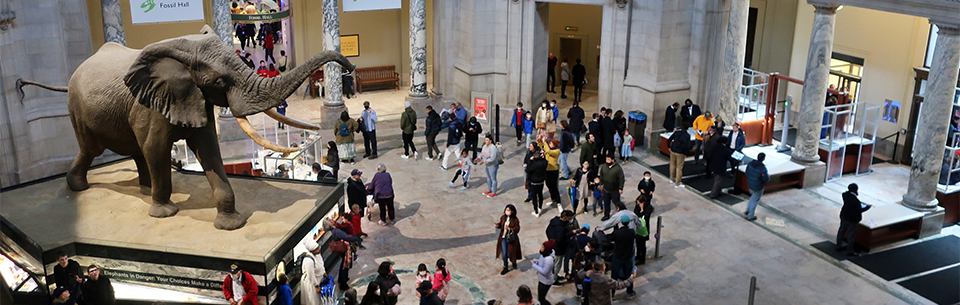
Image CC BY-NC-ND 2.0 by Wally Gobetz via Flickr
6 Tips for Touring an Evolutionary Natural History Museum
What are your travel plans for this summer? For many Americans—especially with the 250th anniversary of America taking place this year—summer plans include a road trip and seeing some of America’s greatest sights. (How about the two leading Christian themed attractions in the world?) I recently shared my tips for visiting the Creation Museum and Ark Encounter on your road trip, and today I want to share my suggestions for touring an evolutionary natural history museum.
Obviously, a secular museum is probably going to present evolution and millions of years as fact and may have other scientifically or biblically problematic content. So how do you and your family tour these museums, enjoying the artifacts, displays, and more, without absorbing evolutionary ideas? Here are my six tips:
-
Learn the 7 C’s of History before you go. At the Creation Museum, we summarize the foundational history God has given us in his Word (Genesis 1–11, the foundation for everything) in the 7 C’s of History. It’s an easy way of remembering this foundational history and the gospel chronologically. When you have the framework of Creation, Corruption, Catastrophe, Confusion, Christ, Cross, and Consummation in your mind, it makes it easier to properly interpret museum exhibits. And it’s a great teaching tool for kids. You can walk up to an exhibit and ask, “Which C of History does this fit into?” and have some great discussions, teaching them to interpret everything through the lens of Scripture.
You can learn more about the 7 C’s of History in this blog post.
-
Discuss the importance of worldview and the two kinds of science. Science is not some kind of neutral endeavor (one is either for or against Christ) where the evidence speaks for itself. Everyone (including every scientist) has a worldview, and they use that worldview to interpret the evidence we have in the present. That’s why it’s important to understand the difference between observational science and historical science.
Observational science is directly testable, observable, and repeatable (think technology and medical innovations).
Historical science, though, deals with the past. We only have access to the present.
The worldview you bring to the evidence in the present will determine your interpretation.
Fossils, rock layers, etc. exist in the present, and we can’t directly test, observe, or repeat the past. We didn’t see how they were formed. So the worldview you bring to the evidence in the present will determine your interpretation.
It’s not a battle of science vs. the Bible—it’s really this: Will we start with God’s Word or man’s word?
-
Always separate the fact from the interpretation. Museum cases often include the facts (e.g., the fossils), and then the signage and illustrations add the interpretation! Learn to separate what was actually found from the evolutionary interpretation applied to the evidence. For example, fossils rarely contain soft tissues so it’s difficult to reconstruct what that creature looked like when it was alive. Because evolutionists believe life evolved from primitive to complex, they often illustrate life in the lower rock layers as very primitive looking. Remember that the illustration is not what they found—what they found was a fossil (or bits of a fossil). The illustration is merely an evolutionary worldview applied to the evidence.
-
Understand the order in the fossil record. Some museums will present life as a progression from simple to complex through the fossil record. Understanding that the fossil record does not represent eons of time and different eras of life but, rather, different stages of the flood as the waters rose (first burying the deep ocean and later the continents) is important for properly interpreting the rough “order” to the fossil record.
If you have kids, they can learn all about this in Schus Off!: The Movie, a one-hour special on geology and the flood featuring AiG’s Avery Foley Schu and her family, streaming exclusively on Answers TV. (Why not get an Answers TV subscription, and your kids can watch this movie and the other great, family-friendly, God-honoring programs while you drive?)
-
Remember to ask, “Were you there?” For decades, I’ve taught children that whenever they hear about evolution or millions of years, they should (politely) ask the question, “Were you there?” You see, no scientist was there in the beginning, no scientist knows everything, and scientists often make mistakes. Now, I wasn’t there either and neither were you, but we know the one who was there—and he is perfect, doesn’t make a mistake, knows everything, and has given us an eyewitness account of history in his Word. So even if a museum exhibit stumps you and you don’t know how to properly interpret it, remember God was there and we can trust his Word over the interpretations of man.
-
Give God the glory. As you tour museums and other attractions, you will see many examples of God’s handiwork and creativity. In the midst of correcting the evolutionary signage and offering a biblical worldview interpretation for your family, don’t forget to give God the glory for the wonderful things he’s made!
Oh, and here’s one more bonus tip: Visit the Creation Museum and Ark Encounter first! Our God-honoring, Bible-upholding attractions help you put on your “Bible glasses” so you can properly interpret the world around you. It’s a great way to help your kids know how to spot error. And I have family after family share with me how refreshing it is to visit attractions where they aren’t having to correct everything on the signage—they can just enjoy their time!

Plan your visit today at ArkEncounter.com or CreationMuseum.org.
Thanks for stopping by and thanks for praying,
Ken
This item was written with the assistance of AiG’s research team.
Support the creation/gospel message by donating or getting involved!

Answers in Genesis is an apologetics ministry, dedicated to helping Christians defend their faith and proclaim the good news of Jesus Christ.
- Customer Service 800.778.3390
- Available Monday–Friday | 9 AM–5 PM ET
- © 2026 Answers in Genesis