
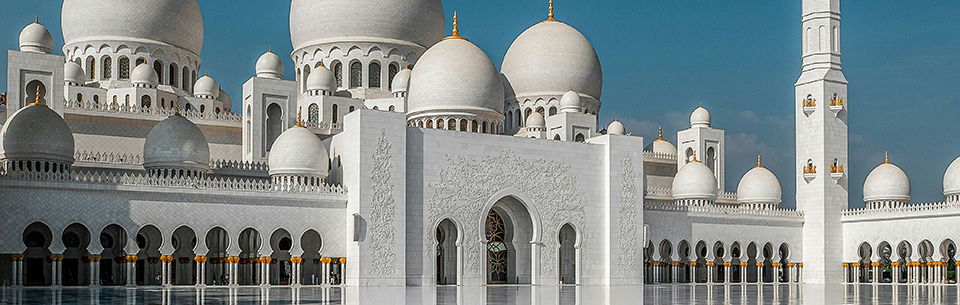
Photo by Leon Macapagal on Unsplash
What Every Christian Should Know About Islam
Part 1
Today, Islam has become a massive conversation religiously, politically, and societally. Why is this? Well, of the eight billion people living in the world, approximately two billion are Muslims.1 That’s one-quarter of the world’s population. This makes Islam the world’s second-largest and fastest-growing religion. Pew Research has predicted that by 2050, the number of Muslims and Christians in the world would be close to equal and that by 2075, Islam will be on course to become the world’s largest religion.2 This growth is due to not converts to Islam but high birth rates among Muslims. Historically, Islam has spread by conquest, not conversion. The importance of the growth of Islam is that the more Muslims there are in the world, the more weight their voices will have in society.
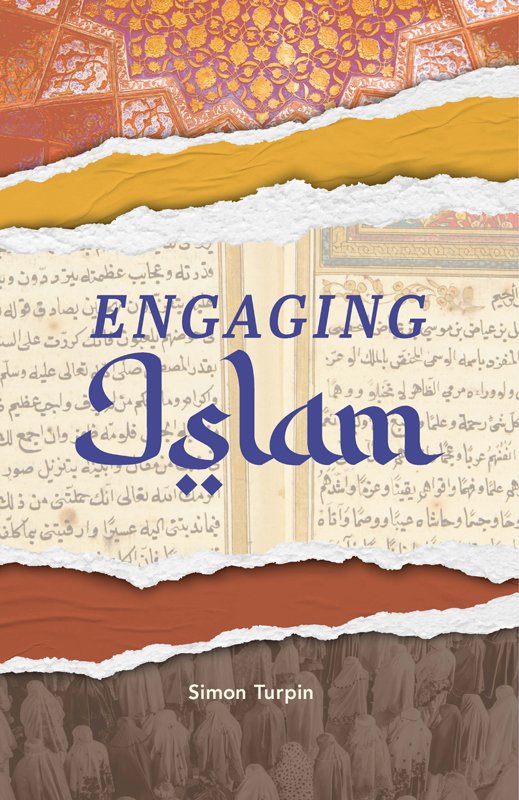
Portions of this article have been adapted from Simon Turpin, Engaging Islam (Hebron, KY: Answers in Genesis, 2021).
With billions of followers, Islam has become dominant in the world—whether it is living next door or working with a Muslim or hearing about the 2026 conflict in Iran, the Taliban fighting in Afghanistan, the militant group ISIS killing people in Iraq or Syria, Islamic militants killing Christians in Nigeria, the terror attacks in New York, London, Paris, Madrid, and many other places.
For these reasons, if we are thinking about Islam from a Christian worldview and want to engage with it, then we need to ask the question, “What do Muslims believe?” This is because Muslims are not only taught to challenge the central teachings of Christianity, but the Quran misunderstands and misrepresents them (the deity of Christ, the Trinity, the crucifixion, and the resurrection). Christians won’t be able to clearly communicate the gospel to Muslims without understanding what Muslims believe.
If we are thinking about Islam from a Christian worldview and want to engage with it, then we need to ask the question, “What do Muslims believe?”
For example, the Bible teaches that Jesus is the Son of God (a divine title), but when Muslims hear this, they think that this means God had intercourse with a woman (Mary) and produced Jesus as their offspring. The belief that Jesus is the Son of God is not acceptable for Muslims because the Quran teaches Allah (“God”) does not have any partners and is a Father to no one (Surah 5:18; 6:101; 21:26). This misrepresentation of the meaning of Jesus being the Son of God has led many Muslims to not understand the gospel.
Furthermore, when sharing the gospel with Muslims, it is not uncommon to hear the objection: “Where did Jesus say, ‘I am God; worship me’?” This is because many Muslims have been trained (by Muslim apologists) to ask this question of Christians and demand that the answer must be in those exact words. Of course, this is an inconsistent and irrational demand. If we applied the same criteria, then we could ask them to show us in the Quran where it says that to become a Muslim you must use the exact words of the shahada: “There is no god but Allah, and Muhammad is His Messenger.” Although both statements in the shahada are in the Quran (Surah 37:35 and 48:29), they are not found in those exact words in that order as a formula for someone to become a Muslim. Nevertheless, often when Christians do show Muslims that Jesus claimed to be divine (cf. Mark 14:61–64; John 8:58), their response is to argue that the Gospels have been corrupted, and therefore, we cannot trust what they say about Jesus. This is a strange claim since the Quran does not teach that the Gospels have been corrupted but, rather, commands Christians and Muslims to judge by what is written in the Gospels (Surah 5:47, see below).
Christians need to know where the Islamic faith came from and what Muslims believe, or they will not be able to share the gospel of the Lord Jesus Christ with them. Christians do not need to know everything about Islam, but they do need to know some things, as Islam is too big and relevant to current events for a Christian not to know anything about it. Many Muslims who believe in the truth of Islam will not take the gospel seriously until their own belief has been challenged with the truth of the gospel.
The Origin of Islam
According to classical Muslim sources (Sīrat Rasūl Allāh, “Life of the Messenger of Allah” by Ibn Ishaq, c. AD 773), Islam originated under a man named Muhammad, who is the last and greatest prophet sent by Allah (Surah 33:40).
Muhammad is said to have been born around AD 570 in Mecca (Saudi Arabia) to the aristocratic Banu Hashim clan of the Quraysh. The beginning of Muhammad’s life is filled with tragedy as his father, Abdullah, died before he was born, and his mother, Amina, died when he was six years old. After his mother died, he went to stay with his grandfather (Abdul-Muttalib) for the next two years until he died. At age eight, Muhammad went to live with his uncle Abu Talib, the leader of the Banu Hashim clan within the Quraysh tribe—a prominent Arab Quraysh tribe in Mecca. In the seventh century, Mecca was a regional trade route along the west coast of Arabia and was home to two polytheistic religions whose gods were thought to protect the lucrative trade.3 In his early life, Muhammad accompanied his uncle in the Meccan caravan trade up into the region of Syria, which would put him in contact with many religious traditions (including Judaism and Christianity). In his early twenties, Muhammad was hired by a wealthy widow named Khadija to safely transport her trade caravans to Syria. Khadija was impressed by Muhammad’s success in business and proposed marriage (c. AD 595). Muhammad’s marriage to Khadija provided him with financial security and time for him to go and pray alone in a cave named Hira on Mount Jabal al-Nour, near Mecca, for several weeks a year.
In AD 610, when Muhammad was 40 years old, during one of those trips to the Hira cave, he supposedly encountered the archangel Gabriel (Jibra’il in Arabic), who tells him to “recite”! Muhammad responded, “I cannot recite.”4 This caused Gabriel to press him so forcefully three times that Muhammad thought he was dying, and after releasing him, Gabriel recited the first verses of the Quran, beginning with “Recite, O prophet, in the name of your Lord” (Surah 96:1). At first, after receiving these revelations, Muhammad became distressed and even tried to commit suicide because he thought he was possessed. However, his wife, Khadijah, and her cousin Waraqah ibn Naufal (a Nestorian Priest)5 persuaded him that he was a prophet of Allah.6
It was between AD 610 and 622 that Muhammad is claimed to have received his Meccan revelations. Although Muhammad is claimed to have received the Quran over a period of 23 years, the classical Islamic belief is that the Quran was “sent down” in one night—Laylat al-Qadr, the Night of Power. The provocative nature of Muhammad’s monotheistic messages, regarding Allah’s oneness (tawhid), angered the polytheistic Meccan merchants who began to ridicule and persecute Muhammad and his followers. This led Muhammad and his followers (80 to 200) to flee 210 miles north to the city of Medina (c. AD 622), where they were promised freedom to practice their religion. Muhammad’s move from Mecca to Medina is known as the hijra—the flight—and marks year one of the Islamic lunar calendar.
Just before Muhammad moved to Medina, the Mi’raj took place (AD 621). This was a night journey when Muhammad supposedly traveled on the back of a winged horse (Buraq) from the Kaaba in Mecca to the “Farthest Mosque,” the Al-Aqsa Mosque in Jerusalem. There, Muhammad met with several different prophets and then Allah in the seven heavens. It was there that Muhammad agreed with Allah to pray five times a day. This event became central in proving the divine approval of Muhammad’s prophethood. It was from Medina that Muhammad established himself as “the Prophet” and began to subdue Arabia. In AD 630, Muhammad led a huge army into Mecca and conquered it, cleansing the Kaaba of all its idols. All non-Muslims were driven out of Mecca and Medina.
Muhammad died in AD 632 (possibly by poisoning from a Jewish woman, Sahih al-Bukhari 2617) without the Quran ever having been written down; it was received but not written down.
When Muhammad died in AD 632, he had not named a successor. This caused a faction among his followers. The Shia believed that only persons with a direct ancestry to the prophet Muhammad could guide the Muslim community. They chose Ali ibn Abi Talib the cousin and son-in-law of Muhammad to be their leader. On the other hand, the Sunnis believed that Muhammad’s successor should be determined by consensus, and they consecutively chose three of Muhammad’s most trusted companions as leaders of the Muslim community: Abu Bakr (AD 632–634), 'Umar ibn al-Khattab (AD 634–644), and 'Uthman ibn-Affan (AD 644–656).
Within 100 years of Muhammad’s death, Islam quickly conquered vast territories stretching from North Africa to south Asia.
| Classical Account of Muhammad’s Life | |
|---|---|
| AD 570 | Born |
| AD 610 | Encountered the Archangel Gabriel |
| AD 610–622 | Received Meccan Revelations |
| AD 621 | Mi’raj to the Seven Heavens |
| AD 622 | Hijra from Mecca to Medina |
| AD 622–632 | Received Medinan Revelations |
| AD 630 | Conquered Mecca |
| AD 632 | Died |
Islam’s Beliefs
Islam is not only based on the Quran but is also based on the teachings, deeds, and sayings of Muhammad (the Sunnah).
Islam is not only based on the Quran but is also based on the teachings, deeds, and sayings of Muhammad (the Sunnah). The Sunnah is documented in the Hadith, which is a record of the sayings, actions, approvals, and teachings of Muhammad.7 For Muslims, Muhammad is the final and greatest prophet sent by Allah (Surah 33:40), as well as the pattern of conduct for Muslims, so they are meant to follow him (Surah 33:21). Therefore, Islam is the final religion based on the Quran’s teaching and Muhammad’s life and sayings found in the Hadith. Islam is completely dependent on the Quran and the life of Muhammad.
Islam’s main groups are the Sunni and Shia. About 90% (or 85%) of the nearly two billion Muslims in the world identify as Sunni (i.e., Saudi Arabia, Egypt, Yemen, Pakistan, Indonesia, and Turkey). The other 10% (or 15%) are Shia (i.e., Iraq, Iran, and minority communities in Yemen, Bahrain, Syria, and Lebanon). Both Sunni and Shia Muslims follow the Quran as well as the Hadith and agree to the essential details for the presentation and practice of the five pillars of Islam (see below). The differences between the two groups come in religious practices (prayer and marriage) and religious leadership (see above).
There are also other branches within Islam. Sufism is a more mystical discipline that exists within both Sunni and Shia Islam. It emphasizes the possibility of gaining more knowledge of God through mysticism and is most common in sub-Saharan Africa. A more radical (root) group of Muslims are the Salafis, who originated in the nineteenth century. Salafism is primarily a Sunni Islamic movement, seeking to return to the Islam practiced by the earliest generation of Muslims. Some Salafi groups (like ISIS, Al-Qaeda) violently oppose Sufism, viewing its devotional practices (like shrine veneration) as idolatry. Another group of Muslims who originated in the nineteenth century are the Ahmadiyya. Their beliefs are identical, though with some distinct teachings, to those of mainstream Sunni Muslims. However, the Ahmadiyya are considered non-Muslims by many mainstream Muslims since they believe Mirza Ghulam Ahmad, the founder of the movement, is the promised Mahdi and messiah awaited by the Muslims.
The Arabic word Islam means “to show submission,”8 and in its religious context, submission refers to submitting one’s will to Allah. The word Muslim means “one who submits to Allah.” The justification for submission in Islam comes from the Quran, as Allah says:
Say, O believers, “We believe in Allah and what has been revealed to us; and what was revealed to Abraham, Ishmael, Isaac, Jacob, and his descendants; and what was given to Moses, Jesus, and other prophets from their Lord. We make no distinction between any of them. And to Allah we all submit.” (Surah 2:136)9
Part of this submission is not to doubt anything that Muhammad has decided, or you are not a real Muslim (Surah 4:65). This is because in Islam once Allah or his messenger Muhammad have decided something, you cannot question them (Surah 33:36). The message of Islam is not just about submitting to Allah but how you submit to Allah by doing certain deeds and believing certain things. Islam has two lists of the most important deeds (five pillars of Islam) and the most important beliefs (the six articles of faith).
The uniqueness of Islam is seen in their doctrinal practices of the five pillars of Islam, which are central to the faith:
- Shahada (Faith): To become a Muslim, you must say in Arabic: “There is no god but Allah. Muhammad is the messenger of Allah.”
- Salah (Prayer): These prayers are memorized recitations done in Arabic five times a day with the Muslim prostrated facing Mecca.
- Zakat: (Charity): All Muslims (except for the extremely poor) are required to give 2.5% of their individual income to take care of mosques, Muslim communities, or those in poverty.
- Sawm (Fasting): Fasting—which is defined in Islam as not eating or drinking from sunrise to sunset, with eating and drinking taking place from just after sunset to just before sunrise—takes place during Ramadan, the holy month in the Islamic lunar calendar.
- Hajj (Pilgrimage to Mecca): Once in their life, every Muslim who is physically and financially able is required to make the pilgrimage to Mecca during the twelfth month of the lunar calendar.
The five pillars are not defined in the Quran but in the Hadith and are definitional of Islam. In fact, the five pillars are demands that are expected of every Muslim. The Quran summarizes several of the pillars of faith in one verse:
Indeed, those who believe, do good, establish prayer, and pay alms-tax will receive their reward from their Lord, and there will be no fear for them, nor will they grieve. (Surah 2:277)
It is obvious from this verse that Muslims are required to do these pillars (“do,” “establish,” “pay”) to be rewarded. The first Surah of the Quran is the foundation of the five daily prayers, and the verses are a prayer for the guidance, mercy, and lordship of Allah:
Guide us along the Straight Path, the Path of those You have blessed—not those You are displeased with, or those who are astray. (Surah 1:6–7)
When a Muslim prays these words, what are they praying? The early commentaries (Tafsirs) on these verses identified “those You are displeased with” as referring to Jewish people and “those who are astray” were Christians (see Ibn Al Kathir, 1:7). Given this understanding of this Surah, every day in every prayer a Muslim prays not to be a Christian since they have gone astray. The Muslim belief that Christians have gone astray is confirmed elsewhere in the Quran (Surah 5:77).
The belief that Christians have gone astray is a huge barrier to the Muslim becoming a Christian. However, this is opposite to the teaching of the Bible, which the Quran confirms (see below), as it teaches salvation comes through the person and work of the Lord Jesus Christ and that he alone is the only way to God (John 14:6; Acts 4:12, 24:14–16).
Islam also has six articles of faith that you must believe to be considered a true believing Muslim:
- To believe in the oneness of Allah
- To believe in the angels
- To believe in the books of Allah (Torah, Psalms of David, The Gospel, and the Quran)
- To believe in all the prophets (Muhammad the last of them, Jesus the penultimate, and Moses who came before them)
- To believe in the Day of Judgment (heaven and hell)
- To believe in the Divine Decree (Will of Allah)
For someone to be considered a believing Muslim, they must accept these six articles of faith. Muslims, therefore, must believe that Muhammad was a prophet sent by Allah; this means that those who identify as moderate Muslims in secular Western nations and reject Muhammad as a prophet are not to be considered believing Muslims.
The goal of Islam is not only about the submission of the complete person to Allah but that the entire world be submitted to Allah and his law. In Islam, religion is not part of life, but life is part of religion. Therefore, the goal of Islam is to spread their message and lifestyle and then take over society and bring everyone under Islamic law (Sharia).
Sharia law is Islam’s divine code of ethical, moral, and legal principles derived from the Quran and Hadith. Some form of Sharia law is practiced in at least 48 different countries. These countries are invariably Muslim nations, and each has its own school of interpretation (the Hanafi school, the Hanbali school, the Ja’fari school, the Maliki school, the Shafi’i school).10 Afghanistan (under the Taliban) has highly strict application of Sharia law as it aims to implement classical Sharia (the Hanbali school). The basis of Iran’s legal code is Sharia law (Ja’fari school), but it’s integrated into a codified civil law system, with the judiciary overseen by the state but also influenced by religious oversight bodies like the Council of Guardians. The United Kingdom doesn’t have Sharia law courts, but it does have Sharia councils that operate as voluntary, religious advisory bodies, primarily using interpretations from the four Sunni schools of thought (Hanafi, Maliki, Shafi’i, Hanbali) for family matters like marriage and divorce, that operate alongside the UK legal system.
Under Sharia law, there is a theological justification for sanctioning violent acts on any number of offenses, including, but not limited to, adultery, blasphemy, homosexuality, and apostasy (see Surah 24:2; 4:89; Sahih al-Bukhari 6922; Sunan an-Nasa’I 4063).
Despite what many Western politicians believe, the violent acts of terror committed by ISIS, Boko Haram, Al-Shaba, Al-Qaeda, and the Taliban cannot be divorced from the religion of Islam, which comes from the text of the Quran and the Hadith (see Surah 9:123; 48:29; Sahih Muslim 33). In the Hadith, Muhammad declares:
I have been ordered to fight the people till they say: ‘None has the right to be worshipped but Allah, ‘and whoever said, ‘None has the right to be worshipped but Allah’, Allah will save his property and his life from me, unless (he does something for which he receives legal punishment) justly, and his account will be with Allah?’ (Sahih Bukari 6924)
A popular part of a verse that Muslims and Western politicians use to show that Islam is a religion of peace is Surah 5:32: “Whoever saves a life, it will be as if they saved all of humanity.” The beginning of the verse, however, makes it clear who is being talked about in context:
That is why We ordained for the Children of Israel that whoever takes a life—unless as a punishment for murder or mischief in the land—it will be as if they killed all of humanity; and whoever saves a life, it will be as if they saved all of humanity.
The beginning of Surah 5:32 is referring to Surah 5:31, which is talking about Cain killing his brother Abel, so it is a redemption analysis on the blood of Abel for the “Children of Israel.” The next verse is not so peaceful:
Indeed, the penalty for those who wage war against Allah and His Messenger and spread mischief in the land is death, crucifixion, cutting off their hands and feet on opposite sides, or exile from the land. This penalty is a disgrace for them in this world, and they will suffer a tremendous punishment in the Hereafter. (Surah 5:33).
Muslims and politicians who like to cite peaceful verses in the Quran need to realize that the surrounding context of those verses show that they are not so peaceful
Muslims and politicians who like to cite peaceful verses in the Quran need to realize that the surrounding context of those verses show that they are not so peaceful (see Surah 2:256 followed by Surah 2:257; Surah 2:190 followed by 2:191–193). Although the Quran is often portrayed as a book of peace, this is hardly the case when it is read in context.
The fact of the matter is that the Quran teaches that Muslims are the best people in the world (Surah 3:110), whereas Jewish people, Christians, and the Al-Mushrikun (idolaters) are the worst of creatures (Surah 98:6). This is because the only religion that is acceptable to Allah is Islam (Surah 3:85), and the Quran calls Muslims to violently subdue those who do not believe in Allah:
Fight those who do not believe in Allah and the Last Day, nor comply with what Allah and His Messenger have forbidden, nor embrace the religion of truth from among those who were given the Scripture, until they pay the tax, willingly submitting, fully humbled. The Jews say, “Ezra is the son of Allah,” while the Christians say, “The Messiah is the son of Allah.” Such are their baseless assertions, only parroting the words of earlier disbelievers. May Allah condemn them! How can they be deluded from the truth? (Surah 9:29–30)
There are Muslim apologists who would argue that Surah 9:29 is temporally limited to a particular period. However, 9:29 is contextually connected to 9:30, which does not have a temporal application. Surah 9:29 has nothing to do with fighting invaders (self-defense) but unbelievers, as the criteria for fighting has to do with the religious beliefs of Jews and Christians. These violent Surahs were revealed to Muhammad later in the history of his revelations and are said to abrogate (Surah 2:106; 16:101) the earlier message of peace that Muhammad is said to have preached (Surah 2:256; 109:6).11 The Hadith makes it clear which Surah came last:
The last Sura which was revealed in full was Baraa (i.e. Sura-at-Tauba), and the last Sura (i.e. part of a Sura) which was revealed was the last Verses of Sura-an-Nisa':-- “They ask you for a legal decision. Say: Allah directs (thus) About those who have No descendants or ascendants As heirs.” (Sahih al-Bukhari 4364)
Surah Baraa is another name for Surah At-Tawbah, which is Surah 9, Muhammad’s last words to Muslim. It is important to make clear that many Muslims do not believe or act upon what these violent verses in the Quran command them to believe and do.
In the next article in this three-part series, we’ll take a closer look at the Quran.
Footnotes
- Around 62% of Muslims live in the Asia-Pacific (from Turkey to Indonesia) region of the world, surpassing the number of Muslims living in Africa and the Middle East.
- See Conrad Hackett, Marcin Stonawski, Yunping Tong, Stephanie Kramer, Anne Shi, and Dalia Fahmy, “3. Muslim Population Change,” in “How the Global Religious Landscape Changed from 2010 to 2020,” Pew Research Center, June 9, 2025, https://www.pewresearch.org/religion/2025/06/09/muslim-population-change/.
- The two polytheistic cults in Mecca were the veneration of the goddess Manāt (goddess of fate) and the Hubal cult, which centered on the Syrian god of the moon and was the most prominent deity housed within the Kaaba.
- The fact that Muhammad could not read is considered a key aspect of the miracle of the Quran, demonstrating that the divine text was a revelation from God, not something he could have authored himself.
- Nestorians rejected the hypostatic union and taught that Jesus’ deity and humanity were divided so that he was two persons living in one body.
- The Life of Muhammad: A Translation of Ishaq’s Sirat Rasul Allah (Oxford: Oxford University Press, 1955), 106–107.
- The most important Hadith for Sunni Muslims are Sahih al-Bukhari, Sahih Muslim, Sunan Abi Dawud, Sunan al-Tirmidhi, Sunan al-Nasa'i, and Sunan Ibn Majah. For Sunni Muslims, Sahih al-Bukhari and Sahih Muslim are considered the most authentic.
- Ibn Manzur, Lisan al-Arab, Dar Sadir, Beirut vol. 12, 293.
- All Quranic verses quoted are from https://quran.com/.
- World Population Review, “Sharia Law Countries 2026,” accessed March 2026, https://worldpopulationreview.com/country-rankings/sharia-law-countries.
- The doctrine of abrogation (Naskh) was developed to resolve contradictory rulings of Islamic revelation by suspending or canceling the earlier revelation.
Support the creation/gospel message by donating or getting involved!

Answers in Genesis is an apologetics ministry, dedicated to helping Christians defend their faith and proclaim the good news of Jesus Christ.
- Customer Service 800.778.3390
- Available Monday–Friday | 9 AM–5 PM ET
- © 2026 Answers in Genesis