

Photo by Annabel Podevyn on Unsplash
Over 76,400 Adults Killed by Doctors in Canada
By the end of 2024, enough Canadians to fill a sizable football stadium had died by euthanasia, according to recently released official statistics.1 As Canadian ethicist Daryl Pullman observes, these deaths “are in point of fact, homicides.”2 So while the government refers to euthanasia and assisted suicide as MAID (for “medical assistance in dying”), a more accurate term is SHAM: sanctioned homicide actualized medically.
A detailed exposé of SHAM from a biblical worldview perspective is available in the article “When Health Care Becomes Homicide.” As an update to this article, the following overview will highlight some concerning details from the latest data, which represent Canadian SHAM deaths during the year 2024. First, a little background information is in order.
Some Background
SHAM includes both physician-assisted suicide (PAS) and euthanasia. In PAS, an individual gives himself or herself lethal drugs that a medical practitioner has prescribed for suicide purposes. In euthanasia, a medical practitioner personally kills the individual. Euthanasia has accounted for the overwhelming majority of Canadian SHAM deaths.3
SHAM has been legal (or at least, not criminally prosecutable) in Canada since 2016.4 Originally, restrictions stated that only adults with a “grievous, irremediable medical condition” and a “reasonably foreseeable natural death” could die by SHAM.5 However, the government struck down the foreseeable natural death restriction in 2021.6 Since then, the government uses the term “Track 1” for SHAM cases where people had a reasonably foreseeable natural death. “Track 2,” meanwhile, refers to cases where people were not already dying of natural causes.
Health Canada has released six annual reports on SHAM, beginning in 2019. Let’s see some of the stats.
Highlights from the Latest Data
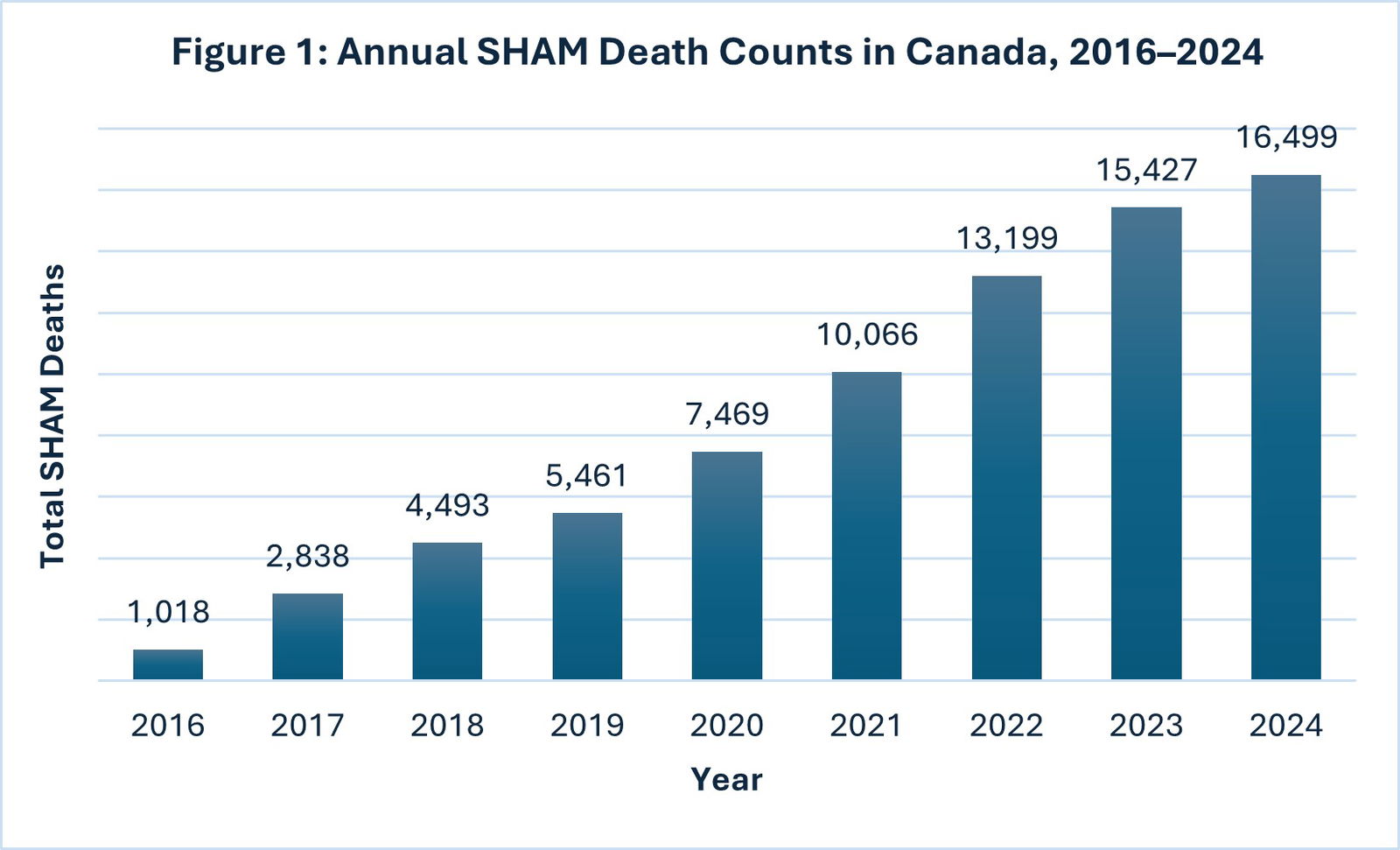
- Totals: Between 2016 and 2024, SHAM extinguished a reported total of 76,475 Canadian lives.7 Of these deaths, 16,499 occurred last year alone—a record number compared to previous years, as Figure 1 shows.8
- Causes of Deaths: In 2024, all cases of SHAM occurred by euthanasia rather than PAS.9
- Percentage of Deaths via SHAM: Just over 1 in 20 Canadians now die by SHAM.10 Oddly, however, the last two annual reports both state that SHAM does not qualify as a “cause of death” according to World Health Organization criteria and “should not be compared to cause of death statistics in Canada.”11 The idea that SHAM shouldn’t count as a cause of death does not appear to be similarly emphasized in earlier annual reports, which all include a sentence stating, “In [x year], there were [x number of] cases of MAID reported in Canada, accounting for [x percent] of all deaths in Canada.”12
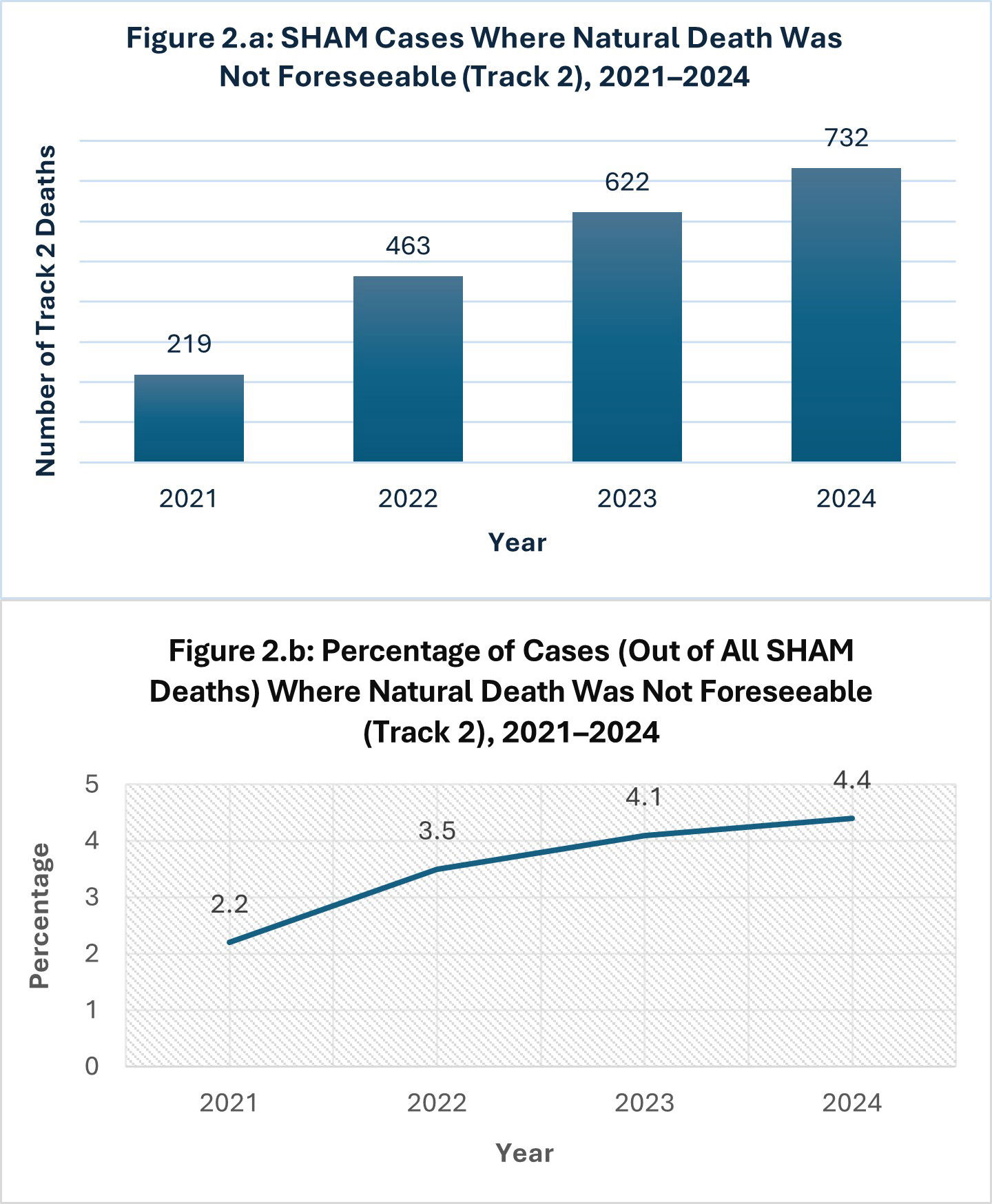
- Cases Where Natural Death Was Not Foreseeable: In 2024, medical practitioners killed 732 Canadians who did not have a reasonably foreseeable natural death, representing 4.4% of SHAM cases that year.13 This is also a record number (Figure 2.a), although the government emphasizes the rate by which these “Track 2” cases are annually increasing has lessened14 (Figure 2.b).15
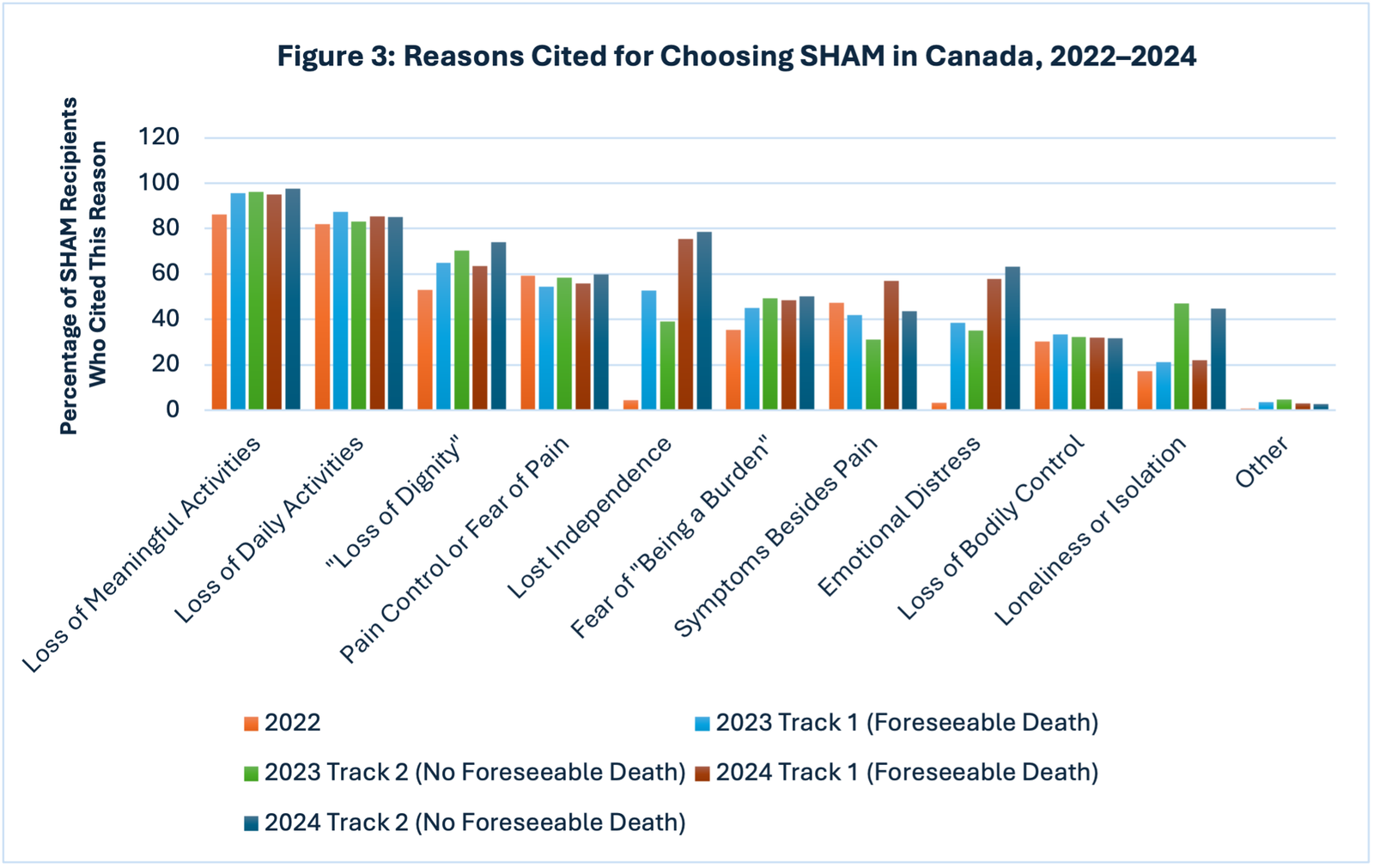
- Reasons Given for Choosing SHAM: Compared to 2022 and 2023, more Canadians in 2024 reported choosing SHAM for reasons including lost independence and emotional distress. Tellingly, people who died of SHAM without having a reasonably foreseeable natural death (Track 2) were twice as likely to cite loneliness (44.7%) as the reason compared to people whose natural death was foreseeable (Track 1, 21.9%). Figure 3 summarizes these trends.16
A Biblical Response
What are Christians to make of these tragic realities? Here are a few ideas for how to respond:
- Be equipped to help others understand why SHAM opposes a biblical worldview and is not justifiable from a public-policy perspective. This article is here to help.
- Pray for changes of hearts in Canada and around the world, that people would turn from choosing death to choosing life—and especially would find eternal life in Jesus Christ.
- Advance the gospel, sharing the hope that our secularized society needs.
- Advocate for life, especially as more jurisdictions in the US and elsewhere consider legalizing forms of SHAM.17
- Support pro-life palliative care options.
- Reach out to others as the church, to combat factors such as emotional distress and loneliness that are motivating people to seek death for themselves. (See also Matthew 25:36.)
As SHAM snuffs out tens of thousands of lives, we must stand as lights amid a world desperate for the hope found only in Jesus—the way, the truth, and the life (John 14:6).



Footnotes
- Health Canada, Sixth Annual Report on Medical Assistance in Dying in Canada, November 2025, https://www.canada.ca/en/health-canada/services/publications/health-system-services/annual-report-medical-assistance-dying-2024.html#a2.2.
- Daryl Pullman, “Slowing the Slide Down the Slippery Slope of Medical Assistance in Dying: Mutual Learnings for Canada and the US,” The American Journal of Bioethics 23, no. 11 (2023): 64–72.
- The first through fourth annual reports all stated that “fewer than seven” cases of SHAM were self-administrated during each of these years but do not seem to specify how many cases occurred prior to 2016. The fifth report said there were “fewer than five” such cases in 2023. This implies the maximum number of PAS cases must be (6x4) + 4 = 28. See Health Canada, First Annual Report on Medical Assistance in Dying in Canada, 2019, July 2020, https://www.canada.ca/en/health-canada/services/publications/health-system-services/annual-report-medical-assistance-dying-2019.html; Health Canada, Second Annual Report on Medical Assistance in Dying in Canada 2020, June 2021, https://www.canada.ca/en/health-canada/services/publications/health-system-services/annual-report-medical-assistance-dying-2020.html; Health Canada, Third Annual Report on Medical Assistance in Dying in Canada 2021, July 2022, https://www.canada.ca/en/health-canada/services/publications/health-system-services/annual-report-medical-assistance-dying-2021.html; Health Canada, Fourth Annual Report on Medical Assistance in Dying in Canada 2022, October 2023, https://www.canada.ca/en/health-canada/services/publications/health-system-services/annual-report-medical-assistance-dying-2022.html; Health Canada, Fifth Annual Report on Medical Assistance in Dying in Canada, 2023, December 11, 2024, https://www.canada.ca/en/health-canada/services/publications/health-system-services/annual-report-medical-assistance-dying-2023.html#t2.2a.
- See “Legislative Background: Medical Assistance in Dying (Bill C-14),” Government of Canada, accessed December 4, 2025, www.justice.gc.ca/eng/rp-pr/other-autre/ad-am/p2.html.
- See “Legislative Background,” Government of Canada.
- “Bill C-7: An Act to Amend the Criminal Code (Medical Assistance in Dying),” Government of Canada, accessed July 11, 2024, www.justice.gc.ca/eng/csj-sjc/pl/charter-charte/c7.html.
- This is the total stated in Health Canada, Sixth Annual Report, section 2.2; however, the number that can be calculated from the data cited in note #3 above falls five persons short of this.
- Statistics shown in Figure 1 represent the totals reported in Health Canda, Sixth Annual Report, Figure 2.2a (see “Text Description” under the figure) for the years 2019–2024, and Health Canada, Fourth Annual Report, Chart 3.1 for the years 2016–2018 (which do not appear to be listed in the fifth or sixth annual reports). The stated totals for the years 2019–2022 differ between the reports, with slightly higher numbers reported for all these years in the Fourth Annual Report, Chart 3.1, than in the Sixth Annual Report, Figure 2.2a. The Sixth Annual Report states, “Previous years’ reporting has been revised to include corrections and additional reports,” so these are the data shown here. However, the resulting totals shown for Figure 1 add up to 76,470, five short of the figure reported in section 2.2 of the Sixth Annual Report.
- Specifically, the report states, “MAID was administered by a practitioner in all cases that occurred in 2024. While self-administration of MAID is permitted in all provinces and territories in Canada (except for Quebec), very few people have chosen this option since 2016.” (Health Canada, Sixth Annual Report, section 2.2.)
- According to Health Canada, Sixth Annual Report, section 2.2, “In 2024, 5.1% of people in Canada who died received MAID, a small (0.4%) increase from 2023.”
- Specifically, Health Canada, Sixth Annual Report, section 2.2 includes the statements, “As stated by the World Health Organization, a ‘cause of death’ is the disease or injury that initiated the train of events leading directly to death, or the circumstances of the accident or violence which produced the fatal injury. MAID, by contrast, is a health service provided as part of end-of-life or complex care. . . . For example, if a person suffering from advanced cancer chooses to receive MAID to alleviate their suffering, the cause of death extracted from their death certificate for the purposes of vital statistics will be cancer. Accordingly, the number of MAID provisions should not be compared to cause of death statistics in Canada in order to determine the prevalence (the proportion of all decedents) nor to rank MAID as a cause of death.” (Emphasis in original; footnote removed.) Similar statements can be found in Health Canada, Fifth Annual Report, section 2.2. Notably, however, the idea that giving someone a lethal dose of drugs is “health care” rather than an action that in fact “initiated the train of events leading directly to death” does not accord either with traditional reasoning or with Hippocratic medicine. (See “When Health Care Becomes Homicide.”)
- See Health Canada, First Annual Report; Health Canada, Second Annual Report; Health Canada, Third Annual Report; and Health Canada, Fourth Annual Report. Granted, the phrase “accounting for [x percent] of all deaths” may not fully equate to the phrase “cause of death”; still, the resulting change in tone between the fourth and fifth reports is noticeable.
- Health Canada, Sixth Annual Report, Figure 2.2a.
- Specifically, the report states, “While Track 2 has only be allowed since 2021, when looking at Track 2 MAID provisions specifically, the rate of growth has decreased from 33.3% between 2022 and 2023 to 17.1% between 2023 and 2024.” (Health Canada, Sixth Annual Report, section 2.2.)
- Data shown in Figure 2.a and Figure 2.b represent the statistics reported in Health Canada, Third Annual Report; Health Canada, Fourth Annual Report; Health Canada, Fifth Annual Report; and Health Canada, Sixth Annual Report.
- Data in Figure 3 represent statistics stated in Health Canada, Fourth Annual Report, Health Canada, Fifth Annual Report, and Health Canada, Sixth Annual Report.
- The exact number of states that are considering legalizing SHAM fluctuates, but the pro-SHAM organization Death with Dignity keeps a fairly updated map at deathwithdignity.org/states/. See also Rachael Yi, “Most Americans Favor Legal Euthanasia,” Gallup, August 8, 2024, https://news.gallup.com/poll/648215/americans-favor-legal-euthanasia.aspx.


Support the creation/gospel message by donating or getting involved!

Answers in Genesis is an apologetics ministry, dedicated to helping Christians defend their faith and proclaim the good news of Jesus Christ.
- Customer Service 800.778.3390
- Available Monday–Friday | 9 AM–5 PM ET
- © 2026 Answers in Genesis