
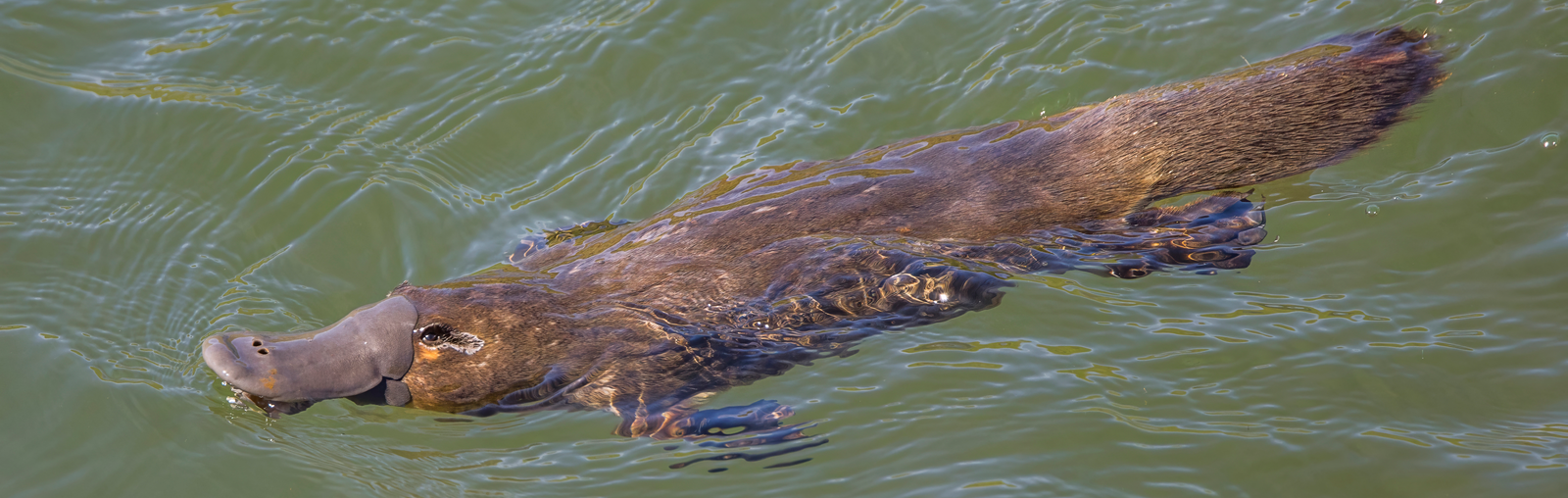
Image CC BY-SA 4.0 via Wikimedia Commons
The Platypus Just Got Weirder
The platypus is a strange animal. The small, semiaquatic mammal from eastern Australia has a long list of unique features:
- Bill like a duck,
- Fur like a mammal,
- Lays eggs like a reptile,
- Venomous like a snake,
- Spurs like a rooster,
- Webbed feet like a beaver,
- Electroreceptors,
- And fur that glows under UV light.
Well, scientists have now added another unique feature to the already long list: “Their fur also contains melanosomes that are unlike in any other animal—and scientists can’t figure out why.” Melanosomes “produce, store, and transport melanin pigment, which is the key determinant of skin, hair, and eye color, but can also serve other functions, like UV protection.”
Melanosomes come in different shapes but are always solid in mammals (they are often hollow in birds, which enhances their ability to produce vibrant or iridescent colors). But of course, the platypus once again breaks the rules. Its melanosomes are hollow and spherical, a never-before-seen combination. And they just produce brown fur—no bright colors or iridescence. Scientists still aren’t quite sure what’s going on with this new find!
So how do they explain this evolutionarily?
The team says that the hollowness might be ancestral, shared by a common ancestor of both mammals and birds. However, its absence in other egg-laying mammals and likely derivation in birds may indicate a single evolutionary origin. The team also says that the loss of the hollow melanosomes in genetically similar animals, like echidnas, cannot be ruled out. . . .
Excitingly, over 200 years after its description as something in between birds and mammals, we find additional convergence between the platypus and birds. The discovery of a unique melanosome morphology opens up exciting new avenues of research into melanin genetics, melanosome development and the evolution of melanosomes.
It’s like every other feature of the platypus: Evolutionists don’t know where it could have evolved from!
In other words, maybe it’s a unique evolutionary trait . . . but maybe it’s not and has just been lost by other “closely related” monotremes (egg-laying mammals). And maybe it’s evidence of a close relationship between birds and the platypus, even though they are separated on the evolutionary tree by a supposed 315 million years, no other mammal kept it, and birds don’t have spherical melanosomes anyway. So basically, it’s like every other feature of the platypus: Evolutionists don’t know where it could have evolved from!
Creatures like the platypus (often referred to as the most evolutionarily distinct mammal) are a puzzle for evolutionists—they certainly don’t fit neatly on the supposed tree of life! But they aren’t a problem for creationists. We understand that our God is a God of creativity who designed a wide variety of creatures with many different features and body plans.
The weirder the platypus gets, the more God’s boundless creativity is put on display.
Thanks for stopping by and thanks for praying,
Ken
This item was written with the assistance of AiG’s research team.
Support the creation/gospel message by donating or getting involved!

Answers in Genesis is an apologetics ministry, dedicated to helping Christians defend their faith and proclaim the good news of Jesus Christ.
- Customer Service 800.778.3390
- Available Monday–Friday | 9 AM–5 PM ET
- © 2026 Answers in Genesis