
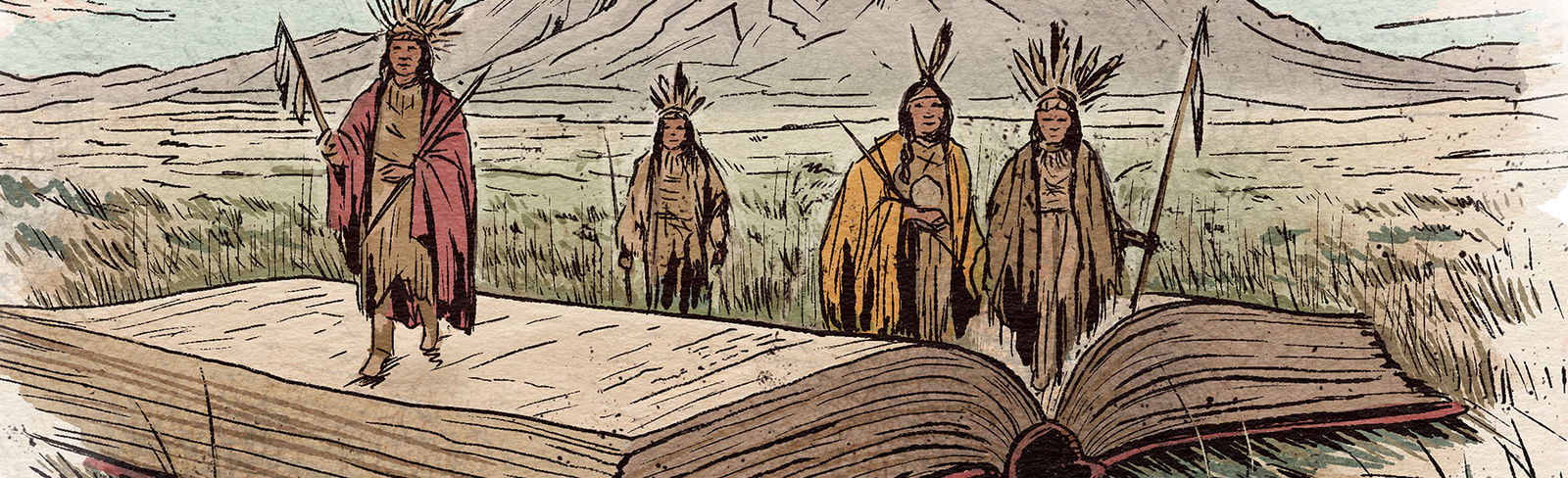
Rediscovering Pre-Colombian America
How creation science is giving Native Americans back their history
What happened in North America before the Pilgrims landed in AD 1620? Before Columbus arrived in the Caribbean in AD 1492? Who roamed the eastern woodlands and Great Plains, the humid Southeast and arid Southwest, the frigid Arctic and the balmy California coast? Growing up, I had no history to reference. I was never taught the play-by-play for pre-European North America. I had no images to fill in the empty space in my mind that was the map of pre-European North America.
In fact, when I first saw a map of North America at European contact, I was shocked by how much it resembled maps of Europe during the Middle Ages. I knew the latter was part of a long history of empires, kings, queens, diverse peoples and migrations, heroes and villains. Surely, precontact North America was the result of the same.
But what, specifically?
I’m guessing that your upbringing was like mine—devoid of any real insights into the pre-Pilgrim events on the continent that I call home.
This situation is now changing. Dramatically. Thanks to recent discoveries from young-earth-creation science, our understanding of precontact North America is undergoing a revolution.
Ruins
For the first 30 or so years of my life, I made regular trips to Germany, where the detailed history of Europe—in contrast to the inscrutable history of North America—stood out in stark relief. My primary purpose in going was to visit my relatives. But we’d also do touristy things.
On our trips throughout the country, I kept bumping into the evidence for the long history of Europe. Old castles popped up frequently. Medieval towns—like Rothenburg ob der Tauber, an exquisitely preserved, still-inhabited, picturesque site near the geographic belly button of Germany—enthralled my mind. The cathedral at Rothenburg dated back to the fourteenth century.
And then we’d come back to the United States where I knew of zero touristy sites from pre-Pilgrim days. Where were the ruins from precontact civilizations? Where was the evidence that North America watched thousands of years of human history unfold?
Once again, research based in young-earth creation (YEC) science is making revolutionary discoveries on their significance and history.
I have since found out that ruins do indeed exist across the continent. Once again, research based in young-earth creation (YEC) science is making revolutionary discoveries on their significance and history.
Rise and Fall
In short, a multiyear investigation involving the fields of archaeology, linguistics, genetics, and indigenous histories has uncovered the following narrative:
Around 2,000 years ago, some of the earliest Americans built geometric earthworks which, in some cases, were precisely aligned with astronomical phenomena, such as the 18.6-year cycle of the moon. I don’t know much more about these ancient peoples. I don’t know their names or the names of the nations to which they belonged. Because in the centuries after Christ, the Americas were invaded from Central Asia. Male genetic evidence for these early peoples disappeared.
The ruins of their culture, however, can still be visited.
Several centuries later, around AD 900, another group of Central Asians invaded North America. This time, I know the names of the invaders. Members of the Algic language family arrived in Alaska and defeated the indigenous residents, such as people speaking languages belonging to the Eskimo-Aleut language family.
The body of Algic speakers would eventually move south and then east, all the way to the shores of the Atlantic. Along the way, they spawned many nations that the Europeans encountered at contact, including Delaware, Blackfeet, Menominee, Potawatomi, Arapaho, Cree, Illinois, Miami, and Mohican. In fact, when the Pilgrims landed in Massachusetts, they encountered speakers of Algic languages.
But the famous AD 1620 encounter almost didn’t happen, had events from more than three centuries prior turned out differently.
Around the same time that the Algics arrived in North America, the Natchez migrated north from Mexico to near the area where modern St. Louis sits. The Natchez eventually built an empire that reached down to the Gulf and over the Atlantic. When the Algic migrated across the Great Plains and attempted to go east across the Mississippi, there were the Natchez. The Algic attempted diplomacy. The Natchez massacred them.
Allies from the north, probably the ancestors of Siouan groups (like the Lakota), came to the aid of the Algic. Together, they dealt the Natchez empire a fatal blow. Without this fatal blow, the first Thanksgiving would have looked very different.
Heroes
Thanks to the Algic records of their history, we now know the names of the leaders of the Algic who won the critical victories. Sharp One, Stirring, and Breaking Open led the initial turning of the tide. The Crusher put an end to the Natchez threat.
You won’t find narratives like this in mainstream science. Evolution depends on a timescale that buries this history under layers and layers of misguided research conclusions. Conversely, with the foundation of the biblical timescale, we’ve been able to connect the dots and continue the increasingly successful process of Replacing Darwin.
Narratives like this and many more, including the tumultuous history of the spectacular ruins in the Southwest, can now be found in my new book, They Had Names: Tracing the History of the North American Indigenous People.
Surprises
I haven’t told all the surprises that came out of this research. One of the most unexpected was open doors to the indigenous peoples themselves, some of whom have had long-standing animosity toward outsiders and Christians. Stay tuned for the next installment in this series!



Support the creation/gospel message by donating or getting involved!

Answers in Genesis is an apologetics ministry, dedicated to helping Christians defend their faith and proclaim the good news of Jesus Christ.
- Customer Service 800.778.3390
- Available Monday–Friday | 9 AM–5 PM ET
- © 2026 Answers in Genesis