

I Wasn’t Supposed to Be There
by
Dr. Nathaniel T. Jeanson
on
January 1, 2025
; last featured
May 17, 2025
Featured in
Answers Magazine
Editor’s note: The article below illustrates the unexpected (1) social and (2) scientific impact that the research in They Had Names is already having on the wider culture.
Secular scientists often exclude creation scientists from the scientific process. But when research biologist Dr. Nathaniel Jeanson uncovered groundbreaking genetic discoveries, a new door opened for him.
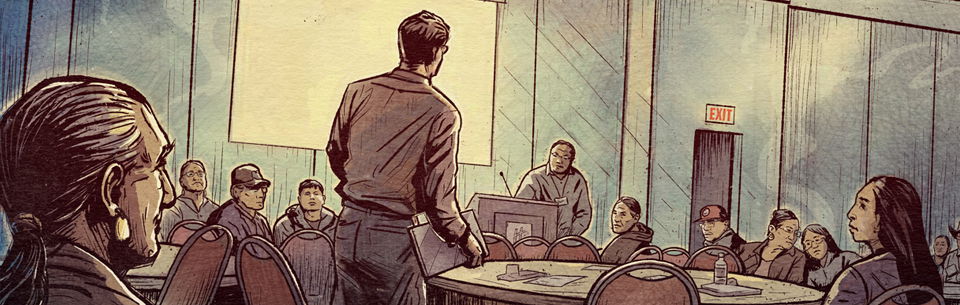
December 12, 2023, I found myself sitting at a table in a Holiday Inn ballroom in Rapid City, South Dakota, among a group of people I had never met before, whose ways were unfamiliar to me. The smell of smoke from the sacred pipe ceremony lingered in the air. Many of the attendees had traditional, descriptive names—names I had experienced only from reading about Native Americans of the past, such as Sitting Bull and Crazy Horse. A group of singers in a drum circle led the group in a distinct musical style. I recognized it only because I had seen video documentaries about the Great Plains Native Americans. It reminded me of a lament, a sad sort of wailing in a minor key. The occasion was the annual Lakota Treaty Council conference. As a ticketed attendee, I was legitimately present. But in another sense, I wasn’t supposed to be there.
The conference hosted a wide diversity of speakers. Activists, lawyers, scientists, tribal leaders, and youth representatives were all given time at the podium. Some of the guest speakers articulated strong anti-Christian, anti-Colonial sentiments.
Several years before the Treaty Council meeting, I had learned the hard way that Anglos (Caucasians) are often not welcome among Native American communities. I had just made some wild genetic discoveries about the pre-European history of the Americas. In my naïve enthusiasm, I started cold-calling Native American reservations, eagerly announcing what I had found. I had hoped that some would reciprocate my excitement and want to help advance the research. At least one hung up on me. In general, those who answered my calls were polite but not interested. At the time, I didn’t understand.
In early 2022, almost two years before the Lakota conference, I learned new lessons on Anglo-Native American interactions. I had published a book on genetics and human history, which included a chapter on pre-European American history. As a companion to the book, Answers in Genesis and I had produced a 30-minute video summarizing the American findings and inviting Native Americans to participate in future research. To my great surprise, I received several responses.
One Native American helpfully explained to me the reason for the failures of my previous attempts to connect with the Native American community: In short, the rule is that I can’t initiate contact with them. But if they initiate, as she was doing in response to my invitation in the video, then we could carry on a relationship. I was grateful for her help.
In December 2023, I wasn’t present at the Lakota meeting because I had circumvented the conference rules to force my way in. I hadn’t demanded an audience or initiated contact.
So how did I, an Anglo, Christian, young-earth scientist with Answers in Genesis, get in?
By defying protocols of another sort—protocols that mark the dawn of a new era in creation science.
Keeping Creationists Out
I showed up at the Lakota Treaty Council conference because the Lakota invited me. They invited me as a guest speaker on the topic of DNA and indigenous histories. In other words, they sought my input as a scientific expert.
According to evolutionists, this is not supposed to happen.
Today, creation scientists like me are prohibited from running academic labs. They are denied government funding for their projects. They are forbidden from publishing in mainstream peer-reviewed journals. In short, creation science is excluded from every stage of the scientific process.
To clarify, scientists who happen to be creationists are allowed to run academic labs, to receive government funding, and to publish in mainstream peer-reviewed journals. But only if they never promote creationist conclusions.
Why? Because mainstream scientists are convinced that creationists don’t do science. The specific, technical manifestation of this view is the claim that creation science doesn’t make testable predictions.1 For creation science to be considered science, creationists would have to put in print predictions that future experiments in the lab and in the field could demonstrate to be true or false. In other words, creation science has to be, in theory, able to be disproven. It’s not that evolutionists are waiting with bated breath for creationists to meet this standard. No, they’ve concluded that creationists have not met this standard and never will.
The problem for the evolutionary community? I’ve been publishing, testing, and fulfilling creation science predictions for over 10 years. My early work focused on the origin of species. I made predictions about their genetic rates of change (i.e., mutation rates) and about genetic function.2 I also predicted the genetic mechanisms by which species would form and how fast new species would appear.3
And then I saw these predictions fulfilled. Much to my surprise, one of the first fulfillments appeared just a few months after I put them in print, in none other than the long-standing icon of evolution, Darwin’s finches on the Galápagos Islands. A new finch species is in the process of formation at rates predicted by my work4 and with mechanisms in line with what I expected.5
I also put testable predictions in print for humans. For a variety of technical reasons, I’ve been evaluating the predictions with male-inherited Y chromosome DNA. Over the last five years, I’ve seen multiple predictions fulfilled. From the fast rate at which the Y chromosome changes from generation to generation,6 to the match between young-earth-based genetic history and known history and archaeology both at the global7 and regional8 scales, to the clear echo of the history of civilization in the Y chromosome,9 our creation science-based predictions are seeing success after success.
In fact, we’ve even witnessed explicit confirmation of the biblical anthropology. Genesis 10 lists the male descendants of Noah and his sons. In short, this chapter contains a clear, early post-flood family tree. Using male-inherited DNA, I’ve found the unmistakable genetic echo of Genesis 10.10
Along the way, I made another discovery—one with outsized relevance to Native American history.
Historic Tension
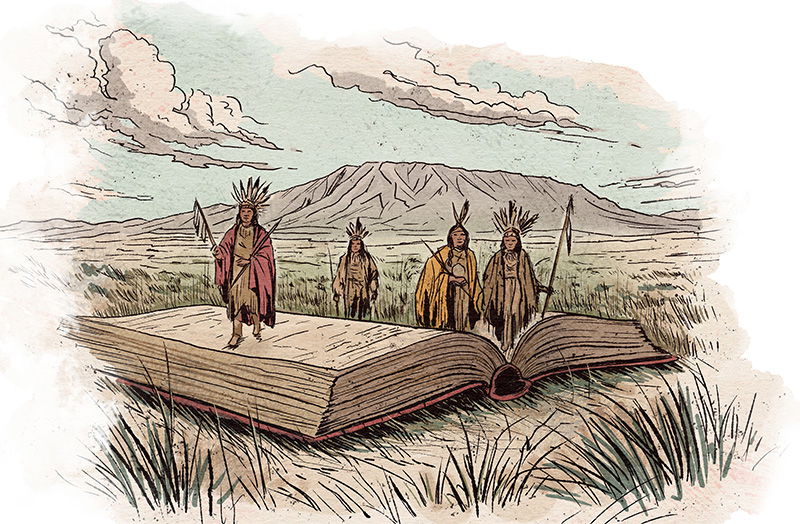
Historically, mainstream science and indigenous communities have been at odds. For example, according to the history of the Lakota’s relatives, their ancestors once resided near the Atlantic Ocean. Beginning in the AD 800s, they began a journey westward. One subgroup ended up moving in the direction of Wisconsin. Another subgroup landed near the mouth of the Ohio River, where they dispersed. The Lakota likely broke off from the Wisconsin subgroup, into Minnesota, and eventually onto the Great Plains.11
Because the ultimate origin of these histories tends to be oral, mainstream scientists typically marginalize or outright reject them. Effectively, evolutionists demote the indigenous conclusions below the inferences that evolutionists make from archaeology and genetics. In short, mainstream science—and genetics in particular—has long been viewed as a foe, not a friend, by peoples like the Lakota.
One of the most infamous examples of this tension comes from another indigenous community, the Lenni Lenape, or Delaware. In the early 1800s, a Kentuckian by the name of Rafinesque obtained their history from a Delaware man. So the story goes.
The history, called the Walam Olum or Red Record, contained a detailed account of the Delaware migration history. It described a crossing of the Bering Strait and also documented a sequence of nearly 100 sachems (tribal leaders) in succession.
Each sachem received a line or two in the Red Record describing a significant event during his reign. From these descriptions, readers could reconstruct the entire path of their migration from Alaska, down the western part of Canada, across the Great Plains, through the Ohio Valley, and over to the Atlantic coast.
From a handful of details for around four sachems, readers could even estimate the time at which the Delawares crossed the Bering Strait, somewhere in the range of the AD 200s to AD 900s.12
In 1995, the Red Record attracted a different kind of attention. A graduate student in anthropology, David Oestreicher, published his PhD thesis on the document. Oestreicher contended that the Red Record was fraudulent. Rafinesque had not obtained it from the Delaware; instead, Rafinesque had fabricated the historical account.
Subsequently, the Delaware nation in Oklahoma “formally withdrew its earlier endorsement”13 of the Red Record.
The mainstream scientific community has troubled more than just the Delaware nation. It has resisted the Lakota’s histories and marginalized the oral-history-based accounts of the Lakota’s own origins.
It should be no surprise, then, that the Lakota would turn to other experts for help.
A Surprising Resolution
In October 2018, 23 years after Oestreicher’s thesis, the Lakota were nowhere close to my scientific radar. The idea of speaking at their conference never entered my mind. I had no presumptions of being an expert on DNA and indigenous history. Yet in retrospect, I can see that I was well on my way toward a collision course with Oestreicher’s claims and, eventually, with Lakota history.
Specifically, I was trying to understand the DNA-based family tree for all humanity—especially the tree based on male-inherited DNA, the Y chromosome. Fathers pass on the Y chromosome to their sons. But they do so imperfectly. If we identify each change, we can reconstruct a family tree—and a family history.
Did DNA act like a simple clock, marking off the passage of time since Noah and his sons stepped off the ark?
But I was stuck: How was the timescale of human history stamped on the tree? Did DNA act like a simple clock, marking off the passage of time since Noah and his sons stepped off the ark? The answers kept eluding me.
Then I remembered an adage from graduate school: Take what you know and beat it to death until it yields all its secrets. Not long prior to this point, I had read a book on the pre-Columbian history of the Americas. I had learned that European arrival had precipitated a massive population collapse among the indigenous peoples. I thought that surely there must be a genetic echo of this monumental event.
But where was it? When I started diagramming family tree branches, the answer suddenly emerged—and in a manner that confirmed the young-earth timescale of roughly 4,500 years back to Noah.
Fast-forward a year and a half to spring of 2020. By this point, I had connected the genetic dots for the whole family tree of humanity. One of the surprises? The pre-Columbian history of the Americas.
Mainstream science posits a single settling from Asia about 15,000 years ago. My research showed an initial settling only 3,500 to 4,000 years ago, followed by a resettling in the AD 300s to 600s, followed by another migration from Asia around the AD 900s. We have genetic links to the latter two settlings; the genetic origins of the first settlers remain a mystery. These results just so happened to line up with the history in the Red Record. I announced the initial findings in a technical publication.14
Two years later, I released the results of my analysis of the human genetic history for the whole globe.15 After the follow-up videos to this research, the first Native Americans contacted me, giving me the advice about interacting with their people.
The Science of Native American History
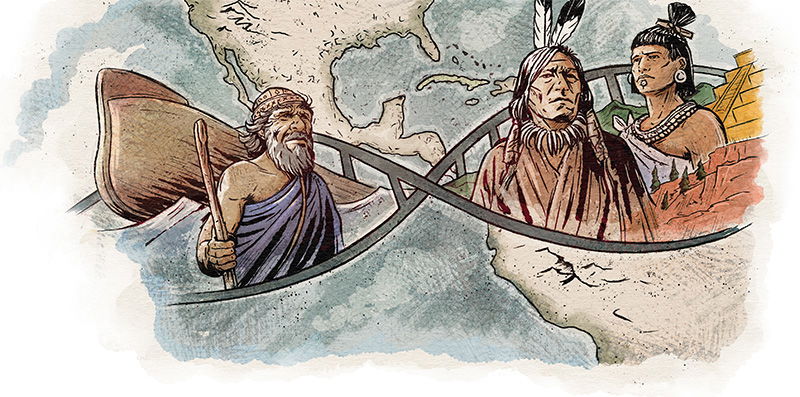
By summer of 2022, the evidence for my conclusions on pre-Columbian history had grown stronger. Before this point, I had confirmed agreement between indigenous histories and genetics for only North American peoples. By the end of summer, I found that both Central and South American indigenous histories also agreed with my genetic findings. The Aztecs16 and Incas17 described timelines for their origins exactly in line with the ones I had derived from genetics.
By the end of summer, I found that both Central and South American indigenous histories also agreed with my genetic findings. The Aztecs and Incas described timelines for their origins exactly in line with the ones I had derived from genetics.
From the winter of 2022/2023 to the end of summer 2023, the pre-Columbian narrative for North America began to fall into place. The agreement between genetics and indigenous histories grew stronger. The volume of narratives from indigenous histories increased, cross-correlating with each other and with linguistics. By September 2023, I was well on my way to reconstructing a play-by-play for precontact North America.
We released videos of these findings on YouTube.18 One video went viral.
In the middle of this process, the executive director of the Lakota conference reached out to me. He wanted to know what my research showed about the Lakota.
My research suggests that they may have been critical allies of the Delaware in one of the greatest battles in pre-Columbian North America.19 I strongly suspect that more DNA testing will confirm the earlier parts of their narrative, including the migration westward from near the Atlantic Ocean.
But the most exciting proposition of all is that, in my discussions with the Lakota, I learned from their own histories that they might have ties to the earliest North Americans—the ones whose genetic signature has been missing.
A Closed Door . . . for Now
I’m eager to find out if some of the Lakota might still possess a long-lost DNA link to the ancient past. But this is a door that seems closed for the indefinite future. Few Lakota have taken Y chromosome DNA tests. Naturally, many Native Americans distrust DNA testing, especially testing run by Anglos. Too many past abuses at the hands of the US government would make anyone suspicious of a big business whose focus is on the most intimate details of a person’s biological identity. They remain hesitant to jump into a field fraught with risks. Having been a guest among the Lakota, I better understand this concern now.
We’re still in the process of getting to know one another. Perhaps with time, and with enough trust, some might be willing to explore their history with DNA.
In the meantime, I’m also exploring the precontact history of Latin America and especially of the Amazon. There, the archaeological evidence and the indigenous histories have a long and rich record. Creation-science-based DNA testing might reveal revolutionary insights. I’m excited to see where this project goes.
And there’s no telling which doors might open to creationists next.
received his PhD from Harvard University. He spent several years as a research associate and speaker for the Institute for Creation Research and now does research for Answers in Genesis.
Answers Magazine
January–March 2025

Wildlife is moving into big cites. How are these creatures adapting?
Browse IssueFootnotes
- E.g., see the text from one of the landmark creation-evolution federal court decisions: “McLean v. Arkansas Bd. of Ed., 529 F. Supp. 1255 (E.D. Ark. 1982).” Accessed at: https://law.justia.com/cases/federal/district-courts/FSupp/529/1255/2354824/.
- E.g., Nathaniel T. Jeanson, “Recent, Functionally Diverse Origin for Mitochondrial Genes from ~2700 Metazoan Species,” Answers Research Journal 6, (2013): 467–501.
- Nathaniel T. Jeanson, Replacing Darwin: The New Origin of Species (Green Forest: Master Books, 2017).
- Nathaniel T. Jeanson, “A Bombshell for Replacing Darwin?” Answers in Genesis, March 1, 2018, https://answersingenesis.org/evidence-against-evolution/bombshell-replacing-darwin/.
- Nathaniel T. Jeanson, “A Second Bombshell for Replacing Darwin?” Answers in Genesis, March 9, 2018, https://answersingenesis.org/evidence-against-evolution/second-bombshell-replacing-darwin/.
- Nathaniel T. Jeanson and Ashley D. Holland, “Evidence for a Human Y Chromosome Molecular Clock: Pedigree-Based Mutation Rates Suggest a 4,500-Year History for Human Paternal Inheritance,” Answers Research Journal 12, (2019): 393–404.
- Nathaniel T. Jeanson, “Testing the Predictions of the Young-Earth Y Chromosome Molecular Clock: Population Growth Curves Confirm the Recent Origin of Human Y Chromosome Differences,” Answers Research Journal 12, (2019): 405–423.
- E.g., Nathaniel T. Jeanson, “Young-Earth Y Chromosome Clocks Confirm Known Post-Columbian Amerindian Population History and Suggest Pre-Columbian Population Replacement in the Americas,” Answers Research Journal 13, (2020): 23–33. See also: Nathaniel T. Jeanson, Traced: Human DNA’s Big Surprise (Green Forest: Master Books, 2022).
- Jeanson, Traced: Human DNA’s Big Surprise.
- Jeanson, Traced: Human DNA’s Big Surprise.
- Nathaniel T. Jeanson, forthcoming manuscript from Master Books in preparation for spring 2025.
- Jeanson, “Young-Earth Y Chromosome Clocks.”
- David M. Oestreicher, “The Tale of a Hoax: Translating the Walam Olum,” in Algonquian Spirit: Translations of the Algonquian Literatures of North America, ed. Brian Swann (Lincoln: University of Nebraska Press, 2005): 23.
- Jeanson, “Young-Earth Y Chromosome Clocks.”
- Jeanson, Traced: Human DNA’s Big Surprise.
- John Bierhorst, trans., History and Mythology of the Aztecs: The Codex Chimalpopoca (Tucson: The University of Arizona Press, 1992).
- Pedro Sarmiento de Gamboa, History of the Incas, trans. Sir Clements Markham K.C.B. (Cambridge: In Parentheses Publications, 2000), https://www.yorku.ca/inpar/sarmiento_markham.pdf.
- Answers in Genesis, Lost History of North America with Dr. Nathaniel Jeanson, playlist, six videos, https://www.youtube.com/playlist?list=PL1v9pqs4w1mzCLWAyzc3Kz_vw0RQPmqa_.
- Nathaniel T. Jeanson, forthcoming manuscript from Master Books in preparation for spring 2025.

Support the creation/gospel message by donating or getting involved!

Answers in Genesis is an apologetics ministry, dedicated to helping Christians defend their faith and proclaim the good news of Jesus Christ.
- Customer Service 800.778.3390
- Available Monday–Friday | 9 AM–5 PM ET
- © 2026 Answers in Genesis