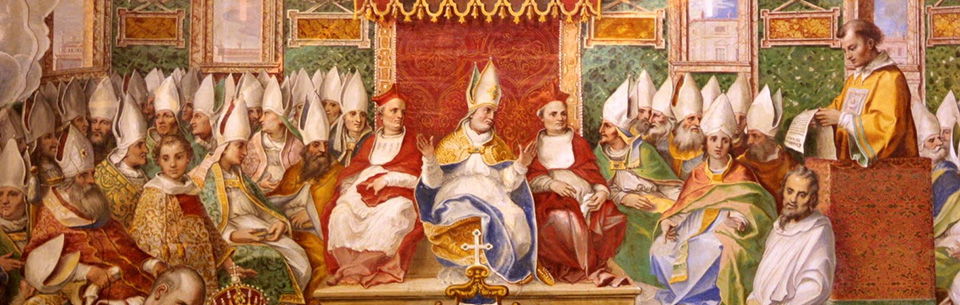
Giovanni Guerra (1544-1618), Cesare Nebbia (1534-1614) e aiuti, Public domain, via Wikimedia Commons
Athanasius, Arius, and . . . Santa Claus?
Why Nicaea still matters 1,700 years later
There are a few creeds that all professing Christians—whether Protestant, Catholic, or Orthodox—affirm, and indeed, the failure to affirm these core beliefs not only places them outside salvation but outside the Christian tradition itself. The Nicene Creed is perhaps the most important:
I believe in one God,
The Father almighty
Maker of heaven and earth,
Of all things visible and invisible.
I believe in one Lord Jesus Christ,
The Only Begotten Son of God,
Born of the Father before all ages.
God from God, Light from Light,
True God from true God,
Begotten, not made, consubstantial1 with the Father;
Through him all things were made.
For us men and for our salvation
He came down from heaven,
And by the Holy Spirit was incarnate of the Virgin Mary,
And became man.
For our sake he was crucified under Pontius Pilate,
He suffered death and was buried,
And rose again on the third day
In accordance with the Scriptures.
He ascended into heaven
And is seated at the right hand of the Father.
He will come again in glory
To judge the living and the dead
And his kingdom will have no end.
I believe in the Holy Spirit, the Lord, the giver of life,
Who proceeds from the Father and the Son,2
Who with the Father and the Son is adored and glorified,
Who has spoken through the prophets.
I believe in one, holy, catholic and apostolic Church.
I confess on Baptism for the forgiveness of sins
And I look forward to the resurrection of the dead
And the life of the world to come. Amen.
To understand Nicaea, we have to place it in its historical context. The earliest generations of Christians after the apostles were in no position to convene a church council. Often martyred and persecuted for their beliefs, they still wrote and debated. The biggest accomplishment of this period was the sidelining of the gnostics in the second/third century. While, of course, there would continue to be gnostic individuals, they would not hold sway over the church or influence doctrine.
When Constantine became a patron of Christianity, things improved substantially for Christians. Prior to Constantine’s AD 313 Edict of Milan, Christians could be deprived of property, maimed, and even killed for their faith. In 321, Constantine even created the first Sunday law, creating a day of rest.3
However, if Christianity was going to be the state religion, Constantine wanted a united faith. And at this time, there was a great controversy surrounding Arianism. Arianism, named after Arius, a popular Alexandrian, is the belief that Jesus is a created being and not truly God. (Not to be confused with Aryanism, the belief that a certain type of European is superior to everyone else.) This is a result of a Platonist philosophy that emphasizes the oneness of God to the detriment of the Trinity. Arius was not the first or only person to teach this; rather, he is particularly remembered because opponents of the teaching like Athanasius focused on him as a popular proponent of the heresy.
It is important to note that Arianism itself was a response to the heresy of Sabellianism, which overemphasizes the oneness of God to the point of erasing the distinction between the persons of the Trinity. Arianism, however, makes the opposite error and distinguishes Jesus from God the Father to the extent that it denies the deity of Christ. This shows us the importance of getting our doctrine from Scripture itself, not as a reaction to others’ errors.
The central question: Was Jesus an exalted created being, or is he truly God, coequal with the Father?
The central question: Was Jesus an exalted created being, or is he truly God, coequal with the Father? The answer is only obvious to us today because earlier generations of Christians wrestled with the teaching of Scripture to understand the truth.
The Major Players at Nicaea
In AD 325, there were 1,800 bishops in the Christian church. Although all were invited, only 318 attended the council. Of those, there are only a few names that would be familiar to Christians today.
Arius was one of the main proponents of the Arian heresy, but there were other prominent Arians. The most prominent was Eusebius of Nicomedia, who was favored by Constantine’s sister and was the head of an Arian group called the Eusebians. Near the end of Constantine’s life, it was Eusebius of Nicomedia who baptized him.
Eusebius of Caesarea was considered a moderate anti-Arian who opposed the stronger anti-Arians and felt Arius was being misrepresented. He presented his own church’s statement of faith, which Constantine accepted. However, the anti-Arians did not consider it sufficient because it did not contain the Greek word homoousios—“of the same nature”—which was at the heart of the controversy.
Athanasius was a major defender of the orthodox view of the Trinity against the Arians, even in the face of opposition. The saying Athanasius contra mundum, “Athanasius against the world,” was coined because of his dogged persistence and opposition to the Arian heresy.
Santa Claus at Nicaea?
One interesting historical note is that Nicholas of Myra, who is the historical figure behind “Santa Claus” was present, according to some of the attendance lists, at Nicaea. Like many of the other attendants, he was a survivor of persecution, having been imprisoned during the reign of Emperor Diocletian.
At the time of the Council of Nicaea, Nicholas was the bishop of Myra and held the orthodox view of the Trinity. Legend says he was so incensed by Arius’ error that he slapped the heretic across the face! The other bishops, shocked that a bishop would show such a lack of decorum, detained him for the duration of Nicaea and released him afterward to continue being the bishop of Myra.
People dispute the historicity of this legend (along with many of the biographical details of Nicholas’ life) because the first account of this event is 1,000 years after Nicaea. Those who doubt its truth note that Athanasius of Alexandria and Eusebius, who definitely were there, didn’t mention Nicholas, while those who think he was there note that Nicholas does appear on some lists of attendants of the council.
The Result of Nicaea
Nicaea resulted in an important affirmation of Jesus’ true deity.
Nicaea resulted in an important affirmation of Jesus’ true deity, including the “begotten, not made” language. Arianism was formally anathematized, meaning that anyone holding that belief was placed outside orthodox Christianity.
Even though Arianism was formally rejected, Arians still held influence, especially in Eastern Christianity, for some time afterward.
While Arianism was the major issue, there were other topics on the Nicaea agenda—the timing of the celebration of Easter was unlinked from the Jewish date of Passover, and some rules of church discipline were decided.
Modern Denials of the Deity of Christ
The Arian denial of the deity of Christ came from a misguided defense of God’s oneness. Today, the same error is shared by Oneness Pentecostals, Unitarians, and others.
There are also those that embrace the “eternal submission of the Son” (ESS). In a misguided attempt to impose complementarianism on the Godhead, they place the submission of the Son, not in the incarnate life and ministry of the incarnate Christ where it belongs but extend it back into eternity, which threatens the divinity of Christ. While the majority of those holding to ESS would embrace a Nicaean Christology, ESS contradicts that by implying that God’s will can be divided because submission requires two wills at odds with one another.
Beyond those who consciously reject the orthodox doctrine, an alarming number of professing Christians are unable to articulate the doctrine of the Trinity. Churches that emphasize entertainment over discipleship create Christians who claim Christ but have very little knowledge of who he is.
Nicaea and Creation
One way Nicaea differentiates the persons of the Trinity while acknowledging their coequal and coeternal status is in recognizing each person’s role in the creation of the world and in salvation. The Father is the Creator who spoke the world into being. Jesus is the Word through whom the world was created, and the Spirit imbued the creation with life. In salvation, the Father sent the Son, the Son became incarnate and died for our sins, and the Holy Spirit is the one who indwells the believer, causing them to be born again.
While no one at Nicaea would have necessarily thought of themselves as “young-earth creationists” (because evolutionary timescales would be thought of almost 1,500 years later), their biblical definition of God definitely included that he is the Creator as described in Scripture.
Why Nicaea Still Matters
Most of us don’t spend a lot of time thinking about the Christians who lived almost 2,000 years before us. Their lives were different from ours, and some of the practical ways they lived out their faith are nearly unrecognizable. For Protestants, “tradition” can have a negative connotation. However, we owe some of the truths we take for granted to debates that took place over generations. We do stand within a tradition, linked to previous generations of believers by our common faith in Christ. And Nicaea was an important point of recognizing who Christ was.
Footnotes
- The Greek word here is homoousios.
- The words “and the Son” or filioque in Latin are accepted by Catholics and Protestant Christians but not by Eastern Orthodox.
- R. L. Odom, “The First Civil Sunday Law—No. 1,” Ministry Magazine, October 1935, https://www.ministrymagazine.org/archive/1935/10/the-first-civil-sunday-lawno.-1.

Support the creation/gospel message by donating or getting involved!

Answers in Genesis is an apologetics ministry, dedicated to helping Christians defend their faith and proclaim the good news of Jesus Christ.
- Customer Service 800.778.3390
- Available Monday–Friday | 9 AM–5 PM ET
- © 2026 Answers in Genesis