

Natural Selection—Simply Stating the Obvious
How natural selection became the “fool’s gold” of evolution
“Time flies like an arrow; fruit flies like a banana!”
This classic linguistic joke is often attributed to the comedian Groucho Marx, the fast-talking leader of the famous comedy group The Marx Brothers. The reason the joke works is that the leading nature of the word usage in the first point versus the different meaning in the second. The first locks in a specific parsing strategy in the hearer’s mind, and the second clause exploits that commitment. Only by the time they get to the very last word do they realize that same parsing doesn’t fit, revealing the gag. It’s a well-known example used in linguistics to illustrate ambiguous wordplay known as a garden-path sentence.
Why am I bothering to explain this? Well, it has to do with the importance of defining words in communication, which we will apply to our main topic here—mainly, the question of our ultimate origins, the truth of which is found in Genesis 1–11. Many have rejected the Genesis creation account for the story of evolution, but curiously, just as the word woman seems almost impossible for many people to define today, it also seems many of the same people have trouble defining the word evolution.
Slippery Definitions
The fact is that we hear the term evolution used in so many ways today that I believe most people don’t understand what would need to be scientifically demonstrated for evolution to be justified as anything more than a hypothesis. And by the way, even this National Center for Science article admits there are problems with defining evolution.
When we try to explain evolution to those who do not know much about it, one of the problems we have is the definition of what counts as evolution. In part, this is because some of the definitions found in the scientific literature, including textbooks and popularizations of evolutionary theory, use technical terms that do not seem to convey to the public that evolution explains the diversity of living forms.1
Now again, I don’t think it has so much to do with the use of “technical terms” as much as equivocation, as even here they conclude that “evolution explains the diversity of living forms,” which itself could be taken to mean a variety of things. Does evolution explain the diversity among the same kind of creature, such as the wide variety of dogs we see in the world? Does it refer to the diversity of specific kinds of fish or birds we have cataloged? Is it explaining why there are different kinds of creatures entirely? Again, different people might walk away with a different understanding of what that means.
Much Ado About Nothing
Let me explain one of the most significant truths in the creation/evolution debate that has contributed to these misunderstandings: the most-often-touted scientific marvel that Charles Darwin supposedly discovered, his amazing “big idea” championed by naturalists as a supposed mechanism for evolution, which was stuffed in the face of Bible believers as a “refutation” for belief in God. But it was nothing but bluff and bluster from the beginning.
In fact, it’s likely the biggest nothing burger modern science has ever promoted. To learn why, let’s begin by looking at how Charles Darwin and his story of evolution are commonly discussed, with an example taken from the popular Britannica website.
The 19th-century English naturalist Charles Darwin argued that organisms come about by evolution, and he provided a scientific explanation, essentially correct but incomplete, of how evolution occurs and why it is that organisms have features—such as wings, eyes, and kidneys—clearly structured to serve specific functions.2
Charles Darwin’s Big Idea
I want you to notice something about the way they state this. They say that Darwin supplied a scientific explanation of how organisms “come about” by evolution, of how evolution occurs and why organisms have all the features they do (like wings, eyes, and kidneys).
Now, for the average person reading this, what would likely be the most natural understanding? I believe most people would be given the impression that Darwin explained how brand-new things like wings, eyes, and kidneys were somehow generated, the acquisition of which would enable one kind of creature like an amoeba (which does not have those features) to eventually evolve into a completely different kind of creature (such as a bird, which does have them).
This is what evolution is supposed to be able to explain. If there is some mechanism that can turn pond scum into prawns, perch, porcupines, pandas, and people over millions of years—however incremental you propose this process to be—then it has to be a creative mechanism, one that can somehow generate brand-new forms, functions, and features in creatures that never existed before.
Big Claims, Big Consequences
The Britannica article does mention that Darwin’s explanation was incomplete (which we’ll get to later on) but that it was “essentially correct” and that what he provided was the fundamental concept to explain the origin of every single organism that has ever been on the planet (aside from the very first one, supposedly spontaneously generated from nonliving chemicals).
Now, that is a mighty big claim, and big claims often have big consequences. So before we discover what this mighty mechanism is that could supposedly explain the origin of every biomechanical marvel in nature, let’s get Britannica’s before-and-after shot of Darwin’s explanation. How did it affect Western society’s belief about origins?
Before Darwin, the origin of Earth’s living things . . . had been attributed to the design of an omniscient God. Christian theologians . . . had argued that the presence of design, so evident in living beings, demonstrates the existence of a supreme Creator. . . . Eminent scientists and philosophers would expand on the marvels of the natural world and thereby set forth “the Power, wisdom, and goodness of God as manifested in the Creation.”3
OK, that’s the before shot. What about after Darwin supplied his “scientific” explanation for how everything came about? According to Britannica’s article,
The theory of evolution has been seen by some people as incompatible with religious beliefs, particularly those of Christianity. The first chapters of the biblical book of Genesis describe God’s creation of the world, the plants, the animals, and human beings. A literal interpretation of Genesis seems incompatible with the gradual evolution of humans and other organisms by natural processes.4
And what’s been the final conclusion for many who accepted the story of evolution as true? Well, as the article explains later on, “The significance of these and other discoveries was . . . the workings of the universe no longer needed to be attributed to the ineffable will of a divine Creator.”5
Lest you think this analysis here is a fringe view, let’s compare it to the Museum of Natural History’s article on evolution.
In Darwin and Wallace’s time, most believed that organisms were too complex to have natural origins and must have been designed by a transcendent God. . . . However, . . . even the most complex organisms occur by totally natural processes.
Our researcher Professor Adrian Lister says, “It’s not that biologists don’t understand that organisms are complex and functional, and it does seem almost miraculous that they exist. We realize that, but we think we’ve found another way of explaining it.”6
A Simple Concept, a Simple Conclusion
I grew up in our state-run schools here in Canada and was taught evolution as “fact and science” while belief in God was subtly mocked. Like myself, many people logically concluded that if we have a solid, scientifically proven way to account for our existence, why would we need to invoke belief in God to explain it? The Britannica article explains the juxtaposition between before and after this way:
All human cultures have developed their own explanations for the origin of the world and of human beings and other creatures. Traditional Judaism and Christianity explain the origin of living beings and their adaptations to their environments—wings, gills, hands, flowers—as the handiwork of an omniscient God. The philosophers of ancient Greece had their own creation myths.7
Even in these two condensed accounts of history, we can see how Western culture (once grounded in biblical truth) stepped onto the path of naturalism and eventually arrived where we are today, the most atheistic generation the West has ever seen. A common thought today is “People used to believe in a Creator God, but now we know science has proven evolution.”
Today, anti-Christian attitudes are everywhere, and anti-biblical thought surrounding law and morality is championed and praised in culture—even in many churches. Biblical authority has gone by the wayside. Indeed, we could say the Western world stepped onto the path of naturalism many years ago, slid down its slippery slope, and face-planted in an atheistic trash pile that has now permeated society.
Some might say that we just have to face the facts of science. I mean, we’re this far down the road, so I guess we have to keep going and see where all of this takes us, right? Or do we? Let’s back up for a minute and examine the very footing this whole premise was built upon.
Charles Darwin’s Fool’s Gold
Remember what the Britannica article said? Darwin championed evolution, and he supposedly provided a scientific explanation of how evolution “occurs” and why creatures have the features they do, which implicitly means how all of the specific forms, functions, and features were generated (like wings, eyes, kidneys, blood clotting systems, sonar capabilities, Gecko gripping capacity, web shooters in spiders, tree bark, beaks, and brains).
They state that Darwin’s fundamental scientific concept explained how all of these things inside living things came about, which (we now know) would include DNA language and its translation systems, immune systems, and hormones and pheromones. They are implying that he explained how all of these got put together into the functional, integrated, and mind-blowingly sophisticated micro-biotechnological wonders (like kinesin motor proteins and ATP synthase motors) that we observe in and around us.
And what was that amazing mechanism, that foundational flagstone that was so firmly laid as the launching pad of it all? “Charles Darwin argued that organisms come about by evolution. . . . Natural selection was the fundamental concept in his explanation.”8
Natural selection is a selection process, not a creative one.
Natural selection? That was it? But natural selection is a selection process, not a creative one. Any selection process can only select from what’s already there. So natural selection wasn’t telling us then—and isn’t telling us now—where what was already there came from in the first place. However, watch the shift that occurs in the very next sentence of the same article.
Natural selection occurs because individuals having more-useful traits, such as more-acute vision or swifter legs, survive better and produce more progeny than individuals with less-favorable traits.9
Did you see the pivot? The article first says that Darwin’s fundamental concept—natural selection—provided a scientific explanation of “how evolution occurs” and how all of these forms, functions, and features came about (i.e., time flies like an arrow). Then it pivots to an explanation of how these forms, functions, and features provide a benefit to an organism if they already have them because natural selection occurs (i.e., fruit flies like a banana).
An Explanation That Didn’t Explain Anything
Well, yes, we know. Anyone that’s played competitive sports can figure out how natural selection works. Given equal experience, if the guys you are playing with have longer legs and bigger muscles, then they usually win, and you get selected out of the game. But it certainly doesn’t address where legs, arms, or muscles came from in the first place.
I could sum up the idea of natural selection by saying, “The guy with the bigger stick wins.” This isn’t rocket science; are we really supposed to believe that before Darwin, this was a mind-blowing concept that no one had figured out before? The question that evolution has always needed to explain is this: Where did the “stick” come from in the first place?
How something was created and how it will help you once you have it are completely different concepts. It’s like someone asking, “Where did knives, spears, bows, arrows, and guns come from?” and receiving the answer, “If you have a gun, you’ll be able to hunt, get food, and survive better than people who only have a knife.”
Built-In Variety Already There
You see, the variety of traits expressed in living things is due to the incredible amount of genetic variation already built into living organisms. That’s why a large family of kids (whether puppies or people) often have a wide variety of features (tall/short, blue eyes/brown eyes, thin/stocky, etc.) even within the same generation. But that isn’t evolution; that’s simply differential reproduction due to preexisting genetic variation. There’s nothing new being created.
Despite what is commonly said about Charles Darwin discovering how evolution occurs, he never did so at all. The best one could argue is that Darwin saw what everyone else taking notice already had—there is often a variety of traits expressed in living things—and that he interpreted what he saw as examples of brand-new forms, functions, and features coming about through some unknown mechanism (which was incorrect). Then, he made the rather obvious conclusion that the organisms with the best of these new traits in certain environments would have a survival advantage over the organisms without.
Again, so what? First, creatures expressing preexisting genetic variation aren’t examples of brand-new genetic features coming into existence. And second, an explanation of how a preexisting trait can help an organism survive isn’t an explanation of how that trait arrived in the first place.
So why did so many people begin walking down the garden path toward atheism and fall for this shell game of equating natural selection with a creative process, as Brittanica’s “history” article and many other sources do?
Darwin accepted the facts of adaptation—hands are for grasping, eyes for seeing, lungs for breathing. But he showed that the multiplicity of plants and animals, with their exquisite and varied adaptations, could be explained by a process of natural selection, without recourse to a Creator or any designer agent.10
Again, here you see natural selection referred to as a replacement for a Creator or designer, yet natural selection is not creative in any way. I believe what we’ve seen is that ambiguity, equivocation, and misleading uses of terminology have always surrounded the teaching of evolution in virtually every area.
Once natural selection was equated with evolution, naturalists compiled and referenced example after example of changes in living things and then declared those examples to be a mountain of evidence for the story of evolution.
Darwin Debunked
Darwin, despite being the poster child for the story of evolution for over 150 years, never offered a mechanism anywhere near what would be needed to explain how something like amoebas (with a limited genetic library) could somehow add the thousands upon thousands of brand-new genes that would cause them to transform into fish, frogs, finches, and philosophers over millions of years.
This had been pointed out by honest evolutionists ever since Darwin was first published, as you can see from this quotation from the preface of The Genetical Theory of Natural Selection (published in 1930 by the famous evolutionist Ronald Fisher and touted as one of the most important earliest books on evolution and was described by fellow naturalist J. F. Crow as the “deepest and most influential book on evolution since Darwin”11).
Natural Selection is not Evolution. Yet, ever since the two words have been in common use, the theory of Natural Selection has been employed as a convenient abbreviation for the theory of Evolution by means of Natural Selection. . . .
The alternative theories of modification rely, avowedly, on hypothetical properties of living matter.12
As you can see, Fisher seemed honest about wanting to clear up the muddled waters surrounding the issue, likely because clear-minded objectors were raising concerns regarding the equation of natural selection equaling observable examples of evolution and were pointing out the fallacy. And that’s why I believe you find caveats in most modern explanations about Darwin today, such as the one in the Britannica article, which said, “Charles Darwin argued that organisms come about by evolution, and he provided a scientific explanation, essentially correct but incomplete.”13
You see, in this way, they can still credit him with supposedly discovering how evolution occurs but also admit that the key explanation needed for evolution to be viable (where brand-new, functional genetic information for new traits supposedly comes from in the first place) came much later. This itself is an admission that Darwin didn’t discover anything close to evolution. All he basically said was that if new functions were somehow appearing in living things (i.e., evolution was already occurring), then natural selection would allow the superior ones to survive better than inferior ones (survival of the fittest). Again, so what?
Still Being Done Today
For those who might quibble that I just referenced a book from 1930 and that modern scientists don’t equivocate evolution with natural selection anymore, let me quote from the continually updated textbook from California State University called Biol 102: Introduction to Living Systems, the content of which is copied, reposted, and splattered all over the internet.
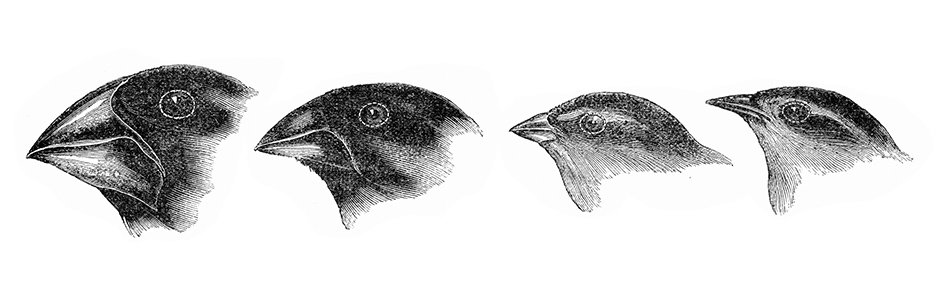
Demonstrations of evolution by natural selection can be time consuming. One of the best demonstrations has been in the very birds that helped to inspire the theory, the Galápagos finches. Peter and Rosemary Grant and their colleagues have studied Galápagos finch populations every year since 1976 and have provided important demonstrations of the operation of natural selection. . . . The birds have inherited variation in the bill shape. . . . The Grants had studied the inheritance of bill sizes and knew that the surviving large-billed birds would tend to produce offspring with larger bills, so the selection would lead to evolution of bill size. Subsequent studies by the Grants have demonstrated selection on and evolution of bill size in this species in response to changing conditions on the island. The evolution has occurred both to larger bills, as in this case, and to smaller bills when large seeds became rare.14
Bottom line to all this evo-babble? These renowned scientists observed that finches already have preexisting built-in variation for bill size—some big and some small. And during different environmental conditions, finches with certain bill sizes survive better and produce more offspring, but when the environmental conditions stabilize, the finches with other bill sizes can survive better and repopulate. Voilà—“evolution” via natural selection in action.
They started out with finches that already had varied inheritable genes for different beak sizes, and they ended up with the exact same thing! How can that possibly be claimed as proof of evolution! Even given the false assumption of “millions of years,” would anything in this entire process ever result in finches becoming anything other than finches? There’s absolutely nothing new here, and yet they tout this as undeniable proof of “evolution in action.”
Mutations to the Rescue?
When really pressed, evolutionists will admit to natural selection’s explanatory inadequacy and point to genetic mutations as the supposed real source of evolution today. But of course, mutations are as impotent as natural selection in terms of their potential as a creative force, as they are simply spelling mistakes in the DNA of living things that only mess things up. As an analogy to mutations in DNA, it would be like downloading the encyclopedia Britannica on your computer and introducing a virus that slowly but surely just randomly swapped out letters here and there throughout the text. At first, it wouldn’t make much of a difference, but eventually, all you would end up with is gibberish.
Even if evolutionists want to believe mutations could somehow do the job, they have certainly never been observed to write the types of genetic algorithms that code for the things we see in living things today. Think of flight navigation systems in birds, 32-part motors such as ATP synthase, blood clotting mechanisms, motor proteins such as kinesin that act like miniature postmen inside cells, or computational abilities like honeybees have that allow them to solve the Travelling Salesman Problem, something our supercomputers struggle to perform.
Just look at this admission from the modern, prestigious, evolution-promoting science journal Trends in Genetics boasting about “observed” examples of evolution due to genetic mutations.
Nonetheless, most studies of recent evolution involve the loss of traits, and we still understand little of the genetic changes needed in the origin of novel traits. . . .
Many of the well-studied examples of adaptive evolution have involved trait loss, such as the loss of bony structures in freshwater stickleback populations and the reduction of pigmentation and eyes in cavefish. However, over the broad sweep of evolutionary time what we would really like to explain is the gain of complexity and the origins of novel adaptations.15
Indeed, the evolutionary literature is so barren of examples of mutations generating the required brand-new genes for their theory that they admit to playing semantic word games in a pathetic attempt to provide some kind of evidence to support their story of evolution.
Of course, to some extent the difference between loss and gain could be a question of semantics, so for example the loss of trichomes [hairlike appendages on flies] could be called gain of naked cuticle.16
Seriously, this is supposedly a world-class science journal. Yet the evidence for evolution is so poor that they basically have to consider the loss of hair to be the “gain” of baldness? Can you see that when you strip away the word games being played here, the evolutionary house of cards tumbles down?
Remember, the story of evolution isn’t science in the way most people think.
Remember, the story of evolution isn’t science in the way most people think. No one has observed evolution, and no one has even come up with a plausible mechanism that could account for it. Even after suffering in a sin-cursed state for the past 6,000 years, what we see in the world reflects the original brilliant engineering of the most magnificent mind we can imagine, which is exactly what we see stated in God’s Word.
Worthy are You, our Lord and our God, to receive glory and honor and power, for You created all things, and because of Your will they existed, and were created. (Revelation 4:11)
Footnotes
- John Wilkins, “Defining Evolution,” Reports of the National Center for Science Education 21, no. 1–2, (January–April 2021): https://ncse.ngo/defining-evolution.
- Francisco Jose Ayala, “Evolution: Scientific Theory,” Britannica, July 7, 2026, https://www.britannica.com/science/evolution-scientific-theory.
- Ayala, “Evolution.”
- Ayala, “Evolution.”
- Ayala, “Evolution.”
- Emily Osterloff, “What Is Natural Selection?,” Natural History Museum, accessed July 6, 2026, https://www.nhm.ac.uk/discover/what-is-natural-selection.html.
- Ayala, “Evolution.”
- Ayala, “Evolution,” emphasis added.
- Ayala, “Evolution,” emphasis added.
- Ayala, “Evolution,” emphasis added.
- James F. Crow, “R. A. Fisher, A Centennial View,” Perspectives: Anecdotal, Historical and Critical Commentaries On Genetics, eds. James F. Crow and William F. Dove, Genetics 125, no. 2 (February 1, 1990): 207–211, https://pmc.ncbi.nlm.nih.gov/articles/instance/1203914/pdf/ge1242207.pdf.
- Ronald Fisher, The Genetical Theory of Natural Selection (Oxford at the Clarendon Press, 1930), vii–viii, emphasis added.
- Ayala, “Evolution,” emphasis added.
- Becki Brunelli, Biol 102: Introduction to Living Systems, California State University (via Pressbooks), accessed July 6, 2026, https://pressbooks.calstate.edu/biol102/.
- Nicola J. Nadeau and Chris D. Jiggins, “A Golden Age for Evolutionary Genetics? Genomic Studies of Adaptation in Natural Populations,” Trends in Genetics 26, no. 11 (November 2010): 484–492, https://doi.org/10.1016/j.tig.2010.08.004.
- Nadeau and Jiggins, “A Golden Age.”
Support the creation/gospel message by donating or getting involved!

Answers in Genesis is an apologetics ministry, dedicated to helping Christians defend their faith and proclaim the good news of Jesus Christ.
- Customer Service 800.778.3390
- Available Monday–Friday | 9 AM–5 PM ET
- © 2026 Answers in Genesis