

Is “God in the DNA”?
Why it’s a lie that God’s name is written in your DNA.
Occasionally, we get inquiries in correspondence asking us about or asking us to promote the idea that the name of God or that some other signature of God is built into our DNA. The idea of God in the DNA (GID) floats around fringe corners of the internet, usually appearing as some kind of proof that there is a God. Unfortunately, not only is it not proof for God’s existence, but the entire idea is based on deliberate, unvarnished lies.
In order to understand the argument and why it is perniciously false, it is important to understand something about DNA. If you took a high school biology class, you probably remember DNA as the molecule of heredity. It codes for who you are. You may not remember that DNA is composed of three parts: nitrogenous bases, of which there are four, a deoxyribose sugar, and a phosphate group. The combination of these three pieces forms a nucleotide. The nitrogenous bases are attached to the deoxyribose sugar. The sugars are bound together using a phosphate group. The nucleotides pair up in the following way C-G, T-A.
You may also be aware that DNA is a double helix that spirals. The image of DNA is iconic. The nucleotide bonding is what holds DNA together. The type of chemical bond holding these nucleotides together are hydrogen bonds.1 That is important because of one of the claims of one of the variants of the GID argument.
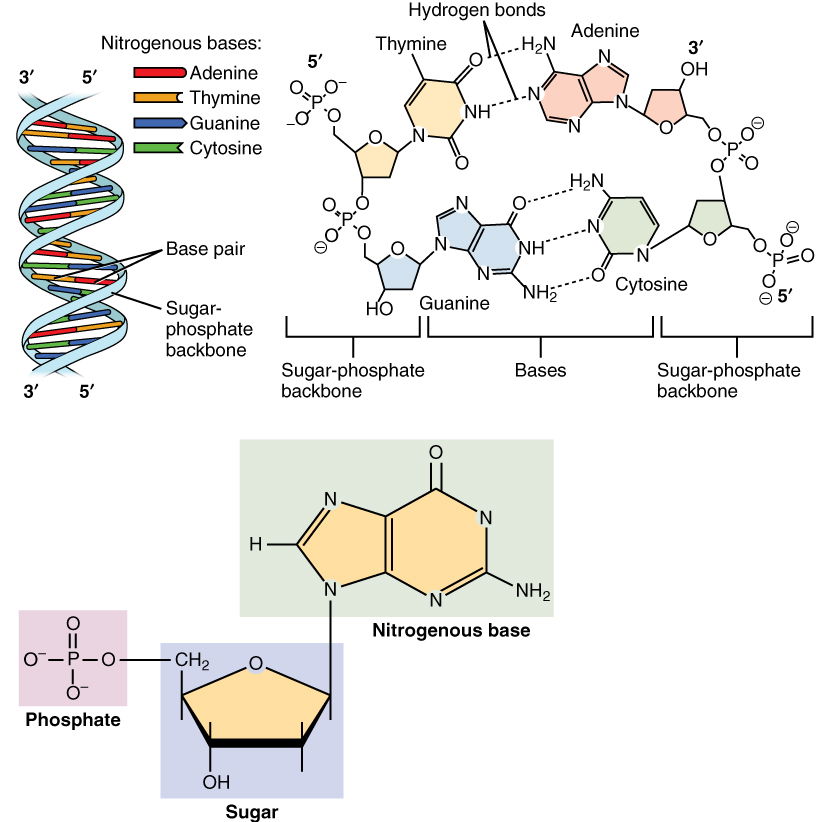
OpenStax, CC BY 4.0, via Wikimedia Commons
The GID argument that is most commonly made is that there are sulfuric bridges that hold the DNA together. These proposed bridges purportedly occur in the following pattern: 10-5-6-5. Numerology is then applied to these purported patterns using Hebrew script to come up with the letters YHWH, the way the Hebrew writers write the name of God.
There is an underlying assumption here that is potentially problematic, even if all the above were true (it’s not). The assumption is that God would write his name in Hebrew. But why Hebrew? Why not the language of Adam (whatever that was)? Or why not English, the modern trade language?
Even if we assume that God would always write in Hebrew (the New Testament was written in Greek) or that Hebrew was the language of Adam, the underlying science is simply false. Most DNA does not contain sulfur. It is composed primarily of carbon, hydrogen, nitrogen, oxygen, and phosphorus. Some bacteria incorporate sulfur into their backbones, but there is no sulfur in most DNA sequences.2 However the sulfuric bridges that are core to the argument do not exist.
You can simply ignore the supposed pattern and numerology because the things that make the pattern are not there.
Without the sulfuric bridges, the entire argument falls apart. You can simply ignore the supposed pattern and numerology because the things that make the pattern are not there. Some people have attempted to salvage the argument by claiming in a murky, nearly indecipherable way that, instead, the atomic numbers of carbon, hydrogen, oxygen, and nitrogen somehow add up to the Hebrew characters related to God.
These theories are lies initially promoted by grifters trying to either scam you out of your money or undermine the faith. And many people who are not thinking critically are using them to try to defend their faith. We urge fellow Christians, please check sources, be good Bereans, and find out if these things are so.


Footnotes
- G. A. Jeffrey, H. Maluszynska, and J. Mitra, “Hydrogen Bonding in Nucleosides and Nucleotides,” International Journal of Biological Macromolecules 7, no. 6 (1985): 336–348.
- P. C. Dedon, Z. Deng, L. Wang, S. Chen, T. Xu, K. Taghizadeh, J. Wishnok, X. Zhou, and D. You, “Phosphorothioation of DNA in Bacteria by dnd Genes,” Nature Chemical Biology 3 (2007): 709–710.

Support the creation/gospel message by donating or getting involved!

Answers in Genesis is an apologetics ministry, dedicated to helping Christians defend their faith and proclaim the good news of Jesus Christ.
- Customer Service 800.778.3390
- Available Monday–Friday | 9 AM–5 PM ET
- © 2026 Answers in Genesis