

The Serpent: Answering Six Questions About Genesis 3
In Genesis 3:1, a new character is introduced to the narrative: the serpent.1 This article will cover the following frequently asked questions regarding the serpent and his temptation of Eve in Genesis 3:
- Who is the serpent?
- Should Eve have been surprised to hear the serpent speak?
- How did the serpent tempt Eve?
- Was Adam with Eve when she spoke to the serpent?
- Did the serpent originally have legs?
- What was the forbidden fruit?
The answers to these questions are not agreed upon by all Christians, as Genesis 3 does not give enough information to answer some of them dogmatically. However, there are still several things we can learn, so let’s dive in.
Who Is the Serpent?
Genesis 3:1 states, “Now the serpent was more crafty than any other beast of the field that the Lord God had made. He said to the woman, ‘Did God actually say, “You shall not eat of any tree in the garden”?’” Instead of identifying the serpent, Moses tells us two things about him: (1) he is crafty; (2) he is a beast (animal) made by the Lord God.
The serpent is compared to one of the beasts of the field that the Lord God had made (cf. Genesis 1:25, 2:19), so he is identified as being part of the animal kingdom. The serpent was a part of God’s “very good” creation (Genesis 1:31). Yet the serpent is described as “crafty.” The Hebrew word here (ʿārûm) is an ambiguous term because it can have a positive meaning “prudent” (Proverbs 12:16, 23, 13:16, 14:8) but it can also have a negative meaning “crafty” (Job 5:12, 15:5). The negative meaning “crafty” fits the context of Genesis 3 as the serpent’s speech distorts the Word of God (Genesis 3:1–5; cf. 2:16–17). The description of the serpent as “crafty” (ʿārûm) is also a play on the word “naked” (ʿārôm) in Genesis 2:25: Adam and Eve are “nude,” but the serpent is “shrewd.” The serpent’s shrewdness causes Adam and Eve to experience the shame of their nakedness (Genesis 3:7).

Does the fact that the serpent can speak mean he is a mythological creature? No, the garden in Eden is not the magical land of Narnia. The garden in Eden is a part of God’s very good creation that had real trees with real fruit, a real river, real animals, and real people (see Genesis 2:4–25). Moreover, the New Testament always treats Genesis 3 as real history (1 Timothy 2:13–14; 2 Corinthians 11:3).
How then should we understand the talking serpent? The only other time in the Bible when an animal speaks is in the account of Balaam’s donkey (Numbers 22:28). In that account, God opens the mouth of the donkey so it can speak. Moses was not trying to depict a world in which animals can speak but was describing what was in fact a supernatural act. So the only other example of a talking animal in Scripture implies that it was through supernatural intervention. The fact that the serpent’s speech directly distorts God’s Word and calls into question the trustworthiness of his character suggests there is an evil force behind the serpent (cf. John 8:44).
The serpent was not acting on its own but was in fact used by Satan.
Although Genesis never calls the serpent Satan, in the progression of revelation the New Testament states that the serpent was Satan (Revelation 12:9, 20:2; cf. 2 Corinthians 11:3, 14).2 The serpent was not acting on its own but was in fact used by Satan to be his mouthpiece in the temptation of Eve. This is why both the serpent and Satan are judged by God for their part in the fall of mankind (Genesis 3:14–15).3
Should Eve Have Been Surprised to Hear the Serpent Speak?
For many modern readers of the Bible, perhaps the most surprising feature of Genesis 3 is the talking serpent (see above). This is partly because of the naturalistic worldview by which they interpret the text. But would a talking serpent have surprised Eve? Some believe Eve’s lack of surprise is an indication that the serpent itself had the ability to speak. However, Genesis 3 gives no specific explanation for the serpent’s ability to speak, other than it was “crafty.” There is no clear indication in the early chapters of Genesis that animals had the ability to speak. While some animals today can mimic human speech (African grey parrots; beluga and orca whales), there is no animal that can speak in the sense of creating complex abstract language.4
Why is it that man can speak but animals cannot? In creation week, God not only spoke creation into existence (Genesis 1:3; cf. Hebrews 11:3), but he spoke to Adam and Eve who were made in his image (Genesis 1:26–27, 2:16–17). As an image bearer of God, Adam had the ability to speak; he named the animals and thereby exercised his dominion over them (Genesis 2:20). In naming the animals, Adam showed how different he was from them as the animals could not name themselves. This is because animals were not made in the image of God, and unlike Adam, they did not have the ability to speak. This is why Old Testament scholar E. J. Young states,
The actions of the serpent, however, constitute a denial that God has made him. The serpent speaks; it does what animals cannot do. Only man, of earthly creatures, possesses the ability to speak. Yet the serpent acts as a man; it raises itself above the beasts of the field which the Lord God had made and it elevates itself to an equality with man. There is something wrong and Eve should have recognized this as soon as the serpent began to speak.5
The very clear distinction between man and the animals shows that a speaking serpent is strange in the context of the creation account. The Bible doesn’t say how Eve reacted when she heard the serpent, but to us, it’s a signal that something strange is going on. And the fact that the serpent immediately attacks God’s Word tells us that Satan is behind the serpent’s speech.
How Did the Serpent Tempt Eve?
In his temptation of Eve, the serpent begins by distorting God’s Word, “Did God actually say, ‘You shall not eat of any tree in the garden’?” (Genesis 3:1). The serpent’s words are designed to get Eve to debate God’s command and entertain the possibility that God did not know what was best or that he was withholding something from them.
God had given the command not to eat from the tree of the knowledge of good and evil to Adam before the creation of Eve (Genesis 2:16–17). Eve probably knew of the command through Adam (Genesis 3:2–3). This would indicate that Eve was the most susceptible of the first couple, and evidently, the serpent knows this. It appears that Eve is uncertain about the command God has given Adam, as she replies to the serpent, “We may eat of the fruit of the trees in the garden, but God said, ‘You shall not eat of the fruit of the tree that is in the midst of the garden, neither shall you touch it, lest you die” (Genesis 3:2–3). Although Eve is partly correct in her response to the serpent, she also shifts the emphasis in several places:
- Eve omits from the original command the word “every,” which places the command in the context of liberality.
- Eve identifies the tree according to its location rather than its significance.
- Eve refers to “God” as the serpent did, rather than using his covenant name Lord (YHWH).
- Eve adds the phrase “neither shall you touch it,”6 which makes the commandment stricter.
- Eve weakens the penalty of death to “lest you die.” The Lord God had said “you shall surely die.”
The serpent’s deception leads the first couple to judge the fruit apart from God’s explicit command to them.
Eve’s response to the serpent shows that his distorting of God’s Word leads her to doubt God’s Word. The serpent goes on to call God’s truthfulness in question (he denies God’s warning) and his trustworthiness (by challenging his motives). Instead of obeying God’s Word not to eat from the tree, Eve sees “the tree was good for food, and that it was a delight to the eyes, and that the tree was to be desired to make one wise, she took of its fruit and ate” (Genesis 3:6). The serpent’s deception leads the first couple to judge the fruit apart from God’s explicit command to them. This was an attempt to be like God, and their rebellion resulted in their knowledge of good and evil (Genesis 3:22).
Was Adam with Eve When She Spoke to the Serpent?
In Genesis 3:6, Eve invites Adam to join her in disobedience: “So when the woman saw that the tree was good for food, and that it was a delight to the eyes, and that the tree was to be desired to make one wise, she took of its fruit and ate, and she also gave some to her husband who was with her, and he ate.” Does the fact that Genesis 3:6 states that Adam was “with her” mean he was a witness to the entire conversation between the serpent and Eve? Or does it indicate that Adam had only just arrived on the scene the moment Eve took the fruit?

Those who believe Adam was with Eve during the entire conversation point out that when the serpent speaks to Eve, the plural form of the verb is used: “You shall not eat . . .” (Genesis 3:2), “you will not surely die . . .” (Genesis 3:4), “when you eat of it . . .” (Genesis 3:5).7 When God speaks to Adam after the fall, he addresses him alone (Genesis 3:9, 11). Yet Adam blames God for giving him Eve to be “with him,” which may also suggest that when Eve was being tempted by the serpent he was, at least passively, “with her.”
Of course, if Adam were with Eve during the entire conversation, then certain questions arise. Why did he not intervene to protect Eve? Why did he eat of the fruit when he knew God’s command not to eat from it?
Before taking the fruit from Eve, Genesis does not suggest that Adam has yet sinned. Adam was sinless until the moment he decided to eat the fruit, and his sin was an active choice to rebel against God rather than an error before the fall occurred. Eve was deceived by the serpent (1 Timothy 2:14), but Adam was not. Adam’s sin was a deliberate, knowing act of rebellion. Adam, as the head of the family and the one who received the command directly from God, bore the ultimate responsibility for the couple’s actions (cf. Romans 5:12–19). However, if Adam were with Eve during the conversation with the serpent, then he would have been guilty of sinful negligence (cf. James 4:17) before he sinned by eating from the tree; thus it would seem likely that Adam only joined Eve when she gave the fruit to him.
Did the Serpent Originally Have Legs?
In Genesis 3:14, God curses the crafty serpent for his role in tempting Eve, “The Lord God said to the serpent, ‘Because you have done this, cursed are you above all livestock and above all beasts of the field; on your belly you shall go, and dust you shall eat all the days of your life.’” Does the fact that God says to the serpent “on your belly you shall go” indicate that the serpent originally walked on legs? Many believe the curse on the serpent “on your belly you shall go” is symbolic, as the rest of the verse states “and dust you shall eat all the days of your life.” Since serpents do not literally eat dust,8 the curse is not speaking about a physical change in the serpent but is a way of stressing the humiliation of the serpent (cf. Isaiah 65:25; Micah 7:17). Later in biblical history, a creature that goes on its belly was seen as unclean (Leviticus 11:42). As part of the same curse against the serpent, Genesis 3:15 also uses symbolic language (“he shall bruise your head, and you shall bruise his heel”), which the Lord Jesus fulfills when he defeated Satan through his death on the cross (cf. 1 John 3:8).
Nevertheless, the words of Genesis 3:14 containing a symbolic meaning does not necessarily mean that the punishment did not alter the serpent physically. As part of God’s judgment, a physical change took place to the ground so that it becomes more difficult to plant (Genesis 3:17), a physical change took place in plants so that they produced thorns (Genesis 3:18), and a physical change took place with Adam as he would return to the dust of the ground and physical death would come into the world (Genesis 3:19; Romans 5:12). Since these physical changes were part of God’s judgment, it is possible that the serpent also went through a physical change: being reduced to crawling on its belly.
What Was the Forbidden Fruit?
In Genesis 3:2–3, Eve repeats God’s command about eating from the tree of knowledge: “We may eat of the fruit of the trees in the garden, but God said, ‘You shall not eat of the fruit of the tree that is in the midst of the garden, neither shall you touch it, lest you die.’”
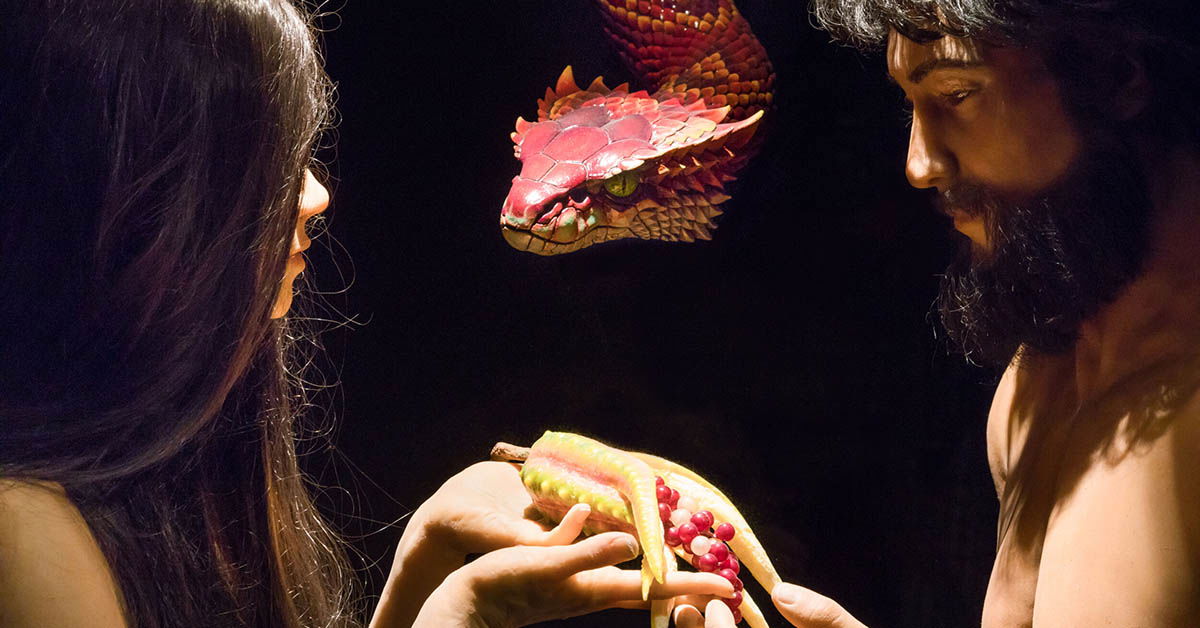
In church tradition, the fruit has often been identified as an apple probably because the Latin word malum, “apple,” sounds like the word malus, “evil.”9 However, Genesis does not tell us what the fruit (pǝrî, cf. Genesis 1:11-12) was. The only fruit mentioned in the passage is the fig (Genesis 3:7).
The serpent was a creature used by Satan to distort God’s Word.
The fact of the matter is that it is not that important to know what the fruit was. What is important is that by taking of the fruit both Adam and Eve sinned against God. Because of Adam’s disobedience, God drove him out of the garden so that he could not eat from the tree of life and live forever (Genesis 3:22–24).
Conclusion
There are many questions regarding the serpent in Genesis 3 with some more important than others and some that are answered more clearly in the text than others. What we do know from Scripture is that the serpent was a creature used by Satan to distort God’s Word. The Apostle Paul warns Christians that we must be aware of Satan’s devices so that we are not outwitted by him (2 Corinthians 2:11).


Footnotes
- The Hebrew word for serpent is nāḥāš and is the common term used for serpents in the Hebrew Scriptures (Genesis 49:17; Exodus 4:2–3; Numbers 21:9).
- Prior to the writing of the New Testament, Jewish interpretations of Genesis 3 (see Wisdom of Solomon 1:13, 2:24) also understood that the serpent was Satan (the devil).
- Genesis 3:15 describes an ongoing war between the serpent and the offspring of the woman.
- It would be mere speculation to stay that animals lost the ability to speak after the fall.
- Edward J. Young, Genesis 3 (London: Banner of Truth, 1966), 18–19.
- The word “touch” involves more than touching the tree with the hand: It has to do with taking possession of the fruit and so consuming it (cf. Genesis 20:6).
- When God speaks to Adam in Genesis 2:16–17, the “you” is singular.
- A snake’s tongue is primarily a sensory organ for smelling and detecting its environment, not for eating. In a fallen world, serpents eat animals for food.
- In the genitive case, the two words would have the same form, mali.



Support the creation/gospel message by donating or getting involved!

Answers in Genesis is an apologetics ministry, dedicated to helping Christians defend their faith and proclaim the good news of Jesus Christ.
- Customer Service 800.778.3390
- Available Monday–Friday | 9 AM–5 PM ET
- © 2026 Answers in Genesis