


The World in Our Pockets
Technology and nature might seem completely opposite, but in many ways, nothing is more natural than the smart phone in your pocket. Nearly every material in your phone started off in the earth during creation week or resulted from the catastrophic conditions of Noah’s global flood. Just as your phone couldn’t have come together on a Silicon Valley workbench without years of research, development, and fabrication, the elements in your phone couldn’t have evolved by random chance processes.
Technology and nature might seem completely opposite, but in many ways, nothing is more natural than the smart phone in your pocket. Nearly every material in your phone started off in the earth during creation week or resulted from the catastrophic conditions of Noah’s global flood. Just as your phone couldn’t have come together on a Silicon Valley workbench without years of research, development, and fabrication, the elements in your phone couldn’t have evolved by random chance processes.
When God made the element yttrium (Y on the periodic table) around 6,000 years ago, he knew that it would one day be used in a compound to provide vivid red color on your smartphone’s screen. Y is just one of many elements that put the world conveniently in our pockets. Even your phone is a reminder that “to the Lord your God belong . . . the earth with all that is in it” (Deuteronomy 10:14).
Powering Up
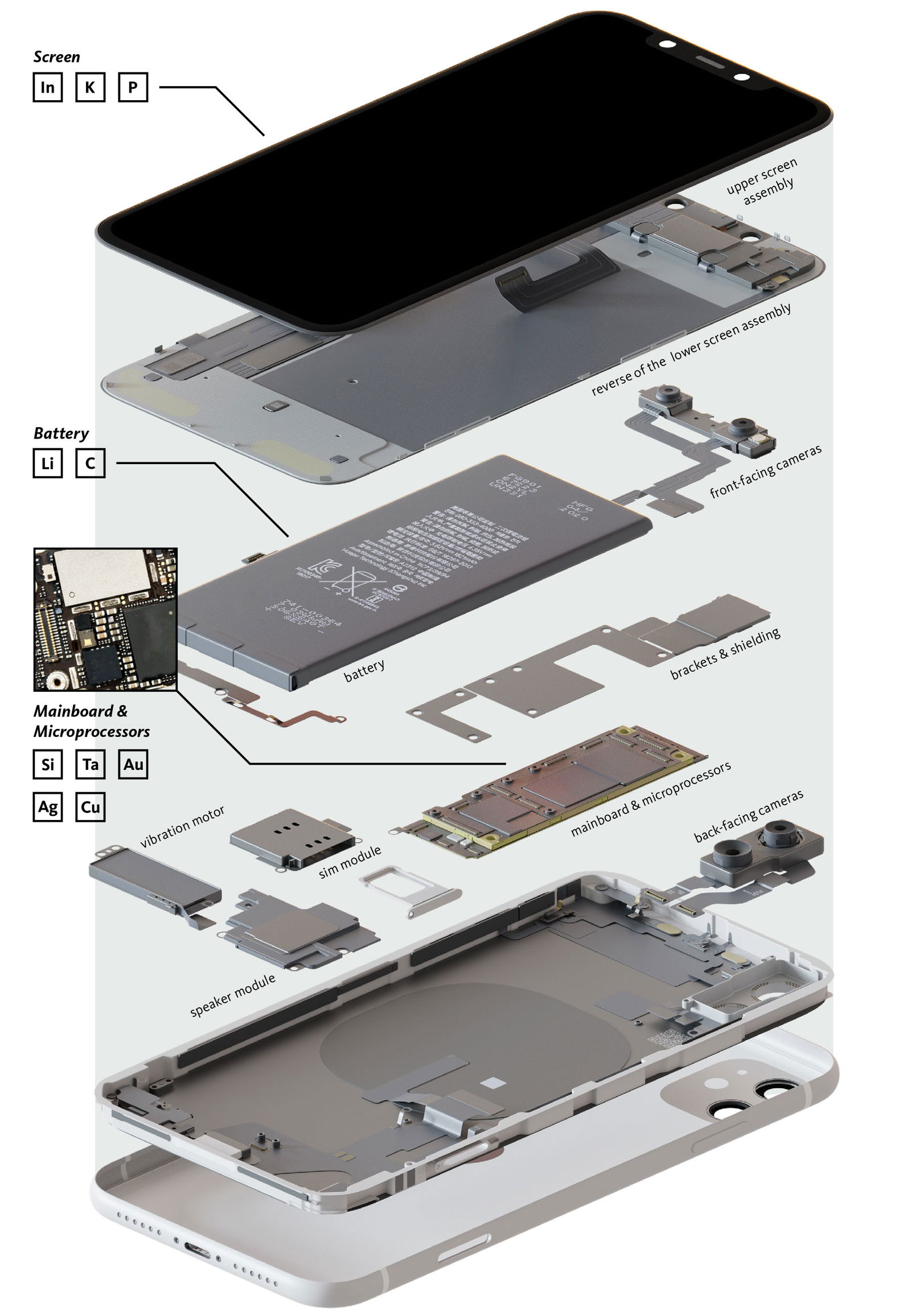
Lithium-Ion Battery
Your phone does a lot of work. But what gives your device the juice it needs to send messages, search the internet, take pictures, and keep time?
Li
Lithium
Lithium, an alkali metal, helps your phone’s battery store energy. Inside the battery, lithium ions travel from the cathode to the anode and back, releasing energy in one direction (discharging) and building up energy in the other (charging). Lithium packs a lot of energy in a lightweight package.
Lithium is found in subsurface saltwater brines leached from volcanic rocks and in the mineral spodumene found in pegmatite rock. Though relatively abundant, lithium is difficult to get our hands on. To extract lithium, the brine is pumped into surface pools where the sun evaporates the water, leaving the raw lithium and other elements to be collected. To extract lithium another way, pegmatite is mined and spodumene is extracted from the crushed rock. (Lithium mining creates many ethical issues. For perspective, see page 62.)
C
Graphite
Graphite serves in the anode of your phone’s battery. The element we have used to write on paper for centuries helps us send information on a cutting-edge communication tool today.
Micro-City
Processing
Inside, your phone looks like a tiny, ultra-planned city with miniscule highways darting this way and that. This is the “smart” part of the smart phone.
Si
Silicon
Silicon accounts for nearly a quarter of the materials in your smartphone, including the microchips that process information.
In your phone, the silicon is doped (made impure) with another element, like boron, to improve conductivity in some specific areas, and oxidized to prevent conductivity in others. This complex mapping enables your phone to receive input and send information via intricate, microscopic superhighways.
Ta
Tantalum
Tantalum, extracted from tungsten ores, makes ideal capacitors for smart phones because of its high capacitance to unit volume ratio. In other words, it does its job very well in tiny amounts. This efficiency is good not only because smartphones are all about packing a connection to the world in a small package, but also because tantalum is rare. For example, some such capacitors are measured in tenths of a millimeter.
Au
Ag
Cu
Gold, Silver, Copper
Your phone may not be worth its weight in gold, but inside, tiny bits of gold, silver, and copper make excellent micro-wiring.
Swipe On, Swipe Off
Screen
Without a screen, your phone would simply be an expensive paperweight. But how do we see the world of information awaiting inside?
In
Indium
Indium is a rare metal, essential for touchscreen liquid crystal displays (LCDs). By conducting electricity, a thin layer of indium tin oxide senses your finger and disturbs the electrical force on the screen. Your finger absorbs a tiny bit of the electricity in that location. That’s why you can’t text wearing regular gloves. No electrical charge is transmitted unless the gloves have conducting material.
Indium is a byproduct of smelting the mineral sphalerite and other ores.
K
Potassium
Potassium strengthens not just your body but also your phone’s glass screen, rendering it much more likely to survive being dropped.
Potassium is found in minerals called langbeinite and sylvite. But don’t try eating those. Better stick with bananas and potatoes!
P
Phosphors
The world is brought to you in full color thanks to phosphors produced from a collection of elements like yttrium, lanthanum, terbium, and europium. The phosphors emit light, providing the vivid, colorful display.
Nd
Pr
Gd
Speaker & Microphone
Phone speakers and microphones include a magnet usually made of rare earth metals such as neodymium, praseodymium, and gadolinium.
Dy
Tb
Nd
W
Vibration Motor
What makes your phone buzz when you receive a call or text? A cell phone’s vibration motor is made of earth elements, including dysprosium, terbium, and neodymium. Tungsten, a heavy, nonmagnetic metal, acts as a counterweight in the motor.
Al
O
Si
Camera
A phone’s camera lens is often made from corundum crystal (pure aluminum oxide), one of the hardest and most scratch-resistant materials available. This material protects the camera’s sensor, made of a thin layer of silicon.
Al
Cu
Fe
Antenna
Cell phone antennas are typically made from copper, but aluminum or steel is sometimes used.
Mg
C
Phone Case
Some phone cases are made with magnesium alloys. Others are carbon-based (plastic).
Answers Magazine
January–March 2025

Wildlife is moving into big cites. How are these creatures adapting?
Browse Issue

Support the creation/gospel message by donating or getting involved!

Answers in Genesis is an apologetics ministry, dedicated to helping Christians defend their faith and proclaim the good news of Jesus Christ.
- Customer Service 800.778.3390
- Available Monday–Friday | 9 AM–5 PM ET
- © 2026 Answers in Genesis