

Shocking Study: Human Babies Have Always Been Human Babies
Sometimes I come across a study that just makes me wonder, “Why did anyone do this study?” And this recent study is a great example of that. The study, published in Proceedings of the Royal Society B, looked at ape and human skulls to see if ancient human infants were as helpless as today’s human infants—all in an effort to discover when our larger brains supposedly evolved—and, well, I don’t think you’ll be shocked by the study findings!
Here’s how they describe the “need” for this study in the abstract of the paper:
Unlike other catarrhine primates, modern humans deliver a helpless newborn who requires prolonged extensive care. Such helpless infancy is associated with fetus-like, rapid postnatal brain growth, which is essential to produce the large human brain. In the debate about its evolution, a key question has been whether it emerged in Homo erectus, whose brain sizes were approximately 20–40% smaller than Homo sapiens.
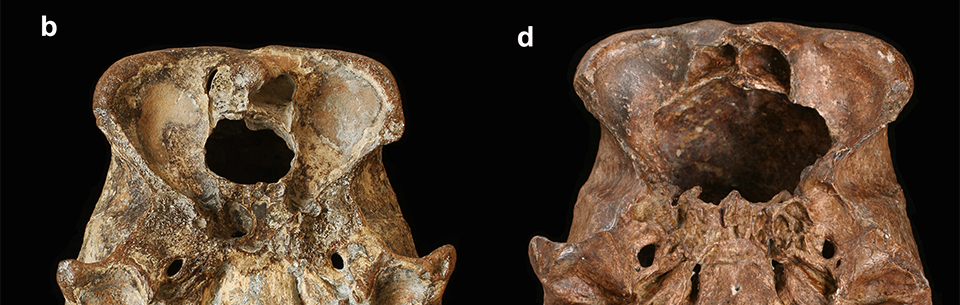
To test this, the authors examined 1,504 “cranial specimens,” including nearly 1,000 from great apes and over 500 from modern humans, looking for deformational plagiocephaly, otherwise known as flat head syndrome. This deformity comes from human babies lying too long on their backs or in the same position and being unable to lift their heads. Apes do not suffer from this condition as they have stronger head control from birth.
The researchers assume that if a skull shows this deformity, it must be because the infant was helpless, like today’s infants. They then looked at cranial fossils from archaic humans, Homo erectus and Homo floresiensis (the so-called “Hobbits”), and found that two of the H. erectus specimens and one of the H. floresiensis specimens exhibited this deformational plagiocephaly. The researchers’ conclusion?
These support a deep evolutionary origin of hominin helpless infancy, and imply both elaborate parental childcare and cooperative social behaviours that could likely have accompanied it.
In other words, humans had babies that looked and acted like human babies! What a shock!
The paper even notes that while Australopithecus—another supposed human ancestor that was really just a variety of ape—was not included in the study, they believe, based on other data, that this species would have had a “postnatal brain and cranial growth pattern” that was “probably different” from the similar-size H. floresiensis (they were quite a short people group) and therefore:
The brain size reduction in the lineage of H. floresiensis was not a simple evolutionary reversal toward the Australopithecus condition; it was rather a unique adaptation that occurred in an insular Homo group while retaining human-like infant growth pattern accompanied by helpless infancy.
In other words, the apes had babies that were apes and looked and behaved like baby apes, and the humans had babies that were humans and looked and behaved like baby humans. What an incredibly shocking study!
The more evolutionists attempt to prove their worldview of millions of years of slow and gradual processes, the more they reveal the truth: God created all of life according to its kind.
The more evolutionists attempt to prove their worldview of millions of years of slow and gradual processes, the more they reveal the truth: God created all of life according to its kind. Apes have always been apes, and humans have always been humans.
We aren’t related to today’s living apes or to extinct ones like Australopithecus. All humans—Homo sapiens, Homo neanderthalensis, Homo erectus, Homo floresiensis, and any other variety (falsely called “species”)—are descendants of the first human couple, Adam and Eve, and made in the image of God. Variety in humans is the result of the genetic diversity God created at the beginning and of the event at Babel, which split the human genome up for a time.
The Bible, not evolutionary fairy tales (which is the correct description of the research mentioned above), explains what we observe.
Thanks for stopping by and thanks for praying,
Ken
This item was written with the assistance of AiG’s research team.
Support the creation/gospel message by donating or getting involved!

Answers in Genesis is an apologetics ministry, dedicated to helping Christians defend their faith and proclaim the good news of Jesus Christ.
- Customer Service 800.778.3390
- Available Monday–Friday | 9 AM–5 PM ET
- © 2026 Answers in Genesis