
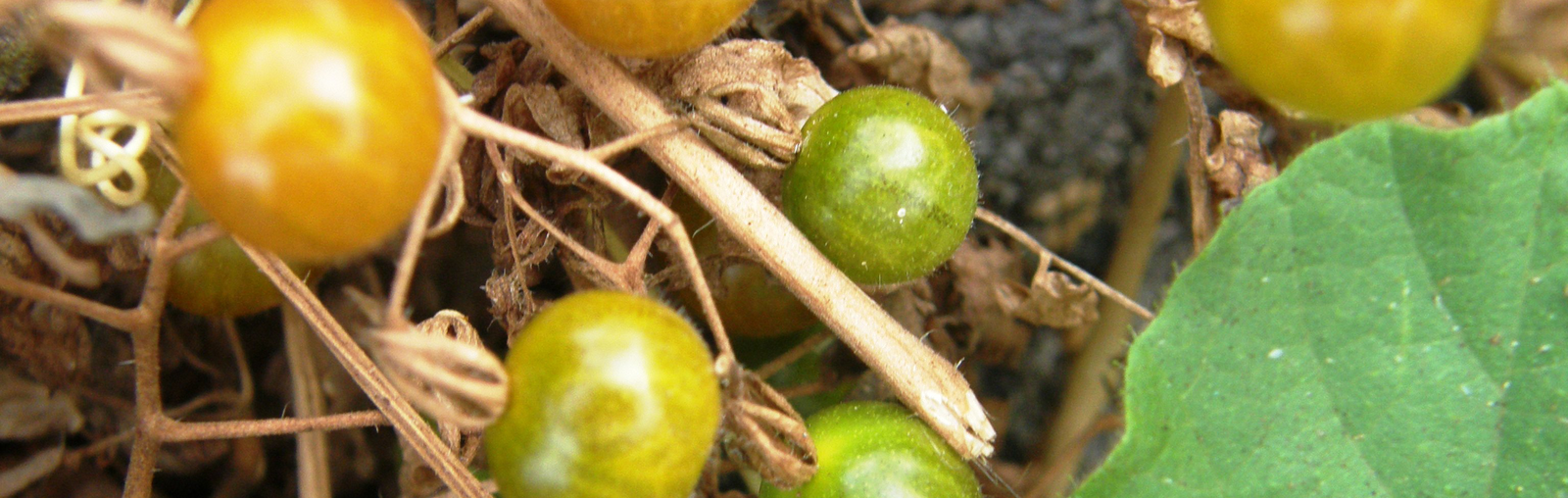
Image CC 4.0 by Laurel Toxico via Wikimedia Commons
Are Tomatoes “De-evolving” on the Galápagos Islands?
Are tomatoes “de-evolving” on the remote Galápagos islands? Well, according to a new study, “Wild-growing tomatoes are doing something peculiar. They’re shedding millions of years of evolution, reverting to a more primitive genetic state that resurrects ancient chemical defenses.”
This so-called “reverse evolution,” as the tomatoes have started making what the writer describes as “a toxic molecular cocktail that hasn’t been seen in millions of years, one that resembles compounds found in eggplant, not the modern tomato,” is an “unexpected development” because
evolution isn’t supposed to have a rewind button. It’s generally viewed as a one-way march toward adaptation, not a circular path back to traits once lost.
Once again, what we observe doesn’t match with evolutionary predictions.
Yes, once again, what we observe doesn’t match with evolutionary predictions. So are these tomatoes really reversing evolution? How do we understand them in a biblical worldview? AiG’s Dr. Georgia Purdom, a geneticist, explains:
The idea that tomatoes are “de-evolving” in the Galápagos islands is based on a chain of evolutionary assumptions. One of the many alkaloids that tomatoes and other members of the nightshade family form are referred to as 25S and 25R. They are the same alkaloid but have different stereochemistry (different orientations in space). GAME8 is the enzyme (or protein) responsible for determining which version (S or R) the plant produces. The researchers performed an “ancestral sequence reconstruction,” based on how they think the nightshade family has evolved over millions of years, to determine the supposed ancestral sequence of GAME8 which produces the R version of the alkaloid.
Although 25R is the supposed ancestral version, certain members of the nightshade family, like the eggplant, produce it today. So it’s ancestral in name only! Tomatoes typically produce 25S, but the Galápagos tomato (Solanum cheesmaniae) produces both 25S and 25R, depending on location. Tomatoes on the older eastern islands produce 25S, but tomatoes on the younger western islands produce 25R (and have a GAME8 enzyme which is more like the supposed ancestral sequence). Scientists aren’t exactly sure why but think the harsher conditions on the western islands (which are still volcanically active) may play a role.
The lead author of the study, Adam Jozwiak, made the statement, “If you change just a few amino acids [referring to the GAME8 enzyme], you can get a completely different molecule [referring to the alkaloid 25S/R].” This is blatantly false! 25S and 25R are both the same alkaloid, they just have different orientations in space with the 25R version presumably being more beneficial than the 25S version in harsher conditions. They are NOT completely different molecules. The reality is that there is variety in the nightshade family with different versions of the GAME8 enzyme and the production of both 25S and 25R in modern plants. The Galápagos tomatoes aren’t “de-evolving” but rather adapting, thanks to the wonderful diversity that God has designed in the nightshade family to help it survive in a fallen world.
To summarize: It’s only “reverse evolution” if you start with evolutionary assumptions and view their genetics through that lens! Really, it has nothing to do with evolution but rather diversity within a kind.
Tomatoes aren’t reversing evolution—because they never evolved in the first place. This is a reminder that evolution is a fairy story!
Thanks for stopping by and thanks for praying,
Ken
This item was written with the assistance of AiG’s research team.
Support the creation/gospel message by donating or getting involved!

Answers in Genesis is an apologetics ministry, dedicated to helping Christians defend their faith and proclaim the good news of Jesus Christ.
- Customer Service 800.778.3390
- Available Monday–Friday | 9 AM–5 PM ET
- © 2026 Answers in Genesis