
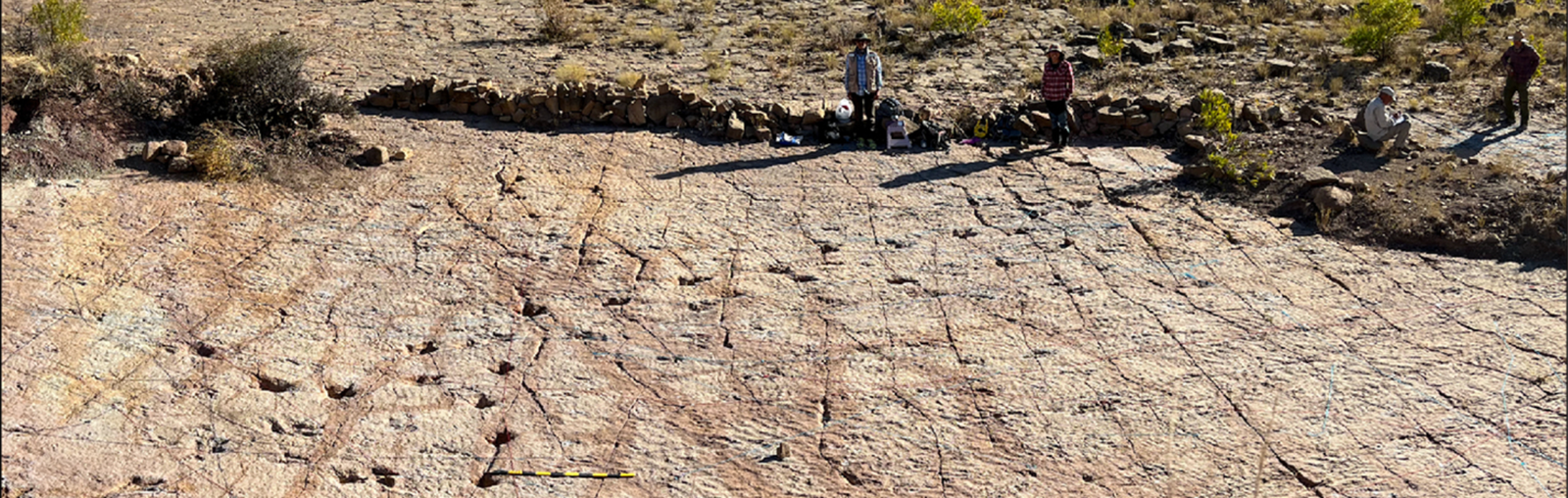
Image CC 4.0 from Esperante et al.
Dino Trackway in Bolivia
A recent news item caught my eye when I saw the headline: “18,000 dinosaur tracks discovered along ancient Bolivian coastline — and they set a new record.” Now, that’s a lot of tracks! And the more I looked over the article, the more I saw what makes this location in Bolivia’s Torotoro National Park appear to be another geological testimony to the global flood.
The footprints were in the Upper Cretaceous El Molino Formation of the Carreras Pampa section of the Torotoro NP, with the largest prints measuring more than 12 inches (30 centimeters) long. The discovery team suggests that “these may have been made by mid-size theropod dinosaurs such as Dilophosaurus or Allosaurus.” (I’m assuming that these two dinosaurs were only being used as an example of mid-size dinosaurs, as both are considered to have gone extinct during the Jurassic, not the late Cretaceous, in the evolutionary view.) “Large theropods such as Tyrannosaurus rex and Giganotosaurus typically leave 16-inch-long (40 cm) footprints, the researchers noted.”
There were also several tracks that “had footprints shorter than 4 inches (10 centimeters), which is rare in the fossil record, according to the study.” It’s unknown if small theropods or juveniles of larger species left them. The researchers were tentative on this question.
One thing that makes this trackway site unique is the different dinosaur behaviors it reveals, including “walking, running, swimming, tail-dragging and making sharp turns.” One of the main authors of the journal paper, Jeremy McLarty, stated: “It preserves evidence of several types of unusually preserved locomotive behaviors and preserves one of the highest numbers of dinosaur tail traces anywhere in the world.”
So how does this equate to evidence of the global flood? Well, the trackways are considered to have been made by dinosaurs walking along an “ancient coastline,” and the authors assume this was a high-traffic area used by theropod dinosaurs. But in addition to walking tracks, there were also many swim tracks discovered. I found the journal paper’s description of the switch from walking to swimming very telling:
Still, some swim tracks cut across previously formed walking tracks and ripple marks, which indicates that the theropods walked on the substrate first, the water level rose, and then the dinosaurs swam, leaving scratches on the still soft bottom.
In addition to dinosaur trackways, there were also avian trackways found, which means that birds were “running with dinosaurs.” Plus, there were numerous fish and bivalve fossils found in the same area, as well as invertebrate burrows. A set of fish teeth were also found, but they were 10 feet (3.2 meters) above the trackway layer.
The LiveScience article attempted to explain the ecological setting by saying, “The abundance of imprints shows that Carreras Pampa was a prehistoric highway, and the parallel orientation of some trackways suggests some dinosaurs traveled in groups.”
But is that what these tracks show? No, it shows that dinosaurs were walking, then swimming, then walking or running again. They were not casually strolling near an ancient coastline but were fleeing the rising floodwaters along with birds that lived alongside them (and did not evolve from them).
The authors of the journal paper briefly discussed the preservation of the trackways:
The preservation potential is minimal under conditions of prolonged exposure without any sedimentation. The morphology and preservation of footprints depend heavily on the events that occur after the tracks are formed, because exposed prints are highly susceptible to destruction through erosional processes (e.g., water currents, wind, invertebrate bioturbation). Preservation is favored by rapid lithification and burial. Therefore, the cementation of the studied track-bearing layer of Carreras Pampa had to occur relatively rapidly before erosion could take place during exposure or before the deposition of the overlying layer. The deposition of the overlying thin green layer filled the depressions between ripple marks, theropod prints, and delicate avian tracks, and this process must have occurred without disrupting those previously formed structures. Footprint recording happens under conditions of rapid cementation.
Once again, the physical evidence seems to be shouting “Noah’s flood,” not “a typical dinosaur day at the beach.”
So, according to the evolutionary interpretation, we have groups of many theropod dinosaurs walking along a beach, then going for a refreshing swim, then getting out of the water again and walking or running pretty much in the same direction (typically to higher elevations). Birds are doing the same thing but flying when the water level reaches them. And the prints and tracks are only preserved because there was rapid sedimentation happening just after the tracks were made. How could we not see this as an example of the rising catastrophic floodwaters which covered and thus ended the preflood world?
Once again, the physical evidence seems to be shouting “Noah’s flood,” not “a typical dinosaur day at the beach.” When stripped of evolutionary interpretation, the actual trace fossils corroborate what is described in Scripture:
And all flesh died that moved on the earth, birds, livestock, beasts, all swarming creatures that swarm on the earth, and all mankind. Everything on the dry land in whose nostrils was the breath of life died. (Genesis 7:21–22)
Thanks for stopping by and thanks for praying,
Ken
This item was written with the assistance of AiG’s research team.
Support the creation/gospel message by donating or getting involved!

Answers in Genesis is an apologetics ministry, dedicated to helping Christians defend their faith and proclaim the good news of Jesus Christ.
- Customer Service 800.778.3390
- Available Monday–Friday | 9 AM–5 PM ET
- © 2026 Answers in Genesis