
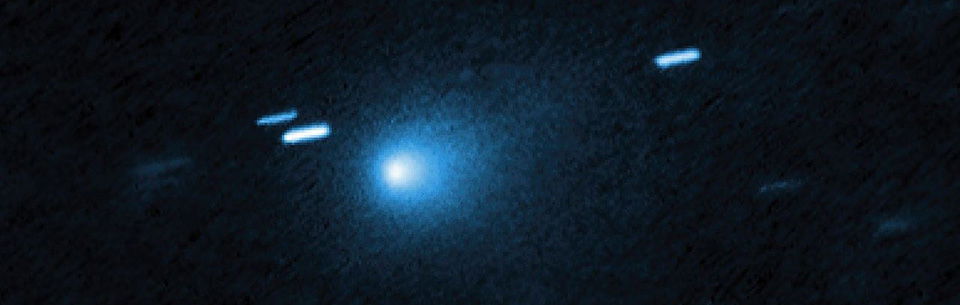
Image: NASA, ESA, David Jewitt (UCLA); Image Processing: Joseph DePasquale (STScI)
Why All the Fuss Over 3I/ATLAS?
What is 3I/ATLAS, will it collide with earth, and is it an alien spacecraft?
There is growing interest in the astronomical object called 3I/ATLAS. What is 3I/ATLAS? Why all the interest in 3I/ATLAS? And how should creationists respond to the reports and claims made about 3I/ATLAS?
What Is 3I/ATLAS?
3I/ATLAS was discovered by the Asteroid Terrestrial-impact Last Alert System (ATLAS) on July 1 of this year. ATLAS is a system of five robotic 0.5-meter telescopes spread around the world. The program is funded by NASA, but it was developed and is operated by the University of Hawaii Astronomy Department. The purpose of ATLAS is to discover near-earth objects (NEOs).
NEOs are asteroids that have orbits around the sun that are very close to earth’s orbit around the sun. NEOs have the potential of colliding with earth, an event that could have consequences that could end civilization. Therefore, advanced knowledge of such an event is of great importance, though it is not clear what, if anything, could be done if we were to have prior knowledge of a collision of this nature. Every clear night, each ATLAS telescope surveys one-quarter of the observable sky four times. Any moving object (such as an orbiting asteroid) is detected by its shift between the four surveys.
When the ATLAS telescope in Chile discovered 3I/ATLAS on July 1, the ATLAS program gave the object the temporary designation A11pl3Z, and the information was passed on to the Minor Planet Center (MPC) in Cambridge, Massachusetts. A preliminary orbit based on the discovery images suggested that 3I/ATLAS could pass close to the earth, which prompted the MPC to issue an alert. Both professional and amateur astronomers quickly pored through archival ATLAS data, as well as archival data from other survey programs, which resulted in images going back nearly four weeks prior to the July 1 discovery of the object (3I/ATLAS was too faint to be detected by the automated systems in earlier images).
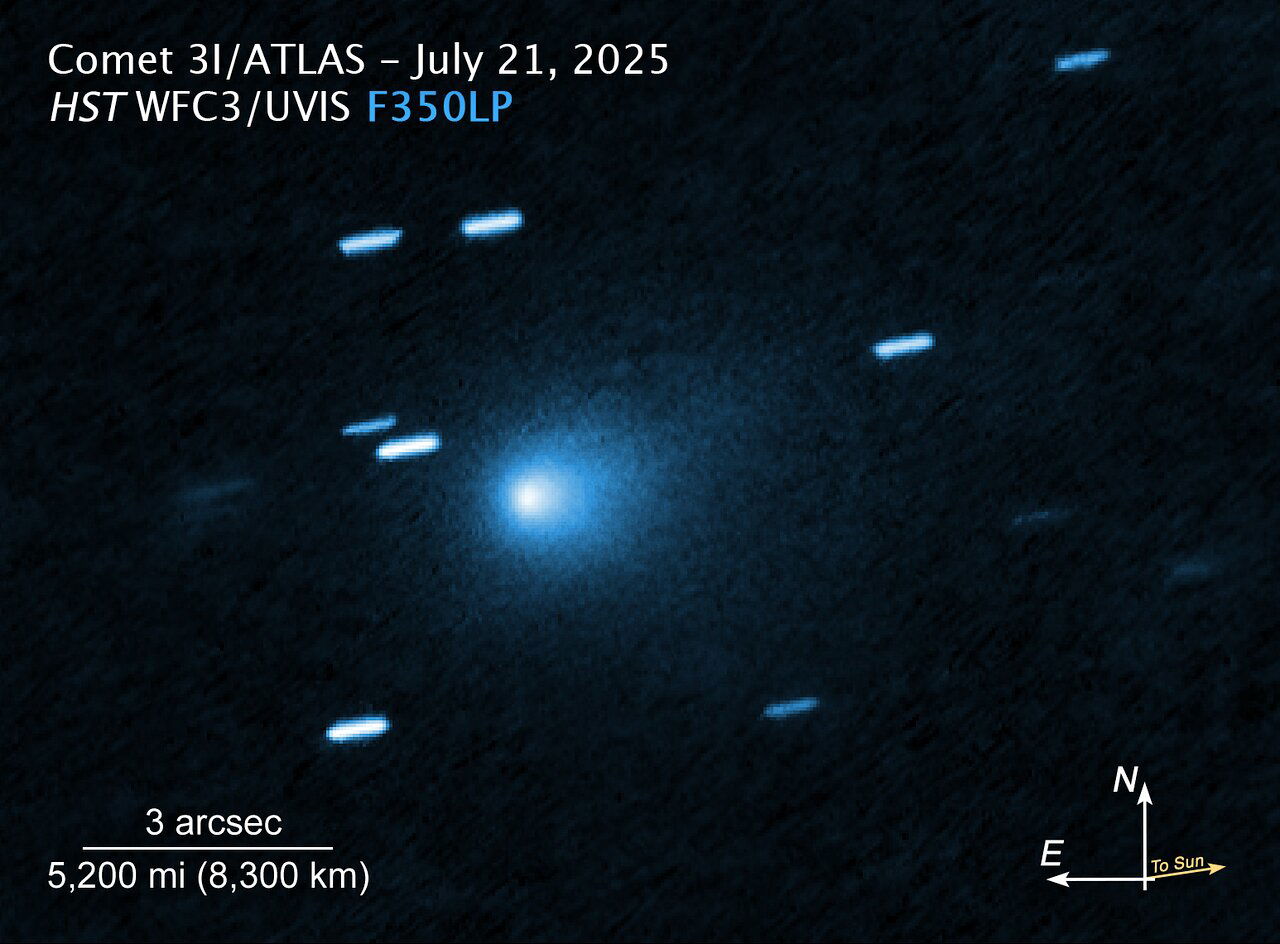
(Image CC 4.0 by NASA, ESA, D. Jewitt (UCLA); Image Processing: J. DePasquale (STScI) via ESA/Hubble)
But was this new object an asteroid or a comet? By July 2, follow-up observations with much larger telescopes revealed a small glow around the otherwise point-like object. This glow was from a coma, the fluorescing gas ejected by a comet, so the object must be a comet and was given the name C/2025 N1 (ATLAS). The preceding “C” indicates that it is a comet, the “2025N1” indicates the order of discovery of new comets in the year 2025, and the “ATLAS” indicates the discoverer.
Quickly, it became obvious that the comet would not pass anywhere near earth.
Prediscovery and follow-up observations were essential in properly determining the orbit of C/2025 N1 (ATLAS). Getting a good knowledge of its orbit required observations spread over as much time as possible, called the observation arc. The longer the spread in time, the longer the arc of motion and the better the orbit calculation. The discovery observation arc was a matter of a few hours, so the initially computed orbit that indicated a possible close pass to the earth was subject to much error. Within days, the observation arc became long enough to establish better knowledge of the orbit of C/2025 N1 (ATLAS). Quickly, it became obvious that the comet would not pass anywhere near earth.
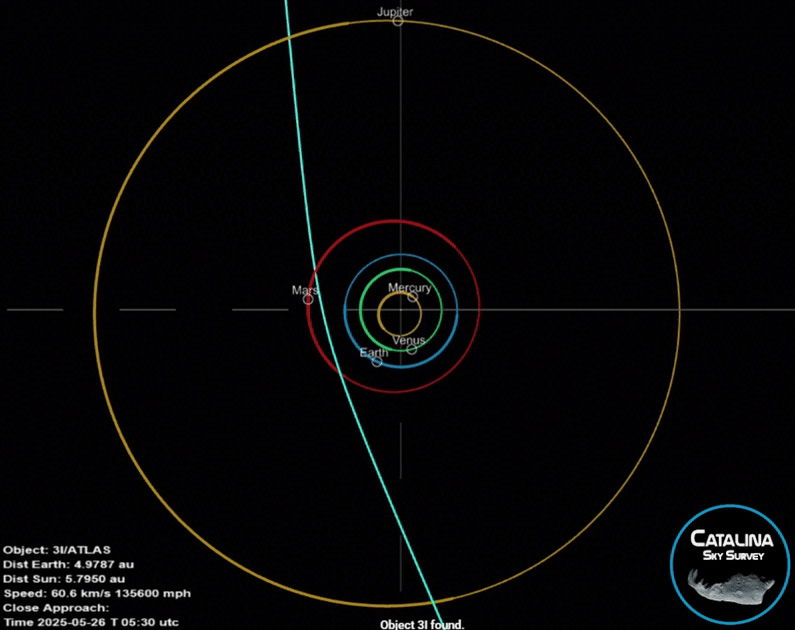
The cyan line shows the movement of 3I/ATLAS through the inner solar system.
(Image CC 4.0 by Renerpho via Wikimedia Commons)
However, something more significant about the orbit of this comet soon became apparent. Comet orbits typically are elliptical or parabolic. This means that they are gravitationally bound to the sun and are permanent members of the solar system, with repeated trips near to the sun once each orbit. But the orbit of C/2025 N1 (ATLAS) turned out to be hyperbolic. An object on a hyperbolic orbit is not gravitationally bound to the sun. That is, this comet is not a permanent member of the solar system and is just passing through once.
Since objects passing through the solar system are not members of the solar system, they are classified as interstellar objects. The first known interstellar object, 1I/ʻOumuamua, was discovered just eight years ago. ʻOumuamua is the proper name of this object, from the Hawaiian word for “scout” (most small objects don’t receive proper names). The “1I” was a newly created designation, indicating that it was the first interstellar (non-solar system) object found passing through the solar system. From its orbit, 1I/ʻOumuamua was originally thought to be a comet, but it never displayed any evidence of a coma, so it is officially recognized as an asteroid, or rocky body. Until this year, the only other interstellar object seen in the solar system was 2I/Borisov, a comet discovered in 2019. The discovery of 3I/ATLAS this year increases the number of known interstellar objects briefly passing through the solar system to three.
Are Interstellar Objects Something New?
Given that the only three known interstellar objects in the solar system were found in the past eight years, one might wonder why interstellar objects are only now showing up. Are we being invaded by interstellar visitors? No, the correct answer lies in our vastly increased ability to discover very small objects in the solar system. Comets have been known since ancient times, but until the invention of the telescope, only the very brightest comets were seen. And it often was years between each comet discovery. Once the telescope was invented four centuries ago, the rate of comet discoveries increased, though most newly discovered comets never reach naked-eye visibility. As recently as the 1980s, 20 comets discovered in one year would have been remarkable. But in the 1990s, the pace of comet discoveries rapidly accelerated, all due to advances in technology, such as more dedicated robotic telescopes, more sensitive cameras, and new spacecraft.
For instance, the most productive comet hunter in history is the Solar and Heliospheric Observatory (SOHO) spacecraft. Going into operation in May 1996, by early 2024, SOHO discovered its 5,000th comet.1 That is an average rate of nearly 200 comet discoveries per year. These comets are all very tiny and are found by this spacecraft only when they are extremely close to the sun, when comets are at their brightest. Ironically, SOHO was not intended to be used for comet discovery—this unanticipated ability of SOHO was a pleasant surprise. Hundreds of comets pass through the inner solar system every year. It’s just that most of these comets are very small and faint and were never detected until recently.
There has been an even larger explosion in the known number of asteroids, the other small objects in the solar system. The first asteroid was discovered in 1801. It was not until the second half of the twentieth century that the number of known asteroids reached 2,000. The 20,000 threshold was reached in the 1990s. But advances in technology and the desire to identify NEOs have prompted a sharp increase in the rate of their discovery since the mid-1990s. For instance, ATLAS has found far more asteroids than comets. Today, the number of known asteroids exceeds one million, with many new discoveries literally every day.
Presumably, such small bodies are not unique to the solar system, so one might expect that occasionally a small body from elsewhere would pass through the solar system. Since the statistics of small solar system bodies (SMMBs, and that is the preferred term for both comets and asteroids when grouped together) are skewed in favor of very tiny objects, it is likely that small bodies from elsewhere are overwhelmingly small too. Therefore, a few interstellar objects probably pass through the solar system every year, but it was not until the advent of modern technology that we were able to detect these small visitors.
Why All the Interest in 3I/ATLAS?
1I/ʻOumuamua, the first interstellar object seen passing through the solar system in 2017, attracted some attention at the time but not nearly the attention that 3I/ATLAS has this year. Why is that? There are at least two reasons for this.
First, the preliminary orbit calculation for 3I/ATLAS indicated a possible close pass to the earth. Any object that presents the danger of a collision with earth gets people’s attention. However, as I’ve already explained, that first orbit calculation was based on limited observations, and it turned out to be completely wrong. Additional observations quickly corrected the orbit, revealing that 3I/ATLAS will not come anywhere near earth, though that out-of-date incorrect orbit calculation indicating a close pass to earth is still circulating with the public.
Second, Harvard astrophysicist Avi Loeb has seriously suggested that 3I/ALAS may be an alien spacecraft. Loeb made a similar claim about 1I/ʻOumuamua. 1I/ʻOumuamua had an elongated shape, similar to the dimensions in the ratio of those of modern, large warships. Or perhaps spacecraft. When I learned of 1I/ʻOumuamua’s unusual shape in 2017, I immediately thought of the Botany Bay, an alien spacecraft with similar dimensions in “Space Seed,” a 1967 episode of Star Trek. While I thought the parallel was amusing, Loeb took it very seriously, for a few weeks later, Loeb went public with his speculation that 1I/ʻOumuamua might be an alien spacecraft. Loeb suggested radio telescopes monitor 1I/ʻOumuamua for any transmissions (none were found). 1I/ʻOumuamua did not strictly follow the orbit that gravity would have dictated as it passed through the solar system. Variation from its predicted motion were very small, but they were detectable. This was unusual activity for an asteroid, a solid body, but not for a comet, which has random jets of material released by solar heating as it passes close to the sun. Jets of material outgassed by comets act as rocket thrusters, slightly jostling the trajectories of comets when near the sun. However, very careful observations revealed no coma around 1I/ʻOumuamua, which would be direct evidence of gas escaping 1I/ʻOumuamua. Loeb interpreted the variations in motion as possibly coming from rocket thrusters changing 1I/ʻOumuamua’s trajectory.
Loeb has similarly picked up on any and every characteristic of 3I/ATLAS that he thinks is unusual. For instance, as 3I/ATLAS passed close to the sun, it ejected much material, with Loeb suggesting if 3I/ATLAS were a natural object (a true comet), then it would have disintegrated.2 Many other astronomers disagreed because comet disintegration is difficult to accurately predict. Earlier Loeb had cited what he thought was 3I/ATLAS’s unusual path through the solar system, its large size, and its unusual composition, as evidence of 3I/ATLAS not being natural.3 Of course, other astronomers disagreed. As it turns out, the supposed unusual composition of 3I/ATLAS was not as unusual as originally thought. Nor do Loeb’s claimed statistics of its trajectory stand up to scrutiny. Comets display a wide array of different characteristics (including composition, size, and orbits), so one could make unique claims about every comet. It’s long been said that comets are similar to cats—both have tails and do whatever they want. I would add that every cat and every comet is unique.
How Should Christians Respond to 3I/ATLAS?
What is Loeb’s motivation? Like most other scientists, Loeb is committed to naturalism, the assumption that nothing exists beyond the natural world. While most scientists may not be atheists, naturalism causes many scientists to conduct their work as if no God exists. If God did not create life, then life must have arisen naturally. But this poses deep scientific problems. If 400 years of biology has taught us anything, it has taught us the law of biogenesis, that life only comes from life. Despite this, many scientists think that life must have naturally arisen from nonlife. However, if the earth is the only place where life exists, then the earth is unique. But recognition that the earth is so special strongly implies creation, which requires a Creator. Since this violates naturalism, most naturalistic scientists conclude that life must be common in the universe, that life inevitably arises wherever the conditions are conducive to life. Hence, the earth is just one of many places where life exists in the universe.
Recognition that the earth is so special strongly implies creation, which requires a Creator.
However, some naturalistic scientists recognize the problem of the law of biogenesis. But rather than strictly adhering to the law of biogenesis, these scientists think that on rare occasions the law of biogenesis is violated, making life in the universe rarer than often thought, but not unique to earth. To make life in the universe more common, these scientists promote panspermia, the belief that life can, and has been, transferred from planet to planet, even between planets orbiting different stars. The most prominent proponent of panspermia was the late Sir Fred Hoyle. Loeb also is a proponent of panspermia.4 Panspermia supposedly can happen naturally when asteroids colliding with planets eject rocks containing microbes from those planets, with some of those rocks eventually falling on other planets to seed life on those planets. Or perhaps alien civilizations build interstellar spacecraft that those civilizations hope one day will end up on planets orbiting other stars so that life can colonize other planetary systems.
This sort of reasoning is antithetical to biblical thinking. Answers in Genesis is committed to the authority of God’s Word. While the Bible does not directly tell us whether God created life on other worlds, and especially life such as humans, who are created in God’s image and in his likeness (Genesis 1:26), the implication is that life, and especially human life, is unique to the earth. So we don’t expect alien spacecraft to show up, nor do we expect them to pass by on their way to somewhere else. I suggest that we shrug at the wild claims about 3I/ATLAS.
Answers in Depth
2025 Volume 20
Answers in Depth explores the biblical worldview in addressing modern scientific research, history, current events, popular media, theology, and much more.
Browse VolumeFootnotes
- Thomas, Vanessa, “ESA, NASA Solar Observatory Discovers Its 5,000th Comet,” NASA, March 27, 2025, https://science.nasa.gov/science-research/heliophysics/esa-nasa-solar-observatory-discovers-its-5000th-comet/.
- Cost, Ben, “New Evidence of 3I/ATLAS’s Alien Origin as Comet Emerges Intact from Trip Behind Sun: Harvard Scientist,” The New York Post, November 13, 2025, https://nypost.com/2025/11/13/science/avi-loeb-claims-comet-3i-atlas-structural-integrity-supports-alien-theory/.
- Tangermann, Victor, “Harvard Scientist Suspicious About 3I/ATLAS’ Origins Fires Back at Critics,” Futurism, November 17, 2025, https://futurism.com/space/harvard-scientist-suspicious-3i-atlas-critics.
- Siraj, Amir, and Loeb, Abraham, “Possible Transfer of Life by Earth-Grazing Objects to Exoplanetary Systems,” Life 10, no. 4 (2020): 44, https://doi.org/10.3390/life10040044.
Support the creation/gospel message by donating or getting involved!

Answers in Genesis is an apologetics ministry, dedicated to helping Christians defend their faith and proclaim the good news of Jesus Christ.
- Customer Service 800.778.3390
- Available Monday–Friday | 9 AM–5 PM ET
- © 2026 Answers in Genesis