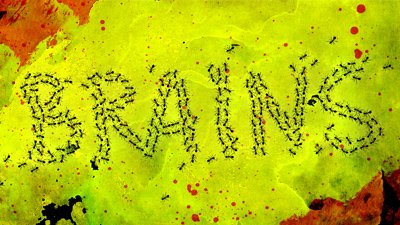
Carpenter ant colonies evade zombie apocalypse because only the climbing dead become weapons of mass dispersion.
Monarch butterflies are famous for their distinctive coloration and multigenerational migration. Now, they may become famous for something else: prescribing medicine for their offspring.
Evolutionists claim that fossilized footprints found in Poland give clues as to the history of dinosaurs.
While structures found in fossilized penguin feathers make evolutionists reconsider their ideas about these early aquatic birds, creationists can enjoy the variety God has put within this fascinating animal kind.
A study of 600 generations of fruit flies, just reported in Nature, sought to unravel the mystery of how advantageous mutations could become fixed in the population.
A new study of the Simian Immunodeficiency Virus (SIV), a virus infecting “almost all African monkeys” but not sickening them, has led to speculation about how long the virus has been around in its present form.
Before the discovery of bowerbirds’ optical effects, only humans were known to design optical illusions. But does the bowerbird possess an artistic sense like humans?
Could the destructive impact of a comet construct life on earth?
Last week we highlighted WORLD magazine’s cover story on a young-earth creationist raft trip. The issue also featured a review of young-earth creationist materials, including several from Answers in Genesis.
In The Grand Design, Stephen Hawking and coauthor Leonard Mlodinow lay out the case for a universe that began without any divine spark—one step beyond even those who accept the big bang but see it as God’s handiwork. To the authors, the big bang was the unavoidable result of the laws of physics at work.
A strange Australian lizard that can, apparently, both give live birth and lay eggs: is it evolution “caught in the act”?
Are controversies over religion, origins, and the like merely academic? Of course not; new research reminds us of the powerful connection between values and actions.
Was Charles Darwin wrong? A few headlines this week have made the claim, but the news isn’t anything that will thrill creationists.
Evolutionists continue to speculate about where life began. The latest answer? Between sheets of the geological substance mica.
Out of Britain comes more news that upsets the idea of “race.”
Natural selection, the force driving so-called “survival of the fittest,” is at the heart of both evolutionist and creationist explanations for life’s diversity. But in one strange case, natural selection is not at work on an animal.
What were humans like a million years ago—fur-wearing, meat-eating, tool-making Britons?
When it comes to a God’s-eye view of the physical universe, the European Space Agency’s Planck telescope mission may have given us the closest approximation yet.
Once again, scientists are turning to God’s creations for inspiration.
For the third time in as many weeks, we’re reporting on purported evidence of water on ancient Mars.
WORLD editor-in-chief Marvin Olasky asks, “Should we hug evolution to further evangelism?”
A new genetic study has revealed that many modern humans have Neanderthal ancestry.
There’s no evidence that aliens even exist—so why is famous physicist Stephen Hawking so worried we’ll talk to them?
Water ice has been discovered again in space, this time on the surface of the asteroid 24 Themis.
Answers in Genesis is an apologetics ministry, dedicated to helping Christians defend their faith and proclaim the good news of Jesus Christ.