

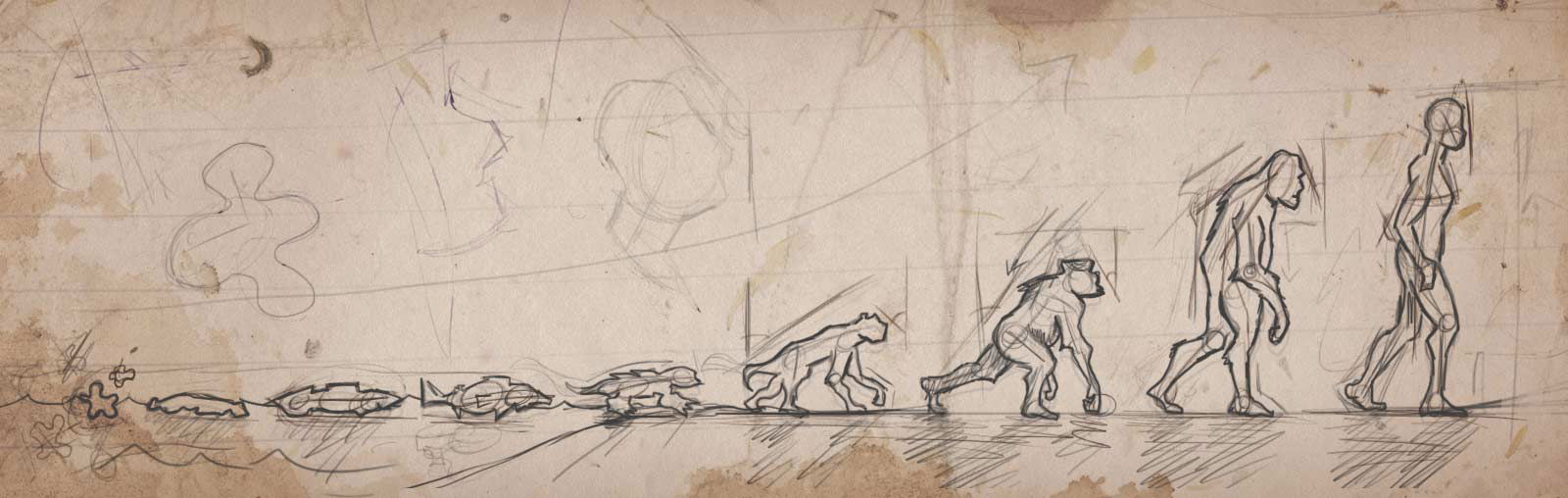
Rules for Thee, but Not for Me: The Unfalsifiability of Evolution
Evolution is pseudoscience by naturalists’ own standards.
Whether it was watching politicians and media personalities completely ignore the very same punitive and draconian measures they insisted be forced upon the general public during the Covid-19 situation, seeing so-called anti-racist groups say absolutely horrific things about entire people groups based solely on their genetic attributes, or observing self-declared feminists ignore eighth grade science regarding human biology and championing men becoming the dominant athletes in female sports, the general public has become fed up with the nonsensical double standards seen so often in society today.
Inconsistent Standards
Of course, this hypocritical “rules for thee but not for me” situation has been a standard operating procedure used by many naturalists in the creation/evolution debate for years now. For example, when creationists point to the DNA code system as an obvious example of intelligent design because codes have only ever been seen to originate from intelligent minds, Bible skeptics viciously attack that position and insist language systems could originate naturally—despite no observational evidence of it happening.
However, when the people involved in the SETI (Search for Extraterrestrial Intelligence) program declare receiving a coded message from space as proof of an intelligent being having sent it, the vast majority of the evolutionary community doesn’t bat an eye, deeming it quite logical.1
And when a flood of biblical proportions once occurring on Mars (where we have yet to confirm the presence of liquid water2) is reported, most evolutionists have no problem with the idea.3 But when the biblical Flood is mentioned as a historical event—on a planet where if all the highest and lowest levels of the land masses were evened out the entire surface would be covered to a depth of close to 3 kilometers4—evolutionists mock it with unprecedented vitriol.
While evolutionists mock the idea that creatures like the platypus migrated from the mountains of Ararat (where Noah’s Ark landed) and crossed the Indian Ocean to arrive in Australia (despite creationists presenting valid explanations for how they could have done so), an international team of evolutionists seems quite comfortable proposing that dinosaurs swam or floated hundreds of miles across the Atlantic Ocean from North America to Africa.
Describing a “once-in-a-million year event,” an international team of paleontologists has suggested that, though nearly impossible, a herd of pony-sized duck-billed dinosaurs must have either floated or swam across to Africa up to 66 million years ago.5
Poisoning the Well
Often, included alongside these double standards are undermining terminology and accusations. A good example is the claim that any scientific support of belief in God, creation, or any biblical narrative is labeled pseudoscience.
Criticisms like this can be seen and heard from evolutionists everywhere, such as in this article from Eugenie Scott—the former executive director of the high-minded–sounding National Center for Science Education—that she actually titled “My Favorite Pseudoscience.” She wrote, “My introduction to skepticism was a fascination with a particular pseudoscience, ‘creation science.’”6
Of course, intelligent design advocates are also equivocated to the same level as creationists and brushed with the same label. Dr. Nicholas Matzke made this clear in his 2010 article “The Evolution of Creationist Movements,” where he wrote, “Creation scientists used big words, also—it’s not as if ID invented this feature of pseudoscience!”7
All of these bold declarations from evolutionists fly out the window as soon as a supposed definition of pseudoscience is clarified and when that standard is applied to the scientific study of both creation and evolution.
However, all of these bold declarations from evolutionists fly out the window as soon as a supposed definition of pseudoscience is clarified and when that standard is applied to the scientific study of both creation and evolution. What do I mean?
What Is Pseudoscience?
Well, ask yourself what is pseudoscience? Is it simply using big words when talking about your beliefs as Matzke childishly implied? Well, obviously not! Evolutionists use big words, so if that were the standard, then only scientists using little words could be credible, which just shows how ludicrous his statement is.
Of course, one can find many dictionary definitions of pseudoscience such as these, but all of them rely on subjective reasoning by the reader.
- Merriam-Webster Dictionary: “a system of theories, assumptions, and methods erroneously regarded as scientific”8
- Collins English Dictionary: “facts and principles systematized and presented as science, but having no true scientific basis or application”9
- American Heritage Dictionary: “a theory, methodology, or practice that is considered to be without scientific foundation”10
Who exactly gets to be the arbiter of truth as to what is considered “erroneously regarded as science”? What exactly are “facts . . . presented as science” (I thought science was based on starting with facts)? And who gets to decide what is “without scientific foundation,” especially if “facts” can be presented as not being scientific in some way as per the second definition? I mean, taking these as presented, a creationist could quite legitimately and logically accuse evolution of being pseudoscience.
Falsifiability?
However, let’s try to be more gracious to the materialists and make sure we aren’t making a straw man of their argument. Here’s how some hardcore evolutionists define what pseudoscience is. We begin with Leon Albert’s article “‘Scientific’ Creationism as a Pseudoscience.” Albert (who was the anthropology professor at East Los Angeles College) was an active critic of creationism, wrote in the Creation/Evolution journal and The Skeptical Inquirer, and even debated the formidable creationist Dr. Duane Gish back in the day. Albert wrote, “Any theory claiming a legitimate scientific status must be, at least in principle, falsifiable.”11
Now, Albert explains what he means by falsifiable immediately following in the article by stating, “There must be some conceivable observation that could disprove the theory.”
He then applies that criterion to creation science, arguing that any observation science makes could be reconciled with the actions of an omnipotent Creator, and so on that basis, scientific creationism is “forever doomed to remain in the realm of pseudoscience.”
Similarly, the American Psychological Association adopted a closely related criterion for intelligent design in 2007. In their statement, they said, “For a theory to be taught as science it must be testable, supported by empirical evidence and subject to disconfirmation. Thus, intelligent design lacks a basis in science.”12
An Even Playing Field
Okay, so now we have a standard we can hold the story of evolution up to. Supposedly, it must be theoretically falsifiable—meaning, there must be some conceivable observation you could make that would disprove it. However, can you imagine an observation someone could make that could absolutely not be reconciled with the story of evolution because personally—based on experience—I can’t!
For example, in an article cowritten by famous atheistic evolutionists Dr. Richard Dawkins and Dr. Jerry Coyne, they bring up the topic of falsifiability in the following way.
As the great biologist J B S Haldane growled, when asked what might disprove evolution: “Fossil rabbits in the pre-Cambrian.” Evolution, like all good theories, makes itself vulnerable to disproof. Needless to say, it has always come through with flying colours.13
Now what’s hilarious about that statement is that Haldane didn’t only make that one falsifying criterion regarding what might disprove evolution, he also said that evolution could never produce “various mechanisms, such as the wheel and magnet, which would be useless till fairly perfect.”14
Now of course, we’ve not found a rabbit in what evolutionists would determine as rock layers dating to the pre-Cambrian. But the discovery of ATP synthase molecular motors—which have gears and wheels found inside every living thing on the planet, including magnetotactic bacteria (that use magnetosome organelles that act like a compass that allow them to navigate their environment)—have absolutely falsified Haldane’s predictions hands down, no argument.
Scientifically speaking, it only takes one contradictory observation to disprove your theory. But do Coyne and Dawkins acknowledge that in their article and admit evolution has been falsified according to the very same man’s predictions they say support evolution by making it supposedly falsifiable? Of course not!
They also wouldn’t admit evolution has been falsified if they did find a rabbit in what they consider pre-Cambrian rocks. They could just as easily do what we’ve seen done hundreds of times before in such cases: rework the story and make whatever they see somehow fit the narrative.
Ever-Changing Stories and Standards
How many times have we seen headlines in popular articles say something like this: ”New discovery causes scientists to totally rethink [insert evolution-based claim here]!”
For example, here are just 5 of at least 80 verifiable (complete list of the links provided here) news articles produced in the last four years that I found when I did a search for such “new discovery rewrites evolutionary predictions” type articles.
- “567-Million-Year-Old Fossils Rewrite the Dawn of Animal Life: A Remarkable Canadian Fossil Site Reveals That Animals Were Moving, Reproducing, and Evolving Complex Bodies up to 10 Million Years Earlier Than Scientists Thought”15
- “The Origins of Complex Life Pushed Back to Before the Cambrian”—“A New Study Examining These New Fossils Shows That Many Key Animal Groups Had Already Evolved Before the Cambrian Explosion”16
- “The First Animals on Earth Had No Skeletons and That Changes Everything: Earth’s First Sponges Were Soft, Skeleton-Free Pioneers—Rewriting the Origin Story of Animal Life”17
- “A 236-Million-Year-Old Fossil Could Rewrite the Story of Mammalian Birth: Scientists May Have Uncovered Evidence That a Mammal Ancestor Was Giving Birth to Live Young 236 Million Years Ago”18
- “Rare Fossil Goose Rewrites the Story of New Zealand’s Giant Birds: A Newly Discovered Fossil Goose Is Rewriting the Evolutionary Story of New Zealand’s Legendary Giant Birds”19
Starting to see the issue? Again, what scientific observation would disprove evolution? Well, interestingly, in the very article “‘Scientific’ Creationism as a Pseudoscience” where Albert declared “any theory claiming a legitimate scientific status must be, at least in principle, falsifiable” and said “there must be some conceivable observation that could disprove the theory,” he gave the following example of how a specific “evidence” for evolution provided what he deemed “a potential means of falsifying the theory of evolution” while discrediting creation science at the same time.
According to the theory of evolution . . . chimpanzees represent our closest living relatives. . . . . . . Recently developed techniques for measuring the detailed structure of the most basic molecules of life, DNA and protein molecules, have provided a potential means of falsifying the theory of evolution or at least this particular implication of that theory. Simply consider the two extremely opposed possible research results: on the one hand, it could have conceivably turned out that humans and chimpanzees were totally dissimilar in their molecular structures; on the other hand, it could have been found—as it was—that humans and chimps are practically identical in those structures. (Indeed, in the molecules so far compared, the identity has been found to be over 99 percent.) Had the former situation been found, it would have constituted a falsification of the postulated close evolutionary relationship between humans and chimpanzees. The findings of such molecular comparisons have provided overwhelming support for the evolutionary relationships postulated initially on the basis of comparative anatomy.20
Double Standards Regarding DNA
Uh-oh! Do you recognize the supposed “evidence for evolution” he’s talking about? His article was published in 1986, so here he was quoting the now-debunked claim that humans and chimps share 99% DNA similarity (which is still being claimed by evolutionists today, despite the fact it’s been completely disproven by modern evolutionists themselves).
Today’s research says if all the currently known differences were counted and combined, there are a total of 600 million DNA differences between humans and chimps, which drops the similarity down to around 80%,21 and it will likely continue to fall as more research is done.
The drop in the supposed percentage of DNA similarity didn’t happen overnight. Since 1975, scientific articles have published varying figures of chimp/human DNA similarity, resulting in an overall gradually descending percentage, depending on the techniques and data points the research was based upon.
It began in 1975 at a supposed roughly 99%22 similarity, then slipped to 98.5%23 around the mid-1980s, fell to 98%24 in 1995, 90.6%25 in 2016, and was sitting at 84.38%26 by 2018. Each time creationists mentioned it when the figure dropped, evolutionists kept insisting the changes didn’t really matter because the new number was “still so similar.”
And even now many evolutionists still maintain this isn’t a big deal and eagerly shout, “But it’s still 80% similar!” as if that somehow continues supporting evolution. Yet one of their own—genetics Professor Steve Jones, a prize-winning author on biology—has already addressed that misconception when he said, “We also share about 50% of our DNA with bananas and that doesn’t make us half bananas, either from the waist up or the waist down.”27
Because of their naturalistic bias, they ignore the far better understanding that what we see in living things is evidence of common design.
You see, because of their naturalistic bias, they ignore the far better understanding that what we see in living things is evidence of common design. It’s not surprising that living things have similar component parts—we were put together by the same designer! Just like how different toy Lego construction kits can look very different from one another and yet typically share 70–80% of their basic parts. Only a small number of pieces make them unique to one another.
No Silver Bullet
Did any of this new data regarding chimp and human DNA make an overall difference to the evolution-believing community? No! And if the similarity drops to 70%, or 60%, or even 50%, do you really think it will do so even then? Again, no, because no observation, real or imagined, could absolutely falsify your beliefs about the past. You can always come up with a way to rescue them.
As a good example, I remember years ago conversing with a colleague about a conversation he was having with an evolution-believing professor he knew. He had asked the professor what evidence he believed would invalidate evolution. The fellow had said that if you could find a human and dinosaur footprint side by side in the rock layers, he felt that would do it.
Later, when just such a find (one AiG does not consider valid upon investigation) was reported to have been discovered, my friend asked him about it. The fellow said, “Well, I’ve thought about it, and if this discovery proves to be valid, I think we’ll have proven time travel.”
You see, rather than invalidate his entire worldview, his clever mind had simply looked for a story that would fix the glitch in the system. So believing that we would eventually evolve and increase our knowledge to the point where we could time travel backward—visit the dinosaurs and run around with them in the mud so the footprints could be discovered in the future—became an escape hatch more plausible to him than to disbelieve evolution.
No Evidence Will Ever Convince Some People
Again, the fact is that there is no observation scientists could make that couldn’t be reconciled with the story of evolution somehow. And if you’re still having a hard time accepting that, let me further demonstrate it to you by citing Professor Richard Dawkins, who I quoted earlier insisting how “scientific” evolution was because of its supposed falsifiability.
When the interviewer asked Dawkins what evidence he would accept that would make him believe in God, he stated this.
Well I used to say it would be very simple—it would be, you know, the second coming of Jesus or a great big deep booming . . . voice saying “I am God and I created,” but . . . even if there was this booming voice and the second coming in clouds of glory, the more probable explanation is that it’s a hallucination. . . . A non-supernatural second coming could be aliens from outer space. . .
I’m starting to think nothing would, which in a way goes against the grain because I’ve always paid lip service to the view that a scientist should change his mind when evidence is forthcoming—trouble is, I can’t think what that evidence would look like.28
Just as I said at the beginning, Dawkins, like myself, can’t even imagine an observation that couldn’t be somehow interpreted and reconciled with evolution, which means it’s pseudoscience according to the evolutionists’ very own criteria!
Only an Open Mind Can Believe
We’ve seen plenty of bluff and bluster from Dawkins over the years, demanding that his worldview is rational and scientific while often painting Christians as dumb hicks who don’t understand how science works. Yet he operates as just another gaslighting hypocrite who uses “big words” (as our skeptic Matzke quoted earlier said), touting rules for thee but not for me. Again, if creation science or intelligent design is pseudoscience based on those criteria, then so is the story of evolution.
Each side interprets facts presented to them considering their prebelief in the history they accept.
Of course, biblical creationists understand that the real issue here is that both creation and evolution fall into the category of historical science, not observational science. So each side interprets facts presented to them considering their prebelief in the history they accept.
However, because evolutionists have positioned themselves as the dominant voice in education and media in Western culture, many people have only ever heard evolution-based explanations of facts regarding the origins debate, and many come to believe science has disproven the need for God as an explanation for life.
Just like myself growing up, it was difficult for me to even consider the truth claims of the Bible until I had specific stumbling blocks regarding evolution removed so that my mind was prepared to believe that God existed and to consider the gospel message seriously. However, once exposed to interpretations based on the history of the Bible, many like me come to see the scientific legitimacy behind biblical creation. As the Word of God says, “And without faith it is impossible to please Him, for he who draws near to God must believe that He is and that He is a rewarder of those who seek Him” (Hebrews 11:6).
Footnotes
- SETI Institute, “About SETI Institute: Frequently Asked Questions,” accessed October 7, 2026, https://www.seti.org/about/#:~:text=Frequently%20asked%20questions.
- Jing Shi, Jiaqi Li, Caoanla Li, Haoran Meng, Cong Sun, and Chao Qi et al., “Near-Surface Liquid Water on Mars Inferred from Seasonal Marsquakes,” Nature Communications 17, no. 1024 (December 2025, 2026): https://doi.org/10.1038/s41467-025-67784-4.
- “Mission to Mars // Biblical-Sized Flood Swept Mars,” Tampa Bay Times, updated July 6, 2006, https://www.tampabay.com/archive/1997/07/08/mission-to-mars-biblical-sized-flood-swept-mars/.
- Paul Webb, Introduction to Oceanography (LibreTexts 2026), “1.1 Overview of the Oceans,” last modified July 24, 2026, https://geo.libretexts.org/Bookshelves/Oceanography/Introduction_to_Oceanography_(Webb)/01%3A_Introduction_to_the_Oceans/1.01%3A_Overview_of_the_Oceans.
- Andy Corbley, “Pony-Sized Dinosaurs Swam or Floated Across Hundreds of Miles of Ocean from America to Colonize Africa,” Good News Network, February 23, 2024, https://www.goodnewsnetwork.org/pony-sized-dinosaurs-swam-or-floated-across-hundreds-of-miles-of-ocean-from-america-to-colonize-africa/.
- Eugenie C. Scott, “My Favorite Pseudoscience,” Reports of the National Center for Science Education 23, no. 1 (January–February 2003): https://ncse.ngo/my-favorite-pseudoscience.
- Nicholas J. Matzke, “The Evolution of Creationist Movements,” Evolution: Education and Outreach 3 (May 15, 2010): 145–162, https://doi.org/10.1007/s12052-010-0233-1.
- Merriam-Webster.com Dictionary, s.v. “pseudoscience,” accessed October 7, 2026, https://www.merriam-webster.com/dictionary/pseudoscience.
- Collins English Dictionary, s.v. “pseudoscience,” accessed October 7, 2026, https://www.collinsdictionary.com/dictionary/english/pseudoscience.
- The American Heritage Dictionary, s.v. “pseudoscience,” accessed October 7, 2026, https://www.ahdictionary.com/word/search.html?q=pseudoscience.
- Leon H. Albert, “‘Scientific’ Creationism as a Pseudoscience,” Creation/Evolution Journal 6, no. 2 (Summer 1986): https://ncse.ngo/scientific-creationism-pseudoscience.
- American Psychological Association, “APA Adopts Policy Statement Opposing the Teaching of Intelligent Design as Scientific Theory,” March 1, 2007, https://www.apa.org/news/press/releases/2007/03/design.
- Richard Dawkins and Jerry Coyne, “One Side Can Be Wrong,” The Guardian, September 1, 2005, https://www.theguardian.com/science/2005/sep/01/schools.research.
- Is Evolution a Myth? A Debate Between D. Dewar and L.M. Davies vs. J.B.S. Haldane (London: Watts & Co. Ltd., 1949), 90.
- American Museum of Natural History, “567-Million-Year-Old Fossils Rewrite the Dawn of Animal Life,” ScienceDaily, August 5, 2026, https://www.sciencedaily.com/releases/2026/08/260804034644.htm.
- Emma Caton, “The Origins of Complex Life Pushed Back to Before the Cambrian,” Natural History Museum, April 2, 2026, https://www.nhm.ac.uk/discover/news/2026/april/origins-of-complex-life-push-back-to-before-the-cambrian.html.
- University of Bristol, “The First Animals on Earth Had No Skeletons and That Changes Everything,” ScienceDaily, February 28, 2026, https://www.sciencedaily.com/releases/2026/02/260227071924.htm.
- Frontiers, “A 236-Million-Year-Old Fossil Could Rewrite the Story of Mammalian Birth,” ScienceDaily, August 13, 2026, https://www.sciencedaily.com/releases/2026/08/260813045534.htm.
- University of Otago, “Rare Fossil Goose Rewrites the Story of New Zealand’s Giant Birds,” ScienceDaily, July 10, 2026, https://www.sciencedaily.com/releases/2026/07/260709160637.htm.
- Albert, “‘Scientific’ Creationism as a Pseudoscience.”
- Dr. Georgia Purdom, Dr. Nathaniel T. Jeanson, and Dr. Terry Mortenson, “Making the Leap from Ape to Adam,” Answers in Genesis, October 27, 2024, https://answersingenesis.org/human-evolution/making-leap-ape-adam/.
- Mary-Claire King and A. C. Wilson, “Evolution at Two Levels in Humans and Chimpanzees,” Science 188 (April 11, 1975): 107–116, https://www.mun.ca/biology/scarr/King_%26_Wilson_1975_Science_188%2C107-16.pdf.
- R. Sakate, N. Osada, and M. Hida, et al., “Analysis of 5'-End Sequences of Chimpanzee cDNAs,” Genome Research 13, no. 5 (2003): 1022–1026, https://pmc.ncbi.nlm.nih.gov/articles/PMC430928/.
- Sunny Luke and Ram S. Verma, “Human (Homo sapiens) and Chimpanzee (Pan troglodytes) Share Similar Ancestral Centromeric Alpha Satellite DNA Sequences but Other Fractions of Heterochromatin Differ Considerably,” American Journal of Physical Anthropology 96, no. 1 (January 1995): 63–71, https://doi.org/10.1002/ajpa.1330960107.
- Jeffrey P. Tomkins, “Analysis of 101 Chimpanzee Trace Read Data Sets: Assessment of Their Overall Similarity to Human and Possible Contamination with Human DNA,” Answers Research Journal 9 (November 16, 2016): 294–298, https://answersresearchjournal.org/analysis-chimpanzee-trace-read-data-sets/.
- Richard Buggs, “How Similar Are Human and Chimpanzee Genomes?,” July 14, 2018, https://richardbuggs.com/2018/07/14/how-similar-are-human-and-chimpanzee-genomes.
- Steve Jones, “Almost like a Whale,” The Science Show, ABC Radio National, interview by Robyn Williams, January 11, 2002, https://www.abc.net.au/listen/programs/scienceshow/almost-like-a-whale/3504048.
- Peter Boghossian, “Richard Dawkins in Conversation with Peter Boghossian,” YouTube, November 7, 2013, https://www.youtube.com/watch?v=RoQurwEZmmQ.
Support the creation/gospel message by donating or getting involved!

Answers in Genesis is an apologetics ministry, dedicated to helping Christians defend their faith and proclaim the good news of Jesus Christ.
- Customer Service 800.778.3390
- Available Monday–Friday | 9 AM–5 PM ET
- © 2026 Answers in Genesis