
The Dinosaur Delusion: Part 1
Evolutionists denying what is in front of their eyes and under their very noses
The phrase “here be dragons” is used metaphorically today as a warning of sorts, implying that a foray into the unknown or unfamiliar may lead to disastrous results. For example, computer programmers use it to comment on code that works but isn’t really understood, warning other programmers not to mess around for fear of breaking it and having to deal with all sorts of new problems. And you can still see it used by cartographers creating replicas or fantasy maps popular in role-playing games.
But its first known usage was on one of the earliest terrestrial globes, called The Hunt-Lenox Globe. Estimated to have been created between 1505 and 1510 in France or Italy, it’s quite unique; for example, it contains the earliest known depiction of the Americas. Yet as this 2019 Atlas Obscura article explains,
Perhaps the most memorable detail, however, is the Latin phrase “HC SVNT DRACONES,” placed in the region of present-day Southeast Asia. Translated to English, the phrase means “here lie dragons” or “here be dragons” . . . which derives solely from the Hunt-Lenox Globe.1
Dragon Legends Around the World
As interesting as that tidbit of history is, the declaration that dragons were here and there—and pretty much everywhere—has come from people groups all over the world throughout history, as this 2003 New York Times article admitted.
Of all the hoary old monsters, dragons are the most persistent, appearing everywhere from mall crystal shops to Disney movies. . . .
Dragon images have been found on the Ishtar Gate of Babylon, on scrolls from China, in Egyptian hieroglyphs and Ethiopian sketches, on the prows of Viking ships, in bas relief on Aztec temples, on cliffs above the Mississippi river and even on bones carved by Inuits in climates where no reptile could live.2
To understand what this article is referring to, here are a few examples of these types of images mentioned. The first comes from Holy Trinity Church in the High Caucasus of northern Georgia.
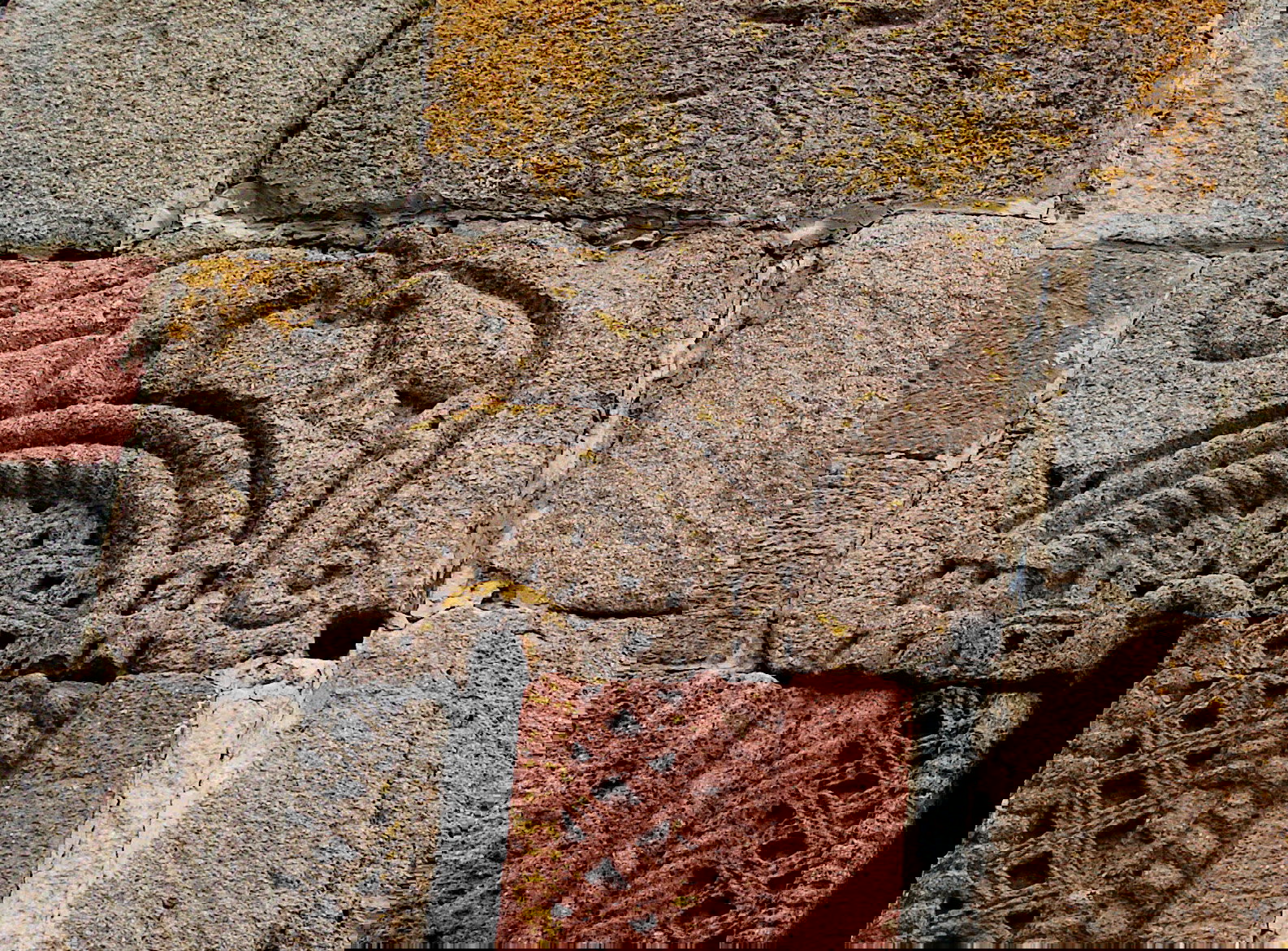
Morten Oddvik, CC BY 2.0, via Flickr
Now the question is, why would a fourteenth-century building contain such images? It’s pretty obvious what they look like. And here is another one—it’s from a rock column in a Cambodian temple built in the twelfth century, and it has a creature on all fours with conspicuous-looking plates appearing to stick out of its back.
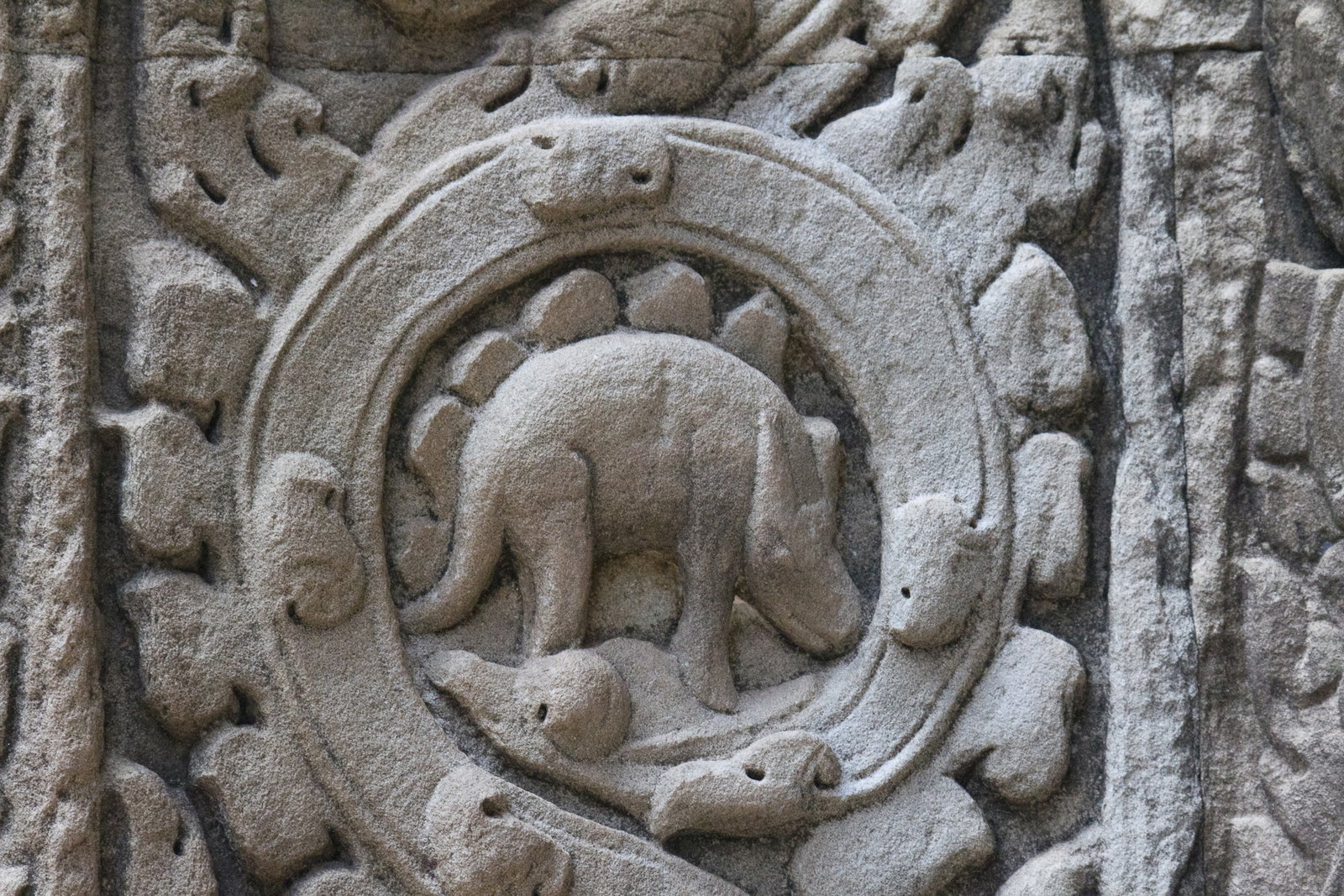
Harald Hoyer from Schwerin, Germany, CC BY-SA 2.0, via Wikimedia Commons
.jpg)
And here are three more artifacts (respectively, a Mesopotamian cylinder seal, an engraving on the Bishop of Carlisle’s tomb at Carlisle Cathedral in the UK, and a vase from the First Dynasty Egypt called the Narmer Palette [estimated to be from 3100 to 2890 BC]) that all have four-legged creatures with extremely long necks and long tails.
-
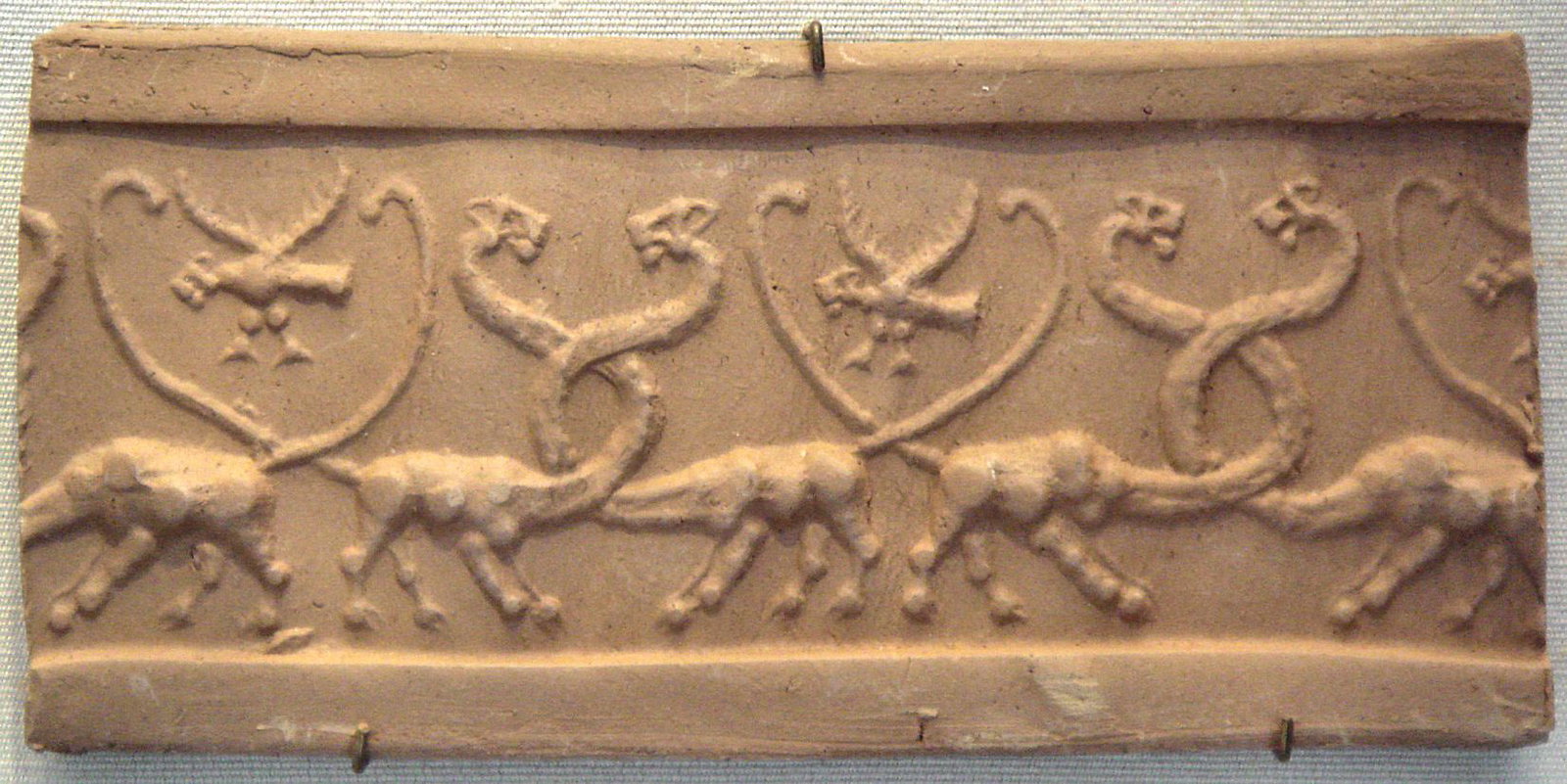
Louvre Museum, CC BY-SA 4.0, via Wikimedia Commons
-
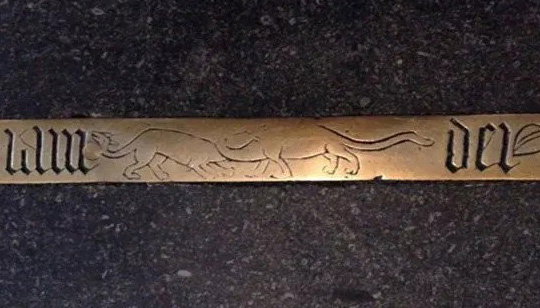
Bishop Bell’s sauropods. Photo credit: Answers in Genesis–UK/Europe.
-
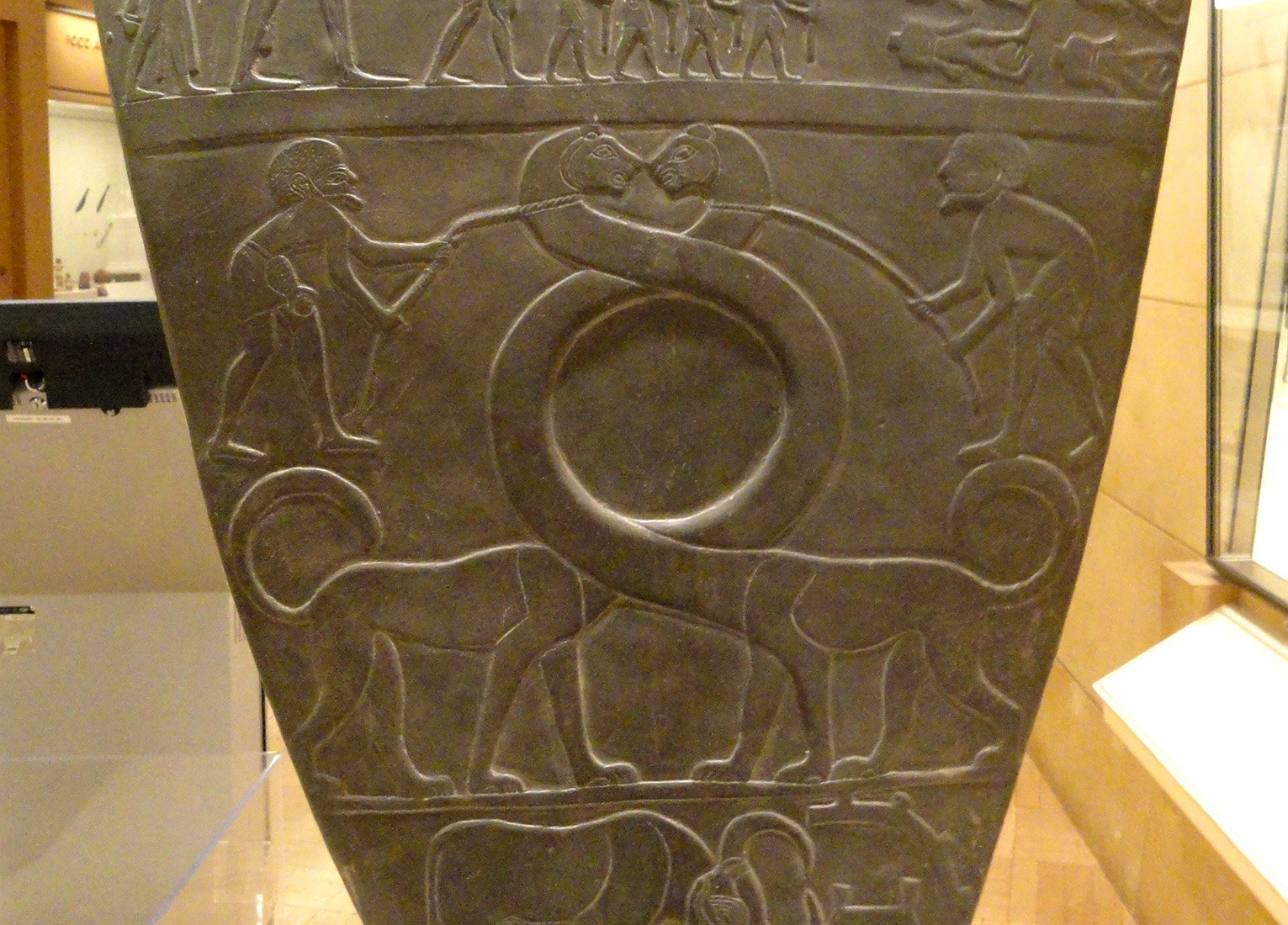
Daderot, CC0, via Wikimedia Commons


The authenticity of these artifacts (and the numerous others I simply don’t have time to show) has been challenged, and people have tried to explain them away as being something other than what they plainly seem to depict. But I believe almost all of these objections are grounded in the pre-belief that dinosaurs died out millions of years ago so the depictions can’t possibly be what they obviously appear to represent.
It’s very similar to how many Christians who believe in secular interpretations of geology and biology (i.e., the story of evolution) try to argue that the days in Genesis don’t have to be literal 24-hour days because of their commitment to long ages, rather than taking the relevant passages on their own in a proper grammatical, historical sense.
How to Explain Biblically?
The vast majority of cultures declared to have seen large reptilian beasts in the past and recorded various iterations of them in their stories, written accounts, and depictions using several different mediums (rock carvings, paintings, murals, tapestries, architectural decoration, etc.), and the records of them can be found everywhere. As the New York Times admitted, dragons as an entity are truly ubiquitous, and the big question is, why?
The dragon legends we see worldwide are, in most cases, likely because dinosaurs and people coexisted both before and after Noah’s flood.
Biblical creationists have a ready answer, one that fits with biblical history and makes sense of the facts from several different fields of scientific study. The dragon legends we see worldwide are, in most cases, likely because dinosaurs and people coexisted both before and after Noah’s flood. Their remains became trapped in the sedimentary rocks during Noah’s flood, and people recorded their encounters with those that exited the ark, reproduced, and interacted with people in various ways until they went extinct.
How Do Evolutionists Explain?
Of course, evolutionists scoff at that idea, believing that dinosaurs died out 65 million years ago, long before man ever entered the arena in their materialistic timeline. But let’s look at several more pieces of evidence that completely overturn that assumption. I think you’ll notice that the insistence that dinosaurs and people never coexisted is simply a necessary conclusion for naturalistic explanations of life, not solely driven from facts.
To begin, notice that even The World Book Encyclopedia had the following entry up until 1973.
The Dragons of legend are strangely like actual creatures that have lived in the past. They are much like the great reptiles [dinosaurs—author], which inhabited the Earth long before man is supposed to have appeared on Earth.3
Today, the association between dragons and dinosaurs being feasible is ridiculed in any sort of academic teaching, despite the abundant evidence that debunks that assumption. But to truly understand why, let’s turn to a quotation from Bible skeptic Luis Jacobs (former president of the Society of Vertebrate Paleontology with nine fossil species named after him4) in his book Quest for the African Dinosaur:
Such an association would dispel an Earth with vast antiquity. The entire history of creation, including the day of rest, could be accommodated in the seven biblical days of the Genesis myth. Evolution would be vanquished.5
Exactly! He admits that if people actually saw dinosaurs—what we generically refer to as dragons—which they did, then evolution would be dead in its proverbial paleontological tracks. However, aside from the common arguments from rocks, fossils, and dating methods that evolutionists use to support their timeline, they still have to contend with the facts and somehow explain why so many people groups have such accounts if they did not encounter them. Because the reality of such dragon legends is far too common to be coincidental, as this quotation from the famous atheist and evolution-promotor Carl Sagan admitted in his book Dragons of Eden: “The pervasiveness of dragon myths in the folk legends of many cultures is probably no accident. . . . It is not a Western anomaly. It is a worldwide phenomenon.”6
Here you see he openly admits to the phenomenal prevalence of these dragon legends and admits it’s unlikely to be an “accident,” so what was his answer as to why they exist? “The R-complex is functioning in the dreams of humans; the dragons can be heard, hissing and rasping, and the dinosaurs thunder still.”7
Notice several things in his quotation. First, he clearly mentions the same type of association mentioned earlier by specifically using the terms dragons and dinosaurs interchangeably in the same sentence.
Second, the R-complex he is referring to is the long-debunked8 (but still commonly touted) idea of a supposed reptilian complex, or “lizard brain” component, of our human brain—proposed as common to us and all of our former evolutionary iterations, all the way down to our reptilian ancestors.
His thesis (written in a rather esoteric fashion weaving psychological concepts, dream states, and philosophical and theological references to the garden of Eden throughout) was that our behavior is still largely ruled by this archaic “reptile brain” region, suggesting that memories of our early evolutionary cousins struggling against reptilian predators were so terrifying that they were hardwired into this brain structure.
Basically, he claims our evolutionary cousins saw the dinosaurs, and they were so terrifying that memories of them were somehow retained throughout evolutionary history and manifested themselves into the various dragon legends we have today. This is about as scientific an explanation as what you’d get by asking your local tarot card reader to explain the theory of relativity.
The Best Evolutionary Explanation?
Of course, that was just one attempt by a well-known popularizer of evolution to explain the dragon/dinosaur dilemma, but there are more—many of them appealing to some kind of shared monster legend or psychological fear of snakes (which I believe are all rather unsatisfying, even to most evolutionists). So the most popular and plausible explanation from the evolutionary view is an appeal to the idea that ancient cultures must have seen dinosaur bones and developed dragon legends based on those, imagining what they must have been like in real life.
The problem with that is we have no evidence of humans doing dinosaur digs up until very recent history, so in order for this theory to work, people must have seen dinosaur fossils in some kind of setting on the surface of the rock so clearly that they could logically infer the specific types of body associated with the depictions of dragons they produced. Specifically, creatures with massive tails, some who stood on two legs, and some who stood on all fours, many of which also had extremely long necks. But the idea that people groups separated in time and geographical location with no contact with one another all having done so is virtually impossible. Why? Because even with the tremendous amount of modern paleontological research that has been done over the past 200 years, it seems no one has found a single example of such a find, yet for the dragon-legends-based-on-dinosaur-bones theory to hold, it would have happened all over the world throughout history.
Some might disagree, perhaps thinking of some fossil skeletons they’ve seen in textbooks or lectures, such as Archaeopteryx, that were buried in plate-limestone and discovered when the stone slabs were split into thin sheets like a book. However, these aren’t the types of creatures we’re referring to here, as this apparently only works for small creatures (birds, fish, small reptiles) that can get compressed almost completely flat.
That’s likely because big dinosaurs (especially those large enough to model a dragon-sized creature) have bones that are far too bulky and three-dimensional for this “flat-splitting” rock type of fossil to inspire. While we observe pancaked fish and bird fossils, we don’t seem to find fully flattened tyrannosaurs or sauropods in the fossil record. Even if an almost fully articulated dinosaur skeleton (which are very rare) such as a sauropod or tyrannosaur were found, a seemingly impossible circumstance would have needed to occur for the creature’s body plan to be visible on a rock surface without excavation.
Why? Logically, erosion would have to stop very soon after it reaches the uppermost bones, making them visible. Because once a fossil is exposed to the surface, wind and rain begin to destroy it. Rather selective erosion would also have to continue to reveal the rest of the creature underneath in order for the creature’s entire shape to be visible.
Even one of the most famous and pristine dinosaur finds in history, called the “Fighting Dinosaurs” (depicting a Protoceratops and a velociraptor locked in combat), required significant brushing, excavating, and fossil stabilization (i.e., selective erosion) in order to fully reveal the creatures’ body plans.9
Although they are most commonly depicted in their finished, fully articulated form, earlier pictures exist partway through their excavation process that demonstrate their body plans were not immediately apparent, and their excavation and preparation for view was a lengthy process. This quotation from an article from Bristol University covering the Mongolian findings further explains, “This snapshot of brutality in the pair’s final moments painted an increasingly vivid picture as the specimen was prepared and examined over the following years and decades.”10
All that being said, even if you want to believe that could have happened as many times and in as many places as needed to account for all of the specific dragon depictions we see, the reality is that no large dinosaur has ever been found perfectly “laid out” on a flat rock surface like a dead specimen on a table.
The idea of someone strolling up to a cliff and seeing a full dinosaur laid out perfectly on the surface is the stuff of TV shows and movies, not science. In reality, scientists typically only ever see the tip of the iceberg so to speak and have to meticulously dig out the rest in order to be able to understand what they are looking at.
For example, here is a 2023 article from the Natural History Museum of Utah titled “Bringing Dinosaurs to Life Requires a Paleontological Dream Team,” where one researcher is describing the discovery and preparation of an ankylosaur dubbed Akainacephalus johnsoni (estimated between 13 and 16 feet [4–5 m] long and 3.5 feet [1–1.5 m] tall at the hips). The combined prep work in order to display it “reached into the thousands of hours, 800 of which were spent on the skull alone.”11
“All I could see was the back of the skull, just a couple of bones sticking out,” says Randy Johnson, a dedicated volunteer who played a large role in preparing the skull. “It was really exciting to see something developing and I wanted to find more of it to see what it looked like.”12
And this reflects the typical procedure they describe as
how paleontologists go from locating dinosaur fossils in the ground, extracting them from the rock, preparing the bones in the lab, and ultimately putting them on display. It’s a lengthy process that requires the expertise of many different individuals.13
Do Evolutionary Explanations Pass the Smell Test?
The most logical explanation for why people groups worldwide have these dragon legends is that they saw them (what we refer to as dinosaurs today) alive—they didn’t die out millions of years ago. And the evidence for that reality is often literally sitting right underneath scientists’ very noses. Take this interesting detail from the Discover Magazine article’s quotation reporting the discovery of soft tissue in dinosaur bones by Dr. Mary Schweitzer.
Once, when she was working with a T. rex skeleton harvested from Hell Creek, she noticed that the fossil exuded a distinctly organic odor. “It smelled just like one of the cadavers we had in the lab who had been treated with chemotherapy before he died,” she says. Given the conventional wisdom that such fossils were made up entirely of minerals, Schweitzer was anxious when mentioning this to Horner. “But he said, ‘Oh, yeah, all Hell Creek bones smell,’” she says. To most old-line paleontologists, the smell of death didn’t even register.14
The cadaverous “smell of death” both of these PhD paleontologists are referring to is very unique and typically occurs when organic materials decay and exude specific molecules such as putrescine and cadaverine (among others produced when bodies decompose).15 Of course, earth scientists as seasoned as these two would know the difference between this and other odors as they are used to the average smells encountered in the field.
For example, arsenic-bearing minerals like arsenopyrite smell like garlic when they are broken or heated.16 Hitting certain rocks with a steel tool (like a geologist’s hammer) can sometimes produce the sulfur smell of a match being lit.17 Quartz can smell like ozone when crushed,18 and petroliferous shale or limestone can smell like oil and gasoline when broken up.19 Except for some rare exceptions in nature such as a particular group of flowers—one of them literally called the corpse flower, which emits the same type of molecules that corpses do20 to attract insects—not many things seem to smell like death other than death itself.
So if what Schweitzer and Horner are describing is truly a necrotic odor, it has profound implications. This unique death smell doesn’t last indefinitely, even if a body that was producing the gas molecules making it was sealed in an airtight container. Why? Because of chemical decomposition—the same problem that evolutionists have when trying to explain how any type of soft tissue could have lasted for 65 million years while buried in porous, sedimentary rock that was periodically infiltrated by water in locations with widely fluctuating temperatures. Stay tuned for Part 2 where we’ll explore even more of what has been discovered inside dinosaur fossils and several more fascinating dinosaur finds that support a plain reading of the Genesis account.
Footnotes
- Lizzie Philip, “Secrets of One of the Earliest Terrestrial Globes,” Atlas Obscura, February 27, 2019, https://www.atlasobscura.com/articles/hunt-lenox-globe-here-be-dragons.
- Donald G. McNeil Jr., “From Many Imaginations, One Fearsome Creature,” The Learning Network, New York Times, April 29, 2003, https://archive.nytimes.com/www.nytimes.com/learning/teachers/featured_articles/20030429tuesday.html.
- Knox Wilson, “Dragon,” vol. 1 in The World Book Encyclopedia, 1973, 265.
- Smithsonian Magazine, “Louis L. Jacobs: National Museum of Natural History,” Smithsonian Voices, accessed April 7, 2026, https://www.smithsonianmag.com/blogs/national-museum-of-natural-history/author/louis-jacobs/.
- Louis Jacobs, Quest for the African Dinosaurs (Baltimore and London: John Hopkins University Press, 1993), 260–261.
- Carl Sagan, The Dragons of Eden (New York: Ballantine Books, 1977), 95.
- Sagan, Dragons of Eden, 101.
- Joseph Cesario, David J. Johnson, and Heather L. Eisthen, “Your Brain Is Not an Onion with a Tiny Reptile Inside,” Current Directions in Psychological Science 29, no. 3 (May 8, 2020): https://doi.org/10.1177/0963721420917687.
- Guest Blogger, “In the Field—Polish-Mongolian Expeditions 1963–1971 (Part 2),” Palaeocast, February 7, 2020, https://www.palaeocast.com/polish-mongolian-expeditions-2/.
- Guest Blogger, “In the Field.”
- Grant Olsen and Mark Johnston, “Bringing Dinosaurs to Life Requires a Paleontological Dream Team,” Natural History Museum of Utah, January 26, 2023, https://nhmu.utah.edu/articles/bringing-dinosaurs-life-requires-paleontological-dream-team.
- Olsen and Johnston, “Bring Dinosaurs to Life.”
- Olsen and Johnston, “Bring Dinosaurs to Life.”
- Barry Yeoman, “Schweitzer’s Dangerous Discovery,” Discover Magazine, April 26, 2006, https://www.discovermagazine.com/schweitzers-dangerous-discovery-1172.
- Erika Engelhaupt, “Why Death Smells So Deadly,” Science News, November 15, 2013, https://www.sciencenews.org/blog/gory-details/why-death-smells-so-deadly.
- Andrew A. Sicree, “Minerals That Do Things: Hands-On Demonstrations of Mineral Properties,” Minerals Education Coalition, accessed April 7, 2026, https://mineralseducationcoalition.org/wp-content/uploads/scratch_sniff_minerals_2017.pdf.
- Sicree, “Minerals That Do Things.”
- University of Virginia, “Ozone from Rock Fracture Could Serve As Earthquake Early Warning,” ScienceDaily, November 21, 2011, https://www.sciencedaily.com/releases/2011/11/111117154635.htm.
- Sicree, “Minerals That Do Things.”
- Rolls Tech Global, “The Scent of Decomposition: What a Rare Flower Reveals About Human Remains,” accessed April 7, 2026, https://rollstechglobal.com/the-scent-of-decomposition-what-a-rare-flower-reveals-about-human-remains/.
Support the creation/gospel message by donating or getting involved!

Answers in Genesis is an apologetics ministry, dedicated to helping Christians defend their faith and proclaim the good news of Jesus Christ.
- Customer Service 800.778.3390
- Available Monday–Friday | 9 AM–5 PM ET
- © 2026 Answers in Genesis