
New Discoveries About the Aztecs, Mayans, and Olmecs
AiG geneticist Dr. Nathaniel Jeanson recently revealed some of his findings on Mesoamerican peoples.
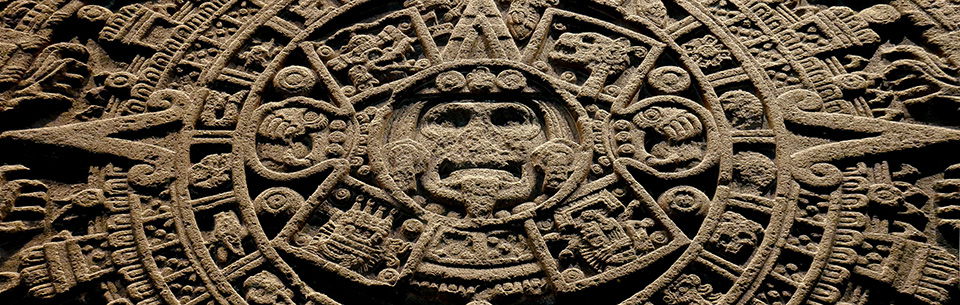
The Aztec Empire is remembered for the massive city Tenochtitlan, which was constructed on small islands on Lake Texcoco, as well as for stunning ziggurat temples in the jungle; and it’s often associated with accounts of brutal human sacrifice. If you think of the Mayans, their stone pyramids, strange hieroglyphs, or artwork might come to mind. There are also the Olmecs, who are not as well-known, but they were also a Mesoamerican culture that left proof of their existence behind—things like earthen temples and pyramids, massive stone heads, and evidence of strange religious rituals.
But who were these people? Where did they come from and what happened to them? These are questions AiG geneticist Dr. Nathaniel Jeanson has been researching. And he appeared on an Answers News episode recently to answer a few questions about his research: Mainly, what was known about these people before he started studying them? And what were the main questions he wanted answers to? He says,
According to mainstream science, all three of these groups descended from a single migration in the incomprehensibly distant past 15,000 years ago and then remained in isolation for the next 14,500 years.
Dr. Jeanson’s study overturned all that evolutionary interpretation and showed that “there were multiple migrations from Asia into the Americas within the last 4,500 years.
Dr. Jeanson’s study overturned all that evolutionary interpretation and showed that “there were multiple migrations from Asia into the Americas within the last 4,500 years—one in AD 900, one around AD 400, and then at least one more before that.” Regarding the Aztecs and the Olmecs, this information poses no problems. The Aztec’s own history goes back to about AD 500–600 and is consistent with one of those migrations.
But there was more to reconcile with regard to the Mayans, whose archaeological history goes back to 1000 BC or earlier. Their languages go back to the BCs yet still exist today. In this interview, Dr. Jeanson, who knows some Mayan speakers, states:
The problem for my research prior to this was that it suggested they had disappeared. We have no genetic lineage, or we had no genetic lineage, going back into the BC era. And so, how could these people whose languages still exist, but their DNA apparently disappeared—how could that contradiction be resolved? . . .
I’d been using the male-inherited Y chromosome DNA. That’s what revealed the two migrations, and then I added on a third just because you have to explain the earlier people somehow. I then reexplored the female-inherited mitochondrial DNA, and that revealed two more migrations—one in 100 BC and, most importantly with regards to the Maya, one in 1000 BC that directly explained when they appeared, why they still exist, and how they rose and fell over the millennium that preceded today. . . .
There’s one that still we haven’t detected that goes back to the Olmecs, but again, they’re not really a problem for what I’m saying because their rise and fall is perfectly consistent with all these genetic discoveries.
Bryan Osborne, one of our Answers News cohosts, then asked, “So what does all this mean for the history of these people?” In his response, Dr. Jeanson notes,
One of the exciting ramifications for me is being able to see how each of these American migrations, or migrations into the Americas, ties to specific old-world events, which of course is completely absent from the evolutionary explanation because they bump the “single migration” into the incomprehensibly distant past long before the history of civilization.
So none of the history of civilization in the old-world matters in the evolutionary view. In this new view with these genetic linkages, we can tie the 1000 BC migration to the fall of the Shang dynasty. So there’s genetic linkages back to East Asia, back to the Chinese era specifically. I can map that with DNA, and we can find political events that seem to explain why there may have been a movement of peoples around that time into the Americas. . . .
With regard to the 100 BC migration, there’s, again, Chinese history that matters. . . . The Han dynasty is one of the more famous dynasties in Chinese history . . . were just beginning to rise and sort of push off some of their northern enemies. The specific northern enemies in this case were the Xiongnu. . . . So it makes sense they would migrate into the Americas and start building a new empire, which we can tie to empires in the Americas.
The AD 400s [migration] ties to the Huns. They were invaders into Europe around the fall of the Roman Empire. And I can genetically specifically tie this American migration to them.
In the last migration, AD 900s, not so well-known in terms of European history, this is a period of migration from Central Asia into Europe. Some of the modern Europeans like the Hungarians can tie their ancestry back to peoples like the Magyars. They were Central Asians in the Middle Ages. So no surprise again, we’ve got migration in the other direction. . . .
So all of these make sense in retrospect, and that’s been very satisfying to see how the genetics lines up with known history. And this is one of the expectations of the young-earth model. We should be able to see the history of civilization written in our DNA. And the more we look, the more we see this confirmed over and over again . . . .
I encourage you to watch the whole video for more fascinating details and agree with what Bryan noted near the end of the interview: “Creationists are the only ones that can do this kind of DNA research because we have the proper timeline for understanding human history and therefore those DNA clues.”
Great news, Dr. Jeanson! History makes much more sense when you start with Scripture. And Nathaniel Jeanson’s videos and articles on such history are very popular.
Thanks for stopping by and thanks for praying,
Ken
This item was written with the assistance of AiG’s research team.
Most Recent News
-
April 2, 2026 from Ken Ham Blog
Canada is one step closer to passing “hate crime” legislation that would make historic Christian beliefs illegal to express.
-
March 30, 2026 from Ken Ham Blog
Scientists have now added another unique feature of the platypus to the already long list.


Support the creation/gospel message by donating or getting involved!

Answers in Genesis is an apologetics ministry, dedicated to helping Christians defend their faith and proclaim the good news of Jesus Christ.
- Customer Service 800.778.3390
- Available Monday–Friday | 9 AM–5 PM ET
- © 2026 Answers in Genesis