
Απαντήσεις
-
02/01/2025 from Ken Ham Blog
A new study quantifying sulfur emissions from plankton found these emissions contribute to climate change much more than previously thought.
-
01/01/2025 from Answers Magazine
Find out how readers respond to the latest issues of Answers magazine.
-
01/01/2025 from Answers Magazine
Crimson landmarks, a Puritan poet, and the metals in your phone—here’s we don’t want you to miss!
-
01/01/2025 from Answers Magazine
Sand can be a nuisance after a day at the beach. But a deep dig into our surroundings reveals that our world is built on sand.
-
01/01/2025 from Answers Magazine
Scientists have barely scratched the surface of understanding the body’s intricate itch signaling, but we know God created skin as our body’s first line of defense.
-
01/01/2025 from Answers Magazine
These helpers are part of God’s common grace that extends to all people.
-
01/01/2025 from Answers Magazine
The finding shows how our biology and life experiences are more deeply connected than scientists previously thought possible.
-
01/01/2025 from Answers Magazine
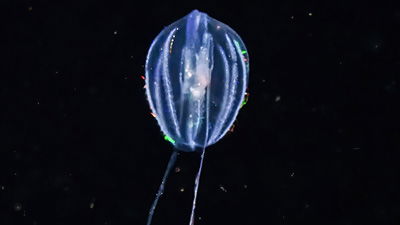
Scientists recently learned that comb jellies survive under pressure thanks to specially adapted cell membranes made of lipids (fatty molecules).
-
01/01/2025 from Answers Magazine
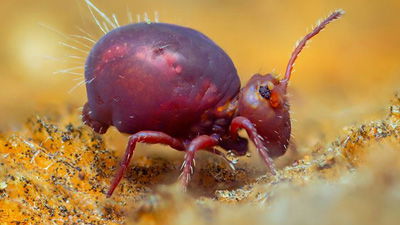
Recently, for the first time, researchers used a high-speed camera to capture a globular springtail’s backflips.
-
01/01/2025 from Danny Faulkner Blog
Looking back at the astronomical events of last year and forward to next year’s predicted events.
-
01/01/2025 from Answers Magazine
Curiosity is important for our development—but what about its role in our walk with God?
-
01/01/2025 from Answers Magazine
Even your phone is a reminder that “to the Lord your God belong . . . the earth with all that is in it” (Deuteronomy 10:14).
-
01/01/2025 from Answers Magazine
Do the details in the account of Jonah distract us from the real point?
-
01/01/2025 from Answers Magazine
For the past 200 years, Christian scholars have reinterpreted the Genesis creation account in various ways. However, there are only two overarching viewpoints among the range of interpretations.
-
01/01/2025 from Answers Magazine
When we start with the history in Genesis, Christians can explain fossils without fear.
-
01/01/2025 from Answers Magazine
Because Neanderthals were humans made in God’s image, they were capable of kindness, love, and compassion for children and the needy.
-
01/01/2025 from Answers Magazine
All DNA is important, even when acting simply as a spacer—just as the spaces between words in written English help readers make sense of the words themselves.
-
01/01/2025 from Answers Magazine
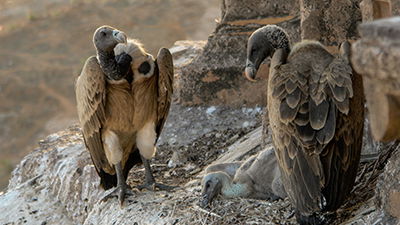
Vultures are usually associated with death. But can vultures save lives?
-
01/01/2025 from Answers Magazine
From fish and birds to reptiles and mammals, nearly all vertebrates yawn. But why do we yawn?
-
01/01/2025 from Answers Magazine
Once this wave of cultural change has swept over the West, something will be left standing. It will be the “Daniels” of this generation.
-
01/01/2025 from Ken Ham Blog
God did so much at Answers in Genesis throughout 2024. As we begin a new year, I want to highlight an exciting thing that happened last week and share about our first big event planned for 2025!
-
01/01/2025 from Answers Magazine
Metallic nodules on the ocean floor are found to produce their own oxygen. Despite evolutionists’ wishful thinking, these nodules are a nod to the Creator.














Βοήθεια Μετάφρασης
Βοηθήστε μας να παρέχουμε περισσότερο υλικό στα ελληνικά.
Visit our English website.
- © 2026 Answers in Genesis