
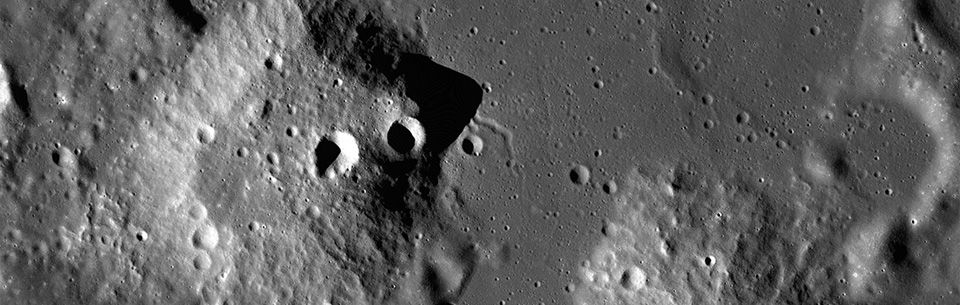
The Gruithuisen Domes, imaged by the Lunar Reconnaissance Orbiter Camera (LROC). NASA/GSFC/Arizona State University
When Did Lunar Volcanism End?
A recent study raises questions about evolutionists’ history of the moon.
For more than four decades, the standard model of the origin of the moon has been that an object about the size of Mars had a grazing collision with the still-forming earth. Much of the matter of the interloper was sprayed into orbit around the earth, along with some of the early earth’s surface and near-surface material. This mix of matter soon coalesced into the moon, which gradually spiraled out to the moon’s current distance from the earth.
An important part of this model is that many of the heavier elements originally on the earth had already sunk to the earth’s core, robbing the moon of the heavier elements that the earth has. Both the earth and moon supposedly were volcanically active at first, but since the moon is much smaller than the earth and lacked many of the heavier radioactive elements, the moon’s volcanism concluded two billion years ago.
But according to a report in Physics Today, a recent study may upend this timeline.1 China’s Chang´e 5 mission returned lunar samples to the earth. In the sample were more than 3,000 tiny glass beads, most of which formed from impacts on the moon. However, the researchers identified three beads as having a volcanic origin. Comparison of the amount of uranium-238 to its decay product, lead-206, yielded a radiometric age of only 180 million years. That is just 3% of the supposed 4.5-billion-year age of the moon.
This upsets the supposed evolution of the moon over the past 4.5 billion years.
This result is sure to be questioned because this upsets the supposed evolution of the moon over the past 4.5 billion years. Since the moon is so small, most of the moon’s initial internal heat ought to have escaped a long time ago. The earth ought to have lost its primordial heat too, but radioactive elements inside the earth probably are sufficient to keep the earth’s interior hot. However, unlike the earth, the moon is thought to lack sufficient radioactive elements to keep the lunar interior hot enough to produce magma. How revolutionary is this result? Fattaruso quoted Stephen Elardo, a specialist in thermal evolution models of the moon, “If there’s young volcanism on the Moon, we really need to rethink models about how planets cool off with time. . . . And that isn’t just the Moon, that goes for any planetary bodies.”2
Of course, if the moon is only thousands of years old as the Bible strongly implies, then a hot lunar interior is not a problem.
Footnotes
- Laura Fattaruso, “Three Glass Beads Bring into Question the Timeline of Lunar Volcanism,” Physics Today 77, no. 11 (2024): 14–16, https://doi.org/10.1063/pt.dadh.vcxz.
- Fattaruso, “Three Glass Beads Bring.”
Support the creation/gospel message by donating or getting involved!

Answers in Genesis is an apologetics ministry, dedicated to helping Christians defend their faith and proclaim the good news of Jesus Christ.
- Customer Service 800.778.3390
- Available Monday–Friday | 9 AM–5 PM ET
- © 2026 Answers in Genesis