

Evolutionary Explanations for Fossils Fail
Part 1 of “Shifting Sands Between Rocks and Fossils”
Have you been taught that the rock layers we see around the world are proof of millions of years of earth history and that the fossils often found within them are additional evidence of deep time and evolution having occurred? Well, let me demonstrate how long age/evolutionary explanations create a logical rift between rocks and fossils and why the Bible has a far better explanation for both.
To do so, let’s look at the typical high school-level explanation for rocks and fossils that evolution-believing scientists submit to justify their explanations. Because let’s face it, this is where the public gets their ideas about these things for the most part. Unfortunately, these explanations have contributed to many people not trusting in the accuracy and authority of God’s Word.
Time Required
First, we should understand that, unlike the Bible which teaches a younger age for earth history, the story of evolution requires enormous amounts of time to have elapsed for it to have any credibility. This is one of the main reasons many people doubt the Bible’s accuracy: They believe science has proven long ages, and therefore, the Bible’s history is false.
Now, without long ages, there wouldn’t have been enough time to have evolved “pond scum into people,” so the concept of millions of years is a well-protected and promoted idea in almost all areas of secular science today. However, the “proof of millions of years” was initially argued and established in academia by the existence of finely layered sedimentary rock we observe worldwide.
For the most part, the rock layers were said to have been laid down slowly and gradually through similar sedimentary deposition processes we see today in lakes, rivers, and oceans. We’ll soon explain this concept in more detail. The fossils within these layers were interpreted as a succession of plant and animal life that has evolved over those “millions of years.”
So let’s dig into these ideas to see if they really make sense and look at some current online sources available.
Common Sediment Sentiment
To begin, let’s start with a modern example of research from this 2014 paper in Oceanologia (a journal of basic marine research) which studied sediment deposition in the Baltic Sea and concluded, “The average rate of deposition was calculated at 1.67 mm year.”1
Of course, this and other sources you find discussing deposition rates will always include caveats. These caveats explain that the rates of deposition may vary and there could be dramatic exceptions in the past from what they discovered in the present. However, I’m presenting what the “typical” rates are to show what popular scientific literature touts for people to form their ideas around.
Another example comes from a popular education website called Brainly. Numerous expert collaborators2 with various degrees and expertise provide Expert-Verified Answers for specific questions one might ask. I found the following Expert-Verified Answer to my query, “How long does it take to make sedimentary rock?”:
Sedimentary rocks typically take thousands to millions of years to form. This process involves sedimentation, layering, compaction, and cementation, all of which occur over long periods. Various environmental factors influence the rate of formation, leading to this vast time requirement.3
Continuing the trend, my next example comes from a popular 2022 textbook titled Introduction to Earth Science.4 This textbook can be found all over the internet and is used by many different schools (especially in the US). Under the section titled “Rates of Deposition” (referring to sediments), it states:
Another way to estimate absolute age is to calculate the rate of sediment deposition. By using data collected over a long period of time, geologists can estimate the average rates of deposition for common sedimentary rocks such as limestone, shale, and sandstone. In general, about 30 cm of sedimentary rock are deposited over a period of 1,000 years. However, any given sedimentary layer that is being studied may not have been deposited at an average rate.
The Big Picture Regarding Rates of Sedimentary Rock Formation
OK, so even though (once again) they caveat their belief that deposition rates may vary, their statements reveal a trend that they believe the sedimentation leading to rock accumulation took place over time. It supposedly happened slowly over hundreds of thousands of years.
Instead of citing more and more individual studies, I’m going to stop after I show you what Google’s AI-generated overview (which pulls data from a wide variety of sources to make its conclusions) states when I used the key word prompt “What is the average rate of sediment deposition?”:
The average rate of sediment deposition varies significantly depending on the location and environment, but generally falls within a range of 0.005 to 0.5 centimeters per year; with some studies reporting average rates around 0.2 to 0.5 centimeters per year, often measured using techniques like radioisotope dating with elements like lead-210 (210Pb) and cesium-137 (137Cs).5
So again, the typical explanation in academia for how sedimentary rocks formed is the sediments slowly accumulating at rates of less than a centimeter per year, which are supposed to gradually harden into rock over long time periods. That concept is then extrapolated and applied to the explanation of the rock layers we see worldwide to demonstrate the “truth” of millions of years of earth history.
Fast Fossils vs. Slow Sedimentation
However, here’s the catch. Because most fossils are found predominantly within sedimentary rock layers, the speed that the layers of rock were laid down becomes the Achilles heel of the typical explanations regarding fossil formation seen by millions of students in their textbooks, online educational websites, and videos.
And why do I say that? Well, when I asked Brainly, “How do most fossils form?” I found this Expert-Verified Answer.
Fossils typically form when an organism dies and is quickly buried [emphasis mine] under sediment, which eventually hardens into rock. In this process, the remains can undergo mineralization, turning them into stone over time.6
Hmm. Do you see the problem here? If an organism requires rapid burial under sediments to turn into a fossil, and sediments which eventually form rock layers are supposed to typically take thousands (and sometimes millions) of years to form, doesn’t that mean the existence of most fossils is evidence of an abnormally rapid sedimentation event?
This would mean almost every fossil we find would be the evidence of something happening quickly rather than evidence of the slow and steady processes normally touted regarding sedimentary formation. As this Discover article discussing fossilization explains, “It’s paradoxical here, but for something to survive millions of years, it must survive the very first minutes after its death.”7
This would mean almost every fossil we find would be the evidence of something happening quickly rather than evidence of the slow and steady processes normally touted regarding sedimentary formation.
How Rare Are Fossils?
Now, here’s another thing we need to understand about fossils—they aren’t that rare and are quite easy to find for the most part. Although evolutionary explanations describe fossil formation as being extremely rare, they will admit that the fossils found worldwide are quite numerous. The US National Parks Service article “How Fossils Form” demonstrates, “The odds of any individual organism becoming fossilized is very small, but overall the fossil record provides a rich history of life on Earth.”8
Again, while they may conclude that fossilization itself is rare, fossils themselves are not, especially marine fossils. In fact, they are quite commonplace overall, as this Discover magazine article admits, “There are loads of fossils to be found worldwide.”9
Indeed, there are billions of fossils estimated to be found all over the world, and The Paleobiology Database10 website demonstrates the ubiquitous nature of fossil distribution quite clearly in this chart:
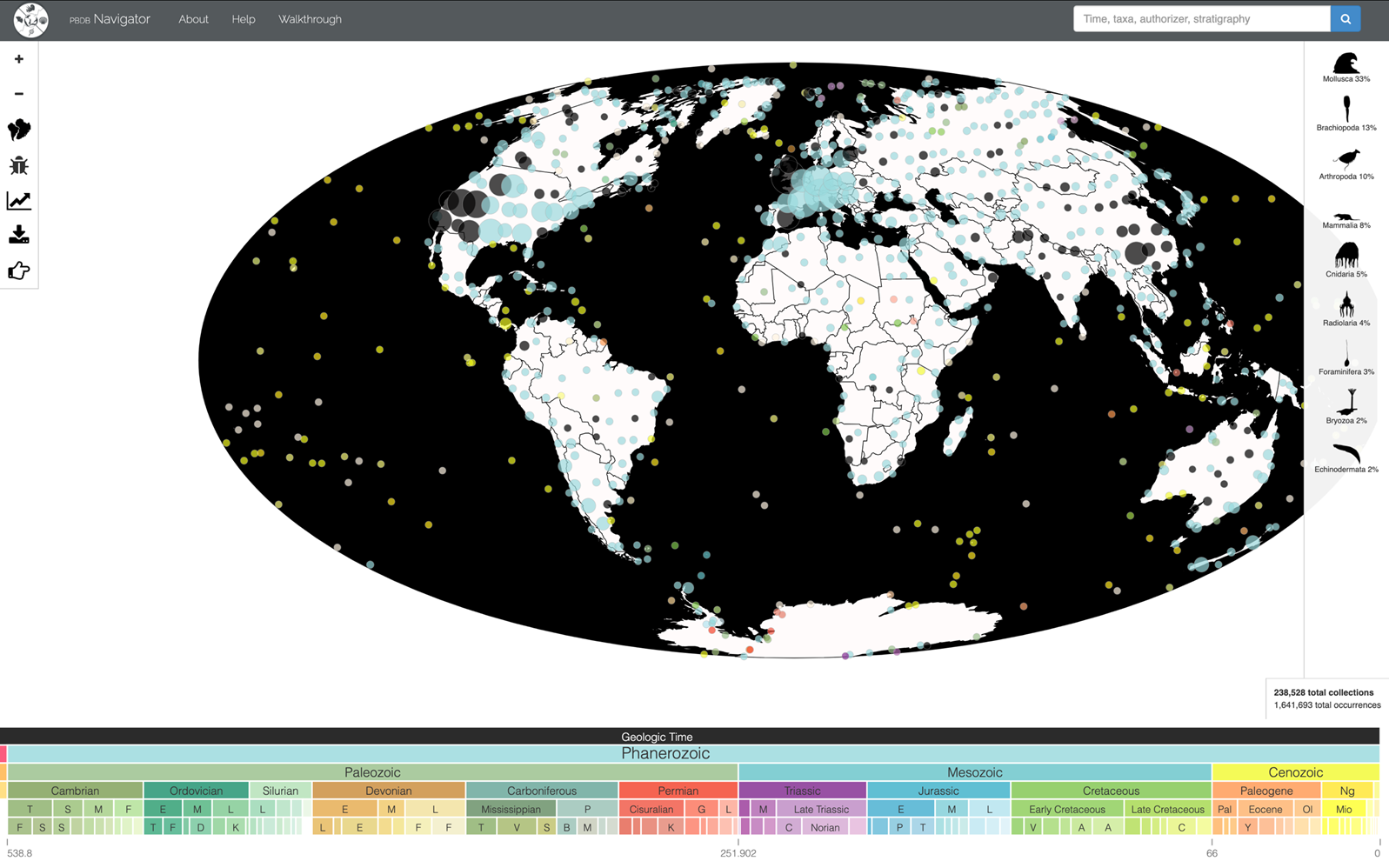
So are you starting to see an even bigger problem with the evolutionary explanations here? Although some large sedimentary deposits with hardly any fossils in them do exist (except for pollen, plankton, etc.), there are other extremely large deposits of sedimentary rock strata all over the world chock-full of fossils. However, in general, it’s still commonly taught that the majority of all these strata were supposedly laid down slowly over many thousands and/or millions of years.
All or Nothing
Simultaneously, they claim the fossils trapped within those layers required rapid burial, deposition of sediments to whatever height the creature or organism was pronated, and complete coverage for fossilization to have occurred. Why? Because any dead organism (whether plant or animal) with even a portion uncovered or not buried deeply enough would rapidly decay and be destroyed by various forces, as these quotations from evolution-promoting sources explain:
They can be as small as a single cell or as giant as a dinosaur skeleton or petrified tree. . . . For a fossil to form, sediment must cover the organism quickly.11 [emphasis mine]
Rapid burial by sediments that were previously suspended in water is required for fossilization to occur. The burial process isolates the remains from the biological and physical processes that would otherwise break up or dissolve the body material.12 [emphasis mine]
Fossils . . . are formed when a living organism (such as a plant or animal) dies and is quickly buried by sediment.13 [emphasis mine]
Whether it’s a dead fish a few centimeters thick, a dead dinosaur 2 meters high when it slumped over, or a giant tree 10 meters tall, the entire organism would have to be covered rapidly and completely for fossilization to occur.
Having Your Cake and Eating It Too?
So it seems the only way long age and/or evolution-believing geologists and paleontologists could have their cake and eat it too (i.e., say the layers were laid down slowly to “prove” millions of years while at the same time saying fossils require rapid deposition of sediments) would be to say that any layers without fossils were laid down slowly while any with fossils were laid down quickly. But does that really make sense of what we observe?
Well, no. To further illustrate, join me for Part 2 where I’ll use one of the world’s most famous fossil sites to continue to show how the relationship between rocks and fossils simply don’t make sense from an evolutionary viewpoint, while the Bible provides rock-solid answers for the facts we see.
Footnotes
- Angelika Szmytkiewicz and Tamara Zalewska, “Sediment Deposition and Accumulation Rates Determined by Sediment Trap and 210Pb Isotope Methods in the Outer Puck Bay (Baltic Sea),” Oceanologia 56, no. 1 (January 2014): 85–106, https://www.sciencedirect.com/science/article/pii/S0078323414500048.
- Brainly, “Expert Knowledge, Enhanced by AI,” accessed February 14, 2025, https://brainly.com/experts?source=Homepage+Experts.
- Expert-Verified Answer, “Revise This Statement to Make It True: Sedimentary Rocks Take Only a Few Days to Form,” asked August 31, 2023, https://brainly.com/question/36517968; The answer provided was cross-checked with these textbooks: Forest Ray Moulton, An Introduction to Astronomy; John Southard, The Environment of the Earth’s Surface; John Southard, CK-12 Earth Science For Middle School.
- Holt McDougal, “The Rock Record,” Chapter 8 in Earth Science (Evanston, IL: Holt McDougal, 2009), 208
- Google AI overview, https://www.google.com/search?q=what+is+the+average+rate+of+sediment+deposition, February 10, 2025.
- Expert-Verified Answer, “How Do Most Fossils Form? Be Sure to Explain Your Answer,” asked December 6, 2019, https://brainly.com/question/14097516?referrer=searchResults.
- Sofia Quaglia, “What Are Fossils and Where Are They Found the Most?,” Discover, December 21, 2023, https://www.discovermagazine.com/the-sciences/what-are-fossils-and-where-are-they-found-the-most.
- National Park Service, “How Fossils Form,” Fossils and Paleontology, National Park Service, last updated October 23, 2024, https://home.nps.gov/subjects/fossils/how-fossils-form.htm#:~:text=The%20odds%20of%20any%20individual,history%20of%20life%20on%20Earth.
- Quaglia, “What Are Fossils and Where Are They Found the Most?”
- The Paleobiology Database, accessed February 14, 2025, https://paleobiodb.org/navigator/.
- Iowa Department of Natural Resources, “How Do Fossils Form?,” May 13, 2021, https://www.iowadnr.gov/About-DNR/DNR-News-Releases/ArticleID/3530/How-do-Fossils-Form.
- British Geological Survey, “Fossils: Discovering Geology—Fossils and Geological Time, accessed February 14, 2025, https://www.bgs.ac.uk/discovering-geology/fossils-and-geological-time/fossils/.
- Australian Museum, “How Do Fossils Form?,” last updated November 16, 2023, https://australian.museum/learn/australia-over-time/fossils/how-do-fossils-form/#:~:text=Fossils%20are%20formed%20in%20many,foot%20prints%20or%20worm%20burrows.
Support the creation/gospel message by donating or getting involved!

Answers in Genesis is an apologetics ministry, dedicated to helping Christians defend their faith and proclaim the good news of Jesus Christ.
- Customer Service 800.778.3390
- Available Monday–Friday | 9 AM–5 PM ET
- © 2026 Answers in Genesis