
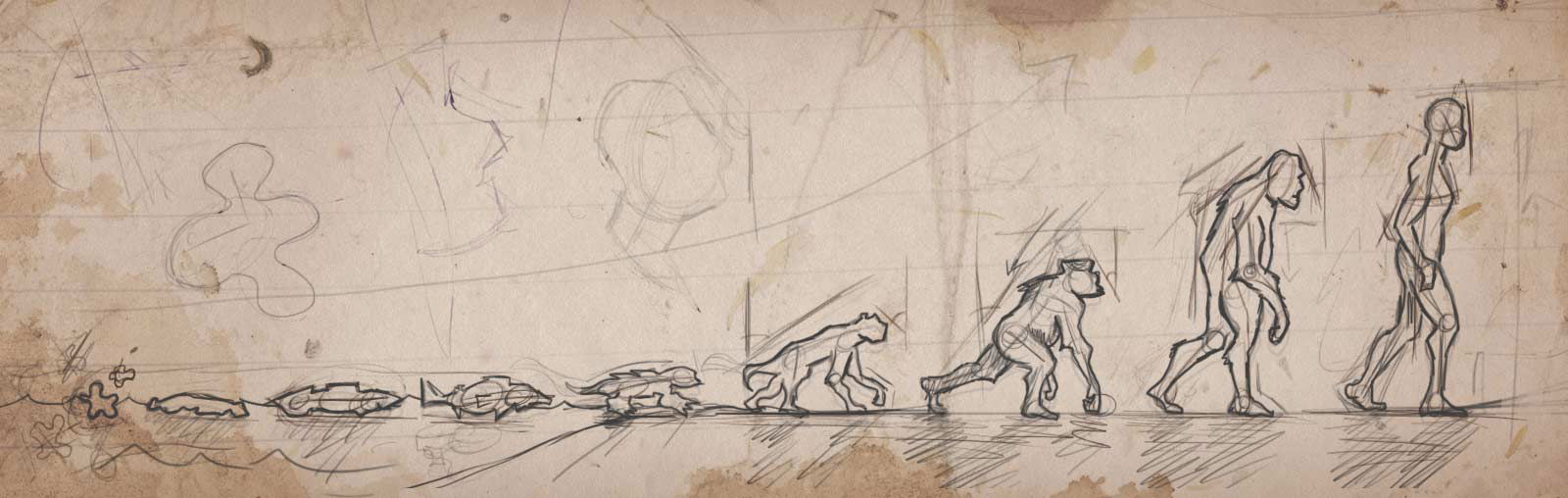
Evolution Is Running Out of Options: Part 2
How real science is forcing evolution to “evolve”
In Part 1, we discussed why the concept of detecting intelligent design, which is so often attacked by secular academia, is not inherently religious by itself. After all, both scientists and laypersons alike constantly use evidence of design to try to determine various things.
As we concluded, to determine whether something has been designed, we should use this formula: Determine whether the end product is greater than that of its component parts. If it is, you can accurately conclude that it has been designed. For example, it would be reasonable to believe that even someone who’d never seen a pencil before could determine it had been designed, because its component parts (wood and pencil lead) in their natural forms (trees and graphite/clay) do not contain the information for the specific shapes (hexagonal and tubular) they are in as a completed pencil for example. But when someone attempts to apply the same formula to living things, naturalists object to the concept.
For example, some evolutionists will point to examples of self-organization in crystals or snowflakes as proof that unique, one-of-a-kind designs can come about through natural processes. Take this (rather sarcastic) example posted by a typical internet atheist on the Facebook page titled Creation VS Evolution.
For those who want to talk about irreducible complexity and evidence for design, take a good look at this [a picture of a snowflake]. Could it ever have been the product of any natural process? Look at all the irreducible complexity! It requires knowledge of mathematics, geometry, and physics. Clearly snowflakes could never [have] simply “emerged” from a natural process. They must be specially designed, all of them (since they are virtually all unique).1
But ice crystals and snowflakes, no matter how beautifully designed they may appear, do not disprove the formula we discussed. Why? Because (in our snowflake example) H2O already contains the natural ability to be arranged in various six-sided patterns when subject to below-zero temperatures due to its inherent properties. Water crystals always form six-sided shapes. Unlike our pencil example I mentioned earlier, nothing new needs to be added to the system for snowflakes to form, as an updated 2022 National Oceanic and Atmospheric Administration article explains.
Q: How are snowflakes formed?
A: A snowflake begins to form when an extremely cold water droplet freezes onto a pollen or dust particle in the sky. This creates an ice crystal. As the ice crystal falls to the ground, water vapor freezes onto the primary crystal, building new crystals—the six arms of the snowflake.
That’s the short answer.
The more detailed explanation is this:
The ice crystals that make up snowflakes are symmetrical (or patterned) because they reflect the internal order of the crystal’s water molecules as they arrange themselves in predetermined spaces (known as “crystallization”) to form a six-sided snowflake. . . .
Q: So, why are no two snowflakes exactly alike?
A: Well, that’s because individual snowflakes all follow slightly different paths from the sky to the ground—and thus encounter slightly different atmospheric conditions along the way. Therefore, they all tend to look unique, resembling everything from prisms and needles to the familiar lacy pattern.2
To make the point even sharper, let’s think about the last example they mentioned: the “lacy” pattern often seen in snowflakes. That lacy pattern in a snowflake could easily be compared to a lace doily or other macrame creation. But there isn’t anything inherent in the component parts of a doily (such as cotton, twine, or hemp) that would arrange themselves into that intricate pattern by natural forces of any kind.
Would subjecting cotton, twine, or hemp to freezing temperatures, driving winds, excessive heat, or any other natural phenomenon cause it to arrange itself into a unique, lacy pattern such as those seen in a snowflake? Of course not. Snowflakes arrange themselves because of their component parts’ (water molecules) inherent, God-given qualities—doilies don’t. Someone had to add intelligence to the component parts that make up the doily in order for the end product to be arranged the way it is.
DNA Doesn’t Know Anything
Unfortunately for our naturalistically minded friends, the chemicals that make up DNA do not contain any special superpowers that could have caused them to arrange themselves into the most sophisticated coded language system we have ever seen. This is also true of the myriad of other biological molecules that make up living things—they don’t have any inherent powers to naturally become any of the mind-boggling systems we observe.
As this Oxford University Press blog points out, the component parts of DNA are really nothing special. DNA only contains information because of the arrangement it has, not because of the sugar, phosphates, and bases it’s made of.
The biological information stored in a DNA molecule depends upon the order of its building blocks—that is, its sequence. . . . Indeed, it is the concept on which written communication is based: each sentence in this blog post is composed of a selection of items—the letters of the alphabet—appearing in different sequences. These different sequences of letters spell out different words, which convey different information to the reader.3
Do you see what they admit here? Just like the information found in a book isn’t the product of the ink it is carried on, but rather how that ink is arranged, the information in DNA isn’t the product of the component parts but of the arrangement of those parts. They fully admit that the information contained in DNA isn’t derived from its chemical makeup.
There is nothing that special about the atoms found in a molecule of DNA: they are no different from the atoms found in the thousands of other molecules from which the human body is made.4
Just like a pool of ink has no inherent ability to arrange itself into meaningful sentences, so the chemicals that make up DNA lack the inherent ability to arrange themselves into the incredibly complex and meaningful structure they do. Instead, the machinery within living organisms follows a program that enables DNA to function, comparable (yet leagues apart in terms of sophistication) to a modern computer system, and everyone knows that programs require a programmer.
Nothing Simple About It
As our science continues to advance, the incredible complexity of even the so-called simplest of living things is becoming more apparent every day. Take this quotation from biochemist Dr. Michael Denton:
To grasp the reality of life as it has been revealed by molecular biology, we must magnify a cell a thousand million times until it is twenty kilometers in diameter and resembles a giant airship large enough to cover a great city like London or New York. What we would then see would be an object of unparalleled complexity and adaptive design. On the surface of the cell we would see millions of openings, like the port holes of a vast space ship, opening and closing to allow a continual stream of materials to flow in and out. If we were to enter one of these openings we would find ourselves in a world of supreme technology and bewildering complexity.5
Doesn’t seem very simple, does it? You see, the naturalistic idea that life evolved from simple to complex is nonexistent and certainly not observable today. Living organisms—even the simplest—are not “simple” in any sense of the world. As a matter of fact, evolutionary scientists have admitted that the simplest living things that we study today are actually degenerate versions of even more complex original organisms, as this article explains:
Although the mycoplasmas are often called atypical bacteria because of their salient characteristics, for minimal cell purposes, the exact opposite is true. Mycoplasmas . . . did not evolve as simpler forms of life. They are not ancient bacteria found at the base of the tree of life. . . . They did not originally evolve with small genomes and the other unusual features. Rather, they descended from conventional bacteria of the Firmicutes class (e.g., Bacillus subtilis or Staphylococcus aureus) through a process of massive gene loss.6
Indeed, living things don’t range from simple to complex—they actually start off so staggeringly sophisticated that they are not even fully comprehensible by scientists at this point, as the article goes on to say.
Richard Feynman’s statement “What I cannot create, I do not understand” (quoted in Gleick 1992), which has become a mantra for the synthetic biology community, is applicable here. Until we understand all aspects of the minimal cell well enough to build computational models that can replicate minimal cell biology, we do not understand the cell.7
Interestingly, Nobel laureate Jack Szostak (while at Harvard Medical School) made this truly incredible statement in an article discussing the possibility of scientists creating life in a laboratory: “We aren’t smart enough to design things, we just let evolution do the hard work and then we figure out what happened.”8
Every new study of even the “simplest” living thing reveals that naturalists must believe matter (with no mind) somehow increasingly created more of the kind of biotechnology that even the collective greatest minds on the planet cannot.
Incidentally, the title of that article was “Artificial Life Likely in 3–10 Years,” and it was written in 2007. And like the doomsday predictions of climate change alarmists are ever-changing, so are these predictions from scientists declaring they will soon be creating life in a lab. Of course, if they ever did craft an experiment that created life, all they would be proving is that it takes intelligence to do so anyway, not random processes.
Evolutionary Explanations Are Falling Apart
And all of this is why more honest origin-of-life researchers such as D. L. Abel are beginning to ask tougher questions and are making paradigm-shaking comments such as the following:
We have spent much of the last century arguing to the lay community that we have proved the current biological paradigm. Unfortunately, very few in the scientific community seem critical of this indiscretion. One would think that if all this evidence is so abundant, it would be quick and easy to falsify the null hypothesis put forward above [his null-hypothesis referring to whether life could come about through naturalistic processes]. . . .
. . . Science has an obligation to be honest about what the entire body of evidence clearly suggests. We cannot just keep endlessly labeling abundant evidence of formal prescription in nature “apparent.” The fact of purposeful programming at multiple layers gets more “apparent” with each new issue of virtually every molecular biology journal.9
Indeed, this purposeful programming he mentions is now often described as the interactome,10 which refers to the complete network of interactions in living things and represents the dynamic web of communication that occurs among the entire collection of molecules within organisms. This includes protein binding, protein-DNA regulation, signaling pathways, metabolic reactions, and many other molecular relationships that coordinate cellular activity.
And as scientists have admitted, the gamut of sophistication inside even the degenerate examples of the simplest living organisms we can study is beyond the scientists’ ability to fully comprehend or create. So as time moves on, evolutionists are running out of options as far as their ability to explain how life evolved, as those who’ve done the research have seen that the old natural-selection-plus-genetic-mutations model has pretty well collapsed. These mechanisms absolutely fail to demonstrate the results they are supposed to have been able to produce.
Is Evolution Intelligent?
Evolutionists’ efforts to keep the “creationist wolves” at bay have now reached peak desperation. And one of the best examples of this I’ve ever seen comes from a Science Daily article I read a few years back. The article reports on research from a paper published in the science journal Trends in Ecology and Evolution, which attempted to grant evolution some truly extraordinary abilities. To begin, they explained the following:
A key feature of intelligence is an ability to anticipate behaviours that that will lead to future benefits. Conventionally, evolution, being dependent on random variation, has been considered “blind” or at least “myopic’”—unable to exhibit such anticipation.11
Well, yes, “conventionally” (as in, anyone with an iota of intelligence would tell you), matter has no mind or intelligence, and only minds can anticipate or formulate plans that can provide future benefits. In a 2004 interview, atheist champion of evolution Richard Dawkins put that idea to bed when asked the very same question as to whether evolution had some kind of foresight or anticipatory power. He responded,
There’s no room in natural selection for the sort of, um, foresight argument that says: “Well, we’ve got to let it persist for the next million years and it’ll start becoming useful.” That doesn’t work.12
However, this 2015 article went on to say,
Evolution may be more intelligent than we thought, according to researchers. In a new article, the authors make the case that evolution is able to learn from previous experience, which could provide a better explanation of how evolution by natural selection produces such apparently intelligent designs.13
The first time I read that, I nearly fell out of my chair in disbelief. After collecting myself and continuing to read, I thought this statement perfectly capped off their musings regarding the story of evolution.
When we look at the amazing, apparently intelligent designs that evolution produces, it takes some imagination to understand how random variation and selection produced them.14
The Story of Evolution
Yes, indeed it does. It takes an immense amount of imagination and, to be honest, for those who’ve examined the evidence for themselves, sheer credulity at this point to believe in the story of evolution.
So for those of you who are still struggling under the weight of believing “science has disproven the Bible,” just remember that evolution isn’t science in the sense most think it is. It’s actually just as the evolutionists I’ve quoted here and in Part 1 have admitted. It’s a “historical narrative.” A “tentative reconstruction” that “takes some imagination to understand.” The bottom line is, it’s actually just a story to explain our existence without God.
As Dr. Michael Ruse—the now-deceased agnostic philosopher of (mainly evolutionary) science from the Department of Philosophy at the University of Guelph in Ontario, CA—once wrote,
Evolution is promoted by its practitioners as more than mere science. Evolution is promulgated as an ideology, a secular religion—a full-fledged alternative to Christianity, with meaning and morality. . . . Evolution is a religion. This was true of evolution in the beginning, and it is true of evolution still today.15
Although some may have concluded Dr. Ruse’s comment was a tad hyperbolic back in the day, just look at the vast majority of criticisms against belief in God and his Word that we see in Western culture today. The unhinged zeal of the (predominantly Marxist) atheists out there fighting against the foundational doctrines of the Christian faith—such as the concept of created norms regarding identity, the attempted removal of traditional (biblical) marriage and family, the destruction of the unborn and infirm, and the outright hatred toward the idea of moral absolutes—is founded on the idea that God does not exist and that man decides truth.
Even though they are running out of options, the story of evolution is their foundational belief and doctrine because, without it, they could not justify their entire ideology. So despite the inescapable evidence of design in nature that is becoming more evident with each new study, some evolutionists are assigning God-like powers to mindless matter and positing that it can somehow think and plan.
It’s just as Romans 1:25 says: “They exchanged the truth about God for a lie and worshiped and served the creature rather than the Creator.”
Footnotes
- Jonathan Burke (@jonathan.burke.961), “For those who want to talk about irreducible complexity,” Facebook group Creation Vs. Evolution, May 27, 2015, https://www.facebook.com/groups/418424908239792/?multi_permalinks=826747214074224.
- National Oceanic and Atmospheric Administration, “How Do Snowflakes Form? Get the Science Behind the Snow,” December 19, 2016, last modified December 21, 2022, https://www.noaa.gov/stories/how-do-snowflakes-form-science-behind-snow.
- Jonathan Crowe, “SciWhys: What Is DNA and What Does It Do?,” OUP Blog, February 28, 2011, https://blog.oup.com/2011/02/dna/.
- Crowe, “SciWhys: What Is DNA?”
- Michael Denton, Evolution: A Theory in Crisis (Bethesda, MD: Adler & Adler, 1985), 328.
- John I. Glass, Chuck Merryman, Kim S. Wise, Clyde A. Hutchison III, and Hamilton O. Smith, “Minimal Cells—Real and Imagined,” Cold Spring Harbor Perspectives in Biology 9, no. 12 (December 9, 2017): https://doi.org/10.1101/cshperspect.a023861.
- Glass, Merryman, Wise, Hutchinson III, Smith, “Minimal Cells.”
- Seth Borenstein, “Artificial Life Likely in 3–10 Years,” Associated Press, August 19, 2007, (site discontinued).
- David L. Abel, “The Capabilities of Chaos and Complexity,” International Journal of Molecular Sciences 10, no. 1 (2009): 247–291, https://doi.org/10.3390/ijms10010247.
- Dariusz Plewczyński, “The Interactome: Predicting the Protein-Protein Interactions in Cells,” Cell & Molecular Biology Letters 14, no. 1 (October 6, 2008): 1–22, https://doi.org/10.2478/s11658-008-0024-7.
- University of Southampton, “Is Evolution More Intelligent Than We Thought?,” December 18, 2015, ScienceDaily, https://www.sciencedaily.com/releases/2015/12/151218085616.htm.
- Jonathan Miller, “Final Hour,” Brief History of Disbelief S1:E3; 30:19–30:51, originally aired October 25, 2004 on BBC Four, https://www.youtube.com/watch?v=-rZsWP2z3cE&t.
- University of Southampton, “Is Evolution More Intelligent?”
- University of Southampton, “Is Evolution More Intelligent?”
- Michael Ruse, “Saving Darwinism from the Darwinians,” National Post, May 13, 2000, B-3.
Support the creation/gospel message by donating or getting involved!

Answers in Genesis is an apologetics ministry, dedicated to helping Christians defend their faith and proclaim the good news of Jesus Christ.
- Customer Service 800.778.3390
- Available Monday–Friday | 9 AM–5 PM ET
- © 2026 Answers in Genesis