
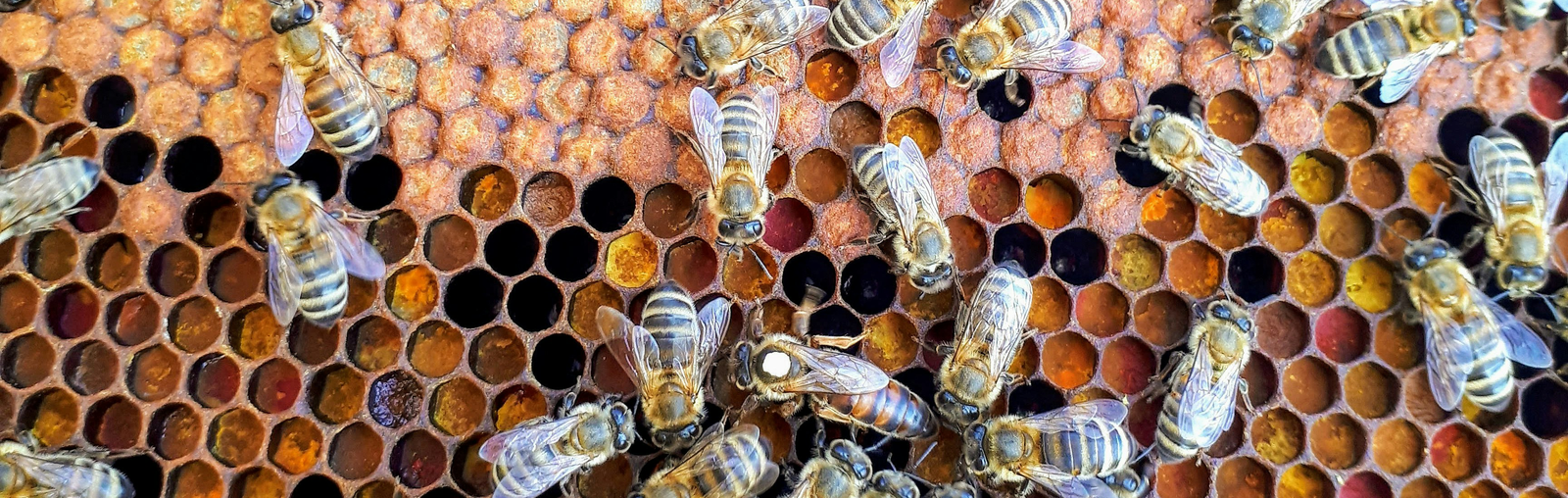
Image by Boba Jaglicic via Unsplash
Samson and the Honeybees: Can Bees Really Build a Hive in a Lion Carcass?
There have been several questions of the accounts told in Judges 14–16 about Samson. But perhaps the most prevalent among skeptics is in relation to the Judges 14 account of the honey in the lion’s carcass, with many claiming it’s completely fictional as there is no record of bees ever building nests inside of a carcass (except for vulture bees, which only exist in South America).
Let’s first set a foundation for how we should consider any historical account that we read in God’s Word. First, historical narratives in Scripture relay true and factual information, not myths, and Judges 14 is clearly a historical narrative and so is not a myth, legend, or parable.
Regarding Judges 14, note that Samson “tore the lion apart as one would have torn apart a young goat” (Judges 14:6 NKJV). Since the lion was “torn apart,” it’s reasonable to consider the strong possibility that the lion carcass was gutted—that when Samson came back “after some days” (Judges 14:8), the “carcass” that Scripture refers to was mostly skeletal remains.
Samson turned aside out of curiosity “to see the carcass of the lion” but instead saw that “there was a swarm of bees with honey inside the lion’s skeleton” (Judges 14:8 CEB). The CEV says, “He was surprised to see that bees were living in the lion’s skeleton, and that they had made some honey.” The biblical text doesn’t tell us exactly how much time passed between the lion’s death and when Samson found the hive. Even if it was just a week or two, that would have been plenty of time for vultures (and other predators and even bacteria) to have eaten the remaining flesh off the skeleton. Bee hives can be reestablished (and have honey) in as little as two weeks.
If bees can build their hives to hang from tree branches, then it’s not a stretch of the imagination by any means to think that bees could build a hive hanging from a rib cage. Interestingly, the second occurrence of “carcass” in Judges 14:8 is the Hebrew word גויה (gᵊvîyâ), which can also mean “tree trunk,” so it is possible that part of the lion landed on and got caught on the branches of an upright tree and remained there even after it was skeletonized, greatly increasing the possibility of bees building a hive from the rib cage downward.
The bees in the biblical account are most likely Apis florea (the Asian dwarf honeybee), which are endemic to Israel. A. florea are frequent migrators, moving seasonally from one habitat to another. Honeybees can travel up to a couple miles away from their hive. Therefore, the location of (and the materials used to make) the beehive is not a problem, because the bees could have gotten the materials from elsewhere.
While this account may sound strange on the surface, after digging into the details, it is easy to see how such a scenario is quite feasible. As humans, we are always learning new things about the unusual and fascinating behaviors of insects. For example, it’s now well-known that fire ants can form themselves into a giant raft and maintain that form for weeks to survive floods, but that’s not an everyday occurrence that most people are likely to witness. Likewise, honeybees constructing hives in animal skeletons is almost certainly not a common occurrence, but just because it’s not common doesn’t mean that it can’t happen. Besides, as I stated earlier, God’s Word records that this did happen, and so we know it certainly did occur.
We can trust that the Bible’s accounts of events are true, even in the minor details.
In fact, there has recently been a documented case of burrowing bees using animal remains to put their nests in, and they even burrowed through the bones of the deceased animals. And if one bee genus has been found to utilize animal skeletons, then other bees could potentially do so as well. Once again, we see that seemingly “impossible” or “never seen before” arguments against biblical accounts are often based on incomplete knowledge.
This isn’t new; it’s something we’ve seen many times. Over the years, many have claimed certain events in the Bible were not true, only to find that archaeological discoveries confirm what the Bible states! We can trust that the Bible’s accounts of events are true, even in the minor details.
Let God be true and every man a liar. (Romans 3:4 LSB)
Thanks for stopping by and thanks for praying,
Ken
This item was written with the assistance of AiG’s research team.
Support the creation/gospel message by donating or getting involved!

Answers in Genesis is an apologetics ministry, dedicated to helping Christians defend their faith and proclaim the good news of Jesus Christ.
- Customer Service 800.778.3390
- Available Monday–Friday | 9 AM–5 PM ET
- © 2026 Answers in Genesis