

Here We Go Again: Life on Mars
A Lesson from the Past
For more than a century, Mars has fascinated both scientists and laypeople as a place where life exists now or sometime in the past. For instance, around the turn of the last century, the astronomer Percival Lowell saw many things on Mars through his telescope that convinced him that Mars hosted an advanced civilization. Lowell popularized his ideas by giving lectures, publishing descriptions in lay publications, and writing several books, also targeting lay audiences. Many other scientists of the day were not impressed with Lowell’s claims, but much of the public was convinced.
This optimistic assessment radically changed when the Mariner 4 spacecraft flew past Mars and took photos of about 10% of the Martian surface. Those photos revealed a heavily cratered terrain, similar to the moon. With a lunar-like surface, it didn’t seem likely that Mars currently had life. Later missions surveyed much more of the Martian surface, and it turned out that Mariner 4 had simply sampled some of the most cratered surface of Mars—other parts of Mars are far less cratered. The atmosphere of Mars is very thin—the surface pressure of Mars is less than 1% of the earth’s surface pressure. The earth’s much more substantial atmosphere blocks most of the harmful ultraviolet radiation from the sun. Lacking this protection, it is unlikely that life could exist on Mars today. Another problem is that Mars’ surface pressure and temperature are far too low for liquid water, an essential ingredient for life, to exist.
In the 1970s, spacecraft photographed erosion channels on Mars, as well as features obviously caused by deposition of eroded material. For water to have flowed on Mars in the past, the planet then must have had a much more substantial, warmer atmosphere. This discovery reignited hope that there once was life on Mars, even if life can no longer exist there. This is important to evolutionary scientists because if life evolved on Mars, that would be construed as evidence that life usually develops naturally wherever the conditions can permit life. Consequently, finding evidence of past life on Mars has been one of the central objectives of sending spacecraft to Mars.
The Latest Round
Recent news accounts have discussed a study published in Nature that claims that the Perseverance rover has found possible evidence that life once existed on Mars. While exploring Neretva Vallis, a river channel, Perseverance found a rock with curious small light spots, similar to leopard spots. The rock is in a mudstone rich in oxidized iron, phosphorus, and sulfur, as well as carbon. The spots are rich in ferrous iron phosphate and iron sulfide. The former may be in the form of vivianite, and the latter may be in the form of greigite. These two minerals usually form in water at low temperature. Furthermore, these minerals can be produced by living organisms in a watery environment. If true, then this could be evidence for life. Or maybe not. While these minerals can form organically, they can also form inorganically.
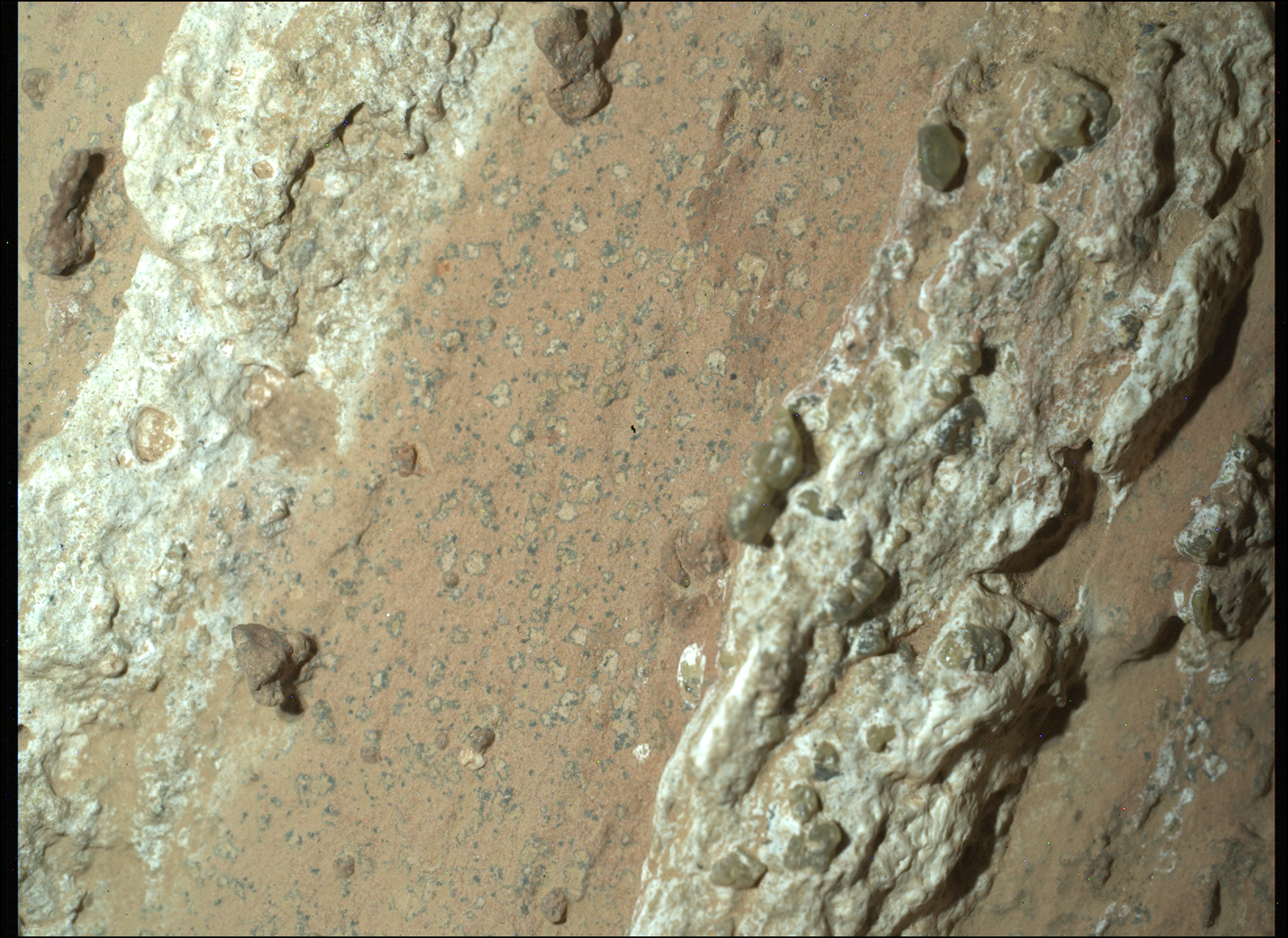
Perseverance Finds a Rock With 'Leopard Spots' via NASA/JPL-Caltech/MSSS
Of course, identification of the minerals in this rock is not confirmed. That would require a chemical analysis. Perseverance collected and stored a sample of the rock, something that the rover has previously done at a few locations that it has visited. The hope is that a future manned or unmanned mission to Mars will retrieve the stored samples and return them to earth for full analysis. However, there are no planned missions to do this yet, and they may never happen. So for now, there is no confirmed evidence for the claim of past life on Mars.
Another Lesson from the Past
When I first heard about this, my immediate reaction was to remember Allan Hills 84001 (ALH84001). Most people have forgotten about this, but I haven’t. ALH84001 was a meteorite found on the glacier in the Allan Hills region of Antarctica. Since Antarctica is a desert, little snow falls over much of the continent, and what little does fall mostly sublimes, so there is no net increase in ice thickness. Consequently, any meteorite that falls on the glacier remains exposed on the surface for a very long time, so meteorites are easy to find there. Later chemical analysis revealed that ALH84001 likely was blasted from the Martian surface, eventually to end up on earth. In 1996, a team of researchers found four microscopic structures inside part of ALH84001 that they said were consistent with an organic origin. This news was huge, even prompting then President Clinton to comment on it. After three decades, I still occasionally hear people mention that scientists have proven that life once existed on Mars. Except they didn’t. There were hundreds of papers after publication of this study that disputed that study’s conclusion. If not in the mind of the public, at least among scientists, there is not much support for this conclusion from AHL84001.
So I am confident that the same thing will happen with this latest study. There probably will be many other papers contradicting this conclusion, but you won’t hear about them. Why? Because “life on Mars” is a huge story; “no life on Mars” is not. It’s the same sort of contrast between “man bites dog” and “dog bites man.” And we really won’t know for sure if the claimed minerals are truly present in the rock until the sample is returned to earth. With no plans to do this, it is doubtful that this will ever happen.
Conclusion
The great interest in finding life elsewhere in the universe is driven by the desire to “prove” that life is not special, and hence, there must not be a Creator.
My belief is that there never was life on Mars, and I am confident that my belief will be upheld. Why do I hold this position? It comes down to design and purpose of life. To atheists, design and purpose of life is a silly notion because there is no design or purpose in the (totally) natural world. But to the Christian, it is clear from Scripture that God took great care to create the earth that we live on. Man is the center of God’s attention. The other living things on earth directly or indirectly benefit man. Though the Bible does not address whether God created ETs, beings similar to us, on other planets, we can make a strong inference from the Bible that we are alone in the universe (and the scientific evidence so far backs this up). If there are no ETs, then “simple” organisms on other planets such as Mars would serve no purpose. The great interest in finding life elsewhere in the universe is driven by the desire to “prove” that life is not special, and hence, there must not be a Creator. Make no mistake—this agenda is driven by atheism. Our differing expectations on whether life exists elsewhere is just one the many differences Christians and atheists have.
Support the creation/gospel message by donating or getting involved!

Answers in Genesis is an apologetics ministry, dedicated to helping Christians defend their faith and proclaim the good news of Jesus Christ.
- Customer Service 800.778.3390
- Available Monday–Friday | 9 AM–5 PM ET
- © 2026 Answers in Genesis