

Debunking a Common Flat-Earther Meme about Lunar Phases
Flat-earthers like to use memes for their arguments. Unfortunately, flat-earthers rarely apply critical thinking to the memes they use. Rather, flat-earthers uncritically repost memes that other flat-earthers use, trusting other flat-earthers would not make or use memes that are fake, false, or simply misleading.
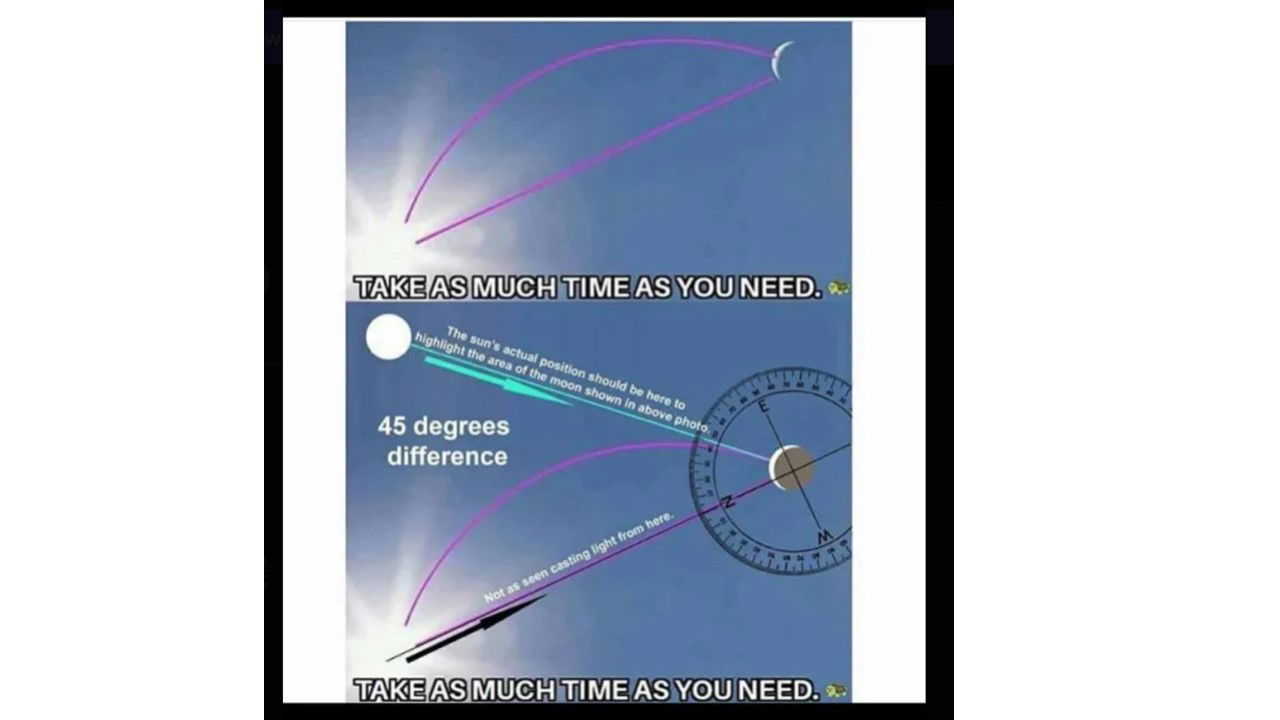
The meme reproduced here is an example of a fake meme that I’ve seen flat-earthers post many times. The top part of the meme shows a supposed photograph of the crescent moon and an overexposed sun. The conventional explanation for lunar phases is that the lit portion of the moon must face the sun. Notice the two tips of the crescent moon. Those tips are called cusps. If you connect the cusps with a straight line, then the direction to the sun should be a line perpendicular to the line connecting the cusps and passing through the lit portion of the moon. The lower part of the meme employs this information to analyze the top photo, with the straight purple line to the sun and the turquoise line and arrow showing the direction the sun must be if the conventional explanation for lunar phases is correct. The protractor shows that the two directions differ by 45 degrees, which the meme implies disproves the conventional explanation of lunar phases. However, proper critical analysis reveals that this image is fake.
The Analysis
When the moon is as close to the sun as shown in this photograph, it is impossible to see the moon, let alone photograph it.
First, as a person who has spent more than half a century watching the moon, I know that when the moon is as close to the sun as shown in this photograph, it is impossible to see the moon, let alone photograph it. A crescent moon this close to the sun is very thin and dim (though the crescent in the meme is neither). If this were a true photograph, for the moon to be visible at all, the sun would have to be far more overexposed than it is.
It is not difficult to quantify some of my conclusions. I printed the meme, and I made some measurements on the printing. I used a precision ruler to measure the diameter of the moon, the separation of the sun and moon, and the thickness of the lunar crescent. The diameter of the moon in the meme was 0.48 inches, and the separation between the centers of the sun and moon on the meme was 4.66 inches. As the moon orbits the earth, its angular size varies, but the moon’s average angular diameter is 1,896 arc seconds = 0.53 degrees. This allows setting up a ratio to find the angular separation, φ, between the moon and sun:
With respect to the sun, the moon moves about 12.2 degrees per day, or 0.51 degrees per hour. Thus, if the angular distance between the moon and sun is 5.1 degrees, then the moon is only 10 hours from new moon. I did a search for the record of young lunar phase observations. One report was the sighting of a young moon without optical aid 15 hours after new moon. A few later reports shaved this time by mere minutes. The record for observing a thin crescent after new moon with optical aid is nearly 12 hours, though someone may have slightly improved upon this since this report. Keep in mind that these observations were done under very favorable conditions, both astronomical and meteorological. It is doubtful that a flat-earther could even match these observations, let alone improve upon them. Thus, it probably is not possible for this claimed photograph to be authentic.
Second, how much illumination would one expect for a moon that appears only 5.1 degrees from the sun? The drawing illustrates the situation.
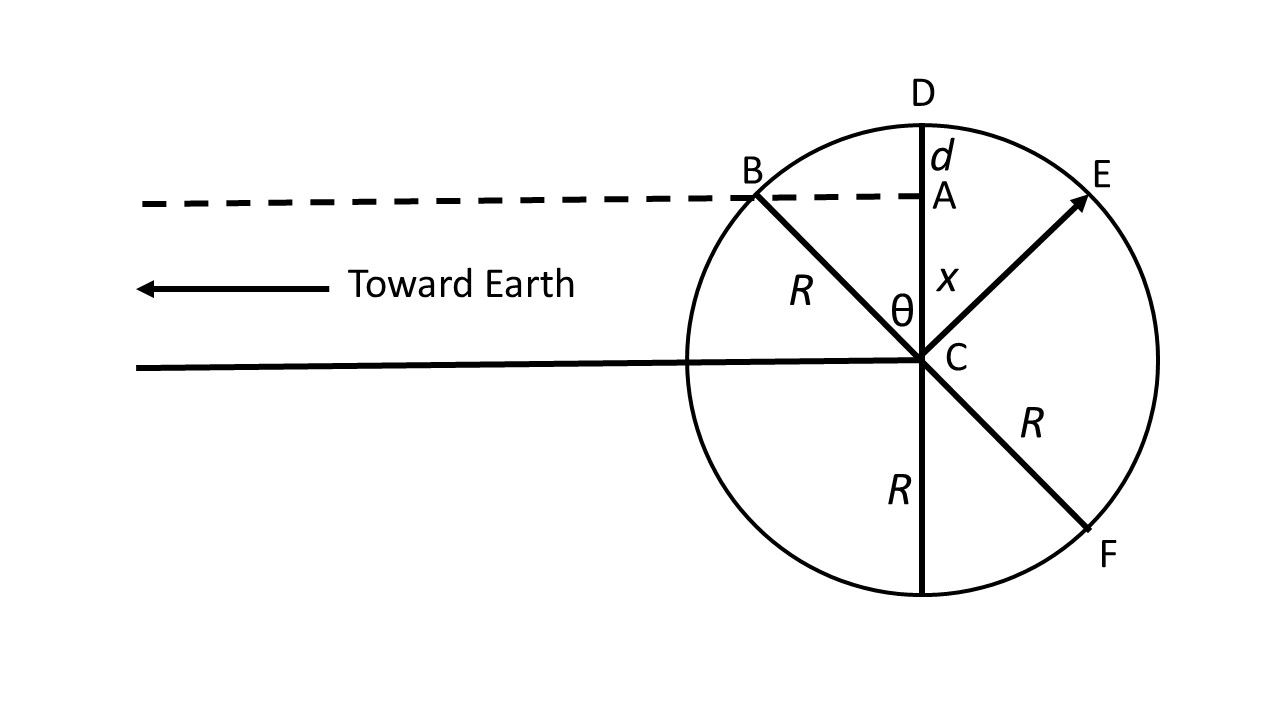
The circle of radius R represents a top view of the spherical moon, with the direction of the earth to the left indicated. The semicircle BEF represents the lit portion of the moon, so the direction to the sun is indicated by the ray CE. As seen from the earth, the point D will be visible on the moon’s limb (edge) where the lit crescent of the moon appears thickest, and the point B will be the other side of the thickest part of the crescent. The angle θ is how much the terminator (the division between light and dark on the moon) has rotated since new moon. Since that angle was zero at new moon, then that angle must be 5.1 degrees. Therefore, the thickest part of the crescent will be the distance d:
But
so
Since the moon’s diameter in the meme is 0.48 inches, then the moon’s radius in the meme must be 0.24 inches. Substituting 0.24 inches for R and 5.1 degrees for θ, we get d = 0.001 inches. That is one thousandth of an inch, far too small to measure with any ruler, yet I easily measured the thickness of the crescent in the photo to be 0.06 inches, 60 times larger! Therefore, if the moon were only 5.1 degrees from the sun as is the case in the meme, then the crescent is 60 times thicker than it ought to be. I have often seen the crescent moon much farther than 5.1 degrees from the moon, and the crescent was much thinner than in this meme.
How far from the sun must the crescent appear to be as thick as it appears in the meme? Rearranging the last equation results in
Placing d = 0.06 inches and R = 0.24 inches into this equation, we get θ = 41 degrees, eight times larger than the measured angular separation of the sun and moon in the meme. Therefore, either the crescent is too thick for the angular separation of the sun and moon depicted in the meme, or the thickness of the crescent is correct but the angular separation of the sun and moon in the meme is incorrect. Since these sizes are out of proportion, it is likely that the orientation of the crescent moon has been altered to create a false meme.
Conclusion
There are several reasons why this meme is obviously fake.
- The brightness of the sun and moon do not match reality.
- The moon is not visible when it is as close to the sun as displayed in this meme.
- For the crescent to be as thick as it appears in the meme, the angular separation between the moon and the sun must be much greater than depicted in the meme.
Some flat-earthers may object that I have assumed the conventional explanation for lunar phases in my refutation. This is true. However, what this meme depicts contradicts more than a half century of experience watching the moon. I knew immediately when I first saw this meme that if the crescent were as thick as shown in this meme, then the moon would have to be much farther from the sun than the distance depicted in the meme. Anyone who begs to differ with my assessment simply has not spent the requisite amount of time looking at the moon for themselves to properly evaluate this meme, choosing to place blind faith in a false meme.
How was this meme created? It is likely a combination of two photographs, one photograph of the moon and the other photograph of the sun. The creator of this meme probably chose an orientation of the lunar crescent to create a problem that does not exist. A more important question is who created this meme. I can think of two possibilities. One possibility is that a flat-earther created this meme, but that raises the question of why that person chose to be dishonest in creating the meme. Flat-earthers pride themselves in being truth seekers, but one cannot employ falsehoods in the pursuit of truth. The other possibility is that a non-flat-earther created this meme to hoodwink flat-earthers into using a false meme. This sort of behavior ought to anger flat-earthers.
This is just one example of the many false flat-earther memes in circulation. Flat-earthers could save themselves much embarrassment if they exercised true critical thinking in evaluating arguments flat-earthers use. Flat-earthers are extremely skeptical of anything that contradicts their belief that the earth is flat. If flat-earthers employed even a smidgen of that skepticism to flat-earth claims and memes, they would not be so easily taken in by false arguments.
Support the creation/gospel message by donating or getting involved!

Answers in Genesis is an apologetics ministry, dedicated to helping Christians defend their faith and proclaim the good news of Jesus Christ.
- Customer Service 800.778.3390
- Available Monday–Friday | 9 AM–5 PM ET
- © 2026 Answers in Genesis