

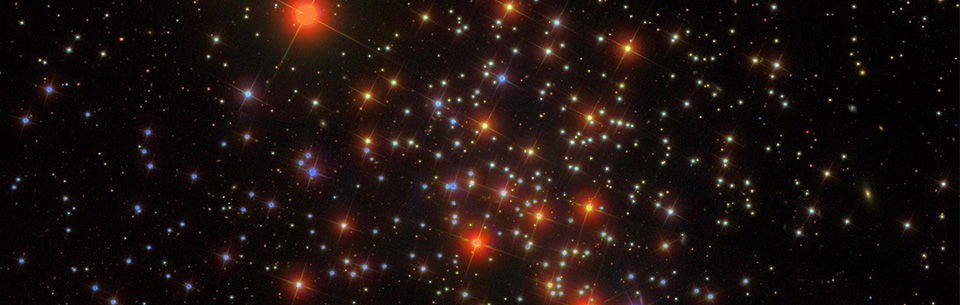
Photo by Sloan Digital Sky Survey (CC BY 4.0)
Science News
Science News
- Stranger Than Science Fiction
- Symphony in the Stars
- Are Man and Ape More Different than We Thought?
- Something to Chew On
- Mass Extinctions and Surviving Ecosystems
- Web-Slinging Caterpillars
- These Recent Discoveries Deepen Our Understanding of Creation and Point to God’s Creative Genius
- Songs in the Night
Stranger Than Science Fiction
On March 2, 2025, Cortical Labs launched the world’s first biological computer. The shoebox-sized unit contains lab-grown human neurons kept alive by a nutrient-rich broth. The neurons grow across a silicon chip that has a life-support system of sorts, handling temperature, gas exchange, and waste. The neurons can remain alive for up to six months.
While the biological computer offers a brainlike testing environment that could improve the success rate of neurological drug trials, it sparks ethical debates surrounding consciousness and suffering. Researchers claim these concerns are unfounded since the current model lacks the complexity to be conscious. But other experts emphasize the need for ongoing ethical oversight for the future of synthetic biological intelligence—oversight that should be guided by a biblical worldview.
True consciousness is a gift from God. As stewards of his creation, Christians should be on the front lines of developing and using technology in ways that honor God and serve humanity wisely—without overstepping ethical boundaries.
Symphony in the Stars
Researchers from UNSW Sydney recently tuned into 27 stars in the M67 cluster, located about 2,700 light-years away. The stars were “ringing,” each with a unique frequency—similar to musical instruments—depending on its physical properties.

The M67 cluster comprises more than 500 stars.
Sloan Digital Sky Survey, CC BY 4.0, via Wikimedia Commons
The research team used a method called asteroseismology, a study of star frequencies. By examining these frequencies, scientists can discover what’s going on inside the stars, including their density, temperature, and age. As stars mature, their frequencies change. By studying these changes, researchers believe they can predict evolutionary changes in color and brightness. They plot these changes on a graph of brightness versus color, then compare the observed color and brightness of the star to this graph to try to figure out the age of the star.
Though each star has a different mass, researchers claim that these stars all formed about 4 billion years ago from the same gas cloud.
Secular scientists come to their conclusions because they start from the wrong foundation. We know from Genesis that stars are much younger than 4 billion years old—God created them on day four of creation week about 6,000 years ago. Asteroseismology allows us one more way to understand how the heavens declare the glory of God, and stars certainly sing the evidence of his handiwork (Psalm 19:1).
Are Man and Ape More Different than We Thought?
Secular scientists have long claimed that similarities between human and chimp DNA confirm that humans evolved from an apelike creature. For years, they’ve argued that chimp and human DNA differ by just 1%. But a recent study published in Nature reveals that humans and chimps genetically differ by at least 14%. The study also showed that significant portions of the two genomes are so unalike that they cannot be aligned.
These findings are not surprising to young-earth creationists. On day six of creation week, God made the beasts of the earth and called them good (Genesis 1:25). Then he made man in his image and gave him authority to rule over every living thing on the earth (Genesis 1:26). No evolutionary processes were required—humans and apes were distinct from the very beginning. Common designs simply indicate a common Designer.
Something to Chew On
According to paleontologists, a new discovery revealed that the earliest teeth weren’t made for chomping.
Secular scientists believe teeth evolved from hard, tooth-like bumps on the armored exoskeletons of fish that supposedly lived about 465 million years ago. Using CT scans and fossil analysis, researchers from the University of Chicago showed that these bumps contained dentine-filled tubules, the same material found in teeth. But the purpose of the fish’s bumps wasn’t for chewing. Rather, they were sensory organs, used to sense pressure, temperature, and other signals in the water.
This news sounds fishy because our teeth didn’t evolve from the armored shells of million-year-old fish. God created everything just 6,000 years ago, including the fish kinds on day five and humans on day six. He gave each creature what it would need to thrive in his creation, from the armored fish’s sensory bumps to our pearly whites.
Mass Extinctions and Surviving Ecosystems
In a recent study by the University of Gothenburg, researchers claim that ecosystems were able to adapt despite two major environmental shifts in history.
The first shift, supposedly occurring about 21 million years ago, happened when shifting continents formed a land bridge between Africa and Eurasia, causing mass migrations. The second shift occurred about 10 million years ago, when earth’s climate became cooler and drier, leading to more grasslands, fewer forests, and ultimately a decline in forest-dwelling herbivores.
Despite these major shifts, the ecosystems remained stable. However, researchers warn that a third shift is coming—and the ecological system might not bounce back this time because of the rates of human-caused climate change and a rapid loss of biodiversity. From this shift, scientists reason, species will not be able to adapt as well as they had in the past.
But this secular study is based on a faulty timescale and fails to acknowledge the two largest environmental shifts in earth’s history—the flood and the resulting ice age. Since sin entered the world through Adam, the earth has been constantly changing, shifting, and losing species. But Scripture promises that it will continue to survive until Jesus returns to make all things new. As we await his coming, our job is to wisely steward his creation.
Web-Slinging Caterpillars
Newly hatched warty birch caterpillars (each smaller than a sesame seed) defend the tips of the leaves they live on by vibrating ferociously. They drum their heads, shake their bodies, and scrape their rear ends against the leaf, sending strong vibratory signals to scare off intruders. If the vibrations don’t work, the caterpillar swings away on a silk thread much like a spider.
Their defensive behavior—vibrational signaling—is silent to our ears but effective in the caterpillar world. Scientists believe this could open a window into unseen communication methods among tiny organisms.
The territorial little caterpillar needs a home where it can eat, cocoon, and metamorphize. Its communicative skills and web-slinging action are testaments of God’s careful provision even in the tiniest critters of his creation.
These Recent Discoveries Deepen Our Understanding of Creation and Point to God’s Creative Genius
- Using data collected by the James Webb Space Telescope, astronomers created the largest map of the universe that includes nearly 800,000 galaxies.
- A colossal squid (the world’s largest invertebrate) was recently caught on camera for the first time.
- The bogong moth is the first invertebrate discovered to navigate using the stars during migrations.
- Scientists recently learned that not all sharks are silent. One species of houndshark clicks its teeth together, possibly helping it to hunt for food.
Songs in the Night
Some songbirds, such as warblers and grosbeaks, might migrate solo, but that doesn’t stop them from joining a chorus.
A new study indicates that these lone night fliers might call to each other. Using microphones across eastern North America, researchers from the University of Illinois Urbana-Champaign recorded more than 18,000 hours of migratory bird calls. After studying the calls, the researchers found that different species flew near each other and seemed to communicate using specific call patterns.
The researchers hypothesize that these songs could be the birds sharing social information, like warnings about bad weather or good places to land. Migrating at night presents many challenges for birds, but these findings show that interspecies communication may help them navigate more safely and effectively.
Our thoughtful and loving God equipped every species with the necessary abilities to thrive in their environments or on long journeys. This isn’t surprising of a Creator who sees and cares for each sparrow that falls (Matthew 10:29).
Answers Magazine
October–December 2025

When invasive species clash with native ecosystems, biologists face tangled questions about biblical dominion.
Browse Issue
Support the creation/gospel message by donating or getting involved!

Answers in Genesis is an apologetics ministry, dedicated to helping Christians defend their faith and proclaim the good news of Jesus Christ.
- Customer Service 800.778.3390
- Available Monday–Friday | 9 AM–5 PM ET
- © 2026 Answers in Genesis