

Answers magazine is the Bible-affirming, creation-based magazine from Answers in Genesis. In it you will find fascinating content and stunning photographs that present creation and worldview articles along with relevant cultural topics from different authors. Each quarterly issue includes a detachable chart, a pullout children’s magazine, a unique animal highlight, excellent layman and semi-technical articles plus bonus content from the AnswersMagazine.com website. Our purpose is to equip you, our reader, with practical answers so you can confidently communicate the gospel and biblical authority with accuracy. Why wait? Subscribe today!
Creation Archive > Volume 20 Issue 2 > Fraud rediscovered
First published: Creation 20(2):49–51 March 1998 | ||
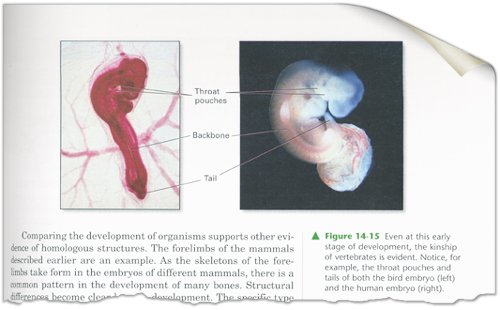
Most people have heard of or been taught the idea that the human embryo goes through (or recapitulates) various evolutionary stages, such as having gills like a fish, a tail like a monkey, etc., during the first few months that it develops in the womb.
The idea has not only been presented to generations of biology/medical students as fact, but has also been used for many years to persuasively justify abortion. Abortionists claimed that the unborn child being killed was still in the fish stage or the monkey stage, and had not yet become a human being.
This idea (called embryonic recapitulation) was vigorously expounded by Ernst Haeckel from the late 1860s to promote Darwin’s theory of evolution in Germany, even though Haeckel did not have evidence to support his views.1
Lacking the evidence, Haeckel set out to manufacture the data. He fraudulently changed drawings made by other scientists of human and dog embryos, to increase the resemblance between them and to hide the dissimilarities. We reported on this particular fraud in a recent issue of Creation magazine.2
Haeckel’s German peers (notably, in 1874, Wilhelm His Sr, professor of anatomy at the University of Leipzig) were aware of this fraud and extracted a modest confession from him, in which he blamed the draughtsman for blundering—without acknowledging that he himself was the draughtsman!2
Most informed evolutionists in the past 70 years have realised that the recapitulation theory is false.3
Nevertheless, the recapitulation idea is still advanced as evidence for the theory of evolution in many books and particularly encyclopedias and by evolutionary popularizers like the late Carl Sagan.4
When evolutionists say that the recapitulation theory is false, they usually do not mean to admit that comparing embryos gives no evidence of common ancestry. In fact, they still frequently highlight the assumed similarities between embryos in their early stages (called embryonic homology) as evidence for evolution. This assumption is based on the idea that such similarities are ‘common knowledge’.5
![]() Haeckel’s
famous (infamous) set of 24 drawings purporting to show eight different
embryos in three stages of development, as published by him in Anthropogenie,
in Germany, 1874. Click
here for larger image.
|
This alleged similarity of embryos has for years been resting, consciously or unconsciously, on a set of 24 of Haeckel’s drawings which he first published in 1866 in his Generalle Morphologie der Organismen, and then repeated in 1874 in his more popular Anthropogenie (see below). These purport to show embryos of fish, salamander, turtle, chicken, pig, cow, rabbit, and human in three stages of development.
The various stages, particularly the earlier ones, show substantial similarity. Ever since these drawings appeared, it has been assumed that they have given us something close to the truth about embryos of vertebrate species. So much so that they still appear in textbooks and popular works on evolution.6,7
In fact, no one has bothered to check—until now. It turns out that Haeckel’s fraud was much worse than anyone realised. It did not just affect the idea of recapitulation, it turns out that the similarities are much, much less than anyone thought.
Michael Richardson, a lecturer and embryologist at St George’s Hospital Medical School, London, has exposed this further fraud, in an article in the journal Anatomy and Embryology, 8 recently reviewed in Science9 and New Scientist.10
![]() Top row: Haeckel’s
drawings of several different embryos, showing incredible similarity
in their early ‘tailbud’ stage. Bottom Row: Richardson’s photographs of how the embryos really look at the same stage. (From left: Salmo salar, Cryptobranchus allegheniensis, Emys orbicularis, Gallus gallus, Oryctolagus cuniculus, Homo sapiens.) Many modern evolutionists no longer claim that the human embryo repeats the adult stages of its alleged evolutionary ancestors, but point to Haeckel’s drawings (top row) to claim that it repeats the embryonic stages. However, even this alleged support for evolution is now revealed as being based on faked drawings. Click here for larger image. |
Richardson says he always felt there was something wrong with Haeckel’s drawings, ‘because they didn’t square with his [Richardson’s] understanding of the rates at which fish, reptiles, birds, and mammals develop their distinctive features’.8 He could find no record of anyone having actually compared embryos of one species with those of another, so that ‘no one has cited any comparative data in support of the idea’.8
He therefore assembled an international team to do just that—examine and photograph ‘the external form of embryos from a wide range of vertebrate species, at a stage comparable to that depicted by Haeckel’.8
The team collected embryos of 39 different creatures, including marsupials from Australia, tree-frogs from Puerto Rico, snakes from France, and an alligator embryo from England. They found that the embryos of different species are very different. In fact, they are so different that the drawings made by Haeckel (of similar-looking human, rabbit, salamander, fish, chicken, etc. embryos) could not possibly have been done from real specimens.
Nigel Hawkes interviewed Richardson for The Times (London).11 In an article describing Haeckel as ‘An embryonic liar’, he quotes Richardson:
‘This is one of the worst cases of scientific fraud. It’s shocking to find that somebody one thought was a great scientist was deliberately misleading. It makes me angry … What he [Haeckel] did was to take a human embryo and copy it, pretending that the salamander and the pig and all the others looked the same at the same stage of development. They don’t … These are fakes.’ 11
Haeckel not only changed the drawings by adding, omitting, and changing features but, according to Richardson and his team,
‘he also fudged the scale to exaggerate similarities among species, even when there were 10-fold differences in size. Haeckel further blurred differences by neglecting to name the species in most cases, as if one representative was accurate for an entire group of animals’.9
Ernst Haeckel’s drawings were declared fraudulent by Professor His in 1874 and were included in Haeckel’s quasi confession, but according to Richardson,
‘Haeckel’s confession got lost after his drawings were subsequently used in a 1901 book called Darwin and After Darwin and reproduced widely in English language biology texts.’ 9,12
Will there now be a rush by libraries, publishers and sellers of evolutionist books to withdraw from circulation, rewrite and otherwise acknowledge the fact that the idea of embryonic similarities’ suggesting evolution is largely based on academic fraud?
More of Richardson’s photographs of embryos at the same ‘tailbud’
stage of development and to the same scale, showing the huge differences
between various species. (From left: Petromyzon marinus, Acipenser
ruthenus, Bufo bufo, Erinaceus europaeus, Felis catus, Manis javanica,
Canis familiaris.) Click here
for larger image. |
| The embryo photos used in this article were kindly supplied by Dr Michael K. Richardson. They originally appeared in M.K. Richardson et al., ‘There is no highly conserved embryonic stage in the vertebrates: implications for current theories of evolution and development’, Anatomy and Embryology, 196(2):91–106, 1997, © Springer-Verlag GmbH & Co., Tiergartenstrasse, 69121 Heidelberg, Germany. Reproduced here with permission. |
Help keep these daily articles coming. Find out how to support AiG.