
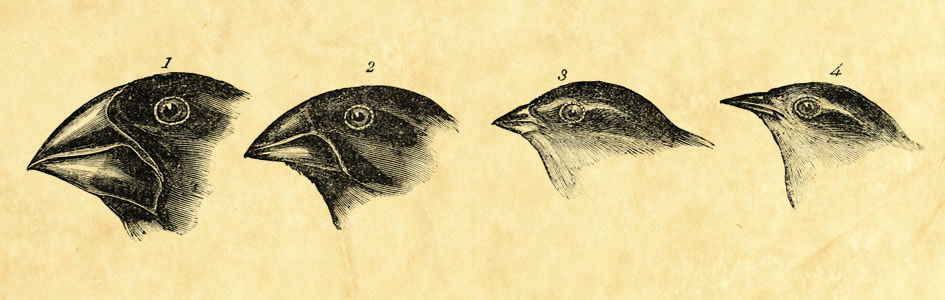
2.3 Change, Yes; Evolution, No
Darwin and Biologic Change
by
Dr. Gary Parker
on
March 26, 2016
Republished with permission and featured in
Creation: Facts of Life
When I “proved” natural selection to my classes (pages 7–11), I just assumed I was also proving evolution. Perhaps the most powerful argument for evolution is the word “change,” and the most persuasive (and ambiguous) definition of evolution is “change through time.” If I say “No” when asked if I believe in evolution, the likely response is an astonished look and the incredulous query, “What?? You don’t believe in change?!”
To get the conversation started, I might reply, “Of course I believe in change; I’ve got some in my pocket.” An evolutionist would counter, of course, “Not that kind of change!” Lots of examples of “change through time” would get the same response: the change from round to flat in an opossum run over by a truck; from athletic young runner to old man in a wheel chair; from seed to mighty oak; God making man from the dust of the ground; plants and animals successively buried during Noah’s flood, etc. There are obviously all kinds of “change through time” that are not evolution, so evolution must be only a particular kind of change through time. Natural selection certainly produces change in populations, but is it the evolutionary kind of change?
Take a look again at the peppered moth example (Figure 11B). What did we start with? Dark and light varieties of the peppered moth, species Biston betularia. After 100 years of natural selection, what did we end up with? Dark and light varieties of the peppered moth, species Biston betularia. The moths themselves didn’t change; there were always dark moths and always light moths from the earliest observations. All that changed was the percentage of moths in the two categories: that’s what creationists call variation within kind. (For details, see the master’s thesis by one of my students, Chris Osborne.1)
According to the biblical outline of history, struggle and death began when man’s rebellion ruined God’s perfect creation. Natural selection is just one of the processes that operates in our present corrupted world when the created kinds spread throughout the earth in all its ecologic and geographic variety. In fact, 24 years before Darwin’s Origin, a scientist named Edward Blyth published the concept of natural selection in the biblical context of a corrupted creation. A book reviewer once asked, rather naively, if creationists could accept the concept of natural selection. The answer is, “Of course. We thought of it first.”
If natural selection is such a profound idea, and Blyth published it before Darwin, then why isn’t Blyth’s name a household word? Perhaps because Blyth made no more of natural selection than could be scientifically observed. It was not the scientific applications of natural selection that attracted attention in 1859; it was its presumed philosophic and religious implications.
Evolutionists were not content to treat natural selection as simply an observable ecological process. Darwin himself was a cautious scientist, painstaking in his work, but others, especially T.H. Huxley and Herbert Spencer, insisted on making natural selection the touchstone of a new religion, a “religion without revelation,” as Julian Huxley later called it. For them, as for many others, the real significance of the Darwinian revolution was religious and philosophic, not scientific, a reason to place human opinion above God’s Word. These early evolutionists were basically anti-creationists who wanted to explain design without a Designer.
In spite of what might be claimed, natural selection has been observed to produce only variation within kind: merely shifts in populations, for example, to moths with greater percentages of darker moths, to flies resistant to DDT, or to bacteria resistant to antibiotics. Modern evolutionists believe, however, that such small changes plus vast amounts of time could lead to huge changes, “macroevolution,” change from one kind to another: Fish to Philosopher, as the title of Homer Smith’s book puts it, or Molecules to Man, the subtitle of the government-funded BSCS “blue version” high school biology textbook.
Macroevolution is the kind of change through time pictured as millions of years of struggle and death producing a “tree of life” rooted in chance chemical combinations forming life, and life branching out through a few simple forms to the twigs representing all the complex and varied species we have today, including man.
Beliefs about macroevolution certainly go far beyond our scientific observations of natural selection. Still, I must admit that there is a potential connection between observed natural selection within kind and hypothetical evolution from one kind to another. That connection is called “extrapolation,” following a trend to its logical conclusion. Scientists extrapolate from population records, for example, to predict changes in the world population. If world population growth continued at the rate observed in the 1960s, statisticians said, then the world population by A.D. 2000 would be over six billion (as observed). Similarly, if natural selection continues over very long periods of time, evolutionists say, the same process that changes moths from mostly light to mostly dark forms will gradually change fish to philosophers or molecules to man.
Now there’s nothing wrong with extrapolation in principle, but there are things to watch for in practice. For example, simple extrapolation would suggest a population of a “zillion” by A.D. 3000. Of course, there will come a point when the earth is simply not big enough to support any more people. In other words, there are limits, or boundary conditions, to logical extrapolation.
Consider my jogging (or should I say “slogging”) times. Starting years ago at an embarrassing 12 minutes per mile, I knocked a minute off each week: a mile in 11 minutes, then 10, 9, 8, 7, 6, 5, 4, 3, 2, 1. Wait a minute! As you well know, I reached my limit long before the one-minute mile! (Just where, I’ll keep secret!) This is an embarrassing example, but it makes an important point: no scientist would consider extrapolation without also considering the logical limits or boundary conditions of that extrapolation.
Evolutionists are aware of the problem. They distinguish between SUBspeciation and TRANSspeciation. “Sub” is essentially variation within species, and “trans” is change from one species to another. Darwinian evolutionists believe that one can “extrapolate” from variation within species to evolution between species. But other evolutionists believe that such extrapolation goes beyond all logical limits, like my running a one-minute mile.2
What does the evidence suggest? Can evolution from “molecules to man” be extrapolated from natural selection among dark and light moths? Or are there boundary conditions and logical limits to the amount of change that can be produced by Darwin’s war of nature—time, chance, struggle, and death?
The answer seems to be: “Natural selection, yes; evolution, no.” As it turns out, there are several factors that sharply limit the amount of change that can be produced by time, chance, and Darwinian natural selection.3
Darwin published his theory in 1859, before Abraham Lincoln became president, long before DNA’s significance was discovered, and even before the germ theory of disease and the modern sciences of genetics and ecology were founded. It is perhaps not surprising, then, that over the past century and a half scientists have discovered a long list of factors that set definite limits to the kind and amount of change natural selection can produce—no matter what the time involved. You could calculate how long it would take you, pedaling a bicycle at 10 mph (16 kph), to reach the moon, but such an extrapolation would ignore serious limits to getting to the moon on a bicycle—even if you had zillions of years to do it!
Following are some of the limits that prevent extrapolation from natural selection to evolution—limits causing a growing number of 21st century scientists to say, “Natural selection, yes; evolution, no.”
Creation: Facts of Life
Dr. Parker, a leading creation scientist and former AiG speaker, presents the classic arguments for evolution used in public schools, universities, and the media, and refutes them in an entertaining and easy-to-read style. A must for students and teachers alike! This is a great book to give to a non-Christian as a witnessing tool.
Read OnlineFootnotes
- Chris D. Osborne, A Reevaluation of the English Peppered Moth’s Use as an Example of Evolution in Progress, Master’s thesis, Institute for Creation Research, Santee, CA. 1985.
- Theodosius Dobzhansky, F. Ayala, L. Stebbins, and J. Valentine, Evolution (San Francisco, CA: W.H. Freeman and Co., 1977).
- Lane Lester and Ray Bohlin, The Natural Limits to Biological Change (Grand Rapids, MI: Zondervan, 1984).

Support the creation/gospel message by donating or getting involved!

Answers in Genesis is an apologetics ministry, dedicated to helping Christians defend their faith and proclaim the good news of Jesus Christ.
- Customer Service 800.778.3390
- Available Monday–Friday | 9 AM–5 PM ET
- © 2026 Answers in Genesis