
Moon Dust and the Age of the Solar System
Originally published in Journal of Creation 7, no 1 (April 1993): 2-42.
Abstract
Using a figure published in 1960 of 14,300,000 tons per year as the meteoritic dust influx rate to the earth, creationists have argued that the thin dust layer on the moon’s surface indicates that the moon, and therefore the earth and solar system, are young. Furthermore, it is also often claimed that before the moon landings there was considerable fear that astronauts would sink into a very thick dust layer, but subsequently scientists have remained silent as to why the anticipated dust wasn’t there. An attempt is made here to thoroughly examine these arguments, and the counter arguments made by detractors, in the light of a sizable cross-section of the available literature on the subject.
Of the techniques that have been used to measure the meteoritic dust influx rate, chemical analyses (of deep sea sediments and dust in polar ice), and satellite-borne detector measurements appear to be the most reliable. However, upon close examination the dust particles range in size from fractions of a micron in diameter and fractions of a microgram in mass up to millimetres and grams, whence they become part of the size and mass range of meteorites. Thus the different measurement techniques cover different size and mass ranges of particles, so that to obtain the most reliable estimate requires an integration of results from different techniques over the full range of particle masses and sizes. When this is done, most current estimates of the meteoritic dust influx rate to the earth fall in the range of 10,000-20,000 tons per year, although some suggest this rate could still be as much as up to 100,000 tons per year.
Apart from the same satellite measurements, with a focusing factor of two applied so as to take into account differences in size and gravity between the earth and moon, two main techniques for estimating the lunar meteoritic dust influx have been trace element analyses of lunar soils, and the measuring and counting of microcraters produced by impacting micrometeorites on rock surfaces exposed on the lunar surface. Both these techniques rely on uniformitarian assumptions and dating techniques. Furthermore, there are serious discrepancies between the microcrater data and the satellite data that remain unexplained, and that require the meteoritic dust influx rate to be higher today than in the past. But the crater-saturated lunar highlands are evidence of a higher meteorite and meteoritic dust influx in the past. Nevertheless the estimates of the current meteoritic dust influx rate to the moon’s surface group around a figure of about 10,000 tons per year.
Prior to direct investigations, there was much debate amongst scientists about the thickness of dust on the moon. Some speculated that there would be very thick dust into which astronauts and their spacecraft might “disappear”, while the majority of scientists believed that there was minimal dust cover. Then NASA sent up rockets and satellites and used earth-bound radar to make measurements of the meteoritic dust influx, results suggesting there was only sufficient dust for a thin layer on the moon. In mid-1966 the Americans successively soft-landed five Surveyor spacecraft on the lunar surface, and so three years before the Apollo astronauts set foot on the moon NASA knew that they would only find a thin dust layer on the lunar surface into which neither the astronauts nor their spacecraft would “disappear”. This was confirmed by the Apollo astronauts, who only found up to a few inches of loose dust.
The Apollo investigations revealed a regolith at least several metres thick beneath the loose dust on the lunar surface. This regolith consists of lunar rock debris produced by impacting meteorites mixed with dust, some of which is of meteoritic origin. Apart from impacting meteorites and micrometeorites it is likely that there are no other lunar surface processes capable of both producing more dust and transporting it. It thus appears that the amount of meteoritic dust and meteorite debris in the lunar regolith and surface dust layer, even taking into account the postulated early intense meteorite and meteoritic dust bombardment, does not contradict the evolutionists’ multi-billion year timescale (while not proving it). Unfortunately, attempted counter-responses by creationists have so far failed because of spurious arguments or faulty calculations. Thus, until new evidence is forthcoming, creationists should not continue to use the dust on the moon as evidence against an old age for the moon and the solar system.
Introduction
One of the evidences for a young earth that creationists have been using now for more than two decades is the argument about the influx of meteoritic material from space and the so-called “dust on the moon” problem. The argument goes as follows:
“It is known that there is essentially a constant rate of cosmic dust particles entering the earth’s atmosphere from space and then gradually settling to the earth’s surface. The best measurements of this influx have been made by Hans Pettersson, who obtained the figure of 14 million tons per year.1 This amounts to 14 x 1019 pounds in 5 billion years. If we assume the density of compacted dust is, say, 140 pounds per cubic foot, this corresponds to a volume of 1018 cubic feet. Since the earth has a surface area of approximately 5.5 x 10¹⁵ square feet, this seems to mean that there should have accumulated during the 5-billion- year age of the earth, a layer of meteoritic dust approximately 182 feet thick all over the world!
There is not the slightest sign of such a dust layer anywhere of course. On the moon’s surface it should be at least as thick, but the astronauts found no sign of it (before the moon landings, there was considerable fear that the men would sink into the dust when they arrived on the moon, but no comment has apparently ever been made by the authorities as to why it wasn’t there as anticipated).
Even if the earth is only 5,000,000 years old, a dust layer of over 2 inches should have accumulated.
Lest anyone say that erosional and mixing processes account for the absence of the 182-foot meteoritic dust layer, it should be noted that the composition of such material is quite distinctive, especially in its content of nickel and iron. Nickel, for example, is a very rare element in the earth’s crust and especially in the ocean. Pettersson estimated the average nickel content of meteoritic dust to be 2.5 per cent, approximately 300 times as great as in the earth’s crust. Thus, if all the meteoritic dust layer had been dispersed by uniform mixing through the earth’s crust, the thickness of crust involved (assuming no original nickel in the crust at all) would be 182 x 300 feet, or about 10 miles!
Since the earth’s crust (down to the mantle) averages only about 12 miles thick, this tells us that practically all the nickel in the crust of the earth would have been derived from meteoritic dust influx in the supposed (5 x 10⁹ year) age of the earth!”2
This is indeed a powerful argument, so powerful that it has upset the evolutionist camp. Consequently, a number of concerted efforts have been recently made to refute this evidence.3-9 After all, in order to be a credible theory, evolution needs plenty of time (that is, billions of years) to occur because the postulated process of transforming one species into another certainly can’t be observed in the lifetime of a single observer. So no evolutionist could ever be happy with evidence that the earth and the solar system are less than 10,000 years old.
But do evolutionists have any valid criticisms of this argument? And if so,
can they be answered?
Criticisms of this argument made by evolutionists fall into three categories:-
- The question of the rate of meteoritic dust influx to the earth and moon,
- The question as to whether NASA really expected to find a thick dust layer on the moon when their astronauts, landed, and
- The question as to what period of time is represented by the actual layer of dust found on the moon.
Dust Influx to the Earth
Petterson’s Estimate
The man whose work is at the centre of this controversy is Hans Pettersson of the Swedish Oceanographic Institute. In 1957, Pettersson (who then held the Chair of Geophysics at the University of Hawaii) set up dust-collecting units at 11,000 feet near the summit of Mauna Loa on the island of Hawaii and at 10,000 feet on Mt Haleakala on the island of Maui. He chose these mountains because
“occasionally winds stir up lava dust from the slopes of these extinct volcanoes, but normally the air is of an almost ideal transparency, remarkably free of contamination by terrestrial dust.”10
With his dust-collecting units, Pettersson filtered measured quantities of air and analysed the particles he found. Despite his description of the lack of contamination in the air at his chosen sampling sites, Pettersson was very aware and concerned that terrestrial (atmospheric) dust would still swamp the meteoritic (space) dust he collected, for he says: “It was nonetheless apparent that the dust collected in the filters would come preponderantly from terrestrial sources.”11 Consequently he adopted the procedure of having his dust samples analysed for nickel and cobalt, since he reasoned that both nickel and cobalt were rare elements in terrestrial dust compared with the high nickel and cobalt contents of meteorites and therefore by implication of , meteoritic dust also.
Based on the nickel analysis of his collected dust, Pettersson finally estimated that about 14 million tons of dust land on the earth annually. To quote Petterson again:
“Most of the samples contained small but measurable quantities of nickel along with the large amount of iron. The average for 30 filters was 14.3 micrograms of nickel from each 1,000 cubic metres of air. This would mean that each 1,000 cubic metres of air contains .6 milligram of meteoritic dust. If meteoritic dust descends at the same rate as the dust created by the explosion of the Indonesian volcano Krakatoa in 1883, then my data indicate that the amount of meteoritic dust landing on the earth every year is 14 million tons. From the observed frequency of meteors and from other data Watson (F.G. Watson of Harvard University) calculates the total weight of meteoritic matter reaching the earth to be between 365,000 and 3,650,000 tons a year. His higher estimate is thus about a fourth of my estimate, based upon theHawaiian studies. To be on the safe side, especially in view of the uncertainty as to how long it takes meteoritic dust to descend, I am inclined to find five million tons per year plausible.”12
Now several evolutionists have latched onto Pettersson’s conservatism with his suggestion that a figure of 5 million tons per year is more plausible and have thus promulgated the idea that Pettersson’s estimate was “high”,13 “very speculative”,14 and “tentative”.15 One of these critics has even gone so far as to suggest that “Pettersson’s dust- collections were so swamped with atmospheric dust that his estimates were completely wrong”16 (emphasis mine). Others have said that “Pettersson’s samples were apparently contaminated with far more terrestrial dust than he had accounted for.”17 So what does Pettersson say about his 5 million tons per year figure?:
“The five-million-ton estimate also squares nicely with the nickel content of deep-ocean sediments. In 1950 Henri Rotschi of Paris and I analysed 77 samples of cores raised from the Pacific during the Swedish expedition. They held an average of. 044 per cent nickel. The highest nickel content in any sample was .07 per cent. This, compared to the average .008- per-cent nickel content of continental igneous rocks, clearly indicates a substantial contribution of nickel from meteoritic dust and spherules.
If five million tons of meteoritic dust fall to the earth each year, of which 2.5 per cent is nickel, the amount of nickel added to each square centimetre of ocean bottom would be .000000025 gram per year, or .017 per cent of the total red-clay sediment deposited in a year. This is well within the .044-per-cent nickel content of the deep-sea sediments and makes the five- million-ton figure seem conservative.”18
In other words, as a reputable scientist who presented his assumptions and warned of the unknowns, Pettersson was happy with his results.
But what about other scientists who were aware of Pettersson and his work at the time he did it? Dr Isaac Asimov’s comments,19 for instance, confirm that other scientists of the time were also happy with Pettersson’s results. Of Pettersson’s experiment Asimov wrote:-
“At a 2-mile height in the middle of the Pacific Ocean one can expect the air to be pretty free of terrestrial dust. Furthermore, Pettersson paid particular attention to the cobalt content of the dust, since meteor dust is high in cobalt whereas earthly dust is low in it.”20
Indeed, Asimov was so confident in Pettersson’s work that he used Pettersson’s figure of 14,300,000 tons of meteoritic dust falling to the earth’s surface each year to do his own calculations. Thus Asimov suggested:
“Of course, this goes on year after year, and the earth has been in existence as a solid body for a good long time: for perhaps as long as 5 billion years. If, through all that time, meteor dust has settled to the earth at the same rate as it does, today, then by now, if it were undisturbed, it would form a layer 54 feet thick over all of the earth.”21
This sounds like very convincing confirmation of the creationist case, but of course, the year that Asimov wrote those words was 1959, and a lot of other meteoritic dust influx measurements have since been made. The critics are also quick to point this out -
“. ..we now have access to dust collection techniques using aircraft, high-altitude balloons and spacecraft. These enable researchers to avoid the problems of atmospheric dust which plagued Pettersson.”22
However, the problem is to decide which technique for estimating the meteoritic dust influx gives the “true” figure. Even Phillips admits this when he says:
“(Techniques vary from the use of high altitude rockets with collecting grids to deep-sea core samples. Accretion rates obtained by different methods vary from 102 to 109 tons/year. Results from identical methods also differ because of the range of sizes of the measured particles.”23
One is tempted to ask why it is that Pettersson’s 5-14 billion tons per year figure is slammed as being “tentative”, “very speculative” and “completely wrong”, when one of the same critics openly admits the results from the different, more modern methods vary from 100 to 1 billion tons per year, and that even results from identical methods differ? Furthermore, it should be noted that Phillips wrote this in 1978, some two decades and many moon landings after Pettersson’s work!
| (a) Small Size In Space (<0.1 cm) | |
|---|---|
| Penetration Satellites Al26 (sea sediment) Rare Gases Zodiacal Cloud (i) (ii) |
36,500-182,500 tons/yr 73,000-3,650,000 tons/yr <3,650,000 tons/yr 91,500-913,000 tons/yr 73-730 tons/yr |
| (b) Cometary Meteors (104-102g) In Space | |
| Cometary Meteors | 73,000 tons/yr |
| (c) “Any" Size in Space | |
| Barbados Meshes (i) Spherules (ii) Total Winter (iii) Total Annual Balloon Meshes Airplane Filters Balloons (i) Dust Counter (ii) Coronograph Ni (Antarctic ice) Ni (sea sediment) Os (sea sediment) CI36 (sea sediment) Sea-sediment Spherules |
< 110 tons/yr <730 tons/yr <220,000 tons/yr <200,000 tons/yr <91 ,500 tons/yr 3,650,000 tons/yr 365,000 tons/yr 3,650,000-11,000,000 tons/yr <3,650,000 tons/yr 110,000 tons/yr 1,825,000 tons/yr 365-3,650 tons/yr |
| (d) Large Size in Space | |
| Airwaves Meteorites |
36,500 tons/yr 365-3,650 tons/yr |
Table 1. Measurements and estimates of the meteoritic dust influx to the earth. (The data are adapted from Parkin and Tilles,24 who have fully referenced all their data sources.) (All figures have been rounded off.)
Other Estimates, Particularly by Chemical Methods
In 1968, Parkin and Tilles summarised all the measurement data then available on the question of influx of meteoritic (interplanetary) material (dust) and tabulated it.24 Their table is reproduced here as Table 1, but whereas they quoted influx rates in tons per day, their figures have been converted to tons per year for ease of comparison with Pettersson’s figures.
Even a quick glance at Table 1 confirms that most of these experimentally-derived measurements are well below Pettersson’s 5-14 million tons per year figure, but Phillips’ statement (quoted above) that results vary widely, even from identical methods, is amply verified by noting the range of results listed under some of the techniques. Indeed, it also depends on the experimenter doing the measurements (or estimates, in some cases). For instance, one of the astronomical methods used to estimate the influx rate depends on calculation of the density of the very fine dust in space that causes the zodiacal light. In Table 1, two estimates by different investigators are listed because they differ by 2-3 orders of magnitude.
On the other hand, Parkin and Tilles’ review of influx measurements, while comprehensive, was not exhaustive, there being other estimates that they did not report. For example, Pettersson25 also mentions an influx estimate based on meteorite data of 365,000-3,650,000 tons/year made by F. G. Watson of Harvard University (quoted earlier), an estimate which is also 2-3 orders of magnitude different from the estimate listed by Parkin and Tilles and reproduced in Table 1. So with such a large array of competing data that give such conflicting orders-of-magnitude different estimates, how do we decide which is the best estimate that somehow might approach the “true” value?
Another significant research paper was also published in 1968. Scientists Barker and Anders were reporting on their measurements of iridium and osmium concentration in dated deep-sea sediments (red clays) of the central Pacific Ocean Basin, which they believed set limits to the influx rate of cosmic matter, including dust.26 Like Pettersson before them, Barker and Anders relied upon the observation that whereas iridium and osmium are very rare elements in the earth’s crustal rocks, those same two elements are present in significant amounts in meteorites.
|
|
|
(tons/year)* |
|---|---|---|
|
Fe Ni Ni Fe Ni Ir Ir Os |
Surface Pacific sediment Pacific sediment Stratosphere Antarctic ice Pacific sediment Pacific sediment Pacific sediment |
40,000,000 |
| * Normalized to the composition of C1 carbonaceous chondrites (one class of meteorites). | ||
Table 2. Estimates of the accretion rate of cosmic matter by chemical methods (after Barker and Anders,26 who have fully referenced all their data sources).
Their results are included in Table 2 (last four estimates), along with earlier reported estimates from other investigators using similar and other chemical methods. They concluded that their analyses, when compared with iridium concentrations in meteorites (C1 carbonaceous chondrites), corresponded to a meteoritic influx rate forth entire earth of between 30,000 and 90,000 tons per year. Furthermore, they maintained that a firm upper limit on the influx rate could be obtained by assuming that all the iridium and osmium in deep-sea sediments is of cosmic origin. The value thus obtained is between 50,000 and 150,000 tons per year. Notice, however, that these scientists were careful to allow for error margins by using a range of influx values rather than a definitive figure. Some recent authors though have quoted Barker and Anders’ result as 100,000 tons, instead of 100,000 ± 50,000 tons. This may not seem a rather critical distinction, unless we realise that we are talking about a 50% error margin either way, and that’s quite a large error margin in anyone’s language regardless of the magnitude of the result being quoted.
Even though Barker and Anders’ results were published in 1968, most authors, even fifteen years later, still quote their influx figure of 100,000 ± 50,000 tons per year as the most reliable estimate that we have via chemical methods. However, Ganapathy’s research on the iridium content of the ice layers at the South Pole27 suggests that Barker and Anders’ figure underestimates the annual global meteoritic influx.
Ganapathy took ice samples from ice cores recovered by drilling through the ice layers at the US Amundsen-Scott base at the South Pole in 1974, and analysed them for iridium. The rate of ice accumulation at the South Pole over the last century or so is now particularly well established, because two very reliable precision time markers exist in the ice layers for the years 1884 (when debris from the August 26,1983 Krakatoa volcanic eruption was deposited in the ice) and 1953 (when nuclear explosions began depositing fission products in the ice). With such an accurately known time reference framework to put his iridium results into, Ganapathy came up with a global meteoritic influx figure of 400,000 tons per year, four times higher than Barker and Anders’ estimate from mid-Pacific Ocean sediments.
In support of his estimate, Ganapathy also pointed out that Barker and Anders had suggested that their estimate could be stretched up to three times its value (that is, to 300,000 tons per year) by compounding several unfavorable assumptions. Furthermore, more recent measurements by Kyte and Wasson of iridium in deep-sea sediment samples obtained by drilling have yielded estimates of 330,000-340,000 tons per year.28 So Ganapathy’s influx estimate of 400,000 tons of meteoritic material per year seems to represent a fairly reliable figure, particularly because it is based on an accurately known time reference framework.
Estimates via Aircraft and Spacecraft Methods
So much for chemical methods of determining the rate of annual meteoritic influx to the earth’s surface. But what about the data collected by high-flying aircraft and spacecraft, which some critics29,30 are adamant give the most reliable influx estimates because of the elimination of a likelihood of terrestriat dust contamination? Indeed, on the basis of the dust collected by the high-flying U-2 aircraft, Bridgstock dogmatically asserts that the influx figure is only 10,000 tonnes per year.31,32 To justify his claim Bridgstock refers to the reports by Bradley, Brownlee and Veblen,33 and Dixon, McDonnel1 and Carey34 who state a figure of 10,000 tons for the annual influx of interplanetary dust particles. To be sure, as Bridgstock says,35 Dixon, McDonnell and Carey do report that “. ..researchers estimate that some 10,000 tonnes of them fall to Earth every year.”36 However, such is the haste of Bridgstock to prove his point, even if it means quoting out of context, he obviously didn’t carefully read, fully comprehend, and/or deliberately ignored all of Dixon, McDonnell and Carey’s report, otherwise he would have noticed that the figure “some 10,000 tonnes of them fall to Earth every year” refers only to a special type of particle called Brownlee particles, not to all cosmic dust particles. To clarify this, let’s quote Dixon, McDonnell and Carey:
“Over the past 10 years, this technique has landed a haul of small fluffy cosmic dust grains known as ‘Brownlee particles’ after Don Brownlee, an American researcher who pioneered the routine collection of particles by aircraft, and has led in their classification. Their structure and composition indicate that the Brown lee particles are indeed extra-terrestrial in origin (see Box 2), and researchers estimate that some 10,000 tonnes of them fall to Earth every year. But Brownlee particles represent only part of the total range of cosmic dust particles”37 (emphasis mine).
And further, speaking of these “fluffy” Brownlee particles:
“The lightest and fluffiest dust grains, however, may enter the atmosphere on a trajectory which subjects them to little or no destructive effects, and they eventually drift to the ground. There these particles are mixed up with greater quantities of debris from the larger bodies that burn up as meteors, and it is very difficult to distinguish the two”38 (emphasis ours).
What Bridgstock has done, of course, is to say that the total quantity of cosmic dust that hits the earth each year according to Dixon, McDonnell and Carey is 10,000 tonnes, when these scientists quite clearly stated they were only referring to a part of the total cosmic dust influx, and a lesser part at that. A number of writers on this topic have unwittingly made similar mistakes.
But this brings us to a very crucial aspect of this whole issue, namely, that there is in fact a complete range of sizes of meteoritic material that reaches the earth, and moon for that matter, all the way from large meteorites metres in diameter that produce large craters upon impact, right down to the microscopic-sized “fluffy” dust known as Brownlee particles, as they are referred to above by Dixon, McDonnell, and Carey. And furthermore, each of the various techniques used to detect this meteoritic material does not necessarily give the complete picture of all the sizes of particles that come to earth, so researchers need to be careful not to equate their influx measurements using a technique to a particular particle size range with the total influx of meteoritic particles. This is of course why the more experienced researchers in this field are always careful in their records to stipulate the particle size range that their measurements were made on.
 />
/>
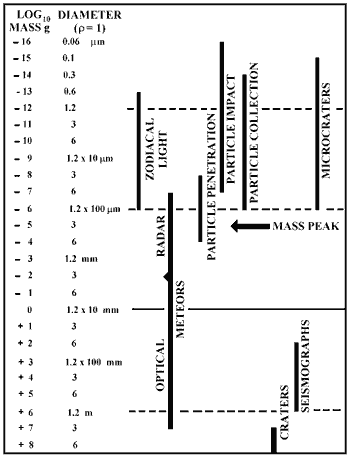
Figure 1. The mass ranges of interplanetary (meteoritic) dust particles as detected by various techniques (adapted from Millman39). The particle penetration, impact and collection techniques make use of satellites and rockets. The techniques shown in italics are based on lunar surface measurements.
Millman39 discusses this question of the particle size ranges over which the various measurement techniques are operative. Figure 1 is an adaptation of Millman’s diagram. Notice that the chemical techniques, such as analyses for iridium in South Pole ice or Pacific Ocean deep-sea sediments, span nearly the full range of meteoritic particles sizes, leading to the conclusion that these chemical techniques are the most likely to give us an estimate closest to the “true” influx figure. However, Millman40 and Dohnanyi41 adopt a different approach to obtain an influx estimate. Recognising that most of the measurement techniques only measure the influx of particles of particular size ranges, they combine the results of all the techniques so as to get a total influx estimate that represents all the particle size ranges. Because of overlap between techniques, as is obvious from Figure 1, they plot the relation between the cumulative number of particles measured (or cumulative flux) and the mass of the particles being measured, as derived from the various measurement techniques. Such a plot can be seen in Figure 2. The curve in Figure 2 is the weighted mean flux curve obtained by comparing, adding together and taking the mean at anyone mass range of all the results obtained by the various measurement techniques. A total influx estimate is then obtained by integrating mathematically the total mass under the weighted mean flux curve over a given mass range.
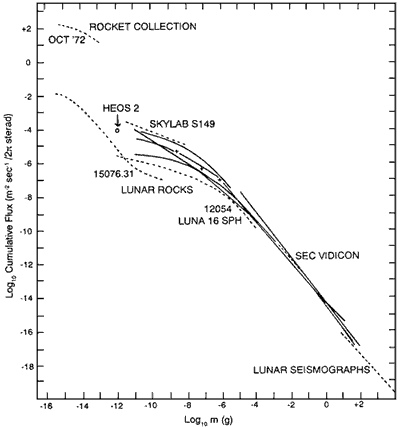
Figure 2. The relation between the cumulative number of particles and the lower limit of mass to which they are counted, as derived from various types of recording - rockets, satellites, lunar rocks, lunar seismographs (adapted from Millman39). The crosses represent the Pegasus and Explorer penetration data.
By this means Millman42 estimated that in the mass range 10-12 to 103g only a mere 30 tons of meteoritic material reach the earth each day, equivalent to an influx of 10,950 tons per year. Not surprisingly, the same critic (Bridgstock) that erroneously latched onto the 10,000 tonnes per year figure of Dixon, McDonnell and Carey to defend his (Bridgstock’s) belief that the moon and the earth are billions of years old, also latched onto Millman’s 10,950 tons per year figure.43 But what Bridgstock has failed to grasp is that Dixon, McDonnell and Carey’s figure refers only to the so-called Brownlee particles in the mass range of 10-12 to 10-6g, whereas Millman’s figure, as he stipulates himself, covers the mass range of 10-12 to 103g. The two figures can in no way be compared as equals that somehow support each other because they are not in the same ballpark since the two figures are in fact talking about different particle mass ranges.
Furthermore, the close correspondence between these two figures when they refer to different mass ranges, the 10,000 tonnes per year figure of Dixon, McDonnell and Carey representing only 40% of the mass range of Millman’s 10,950 tons per year figure, suggests something has to be wrong with the techniques used to derive these figures. Even from a glance at the curve in Figure 2, it is obvious that the total mass represented by the area under the curve in the mass range 10-6 to 103g can hardly be 950 or so tons per year (that is, the difference between Millman’s and Dixon, McDonnell and Carey’s figures and mass ranges), particularly if the total mass represented by the area under the curve in the mass range 10-12 to 10-6g is supposed to be 10,000 tonnes per year (Dixon, McDonnell and Carey’s figure and mass range). And Millman even maintains that the evidence indicates that two-thirds of the total mass of the dust complex encountered by the earth is in the form of particles with masses between 10-6.5 and 10-3.5g, or in the three orders of magnitude 10-6, 10-5 and 10-4g, respectively,44 outside the mass range for the so-called Brownlee particles. So if Dixon, McDonnell and Carey are closer to the truth with their 1985 figure of 10,000 tonnes per year of Brownlee particles (mass range 10-12 to 10-6g), and if two-thirds of the total particle influx mass lies outside the Brownlee particle size range, then Millman’s 1975 figure of 10,950 tons per year must be drastically short of the “real” influx figure, which thus has to be at least 30,000 tons per year.
Millman admits that if some of the finer dust partlcles do not register by either penetrating or cratering, satellite or aircraft collection panels, it could well be that we should allow for this by raising the flux estimate. Furthermore, he states that it should also be noted that the Prairie Network fireballs (McCrosky45), which are outside his (Millman’s) mathematical integration calculations because they are outside the mass range of his mean weighted influx curve, could add appreciably to his flux estimate.46 In other words, Millman is admitting that his influx estimate would be greatly increased if the mass range used in his calculations took into account both particles finer than 10-12g and particularly particles greater than l03g.
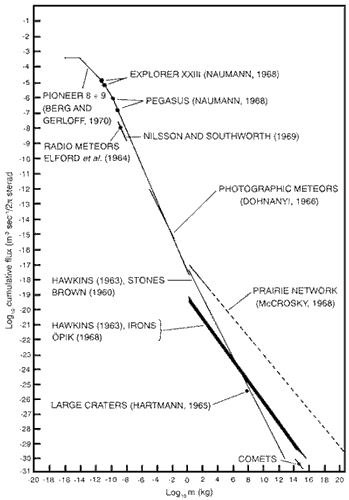
Figure 3. Cumulative flux of meteoroids and related objects into the earth’s atmosphere having a mass of M(kg) (adapted from Dohnanyi41). His data sources used to derive this plot are listed in his bibliography.
Unlike Millman, Dohnanyi47 did take into account a much wider mass range and smaller cumulative fluxes, as can be seen in his cumulative flux plot in Figure 3, and so he did obtain a much higher total influx estimate of some 20,900 tons of dust per year coming to the earth. Once again, if McCrosky’s data on the Prairie Network fireballs were included by Dohnanyi, then his influx estimate would have been greater. Furthermore, Dohnanyi’s estimate is primarily based on supposedly more reliable direct meas- urements obtained using collection plates and panels on satellites, but Millman maintains that such satellite penetration methods may not be registering the finer dust particles because they neither penetrate nor crater the collection panels, and so any influx estimate based on such data could be underestimating the “true” figure. This is particularly significant since Millman also highlights the evidence that there is another concentration peak in the mass range 10-13 to 10-14g at the lower end of the theoretical effectiveness of satellite penetration data collection (see Figure 1 again). Thus even Dohnanyi’s influx estimate is probably well below the “true” figure.
Representativeness and Assumptions
This leads us to a consideration of the representativeness both physically and statistically of each of the influx measurement dust collection techniques and the influx estimates derived from them. For instance, how representitive is a sample of dust collected on the small plates mounted on a small satellite or U-2 aircraft compared with the enormous volume of space that the sample is meant to represent? We have already seen how Millman admits that some dust particles probably do not penetrate or crater the plates as they are expected to and so the final particle count is thereby reduced by an unknown amount. And how representative is a drill core or grab sample from the ocean floor? After all, aren’t we analysing a split from a 1-2 kilogram sample and suggesting this represents the tonnes of sediments draped over thousands of square kilometres of ocean floor to arrive at an influx estimate for the whole earth?! To be sure, careful repeat samplings and analyses over several areas of the ocean floor may have been done, but how representative both physically and statistically are the results and the derived influx estimate?
Of course, Pettersson’s estimate from dust collected atop
Mauna Loa also suffers from the same question of representativeness. In many
of their reports, the researchers involved have failed to discuss such questions.
Admittedly there are so many potential unknowns that any statistical quantification
is well-nigh impossible, but some discussion of sample representativeness should
be attempted and should translate into some “guesstimate” of error
margins in their final reported dust influx estimate. Some like Barker and Anders
with their deep-sea sediments48 have indicated error margins as high
as ±50%, but even then such error margins only refer to the within and
between sample variations of element concentrations that they calculated from
their data set, and not to any statistical “guesstimate” of the physical representativeness
of the samples collected and analysed. Yet the latter is vital if we are trying
to determine what the “true” figure might be.
But there is another consideration that can be even more important, namely,
any assumptions that were used to derive the dust influx estimate from the raw
measurements or analytical data. The most glaring example of this is with respect
to the interpretation of deep-sea sediment analyses to derive an influx estimate.
In common with all the chemical methods, it is assumed that all the nickel,
iridium and osmium in the samples, over and above the average respective contents
of appropriate crustal rocks, is present in the cosmic dust in the deep-sea
sediment samples. Although this seems to be a reasonable assumption, there is
no guarantee that it is completely correct or reliable. Furthermore, in order
to calculate how much cosmic dust is represented by the extra nickel, iridium
and osmium con- centrations in the deep-sea sediment samples, it is assumed
that the cosmic dust has nickel, iridium and osmium concentrations equivalent
to the average respective concentrations in Type I carbonaceous chondrites (one
of the major types of meteorites). But is that type of meteorite representative
of all the cosmic matter arriving at the earth’s surface? Researchers like Barker
and Anders assume so because everyone else does! To be sure there are good reasons
for making that assumption, but it is by no means certain the Type I carbonaceous
chondrites are representative of all the cosmic material arriving at the earth’s
surface, since it has been almost impossible so far to exclusively collect such
material for analysis. (Some has been collected by spacecraft and U-2 aircraft,
but these samples still do not represent that total composition of cosmic material
arriving at the earth’s surface since they only represent a specific particle
mass range in a particular path in space or the upper atmosphere.)
However, the most significant assumption is yet to come. In order to calculate an influx estimate from the assumed cosmic component of the nickel, iridium and osmium concentrations in the deep-sea sediments it is necessary to determine what time span is represented by the deep-sea sediments analysed. In other words, what is the sedimentation rate in that part of the ocean floor sampled and how old therefore are our sediment samples? Based on the uniformitarian and evolutionary assumptions, isotopic dating and fossil contents are used to assign long time spans and old ages to the sediments. This is seen not only in Barker and Anders’ research, but in the work of Kyte and Wasson who calculated influx estimates from iridium measurements in so-called Pliocene and Eocene-Oligocene deep-sea sediments.49 Unfortunately for these researchers, their influx estimates depend absolutely on the validity of their dating and age assumptions. And this is extremely crucial, for if they obtained influx estimates of 100,000 tons per year and 330,000-340,000 tons per year respectively on the basis of uniformitarian and evolutionary assumptions (slow sedimentation and old ages), then what would these influx estimates become if rapid sedimentation has taken place over a radically shorter time span? On that basis, Pettersson’s figure of 5-14 million tons per year is not far-fetched!
On the other hand, however, Ganapathy’s work on ice cores from the South Pole doesn’t suffer from any assumptions as to the age of the analysed Ice samples because he was able to correlate his analytical results with two time-marker events of recent recorded history. Consequently his influx estimate of 400,000 tons per year has to be taken seriously. Furthermore, one of the advantages of the chemical methods of influx estimating, such as Ganapathy’s analyses of iridium in ice cores, is that the technique in theory, and probably in practice, spans the complete mass range of cosmic material (unlike the other techniques - see Figure 1 again) and so should give a better estimate. Of course, in practice this is difficult to verify, statistically the likelihood of sampling a macroscopic cosmic particle in, for example, an ice core is virtually nonexistent. In other words, there is the question” of representativeness again, since the ice core is taken to represent a much larger area of ice sheet, and it may well be that the cross sectional area intersected by the ice core is an anomalously high or low concentration of cosmic dust particles, or in fact an average concentration -who knows which?
Finally, an added problem not appreciated by many working in the field is that there is an apparent variation in the dust influx rate according to the latitude. Schmidt and Cohen reported50 that this apparent variation is most closely related to geomagnetic latitude so that at the poles the resultant influx is higher than in equatorial regions. They suggested that electromagnetic interactions could cause only certain charged particles to impinge preferentially at high latitudes. This may well explain the difference between Ganapathy’s influx estimate of 400,000 tons per year from the study of the dust in Antarctic ice and, for example, Kyte and Wasson s estimate of 330,000-340,000 tons per year based on iridium measurements in deep-sea sediment samples from the mid-Pacific Ocean.
Further Estimates
A number of other workers have made estimates of the meteoritic dust influx to the earth that are often quoted with some finality. Estimates have continued to be made up until the present time, so it is important to contrast these in order to arrive at the general consensus.
In reviewing the various estimates by the different methods up until that time, Singer and Bandermann5l argued in 1967 that the most accurate method for determining the meteoritic dust influx to the earth was by radiochemical measurements of radioactive Al26 in deep-sea sediments. Their confidence in this method was because it can be shown that the only source of this radioactive nuclide is interplanetary dust and that therefore its presence in deep-sea sediments was a more certain indicator of dust than any other chemical evidence. From measurements made others they concluded that the influx rate is 1250 tons per day, the error margins being such that they indicated the influx rate could be as low as 250 tons per day or as high as 2,500 tons per day. These figures equate to an influx rate of over 450,000 tons per year, ranging from 91,300 tons per year to 913,000 tons per year.
They also defended this estimate via this method as opposed to other methods. For example, satellite experiments, they said, never measured a concentration, nor even a simple flux of particles, but rather a flux of particles having a particular momentum or energy greater than some minimum threshold which depended on the detector being used. Furthermore, they argued that the impact rate near the earth should increase by a factor of about 1,000 compared with the value far away from the earth. And whereas dust influx can also be measured in the upper atmosphere, by then the particles have already begun slowing down so that any vertical mass motions of the atmosphere may result in an increase in concentration of the dust particles thus producing a spurious result. For these and other reasons, therefore, Singer and Bandermann were adamant that their estimate based on radioactive Al26 in ocean sediments is a reliable determination of the mass influx rate to the earth and thus the mass concentration of dust in interplanetary space.
Other investigators continued to rely upon a combination of satellite, radio and visual measurements of the “different particle masses to arrive at a cumulative flux rate. Thus in 1974 Hughes reported52 that
“from the latest cumulative influx rate data the influx of interplanetary dust to the earth’s surface in the mass range 10-13 - 106g is found to be 5.7 x 10⁹ g yr-1”,
or 5,700 tons per year, drastically lower than the Singer and Bandermann estimate from Al26 in ocean sediments. Yet within a year Hughes had revised his estimate upwards to 1.62 x 10¹⁰ g yr-1, with error calculations indicating that the upper and lower limits are about 3.0 and 0.8 x 10¹⁰g yr-1 respectively.53 Again this was for the particle mass range between 10-13g and 106 g, and this estimate translates to 16,200 tons per year between lower to upper limits of 8,000 - 30,000 tons per year. So confident now was Hughes in the data he had used for his calculations that he submitted an easier-to-read account of his work in the widely-read, popular science magazine, New Scientist.54 Here he again argued that
“as the earth orbits the sun it picks up about 16,000 tonnes of interplanetary material each year. The particles vary in size from huge meteorites weighing tonnes to small microparticles less than 0.2 micron in diameter. The majority originate from decaying comets.”
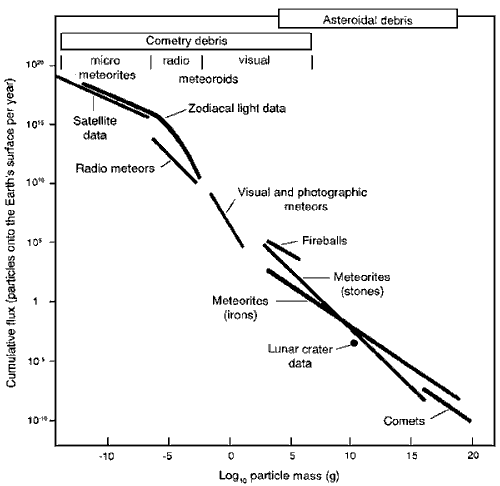
Figure 4. Plot of thecumulative flux of interplanetary matter (meteorites, meteors, and meteoritic dust, etc.) into the earth’s atmosphere (adapted from Hughes54). Note that he has subdivided the debris into two modes of origin - cometary and asteroidal - based on mass, with the former category being further subdivided according to detection techniqes. From this plot Hughes calculated a flux of 16,000 tonnes per year.
Figure 4 shows the cumulative flux curve built from the various sources of data that he used to derive his calculated influx of about 16,000 tons per year. However, it should be noted here that using the same methodology with similar data Millman55 had in 1975, and Dohnanyi56 in 1972, produced influx estimates of 10,950 tons per year and 20,900 tons per year respectively (Figures 2 and 3 can be compared with Figure 4). Nevertheless, it could be argued that these two estimates still fall within the range of 8,000 -30,000 tons per year suggested by Hughes. In any case, Hughes’ confidence in his estimate is further illustrated by his again quoting the same 16,000 tons per year influx figure in a paper published in an authoritative book on the subject of cosmic dust.58
Meanwhile, in a somewhat novel approach to the problem, Wetherill in 1976 derived a meteoritic dust influx estimate by looking at the possible dust production rate at its source.59 He argued that whereas the present sources of meteorites are probably multiple, it being plausible that both comets and asteroidal bodies of several kinds contribute to the flux of meteorites on the earth, the immediate source of meteorites is those asteroids, known as Apollo objects, that in their orbits around the sun cross the earth’s orbit. He then went on to calculate the mass yield of meteoritic dust (meteoroids) and meteorites from the fragmentation and cratering of these Apollo asteroids. He found that the combined yield from both crate ring and complete fragmentation to be 7.6 x 10¹⁰g yr-l, which translates into a figure of 76,000 tonnes per year. Of this figure he calculated that 190 tons per year would represent meteorites in the mass range of 102 - 106g, a figure which compared well with terrestrial meteorite mass impact rates obtained by various other calculation methods, and also with other direct measurement data, including observation of the actual meteorite flux. This figure of 76,000 tons per year is of course much higher than those estimates based on cumulative flux calculations such as those of Hughes,60 but still below the range of results gained from various chemical analyses of deep-sea sediments, such as those of Barker and Anders,61 Kyte and Wasson,62 and Singer and Bandermann,63 and of the Antarctic ice by Ganapathy.64 No wonder a textbook in astronomy compiled by a worker in the field and published in 1983 gave a figure for the total meteoroid flux of about 10,000 - 1,000,000 tons per year.65
In an oft-quoted paper published in 1985, Griin and his colleagues66 reported on yet another cumulative flux calculation, but this time based primarily on satellite measurement data. Because these satellite measurements had been made in interplanetary space, the figure derived from them, would be regarded as a measure of the interplanetary dust flux. Consequently, to calculate from that figure the total meteoritic mass influx on the earth both the gravitational increase at the earth and the surface area of the earth had to be taken into account. The result was an influx figure of about 40 tons per day, which translates to approximately 14,600 tons per year. This of course still equates fairly closely to the influx estimate made by Hughes.67
As well as satellite measurements, one of the other major sources of data for cumulative flux calculations has been measurements made using ground-based radars. In 1988 Olsson-Steel68 reported that previous radar meteor observations made in the VHF band had rendered a flux of particles in the 10-6 - 10-2g mass range that was anomalously low when compared to the, fluxes derived from optical meteor observations or satellite measurements. He therefore found that HF radars were necessary in order to detect the total flux into the earth’s atmosphere. Consequently he used radar units near Adelaide and Alice Springs in Australia to make measurements at a number of different frequencies in the HF band. Indeed, Olsson-Steel believed that the radar near Alice Springs was at that time the most powerful device ever used for meteor detection, and be- cause of its sensitivity the meteor count rates were extremely high. From this data he calculated a total influx of particles in the range 10-6 - 10-2g of 12,000 tons per year, which as he points out is almost identical to the flux in the same mass range calculated by Hughes.69,70 He concluded that this implies that, neglecting the occasional asteroid or comet impact, meteoroids in this mass range dominate the total flux to the atmosphere, which he says amounts to about 16,000 tons per year as calculated by Thomas et al.71
In a different approach to the use of ice as a meteoritic dust collector, in 1987 Maurette and his colleagues72 reported on their analyses of meteoritic dust grains extracted from samples of black dust collected from the melt zone of the Greenland ice cap. The reasoning behind this technique was that the ice now melting at the edge of the ice cap had, during the time since it formed inland and flowed outwards to the melt zone, been collecting cosmic dust of all sizes and masses. The quantity thus found by analysis represents the total flux over that time period, which can then be converted into an annual influx rate. While their analyses of the collected dust particles were based on size fractions, they relied on the mass-to-size relationship established by Griin et al.73 to convert their results to flux estimates. They calculated that each kilogram of black dust they collected for extraction and analysis of its contained meteoritic dust corresponded to a collector surface of approximately 0.5 square metres which had been exposed for approximately 3,000 years to meteoritic dust infall. Adding together their tabulated flux estimates for each size fraction below 300 microns yields a total meteoritic dust influx estimate of approximately 4,500 tons per year, well below that calculated from satellite and radar measurements, and drastically lower than that calculated by chemical analyses of ice.
However, in their defense it can at least be said that in comparison to the chemical method this technique is based on actual identification of the meteoritic dust grains, rather than expecting the chemical analyses to represent the meteoritic dust component in the total samples of dust analysed. Nevertheless, an independent study in another polar region at about the same time came up with a higher influx rate more in keeping with that calculated from satellite and radar measurements. In that study, Tuncel and Zoller74 measured the iridium content in atmospheric samples collected at the South Pole. During each 10-day sampling period, approximately 20,000-30,000 cubic metres of air was passed through a 25-centimetre-diameter cellulose filter, which was then submitted for a wide range of analyses. Thirty such atmospheric particulate samples were collected over an 11 month period, which ensured that, seasonal variations were accounted for. Based on their analyses they discounted any contribution of iridium to their samples from volcanic emissions, and concluded that iridium concentrations in their samples could be used to estimate both the meteoritic dust component in their atmospheric particulate samples and thus the global meteoritic dust influx rate. Thus they calculated a global flux of 6,000 -11,000 tons per year.
In evaluating their result they tabulated other estimates from the literature via a wide range of methods, including the chemical analyses of ice and sediments. In defending their estimate against the higher estimates produced by those chemical methods, they suggested that samples (particularly sediment samples) that integrate large time intervals include in addition to background dust particles the fragmentation products from large bodies. They reasoned that this meant the chemical methods do not discriminate between background dust particles and fragmentation products from large bodies, and so a significant fraction of the flux estimated from sediment samples may be due to such large body impacts. On the other hand, their estimate of 6,000-11,000 tons per year for particles smaller than 106g they argued is in reasonable agreement with estimates from satellite and radar studies.
Finally, in a follow-up study, Maurette with another group of colleagues75 investigated a large sample of micrometeorites collected by the melting and filtering of approximately 100 tons of ice from the Antarctic ice sheet. The grains in the sample were first characterised by visual techniques to sort them into their basic meteoritic types, and then selected particles were submitted for a wide range of chemical and isotopic analyses. Neon isotopic analyses, for example, were used to confirm which particles were of extraterrestrial origin. Drawing also on their previous work they concluded that a rough estimate of the meteoritic dust flux, for particles in the size range 50-300 microns, as recovered from either the Greenland or the Antarctic ice sheets, represents about a third of the total mass influx on the earth at approximately 20,000 tons per year.
|
(year) |
|
(tons/year) |
|---|---|---|
| Petterson (1960) |
Ni in atmospheric dust | 14,300,000 |
| Barker and Anders (1968) |
Ir and Os in deep-sea sediments | 100,000 (50,000 - 150,000) |
| Ganapathy (1983) |
Ir in Antarctic ice | 400,000 |
| Kyte and Wasson (1982) |
Ir in deep-sea sediments | 330,000 - 340,000 |
| Millman (1975) |
Satellite, radar, visual | 10,950 |
| Dohnanyi (1972) |
Satellite, radar, visual | 20,900 |
| Singer and Bandermann (1967) |
Al26 in deep-sea sediments | 456,000 (91,300 - 913,000) |
| Hughes (1975 - 1978) |
Satellite, radar, visual | 16,200 (8,000 - 30,000) |
| Wetherill (1976) |
Fragmentation of Apollo asteroids | 76,000 |
| Grün et al. (1985) |
Satellite data particularly | 14,600 |
| Olsson-Steel (1988) |
Radar data primarily | 16,000 |
| Maurette et al. (1987) |
Dust from melting Greenland ice | 4,500 |
| Tuncel and Zoller (1987) |
Ir in Antarctic atmospheric particulates | 6,000 - 11,000 |
| Maurette et al. (1991) |
Dust from melting Antarctic ice | 20,000 |
Table 3. Summary of the earth’s meteoritic dust influx estimates via the different measurement techniques.
Conclusion
Over the last three decades numerous attempts have been made using a variety of methods to estimate the meteoritic dust influx to the earth. Table 3 is the summary of the estimates discussed here, most of which are repeatedly referred to in the literature.
Clearly, there is no consensus in the literature as to what the annual influx rate is. Admittedly, no authority today would agree with Pettersson’s 1960 figure of 14,000,000 tons per year. However, there appear to be two major groupings -those chemical methods which give results in the 100,000-400,000 tons per year range or thereabouts, and those methods, particularly cumulative flux calculations based on satellite and radar data, that give results in the range 10,000-20,000 tons per year or thereabouts. There are those that would claim the satellite measurements give results that are too low because of the sensitivities of the techniques involved, whereas there are those on the other hand who would claim that the chemical methods include background dust particles and fragrnentation products.
Perhaps the “safest” option is to quote the meteoritic dust influx rate as within a range. This is exactly what several authorities on this subject have done when producing textbooks. For example, Dodd76 has suggested a daily rate of between 100 and 1,000 tons, which translates into 36,500-365,000 tons per year, while Hartmann,77 who refers to Dodd, quotes an influx figure of 10,000-1 million tons per year. Hartmann’s quoted influx range certainly covers the range of estimates in Table 3, but is perhaps a little generous with the upper limit. Probably to avoid this problem and yet still cover the wide range of estimates, Henbest writing in New Scientist in 199178 declares:
“Even though the grains are individually small, they are so numerous in interplanetary space that the Earth sweeps up some 100,000 tons of cosmic dust every year.79
Perhaps this is a “safe” compromise!
However, on balance we would have to say that the chemical methods when reapplied to polar ice, as they were by Maurette and his colleagues, gave a flux estimate similar to that derived from satellite and radar data, but much lower than Ganapathy’s earlier chemical analysis of polar ice. Thus it would seem more realistic to conclude that the majority of the data points to an influx rate within the range 10,000-20,000 tons per year, with the outside possibility that the figure may reach 100,000 tons per year.
Dust Influx to the Moon
Van Till et al. suggest:
“To compute a reasonable estimate for the accumulation of meteoritic dust on the moon we divide the earth’s accumulation rate of 16,000 tons per year by 16 for the moon’s smaller surface area, divide again by 2 for the moon’s smaller gravitational force, yielding an accumulation rate of about 500 tons per year on the moon.”80
However, Hartmann81 suggests a figure of 4,000 tons per year from his own published work,82 although this estimate is again calculated from the terrestrial influx rate taking into account the smaller surface area of the moon.
These estimates are of course based on the assumption that the density of meteoritic dust in the area of space around the earth-moon system is fairly uniform, an assumption verified by satellite measurements. However, with the US Apollo lunar exploration missions of 1969-1972 came the opportunities to sample the lunar rocks and soils, and to make more direct measurements of the lunar meteoritic dust influx.
Lunar Rocks and Soils
One of the earliest estimates based on actual moon samples was that made by Keays and his colleagues,83 who analysed for trace elements twelve lunar rock and soil samples brought back by the Apollo 11 mission. From their results they concluded that there was a meteoritic or cometary component to the samples, and that component equated to an influx rate of 2.9 x 10⁻⁹g cm-2 yr-l of carbonaceous-chondrite-like material. This equates to an influx rate of over 15,200 tons per year. However, it should be kept in mind that this estimate is based on the assumption that the meteoritic component represents an accumulation over a period of more than 1 billion years, the figure given being the anomalous quantity averaged over that time span. These workers also cautioned about making too much of this estimate because the samples were only derived from one lunar location.
Within a matter of weeks, four of the six investigators published a complete review of their earlier work along with some new data.84 To obtain their new meteoritic dust influx estimate they compared the trace element contents of their lunar soil and breccia samples with the trace element contents of their lunar rock samples. The assumption then was that the soil and breccia is made up of the broken-down rocks, so that therefore any trace element differences between the rocks and soils/breccias would represent material that had been added to the soils/breccias as the rocks were mechanically broken down. Having determined the trace element content of this “extraneous component” in their soil samples, they sought to identify its source. They then assumed that the exposure time of the region (the Apollo 11 landing site or Tranquillity Base) was 3.65 billion years, so in that time the proton flux from the solar -wind would account for some 2% of this extraneous trace elements component in the soils, leaving the remaining 98% or so to be of meteoritic (to be exact, “particulate’) origin. Upon further calculation, this approximate 98% portion of the extraneous component seemed to be due to an approximate 1.9% admixture of carbonaceous-chondrite-like material (in other words, meteoritic dust of a particular type), and the quantity involved thus represented, over a 3.65 billion year history of soil formation, an average influx rate of 3.8 x 10⁻⁹gcm-2 yr-l, which translates to over 19,900 tons per year. However, they again added a note of caution because this estimate was only based on a few samples from one location.
Nevertheless, within six months the principal investigators of this group were again in print publishing further results and an updated meteoritic dust influx estimate.85 By now they had obtained seven samples from the Apollo 12 landing site, which included two crystalline rock samples, four samples from core “drilled” from the lunar regolith, and a soil sample. Again, all the samples were submitted for analyses of a suite of trace elements, and by again following the procedure outlined above they estimated that for this site the extraneous component represented an admixture of about 1.7% meteoritic dust material, very similar to the soils at the Apollo 11 site. Since the trace element content of the rocks at the Apollo 12 site was similar to that at the Apollo 11 site, even though the two sites are separated by 1,400 kilometres, other considerations aside, they concluded that this
“spatial constancy of the meteoritic component suggests that the influx rate derived from our Apollo 11 data, 3.8 x 10⁻⁹gcm-2yr-l, is a meaningful average for the entire moon.”86
So in the abstract to their paper they reported that
“an average meteoritic influx rate of about 4 x 10⁻⁹ per square centimetre per year thus seems to be valid for the entire moon. ”87
This latter figure translates into an influx rate of approximately 20,900 tons per year.
Ironically, this is the same dust influx rate estimate as for the earth made by Dohnanyi using satellite and radar measurement data via a cumulative flux calculation.88 As for the moon’s meteoritic dust influx, Dohnanyi estimated that using “an appropriate focusing factor of 2,” it is thus half of the earth’s influx, that is, 10,450 tons per year.89 Dohnanyi defended his estimate, even though in his words it “is slightly lower than the independent estimates” of Keays, Ganapathy and their colleagues. He suggested that in view of the uncertainties involved, his estimate and theirs were “surprisingly close”.
While to Dohnanyi these meteoritic dust influx estimates based on chemical studies of the lunar rocks seem very close to his estimate based primarily on satellite measurements, in reality the former are between 50% and 100% greater than the latter. This difference is significant, reasons already having been given for the higher influx estimates for the earth based on chemical analyses of deep- sea sediments compared with the same cumulative flux estimates based on satellite and radar measurements. Many of the satellite measurements were in fact made from satellites in earth orbit, and it has consequently been assumed that these measurements are automatically applicable to the moon. Fortunately, this assumption has been verified by measurements made by the Russians from their moon-orbiting satellite Luna 19, as reported by Nazarova and his colleagues.90 Those measurements plot within the field of near-earth satellite data as depicted by, for example, Hughes.91 Thus there seems no reason to doubt that the satellite measurements in general are applicable to the meteoritic dust influx to the moon. And since Nazarova et al.’s Luna 19 measurements are compatible with Hughes’ cumulative flux plot of near-earth satellite data, then Hughes, meteoritic dust influx estimate for the earth is likewise applicable to the moon, except that when the relevant focusing factor, as outlined and used by Dohnanyi,92 is taken into account we obtain a meteoritic dust influx to the moon estimate from this satellite data (via the standard cumulative flux calculation method) of half the earth’s figure, that is, about 8,000-9,000 tons per year.
Lunar Microcraters
Apart from satellite measurements using various techniques and detectors to actually measure the meteoritic dust influx to the earth-moon system, the other major direct detection technique used to estimate the meteoritic dust influx to the moon has been the study of the microcraters that are found in the rocks exposed at the lunar surface. It is readily apparent that the moon’s surface has been impacted by large meteorites, given the sizes of the craters that have resulted, but craters of all sizes are found on the lunar surface right down to the micro-scale. The key factors are the impact velocities of the particles, whatever their size, and the lack of an atmosphere on the moon to slow down (or burn up) the meteorites. Consequently, provided their mass is sufficient, even the tiniest dust particles will produce microcraters on exposed rock surfaces upon impact, just as they do when impacting the windows on spacecraft (the study of microcraters on satellite windows being one of the satellite measurement techniques). Additionally, the absence of an atmosphere on the moon, combined with the absence of water on the lunar surface, has meant that chemical weathering as we experience it on the earth just does not happen on the moon. There is of course still physical erosion, again due to impacting meteorites of all sizes and masses, and due to the particles of the solar wind, but these processes have also been studied as a result of the Apollo moon landings. However, it is the microcraters in the lunar rocks that have been used to estimate the dust influx to the moon.
Perhaps one of the first attempts to try and use microcraters on the moon’s surface as a means of determining the meteoritic dust influx to the moon was that of Jaffe,93 who compared pictures of the lunar surface taken by Surveyor 3 and then 31 months later by the Apollo 12 crew. The Surveyor 3 spacecraft sent thousands of television pictures of the lunar surface back to the earth between April 20 and May 3, 1967, and subsequently on November 20, 1969 the Apollo 12 astronauts visited the same site and took pictures with a hand camera. Apart from the obvious signs of disturbance of the surface dust by the astronauts, Jaffe found only one definite change in the surface. On the bottom of an imprint made by one of the Surveyor footpads when it bounced on landing, all of the pertinent Apollo pictures showed a particle about 2mm in diameter that did not appear in any of the Surveyor pictures. After careful analysis he concluded that the particle was in place subsequent to the Surveyor picture-taking. Furthermore, because of the resolution of the pictures any crater as large as 1.5mm in diameter should have been visible in the Apollo pictures. Two pits were noted along with other particles, but as they appeared on both photographs they must have been produced at the time of the Surveyor landing. Thus Jaffe concluded that no meteorite craters as large as 1.5 mm in diameter appeared on the bottom of the imprint, 20cm in diameter, during those 31 months, so therefore the rate of meteorite impact was less than 1 particle per square metre per month. This corresponds to a flux of 4 x 10⁻⁷ particles m-2sec-1 of particles with a mass of 3 x 10⁻⁸g, a rate near the lower limit of meteoritic dust influx derived from spacecraft measurements, and many orders of magnitude lower than some previous estimates. He concluded that the absence of detectable craters in the imprint of the Surveyor 3 footpad implied a very low meteoritic dust influx onto the lunar surface.
With the sampling of the lunar surface carried out by the Apollo astronauts and the return of rock samples to the earth, much attention focused on the presence of numerous microcraters on exposed rock surfaces as another means of calculating the meteoritic dust influx. These microcraters range in diameter from less than 1 micron to more than 1 cm, and their ubiquitous presence on exposed lunar rock sur- faces suggests that microcratering has affected literally every square centimetre of the lunar surface. However, in order to translate quantified descriptive data on microcraters into data on interplanetary dust particles and their influx rate, a calibration has to be made between the lunar microcrater diameters and the masses of the particles that must have impacted to form the craters. Hartung et al.94 suggest that several approaches using the results of laboratory cratering experiments are possible, but narrowed their choice to two of these approaches based on microparticle accelerator experiments. Because the crater diameter for any given particle diameter increases proportionally with increasing impact velocity, the calibration procedure employs a constant impact velocity which is chosen as 20km/sec. Furthermore, that figure is chosen because the velocity distribution of interplanetary dust or meteoroids based on visual and radar meteors is bounded by the earth and the solar system escape velocities, and has a maximum at about 20km/sec, which thus conventionally is considered to be the mean velocity for meteoroids. Particles impacting the moon may have a minimum velocity of 2.4km/sec, the lunar escape velocity, but the mean is expected to remain near 20km/sec because of the relatively low effective crosssection of the moon for slower particles. Inflight velocity measurements of micron-sized meteoroids are generally consistent with this distribution. So using a constant impact velocity of 20km/sec gives a calibration relationship between the diameters of the impacting particles and the diameters of the microcraters. Assuming a density of 3g/cm3 allows this calibration relationship to be between the diameters of the microcraters and the masses of the impacting particles.
After determining the relative masses of micrometeoroids, their flux on the lunar surface may then be obtained by correlating the areal density of microcraters on rock surfaces with surface exposure times for those sample rocks. In other words, in order to convert crater populations on a given sample into the interplanetary dust flux the sample’s residence time at the lunar surface must be known.95 These residence times at the lunar surface, or surface exposure times, have been determined either by Cosmogenic Al26 radioactivity measurements or by cosmic ray track density measurements,96 or more often by solar-flare particle track density measurements.97
On this basis Hartung et al.98 concluded that an average minimum flux of particles 25 micrograms and larger is 2.5 x 10⁻⁶ particles per cm2 per year on the lunar surface supposedly over the last 1 million years, and that a minimum cumulative flux curve over the range of masses 10-12 - 10-4g based on lunar data alone is about an order of magnitude less than independently derived present-day flux data from satellite-borne detector experiments. Furthermore, they found that particles of masses 10-7 - 10-4g are the dominant contributors to the cross-sectional area of interplanetary dust particles, and that these particles are largely responsible for the exposure of fresh lunar rock surfaces by superposition of microcraters. Also, they suggested that the overwhelming majority of all energy deposited at the surface of the moon by impact is delivered by particles 10-6 - 10-2g in mass.
A large number of other studies have been done on microcraters on lunar surface rock samples and from them calculations to estimate the meteoritic dust (micrometeoroid) influx to the moon. For example, Fechtig et al. investigated in detail a 2cm2 portion of a particular sample using optical and scanning electron microscope (SEM) techniques. Microcraters were measured and counted optically, the results being plotted to show the relationship between microcrater diameters and the cumulative crater frequency. Like other investigators, they found that in all large microcraters 100-200 microns in diameter there were on average one or two “small” microcraters about 1 micron in diameter within them, while in all “larger” microcraters (200-1,000 microns in diameter), of which there are many on almost all lunar rocks, there are large numbers of these “smaller” microcraters. The counting of these “small” microcraters within the “larger” microcraters was found to be statistically significant in estimating the overall microcratering rate and the distribution of particle sizes and masses that have produced the microcraters, because, assuming an unchanging impacting particle size or energy distribution with time, they argued that an equal probability exists for the case when a large crater superimposes itself upon a small crater, thus making its observation impossible, and the case when a small crater superimposes itself upon a larger crater, thus enabling the observation of the small crater. In other words, during the random cratering process, on the average, for each small crater observable within a larger microcrater, there must have existed one small microcrater rendered unobservable by the subsequent formation of the larger microcrater. Thus they reasoned it is necessary to correct the number of observed small craters upwards to account for this effect. Using a correction factor of two they found that their resultant microcrater size distribution plot agreed satisfactorily with that found in another sample by Schneider et al.100 Their measuring and counting of microcraters on other samples also yielded size distributions similar to those reported by other investigators on other samples.
Fechtig et al. also conducted their own laboratory simulation experiments to calibrate microcrater size with impacting particle size, mass and energy. Once the cumulative microcrater number for a given area was calculated from this information, the cumulative meteoroid flux per second for this given area was easily calculated by again dividing the cumulative microcrater number by the exposure ages of the samples, previously determined by means of solar-flare track density measurements. Thus they calculated a cumulative meteoroid flux on the moon of 4 (±3) x 10-5 particles m-2 sec-1, which they suggested is fairly consistent with in situ satellite measurements. Their plot comparing micrometeoroid fluxes derived from lunar microcrater measurements with those attained from various satellite experiments (that is, the cumulative number of particles per square metre per second across the range of particle masses) is reproduced in Figure 5.
Mandeville101 followed a similar procedure in studying the microcraters in a breccia sample collected at the Apollo 15 landing site. Crater numbers were counted and diameters measured. Calibration curves were experimentally derived to relate impact velocity and microcrater diameter, plus impacting particle mass and microcrater diameter. The low solar-flare track density suggested a short and recent exposure time, as did the low density of microcraters. Consequently, in their calculating of the cumulative micrometeoroid flux they assumed a 3,000-year exposure time because of this measured solar-flare track density and the assumed solar-track production rate. The resultant cumulative particle flux was 1.4 x 10⁻⁵ particles per square metre per second for particles greater than 2.5 x 10⁻¹⁰g at an impact velocity of 20km/sec, a value which again appears to be in close agreement with flux values obtained by satellite measurements, but at the lower end of the cumulative flux curve calculated from microcraters by Fechtig et al.
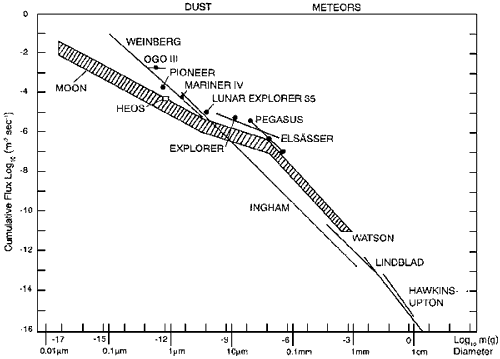
Figure 5. Comparison of micrometeoroid fluxes derived from lunar microcrater measurements (cross-hatched and labelled “MOON’) with those obtained in various satellite in situ experiments (adapted from Fechtig et al.99) The range of masses/sizes has been subdivided into dust and meteors.
Unresolved Problems
Schneider et al.102 also followed the same procedure in looking at microcraters on Apollo 15 and 16, and Luna 16 samples. After counting and measuring microcraters and calibration experiments, they used both optical and scanning electron microscopy to determine solar-flare track densities and derive solar-flare exposure ages. They plotted their resultant cumulative meteoritic dust flux on a flux versus mass diagram, such as Figure 5, rather than quantifying it. However, their cumulative flux curve is close to the results of other investigators, such as Hartung et al.103 Nevertheless, they did raise some serious questions about the microcrater data and the derivation of it, because they found that flux values based on lunar microcrater studies are generally less than those based on direct measurements made by satellite-borne detectors, which is evident on Figure 5 also. They found that this discrepancy is not readily resolved but may be due to one or more factors. First on their list of factors was a possible systematic error existing in the solar-flare track method, perhaps related to our present-day knowledge of the solar-flare particle flux. Indeed, because of uncertainties in applying the solar-flare flux derived from solar-flare track records in time-control led situations such as the Surveyor 3 spacecraft, they concluded that these implied their solar-flare exposure ages were systematically too low by a factor of between two and three. Ironically, this would imply that the calculated cumulative dust flux from the microcraters is systematically too high by the same factor, which would mean that there would then be an even greater discrepancy between flux values from lunar microcrater studies and the direct measurements made by the satellite-borne detectors. However, they suggested that part of this systematic difference may be because the satellite-borne detectors record an enhanced flux due to particles ejected from the lunar surface by impacting meteorites of all sizes. In any case, they argued that some of this systematic difference may be related to the calibration of the lunar microcraters and the satellite-borne detectors. Furthermore, because we can only measure the present flux, for example by satellite detectors, it may in fact be higher than the long-term average, which they suggest is what is being derived from the lunar microcrater data.
Morrison and Zinner104 also raised questions regarding solar-flare track density measurements and derived exposure ages. They were studying samples from the Apollo 17 landing area and counted and measured microraters on rock sample surfaces whose original orientation on the lunar surface was known, so that their exposure histories could be determined to test any directional variations in both the micrometeoroid flux and solar-flare particles. Once measured, they compared their solar-flare track density versus depth profiles against those determined by other investigators on other samples and found differences in the steepnesses of the curves, as well as their relative positions with respect to the track density and depth values. They found that differences in the steepnesses of the curves did not correlate with differences in supposed exposure ages, and thus although they couldn’t exclude these real differences in slopes reflecting variations in the activity of the sun, it was more probable that these differences arose from variations in observational techniques, uncertainties in depth measurements, erosion, dust cover on the samples, and/or the precise lunar surface exposure geometry of the different samples measured. They then suggested that the weight of the evidence appeared to favour those curves (track density versus depth profiles) with the flatter slopes, although such a conclusion could be seriously questioned as those profiles with the flatter slopes do not match the Surveyor 3 profile data even by their own admission.,
Rather than calculating a single cumulative flux figure, Morrison and Zinner treated the smaller microcraters separately from the larger microcraters, quoting flux rates of approximately 900 0.1 micron diameter craters per square centimetre per year and approximately 10 -15 x 10-6 500 micron diameter or greater craters per square centimetre per year. They found that these rates were independent of the pointing direction of the exposed rock surface relative to the lunar sky and thus this reflected no variation in the micrometeorite flux directionally. These rates also appeared to be independent of the supposed exposure times of the samples. They also suggested that the ratio of microcrater numbers to solar-flare particle track densities would make a convenient measure for comparing flux results of different laboratories/investigators and varying sampling situations. Comparing such ratios from their data with those of other investigations showed that some other investigators had ratios lower than theirs by a factor of as much as 50, which can only raise serious questions about whether the microcrater data are really an accurate measure of meteoritic dust influx to the moon. However, it can’t be the microcraters themselves that are the problem, but rather the underlying assumptions involved in the determination/estimation of the supposed ages of the rocks and their exposure times.
Another relevant study is that made by Cour-Palais,105 who examined the heat-shield windows of the command modules of the Apollo 7 - 17 (excluding Apollo 11) spacecrafts for meteoroid impacts as a means of estimating the interplanetary dust flux. As part of the study he also compared his results with data obtained from the Surveyor 3 lunar-lander’s TV shroud. In each case, the length of exposure time was known, which removed the uncertainty and assumptions that are inherent in estimation of exposure times in the study of microcraters on lunar rock samples. Furthermore, results from the Apollo spacecrafts represented planetary space measurements very similar to the satellite-borne detector techniques, whereas the Surveyor 3 TV shroud represented a lunar surface detector. In all, Cour-Palais found a total of 10 micrometeoroid craters of various diameters on the windows of the Apollo spacecrafts. Calibration tests were conducted by impacting these windows with microparticles for various diameters and masses, and the results were used to plot a calibration curve between the diameters of the micrometeoroid craters and the estimated masses of the impacting micrometeoroids. Because the Apollo spacecrafts had variously spent time in earth orbit, and some in lunar orbit also, as well as transit time in interplanetary space between the earth and the moon, correction factors had to be applied so that the Apollo window data could be taken as a whole to represent measurements in interplanetary space. He likewise applied a modification factor to the Surveyor 3 TV shroud results so that with the Apollo data the resultant cumulative mass flux distribution could be compared to results obtained from satellite-borne detector systems, with which they proved to be in good agreement.
He concluded that the results represent an average micrometeoroid flux as it exists at the present time away from the earth’s gravitational sphere of influence for masses < l0-7g. However, he noted that the satellite-borne detector measurements which represent the current flux of dust are an order of magnitude higher than the flux supposedly recorded by the lunar microcraters, a record which is interpreted as the “prehistoric” flux. On the other hand he, corrected the Surveyor 3 results to discount the moon’s gravitational effect and bring them into line with the interplanetary dust flux measurements made by satellite- borne detectors. But if the Surveyor 3 results are taken to represent the flux at the lunar surface then that flux is currently an order of magnitude lower than the flux recorded by the Apollo spacecrafts in interplanetary space. In any case, the number of impact craters measured on these respective spacecrafts is so small that one wonders how statistically representative these results are. Indeed, given the size of the satellite-borne detector systems, one could argue likewise as to how representative of the vastness of interplanetary space are these detector results.
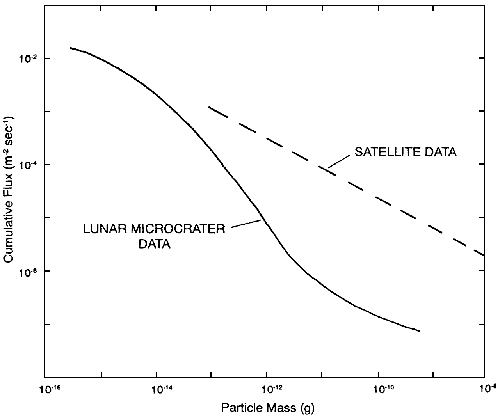
Figure 6. Cumulative fluxes (numbers of micrometeoroids with mass greater than the given mass which will impact every second on a square metre of exposed surface one astronomical unit from the sun) derived from satellite and lunar microcrater data (adapted from Hughes106).
Others had been noticing this disparity between the lunar microcrater data and the satellite data. For example, Hughes reported that this disparity had been known “for many years’.106 His diagram to illustrate this disparity is shown here as Figure 6. He highlighted a number of areas where he saw there were problems in these techniques for measuring micrometeoroid influx. For example, he reported that new evidence suggested that the meteoroid impact velocity was about 5km/sec rather than the 20km/ sec that had hithertofore been assumed. He suggested that taking this into account would only move the curves in Figure 6 to the right by factors varying with the velocity dependence of microphone response and penetration hole size (for the satellite-borne detectors) and crater diameter (the lunar microcraters), but because these effects are only functions of meteoroid momentum or kinetic energy their use in adjusting the data is still not sufficient to bring the curves in Figure 6 together (that is, to overcome this disparity between the two sets of data). Furthermore, with respect to the lunar microcrater data, Hughes pointed out that two other assumptions, namely, the ratio of the diameter of the microcrater to the diameter of the impacting particle being fairly constant at two, and the density of the particle being 3g per cm3, needed to be reconsidered in the light of laboratory experiments which had shown the ratio decreases with particle density and particle density varies with mass. He suggested that both these factors make the interpretation of microcraters more difficult, but that “the main problem” lies in estimating the time the rocks under consideration have remained exposed on the lunar surface. Indeed, he pointed to the assumption that solar activity has remained constant in the past, the key assumption required for calculation of an exposure age, as “the real stumbling block” - the particle flux could have been lower in the past or the solar-flare flux could have been higher. He suggested that because laboratory simulation indicates that solarwind sputter erosion is the dominant factor determining microcrater lifetimes, then knowing this enables the micrometeoroid influx to be derived by only considering rock surfaces with an equilibrium distribution of microcraters. He concluded that this line of research indicated that the micrometeoroid influx had supposedly increased by a factor of four in the last 100,000 years and that this would account for the disparity between the lunar microcrater data and the satellite data as shown by the separation of the two curves in Figure 6. However, this “solution”, according to Hughes, “creates the question of why this flux has increased” a problem which appears to remain unsolved.
In a paper reviewing the lunar microcrater data and the lunar micrometeoroid flux estimates, Hörz et al.107 discuss some key issues that arise from their detailed summary of micrometeoroid fluxes derived by various investigators from lunar sample analyses. First, the directional distribution of micrometeoroids is extremely non-uniform, the meteoroid flux differing by about three orders of magnitude between the direction of the earth’s apex and anti-apex. Since the moon may only collect particles greater than 1012g predominantly from only the apex direction, fluxes derived from lunar microcrater statistics, they suggest, may have to be increased by as much as a factor of p for comparison with satellite data that were taken in the apex direction. On the other hand, apex-pointing satellite data generally have been corrected upward because of an assumed isotropic flux, so the actual anisotropy has led to an overestimation of the flux, thus making the satellite results seem to represent an upper limit for the flux. Second, the micrometeoroids coming in at the apex direction appear to have an average impact velocity of only 8km/sec, whereas the fluxes calculated from lunar microcraters assume a standard impact velocity of 20km/sec. If as a result corrections are made, then the projectile mass necessary to produce any given microcrater will increase, and thus the moon-based flux for masses greater than 10-10g will effectively be enhanced by a factor of approximately 5. Third, particles of mass less than 10-12g generally appear to have relative velocities of at least 50km/sec, whereas lunar flux curves for these masses are based again on a 20km/sec impact velocity. So again, if appropriate corrections are made the lunar cumulative micrometeoroid flux curve would shift towards smaller masses by a factor of possibly as much as 10. Nevertheless, Hörz et al. conclude that
“as a consequence the fluxes derived from lunar crater statistics agree within the order of magnitude with direct satellite results if the above uncertainties in velocity and directional distribution are considered.”
Although these comments appeared in a review paper published in 1975, the footnote on the first page signifies that the paper was presented at a scientific meeting in 1973, the same meeting at which three of those investigators also presented another paper in which they made some further pertinent comments. Both there and in a previous paper, Gault, Hörz and Hartung108,109 had presented what they considered was a “best” estimate of the cumulative meteoritic dust flux based on their own interpretation of the most reliable satellite measurements. This “best” estimate they expressed mathematically in the form
N=l.45m-0.47 l0-13<m<l0-7,
N=9.l4 x l0-6m-l.213 l0-7<m<l03.
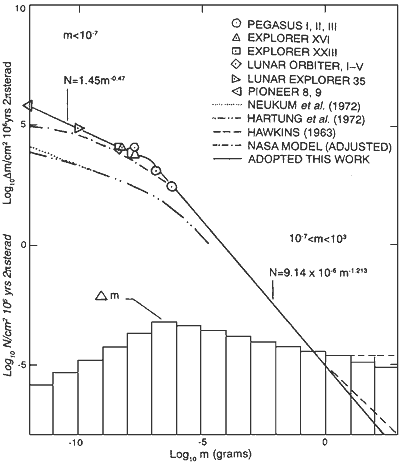
Figure 7. The micrometeoroid flux measurements from spacecraft experiments which were selected to define the mass-flux distribution (adapted from Gault et al.109) Also shown is the incremental mass flux contained within each decade of m, which sum to approximately 10,000 tonnes per year. Their data sources used are listed in their bibliography.
They commented that the use of two such exponential expressions with the resultant discontinuity is an artificial representation for the flux and not intended to represent a real discontinuity, being used for mathematical simplicity and for convenience in computational procedures. They also plotted this cumulative flux presented by these two exponential expressions, together with the incremental mass flux in each decade of particle mass, and that plot is reproduced here as Figure 7. Note that their flux curve is based on what they regard as the most reliable satellite measurements. Note also, as they did, that the fluxes derived from lunar rocks (the microcrater data) “are not necessarily directly comparable with the current satellite or photographic meteor data.” 110 However, using their cumulative flux curve as depicted in Figure 7, and their histogram plot of incremental mass flux, it is possible to estimate (for example, by adding up each incremental mass flux) the cumulative mass flux, which comes to approximately 2 x 10⁻⁹gcm-2yr-1 or about 10,000 tons per year. This is the same estimate that they noted in their concluding remarks:-
“We note that the mass of material contributing to any enhancement, which the earth-moon system is currently sweeping up, is of the order of 1010g per year.”111
Having derived this “best” estimate flux from their mathematical modelling of the “most reliable satellite measurements’ their later comments in the same paper seem rather contradictory:-
“If we follow this line of reasoning, the basic problem then reduces to consideration of the validity of the ‘best’ estimate flux, a question not unfamiliar to the subject of micrometeoroids and a question not with- out considerable historical controversy. We will note here only that whereas it is plausible to believe that a given set of data from a given satellite may be in error for any number of reasons, we find the degree of correlation between the various spacecraft experiments used to define the ‘best’ flux very convincing, especially when consideration is given to the different techniques employed to detect and measure the flux. Moreover, it must be remembered that the abrasion rates, affected primarily by microgram masses, depend almost exclusively on the satellite data while the rupture times, affected only by milligram masses, depend exclusively on the photographic meteor determinations of masses. It is extremely awkward to explain how these fluxes from two totally different and independent techniques could be so similarly in error. But if, in fact, they are in error then they err by being too high, and the fluxes derived from lunar rocks are a more accurate description of the current near- earth micrometeoroid flux.”(emphasis theirs )112
One is left wondering how they can on the one hand emphasise the lunar microcrater data as being a more accurate description of the current micrometeoroid flux, when they based their “best” estimate of that flux on the “most reliable satellite measurements”. However, their concluding remarks are rather telling. The reason, of course, why the lunar microcrater data is given such emphasis is because it is believed to represent a record of the integrated cumulative flux over the moon’s billions-of- years history, which would at face value appear to be a more statistically reliable estimate than brief point-in-space satellite-borne detector measurements. Nevertheless, they are left with this unresolved discrepancy between the microcrater data and the satellite measurements, as has already been noted. So they explain the microcrater data as presenting the “prehistoric” flux, the fluxes derived from the lunar rocks being based on exposure ages derived from solar- flare track density measurements and assumptions regarding solar-flare activity in the past. As for the lunar microcrater data used by Gault et al., they state that the derived fluxes are based on exposure ages in the range 2,500 - 700,000 years, which leaves them with a rather telling enigma. If the current flux as indicated by the satellite measurements is an order of magnitude higher than the microcrater data representing a “prehistoric” flux, then the flux of meteoritic dust has had to have increased or been enhanced in the recent past. But they have to admit that
“if these ages are accepted at face value, a factor of 10 enhancement integrated into the long term average limits the onset and duration of enhancement to the past few tens of years.”
They note that of course there are uncertainties in both the exposure ages and the magnitude of an enhancement, but the real question is the source of this enhanced flux of particles, a question they leave unanswered and a problem they pose as the subject for future investigation. On the other hand, if the exposure ages were not accepted, being too long, then the microcrater data could easily be reconciled with the “more reliable satellite measurements”.
Other Techniques
Only two other micrometeoroid and meteor influx measuring techniques appear to have been tried. One of these was the Apollo 17 Lunar Ejecta and Micrometeorite Experiment, a device deployed by the Apollo 17 crew which was specifically designed to detect micrometeorites.113 It consisted of a box containing monitoring equipment with its outside cover being sensitive to impacting dust particles. Evidently, it was capable not only of counting dust particles, but also of measuring their masses and velocities, the objective being to establish some firm limits on the numbers of microparticles in a given size range which strike the lunar surface every year. However, the results do not seem to have added to the large database already established by microcrater investigations.
The other direct measurement technique used was the Passive Seismic Experiment in which a seismograph was deployed by the Apollo astronauts and left to register subsequent impact events.114 In this case, however, the particle sizes and masses were in the gram to kilogram range of meteorites that impacted the moon’s surface with sufficient force to cause the vibrations to be recorded by the seismograph. Between 70 and 150 meteorite impacts per year were recorded, with masses in the range 100g to 1,000 kg, implying a flux rate of
log N = -1.62 -1.16 log m,
where N is the number of bodies that impact the lunar surface per square kilometre per year, with masses greater than m grams.115 This flux works out to be about one order of magnitude less than the average integrated flux from microcrater data. However, the data collected by this experiment have been used to cover that particle mass range in the development of cumulative flux curves (for example, see Figure 2 again) and the resultant cumulative mass flux estimates.
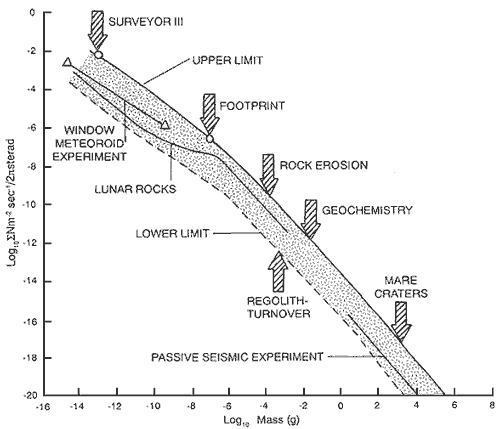
Figure 8. Constraints on the flux of micrometeoroids and larger objects according to a variety of independent lunar studies (adapted from Hörz et al.107)
Conclusion
Hörz et al. summarised some of the basic constraints derived from a variety of independent lunar studies on the lunar flux of micrometeoroids and larger objects.116 They also plotted the broad range of cumulative flux curves that were bounded by these constraints (see Figure 8). Included are the results of the Passive Seismic Experiment and the direct measurements of micrometeoroids encountered by spacecraft windows. They suggested that an upper limit on the flux can be derived from the mare cratering rate and from erosion rates on lunar rocks and other cratering data. Likewise, the negative findings on the Surveyor 3 camera lens and the perfect preservation of the footpad print of the Surveyor 3 1anding gear (both referred to above) also define an upper limit. On the other hand, the lower limit results from the study of solar and galactic radiation tracks in lunar soils, where it is believed the regolith has been reworked only by micrometeoroids, so because of presumed old undisturbed residence times the flux could not have been significantly lower than that indicated. The “geochemical”, evidence is also based on studies of the lunar soils where the abundance of trace elements are indicative of the type and amount of meteoritic contamination. Hörz et al. suggest that strictly, only the passive seismometer, the Apollo windows and the mare craters yield a cumulative mass distribution. All other parameters are either a bulk measure of a meteoroid mass or energy, the corresponding “flux” being calculated via the differential mass-distribution obtained from lunar microcrater investigations (‘lunar rocks , on Figure 8). Thus the corresponding arrows on Figure 8 may be shifted anywhere along the lines defining the “upper” and “lower” limits. On the other hand, they point out that the Surveyor 3 camera lens and footpad analyses define points only.
|
(year) |
|
(tons/year) |
|---|---|---|
| Hartmann (1983) |
Calculated from estimates of influx to the earth | 4,000 |
| Keays et al. (1970) |
Geochemistry of lunar soil and rocks | 15,200 |
| Ganapathy et al. (1970) |
Geochemistry of lunar soil and rocks | 19,900 |
| Dohnanyi (1971,1972) |
Calculated from satellite, radar data | 10,450 |
| Nazarova et al. (1973) |
Lunar orbit satellite data | 8,000 - 9,000 |
| by comparison with Hughes (1975) |
Calculated from satellite, radar data | (4,000 - 15,000) |
| Gault, et al. (1972, 1973) |
Combination of lunar microcrater and satellite data | 10,000 |
Table 4. Summary of the lunar meteoritic dust influx estimates.
Table 4 summarises the different lunar meteoritic dust estimates. It is difficult to estimate a cumulative mass flux from Hörz et al.’s diagram showing the basic constraints for the flux of micrometeoroids and larger objects derived from independent lunar studies (see Figure 8), because the units on the cumulative flux axis are markedly different to the units on the same axis of the cumulative flux and cumulative mass diagram of Gault et al. from which they estimated a lunar meteoritic dust influx of about 10,000 tons per year. The Hörz et al. basic constraints diagram seems to have been partly constructed from the previous figure in their paper, which however includes some of the microcrater data used by Gault et al. in their diagram (Figure 7 here) and from which the cumulative mass flux calculation gave a flux estimate of 10,000 tons per year. Assuming then that the basic differences in the units used on the two cumulative flux diagrams (Figures 7 and 8 here) are merely a matter of the relative numbers in the two log scales, then the Gault et al. cumulative flux curve should fall within a band between the upper and lower limits, that is, within the basic constraints, of Hörz et al.’s lunar cumulative flux summary plot (Figure 8 here). Thus a flux estimate from Hörz et al.’s broad lunar cumulative flux curve would still probably centre around the 10,000 tons per year estimate of Gault et al.
In conclusion, therefore, on balance the evidence points to a lunar meteoritic dust influx figure of around 10,000 tons per year. This seems to be a reasonable, approximate estimate that can be derived from the work of Hörz et al., who place constraints on the lunar cumulative flux by carefully drawing on a wide range of data from various techniques. Even so, as we have seen, Gault et al. question some of the underlying assumptions of the major measurement techniques from which they drew their data - in particular, the lunar microcrater data and the satellite measurement data. Like the “geochemical” estimates, the microcrater data depends on uniformitarian age assumptions, including the solar-flare rate, and in common with the satellite data, uniformitarian assumptions regarding the continuing level of dust in interplanetary space and as influx to the moon. Claims are made about variations in the cumulative dust influx in the past, but these also depend upon uniformitarian age assumptions and thus the argument could be deemed circular. Nevertheless, questions of sampling statistics and representativeness aside, the figure of approximately 10,000 tons per year has been stoutly defended in the literature based primarily on present-day satellite-borne detector measurements.
Finally, one is left rather perplexed by the estimate of the moon’s accumulation rate of about 500 tons per year made by Van Till et al.117 In their treatment of the “moon dust controversy”, they are rather scathing in their comments about creationists and their handling of the available data in the literature. For example, they state:
“The failure to take into account the published data pertinent to the topic being discussed is a clear failure to live up to the codes of thoroughness and integrity that ought to characterize professional science.”118
And again:
“The continuing publication of those claims by young- earth advocates constitutes an intolerable violation of the standards of professional integrity that should characterize the work of natural scientists.”119
Having been prepared to make such scathing comments, one would have expected that Van Till and his colleagues would have been more careful with their own handling of the scientific literature that they purport to have carefully scanned. Not so, because they failed to check their own calculation of 500 tons per year for lunar dust influx with those estimates that we have seen in the same literature which were based on some of the same satellite measurements that Van Till et al. did consult, plus the microcrater data which they didn’t. But that is not all - they failed to check the factors they used for calculating their lunar accumulation rate from the terrestrial figure they had established from the literature. If they had consulted, for example, Dohnanyi, as we have already seen, they would have realised that they only needed to use a focusing factor of two, the moon’s smaller surface area apparently being largely irrelevant. So much for lack of thoroughness! Had they surveyed the literature thoroughly, then they would have to agree with the conclusion here that the dust influx to the moon is approximately 10,000 tons per year.
Pre-Apollo Lunar Dust Thickness Estimates
The second major question to be addressed is whether NASA really expected to find a thick dust layer on the moon when their astronauts landed on July 20, 1969. Many have asserted that because of meteoritic dust influx estimates made by Pettersson and others prior to the Apollo moon landings, that NASA was cautious in case there really was a thick dust layer into which their lunar lander and astronauts might sink.
Early Speculations
Asimov is certainly one authority at the time who is often quoted. Using the 14,300,000 tons of dust per year estimate of Pettersson, Asimov made his own dust on the moon calculation and commented:
“But what about the moon? It travels through spacewith us and although it is smaller and has a weaker gravity, it, too, should sweep up a respectable quan tity of micrometeors.
To be sure, the moon has no atmosphere to friction the micrometeors to dust, but the act of striking the moon’s surface should develop a large enough amount of heat to do the job.
Now it is already known, from a variety of evidence, that the moon (or at least the level lowlands) is covered with a layer of dust. N o one, however, knows for sure how thick this dust may be.
It strikes me that if this dust is the dust of falling micrometeors, the thickness may be great. On the moon there are no oceans to swallow the dust, or winds to disturb it, or life forms to mess it up generally one way or another. The dust that forms must just lie there, and if the moon gets anything like the earth’s supply, it could be dozens of feet thick.
In fact, the dust that strikes craters quite probably rolls down hill and collects at the bottom, forming ‘drifts’ that could be fifty feet deep, or more. Why not?
I get a picture, therefore, of the first spaceship, picking out a nice level place for landing purposes coming slowly downward tail-first … and sinking majestically out of sight.”120
Asimov certainly wasn’t the first to speculate about the thickness of dust on the moon. As early as 1897 Peal121 was speculating on how thick the dust might be on the moon given that “it is well known that on our earth there is a considerable fall of meteoric dust.” Nevertheless, he clearly expected only “an exceedingly thin coating” of dust. Several estimates of the rate at which meteorites fall to earth were published between 1930 and 1950, all based on visual observations of meteors and meteorite falls. Those estimates ranged from 26 metric tons per year to 45,000 tons per year.122 In 1956 Öpik123 estimated 25,000 tons per year of dust falling to the earth, the same year Watson124 estimated a total accumulation rate of between 300,000 and 3 million tons per year, and in 1959 Whipple125 estimated 700,000 tons per year.
However, it wasn’t just the matter of meteoritic dust falling to the lunar surface that concerned astronomers in their efforts to estimate the thickness of dust on the lunar surface, since the second source of pulverised material on the moon is the erosion of exposed rocks by various processes. The lunar craters are of course one of the most striking features of the moon and initially astronomers thought that volcanic activity was responsible for them, but by about 1950 most investigators were convinced that meteorite impact was the major mechanism involved.126 Such impacts pulverise large amounts of rock and scatter fragments over the lunar surface. Astronomers in the 1950s agreed that the moon’s surface was probably covered with a layer of pulverised material via this process, because radar studies were consistent with the conclusion that the lunar surface was made of fine particles, but there were no good ways to estimate its actual thickness.
Yet another contributing source to the dust layer on the moon was suggested by Lyttleton in 1956,127 He suggested that since there is no atmosphere on the moon, the moon‘s surface is exposed to direct radiation, so that ultraviolet light and x-rays from the sun could slowly erode the surface of exposed lunar rocks and reduce them to dust, Once formed, he envisaged that the dust particles might be kept in motion and so slowly “flow” to lower elevations on the lunar surface where they would accumulate to form a layer of dust which he suggested might be “several miles deep”. Lyttleton wasn’t alone, since the main proponent of the thick dust view in British scientific circles was Royal Greenwich astronomer Thomas Gold, who also suggested that this loose dust covering the lunar surface could present a serious hazard to any spacecraft landing on the moon.128 Whipple, on the other hand, argued that the dust layer would be firm and compact so that humans and vehicles would have no trouble landing on and moving across the moon’s surface.129 Another British astronomer, Moore, took note of Gold’s theory that the lunar seas “were covered with layers of dust many kilometres deep” but flatly rejected this. He commented:
“The disagreements are certainly very marked. At one end of the scale we have Gold and his supporters, who believe in a dusty Moon covered in places to a great depth; at the other, people such as myself, who incline to the view that the dust can be no more than a few centimetres deep at most. The only way to clear the matter up once and for all is to send a rocket to find out.”150
So it is true that some astronomers expected to find a thick dust layer, but this was no means universally supported in the astronomical community. The Russians too were naturally interested in this question at this time because of their involvement in the “space race”, but they also had not reached a consensus on this question of the lunar dust. Sharonov,131 for example, discussed Gold’s theory and arguments for and against a thick dust layer, admitting that “this theory has become the object of animated discussion.” Nevertheless, he noted that the “majority of selenologists” favoured the plains of the lunar “seas’ (mares ) being layers of solidified lavas with minimal dust cover.
Research in the Early 1960s
The lunar dust question was also on the agenda of the December 1960 Symposium number 14ofthe International Astronomical Union held at the Puikovo Observatory near Leningrad. Green summed up the arguments as follows:
“Polarization studies by Wright verified that the surface of the lunar maria is covered with dust. However, various estimates of the depth of this dust layer have been proposed. In a model based on the radioastronomy techniques of Dicke and Beringer and others, a thin dust layer is assumed, Whipple assumes the covering to be less than a few meters’ thick.
On the other hand, Gold, Gilvarry, and Wesselink favor a very thick dust layer. … Because no polar homogenization of lunar surface details can be demonstrated, however, the concept of a thin dust layer appears more reasonable. … Thin dust layers, thickening in topographic basins near post-mare craters, are predicted for mare areas.”132
In a 1961 monograph on the lunar surface, Fielder discussed the dust question in some detail, citing many of those who had been involved in the controversy. Having discussed the lunar mountains where he said “there may be frequent pockets of dust trapped in declivities” he concluded that the mean dust cover over the mountains would only be a millimetre or so.133 But then he went on to say,
“No measurements made so far refer purely to marebase materials. Thus, no estimates of the composition of maria have direct experimental backing. This is unfortunate, because the interesting question ‘How deep is the dust in the lunar seas?’ remains unanswered.”
In 1964 a collection of research papers were published in a monograph entitled The Lunar Surface Layer, and the consensus therein amongst the contributing authors was that there was not a thick dust layer on the moon’s surface. For example, in the introduction, Kopal stated that
“this layer of loose dust must extend down to a depth of at least several centimeters, and probably a foot or so; but how much deeper it may be in certain places remains largely conjectural.”134
In a paper on “Dust Bombardment on the Lunar Surface”, McCracken and Dubin undertook a comprehensive review of the subject, including the work of Öpik and Whipple, plus many others who had since been investigating the meteoritic dust influx to the earth and moon, but concluded that
“The available data on the fluxes of interplanetary dust particles with masses less than 104gm show that the material accreted by the moon during the past 4.5 billion years amounts to approximately 1 gm/cm2 if the flux has remained fairly constant.”135
(Note that this statement is based on the uniformitarian age constraints for the moon.) Thus they went on to say that
“The lunar surface layer thus formed would, therefore, consist of a mixture of lunar material and interplanetary material (primarily of cometary origin) from 10cm to 1m thick. The low value for the accretion rate for the small particles is not adequate to produce large-scale dust erosion or to form deep layers of dust on the moon. …”.136
In another paper, Salisbury and Smalley state in their abstract:
“It is concluded that the lunar surface is covered with a layer of rubble of highly variable thickness and block size. The rubble in turn is mantled with a layer of highly porous dust which is thin over topographic highs, but thick in depressions. The dust has a complex surface and significant, but not strong, coherence.”137
In their conclusions they made a number of predictions.
“Thus, the relief of the coarse rubble layer expected in the highlands should be largely obliterated by a mantle of fine dust, no more than a few centimeters thick over near-level areas, but meters thick in steep- walled depressions. …The lunar dust layer should provide no significant difficulty for the design of vehicles and space suits. …”138
Expressing the opposing view was Hapke, who stated that
“recent analyses of the thermal component of the lunar radiation indicate that large areas of the moon may be covered to depths of many meters by a substance which is ten times less dense than rock. …Such deep layers of dust would be in accord with the suggestion of Gold.”139
He went on:
“Thus, if the radio-thermal analyses are correct, the possibility of large areas of the lunar surface being covered with thick deposits of dust must be given serious consideration.”140
However, the following year Hapke reported on research that had been sponsored by NASA, at a symposium on the nature of the lunar surface, and appeared to be more cautious on the dust question. In the proceedings he wrote:
“I believe that the optical evidence gives very strong indications that the lunar surface is covered with a layer of fine dust of unknown thicknes.”141
There is no question that NASA was concerned about the presence of dust on the moon’s surface and its thickness. That is why they sponsored intensive research efforts in the 1960s on the questions of the lunar surface and the rate of meteoritic dust influx to the earth and the moon. In order to answer the latter question, NASA had begun sending up rockets and satellites to collect dust particles and to measure their flux in near-earth space. Results were reported at symposia, such as that which was held in August 1965 at Cambridge, Massachusetts, jointly sponsored by NASA and the Smithsonian Institution, the proceedings of which were published in 1967.142
A number of creationist authors have referred to this proceedings volume in support of the standard creationist argument that NASA scientists had found a lot of dust in space which confirmed the earlier suggestions of a high dust influx rate to the moon and thus a thick lunar surface layer of dust that would be a danger to any landing spacecraft. Slusher, for example, reported that he had been involved in an intensive review of NASA data on the matter and found
“that radar, rocket, and satellite data published in 1976 by NASA and the Smithsonian Institution show that a tremendous amount of cosmic dust is present in the space around the earth and moon.”143
(Note that the date of publication was incorrectly reported as 1976, when it in fact is the 1967 volume just referred to above.) Similarly, Calais references this same 1967 proceedings volume and says of it,
“NASA has published data collected by orbiting satellites which confirm a vast amount of cosmic dust reaching the vicinity of the earth-moon system.”144,145
Both these assertions, however, are far from correct, since the reports published in that proceedings volume contain results of measurements taken by detectors on board spacecraft such as Explorer XVI, Explorer XXIII, Pegasus I and Pegasus II, as well as references to the work on radio meteors by Elford and cumulative flux curves incorporating the work of people like Hawkins, Upton and Elsässer. These same satellite results and same investigators’ contributions to cumulative flux curves appear in the 1970s papers of investigators whose cumulative flux curves have been reproduced here as Figures 3, 5 and 7, all of which support the 10,000 - 20,000 tons per year and approximately 10,000 tons per year estimates for the meteoritic dust influx to the earth and moon respectively - not the “tremendous” and “vast” amounts of dust incorrectly inferred from this proceedings volume by Slusher and Calais.
Pre-Apollo Moon Landings
The next stage in the NASA effort was to begin to directly investigate the lunar surface as a prelude to an actual manned landing. So seven Ranger spacecraft were sent up to transmit television pictures back to earth as they plummeted toward crash landings on selected flat regions near the lunar equator.146 The last three succeeded spectacularly, in 1964 and 1965, sending back thousands of detailed lunar scenes, thus increasing a thousand-fold our ability to see detail. After the first high-resolution pictures of the lunar surface were transmitted by television from the Ranger VII spacecraft in 1964, Shoemaker147 concluded that the entire lunar surface was blanketed by a layer of pulverised ejecta caused by repeated impacts and that this ejecta would range from boulder-sized rocks to finely-ground dust. After the remaining Ranger crash-landings, the Ranger investigators were agreed that a debris layer existed, although interpretations varied from virtually bare rock with only a few centimetres of debris (Kuiper, Strom and Le Poole) through to estimates of a layer from a few to tens of metres deep (Shoemaker).148 However, it can’t be implied as some have done149 that Shoemaker was referring to a dust layer that thick that was unstable enough to swallow up a landing spacecraft. After all, the consolidation of dust and boulders sufficient to support a load has nothing to do with a layer’s thickness. In any case, Shoemaker was describing a surface layer composed of debris from meteorite impacts, the dust produced being from lunar rocks and not from falling meteoritic dust.
But still the NASA planners wanted to dispel any lingering doubts before committing astronauts to a manned spacecraft landing on the lunar surface, so the soft-landing Surveyor series of spacecraft were designed and built However, the Russians just beat the Americans when they achieved the first lunar soft-landing with their Luna 9 spacecraft. Nevertheless, the first American Surveyor spacecraft successfully achieved a soft-landing in mid- 1966 and returned over 11,000 splendid photographs, which showed the moon’s surface in much greater detail than ever before.150 Between then and January 1968 four other Surveyor spacecraft were successfully landed on the lunar surface and the pictures obtained were quite remarkable in their detail and high resolution, the last in the series (Surveyor 7) returning 21,000 photographs as well as a vast amount of scientific data. But more importantly,
“as each spindly, spraddle-legged craft dropped gingerly to the surface, its speed largely negated by retrorockets, its three footpads sank no more than an inch or two into the soft lunar soil. The bearing strength of the surface measured as much as five to ten pounds per square inch, ample for either astronaut or landing spacecraft.”151
Two of the Surveyors carried a soil mechanics surface sampler which was used to test the soil and any rock fragments within reach. All these tests and observations gave a consistent picture of the lunar soil. As Pasachoff noted:
“It was only the soft landing of the Soviet Luna and American Surveyor spacecraft on the lunar surface in 1966 and the photographs they sent back that settled the argument over the strength of the lunar surface; the Surveyor perched on the surface without sinking in more than a few centimeters.”152152
Moore concurred, with the statement that
“up to 1966 the theory of deep dust-drifts was still taken seriously in the United States and there was considerable relief when the soft-Ianding of Luna 9 showed it to be wrong.”153
Referring to Gold’s deep-dust theory of 1955, Moore went on to say that although this theory had gained a considerable degree of respectability, with the successful soft-landing of Luna 9 in 1966 “it was finally discarded.”154 So it was in May 1966 when Surveyor I landed on the moon three years before Apollo 11 that the long debate over the lunar surface dust layer was finally settled, and NASA officials then knew exactly how much dust there was on the surface and that it was capable of supporting spacecraft and men.
Since this is the case, creationists cannot say or imply, as some have,155-160 that most astronomers and scientists expected a deep dust layer. Some of course did, but it is unfair if creationists only selectively refer to those few scientists who predicted a deep dust layer and ignore the majority of scientists who on equally scientific grounds had predicted only a thin dust layer. The fact that astronomy textbooks and monographs acknowledge that there was a theory about deep dust on the moon,161,162 as they should if they intend to reflect the history of the development of thought in lunar science, cannot be used to bolster a lop-sided presentation of the debate amongst scientists at the time over the dust question, particularly as these same textbooks and monographs also indicate, as has already been quoted, that the dust question was settled by the Luna and Surveyor soft-landings in 1966. Nor should creationists refer to papers like that ofWhipple,163 who wrote of a “dust cloud” around the earth, as if that were representative of the views at the time of all astronomers. Whipple’s views were easily dismissed by his colleagues because of subsequent evidence. Indeed, Whipple did not continue promoting his claim in subsequent papers, a clear indication that he had either withdrawn it or been silenced by the overwhelming response of the scientific community with evidence against it, or both.
The Apollo Lunar Landing
Two further matters need to be also dealt with. First, there is the assertion that NASA built the Apollo lunar lander with large footpads because they were unsure about the dust and the safety of their spacecraft. Such a claim is, inappropriate given the success of the Surveyor soft-landings, the Apollo lunar lander having footpads which were proportionally similar to the relative sizes of the respective spacecraft. After all, it stands to reason that since the design of Surveyor spacecraft worked so well and survived landing on the lunar surface that the same basic design should be followed in the Apollo lunar lander.
As for what Armstrong and Aldrin found on the lunar surface, all are agreed that they found a thin dust layer .The transcript of Armstrong’s words as he stepped onto the moon are instructive:
“I am at the foot of the ladder. The LM [lunar module ] footpads are only depressed in the surface about one or two inches, although the surface appears. to be very, very fine grained, as. you get close to it. It is almost like a powder. Now and then it is very fine. I am going to step off the LM now. That is one small step for man, one giant leap for mankind.”164164
Moments later while taking his first steps on the lunar surface, he noted:
“The surface is fine and powdery. I can - I can pick it up loosely with my toe. It does adhere in fine layers like powdered charcoal to the sole and sides. of my boots. I only go in a small fraction of an inch, maybe an eighth of an inch, but I can see the footprints. of my boots and the treads in the fine sandy particles.‘
And a little later, while picking up samples of rocks and fine material, he said:
“This is very interesting. It is a very soft surface, but here and there where I plug with the contingency sample collector, I run into a very hard surface, but it appears to be very cohesive material of the same sort. I will try to get a rock in here. Here’s a couple.”165
So firm was the ground, that Armstrong and Aldrin had great difficulty planting the American flag into the rocky and virtually dust-free lunar surface.
The fact that no further comments were made about the lunar dust by NASA or other scientists has been taken by some166-168 to represent some conspiracy of silence, hoping that some supposed unexplained problem will go away. There is a perfectly good reason why there was silence - three years earlier the dust issue had been settled and Armstrong and Aldrin only confirmed what scientists already knew about the thin dust layer on the moon. So because it wasn’t a problem just before the Apollo 11 landing, there was no need for any talk about it to continue after the successful exploration of the lunar surface. Armstrong himself may have been a little concerned about the constituency and strength of the lunar surface as he was about to step onto it, as he appears to have admitted in subsequent interviews,169 but then he was the one on the spot and about to do it, so why wouldn’t he be concerned about the dust, along with lots of other related issues.
Overn’s Testimony
Finally, there is the testimony of Dr William Overn.170,171 Because he was working at the time for the Univac Division of Sperry Rand on the television sub-system for the Mariner IV spacecraft he sometimes had exchanges with the men at the Jet Propulsion Laboratory (JPL) who were working on the Apollo program. Evidently those he spoke to were assigned to the Ranger spacecraft missions which, as we have seen, were designed to find out what the lunar surface really was like; in other words, to investigate among other things whether there was a thin or thick dust layer on the lunar surface. In Bill’s own words:
“I simply told them that they should expect to find less than 10,000 years’ worth of dust when they got there. This was based on my creationist belief that the moon is young. The situation got so tense it was suggested I bet them a large amount of money about the dust. … However, when the Surveyor spacecraft later landed on the moon and discovered there was virtually no dust, that wasn’t good enough for these people to pay off their bet. They said the first landing might have been a fluke in a low dust area! So we waited until ,.,. astronauts actually landed on the moon. …”172
Neither the validity of this story nor Overn’s integrity is in question. However, it should be noted that the bet Overn made with the JPL scientists was entered into at a time when there was still much speculation about the lunar surface, the Ranger spacecraft just having been crash-landed on the moon and the Surveyor soft-landings yet to settle the dust issue. Furthermore, since these scientists involved with Overn were still apparently hesitant after the Surveyor missions, it suggests that they may not have been well acquainted with NASA’s other efforts, particularly via satellite measurements, to resolve the dust question, and that they were not “rubbing shoulders with” those scientists who were at the forefront of these investigations which culminated in the Surveyor soft-landings settling the speculations over the dust. Had they been more informed, they would not have entered into the wager with Overn, nor for that matter would they have seemingly felt embarrassed by the small amount of dust found by Armstrong and Aldrin, and thus conceded defeat in the wager. The fact remains that the perceived problem of what astronauts might face on the lunar surface was settled by NASA in 1966 by the Surveyor soft-landings.
Moon Dust and the Moon’s Age
The final question to be resolved is, now that we know how much meteoritic dust falls to the moon’s surface each year, then what does our current knowledge of the lunar surface layer tell us about the moon’s age? For example, what period of time is represented by the actual layer of dust found on the moon? On the one hand creationists have been using the earlier large dust influx figures to support a young age of the moon, and on the other hand evolutionists are satisfied that the small amount of dust on the moon supports their billions-of-years moon age.
The Lunar Regolith
To begin with, what makes up the lunar surface and how thick is it? The surface layer of pulverised material on the moon is now, after on-site investigations by the Apollo astronauts, not called moon dust, but lunar regolith, and the fine materials in it are sometimes referred to as the lunar soil. The regolith is usually several metres thick and extends as a continuous layer of debris draped over the entire lunar bedrock surface. The average thickness of the regolith on the maria is 4-5m, while the highlands regolith is about twice as thick, averaging about 10m.173 The seismic properties of the regolith appear to be uniform on the highlands and maria alike, but the seismic signals indicate that the regolith consists of discrete layers, rather than being simply “compacted dust”. The top surface is very loose due to stirring by micrometeorites, but the lower depths below about 20cm are strongly compacted, probably due to shaking during impacts.
The complex layered nature of the regolith has been studied in drill-core samples brought back by the Apollo missions. These have clearly revealed that the regolith is not a homogeneous pile of rubble. Rather, it is a layered succession of ejecta blankets.174 An apparent paradox is that the regolith is both well mixed on a small scale and also displays a layered structure. The Apollo 15 deep core tube, for example, was 2.42 metres long, but contained 42 major textural units from a few millimetres to 13cm in thickness. It has been found that there is usually no correlation between layers in adjacent core tubes, but the individual layers are well mixed. This paradox has been resolved by recognising that the regolith is continuously “gardened” by large and small meteorites and micrometeorites. Each impact inverts much of the microstratigraphy and produces layers of ejecta, some new and some remnants of older layers. -The new surface layers are stirred by micrometeorites, but deeper stirring is rarer. The result is that a complex layered regolith is built up, but is in a continual state of flux, particles now at the surface potentially being buried deeply by future impacts. In this way, the regolith is turned over, like a heavily bombarded battlefield. However, it appears to only be the upper 0.5 - l mm of the lunar surface that is subjected to intense churning and mixing by the meteoritic influx at the present time. Nevertheless, as a whole, the regolith is a primary mixing layer of lunar materials from all points on the moon with the incoming meteoritic influx, both meteorites proper and dust.
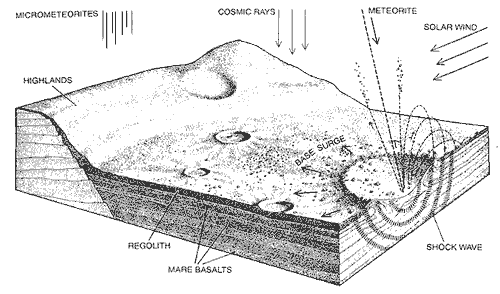
Figure 9. Processes of erosion on the lunar surface today appear to be extremely slow compared with the processes on the earth. Bombardment by micrometeorites is believed to be the main cause. A large meteorite strikes the surface very rarely, excavating bedrock and ejecting it over thousands of square kilometres, sometimes as long rays of material radiating from the resulting crater. Much of the meteorite itself is vaporized on impact, and larger fragments of the debris produce secondary craters. Such an event at a mare site pulverizes and churns the rubble and dust that form the regolith. Accompanying base surges of hot clouds of dust. gas and shock waves might compact the dust into breccias. Cosmic rays continually bombard the surface. During the lunar day ions from the solar wind and unshielded solar radiation impinge on the surface. (Adapted from Eglinton et al.176)
Lunar Surface Processes
So apart from the influx of the meteoritic dust, what other processes are active on the moon’s surface, particularly as there is no atmosphere or water on the moon to weather and erode rocks in the same way as they do on earth? According to Ashworth and McDonnell,
“Three major processes continuously affecting the surface of the moon are meteor impact, solar wind sputtering, and thermal erosion.”175
The relative contributions of these processes towards the erosion of the lunar surface depend upon various factors, such as the dimensions and composition of impacting bodies and the rate of meteoritic impacts and dust influx, These processes of erosion on the lunar surface are of course extremely slow compared with erosion processes on the earth, Figure 9, after Eglinton et al.,176 attempts to illustrate these lunar surface erosion processes.
Of these erosion processes the most important is obviously impact erosion, Since there is no atmosphere on the moon, the incoming meteoritic dust does not just gently drift down to the lunar surface, but instead strikes at an average velocity that has been estimated to be between 13 and 18 km/sec,177 or more recently as 20 km/sec,178 with a maximum reported velocity of 100 km/sec.179 Depending not ,ony on the velocity but on the mass of the impacting dust particles, more dust is produced as debris.
A number of attempts have been made to quantify the amount of dust-caused erosion of bare lunar rock on the lunar surface. Hörz et al.180 suggested a rate of 0.2-0.4mm/106 year (or 20-40 x 10-9cm/yr) after examination of micrometeorite craters on the surfaces of lunar rock samples brought back by the Apollo astronauts. McDonnell and Ashworth181 discussed the range of erosion rates over the range of particle diameters and the surface area exposed. They thus suggested that a rate of 1-3 x 10⁻⁷cm/yr (or 100-300 x 10-9cm/yr), basing this estimate on Apollo moon rocks also, plus studies of the Surveyor 3 camera. They later revised this estimate, concluding that on the scale of tens of metres impact erosion accounts for the removal of some 10-7cm/yr (or 100x 10-9cm/yr) of lunar material.182 However, in another paper, Gault et al.183 tabulated calculated abrasion rates for rocks exposed on the lunar surface compared with observed erosion rates as determined from solar-flare particle tracks. Discounting the early satellite data and just averaging the values calculated from the best, more recent satellite data and from lunar rocks, gave an erosion rate esti mate of 0.28cm/106yr (or 280 x 10-9cm/yr), while the average of the observed erosion rates they found from the literature was 0.03cm/106yr (or 30 x 10-9cm/yr). However, they naturally favoured their own “best” estimate from the satellite data of both the flux and the consequent abrasion rate, the latter being 0.1 cm/106yr (or 100 x 10-9cm/ yr), a figure identical with that ofMcDonnell and Ashworth. Gault et al. noted that this was higher, by a factor approaching an order of magnitude, than the “consensus’ of the observed values, a discrepancy which mirrors the difference between the meteoritic dust influx estimates derived from the lunar rocks compared with the satellite data.
These estimates obviously vary from one to another, but 30-100 x 10-9cm/yr would seem to represent a “middle of the range” figure. However, this impact erosion rate only applies to bare, exposed rock. As McCracken and Dubin have stated, once a surface dust layer is built up initially from the dust influx and impact erosion, this initial surface dust layer would protect the underlying bedrock surface against continued erosion by dust particle bombardment.184 If continued impact erosion is going to add to the dust and rock fragments in the surface layer and regolith, then what is needed is some mechanism to continually transport dust away from the rock surfaces as it is produced, so as to keep exposing bare rock again for continued impact erosion. Without some active transporting process, exposed rock surfaces on peaks and ridges would be worn away to give a somewhat rounded moonscape (which is what the Apollo astronauts found), and the dust would thus collect in thicker accumulations at the bottoms of slopes. This is illustrated in Figure 9.
So bombardment of the lunar surface by micrometeorites is believed to be the main cause of surface erosion. At the Current rate of removal, however, it would take a million years to remove an approximately 1mm thick skin of rock from the whole lunar surface and convert it to dust. Occasionally a large meteorite strikes the surface (see Figure 9 again), excavating through the dust down into the bedrock and ejecting debris over thousands of square kilometres sometimes as long rays of material radiating from the resulting crater. Much of the meteorite itself is vaporised on impact, and larger fragments of the debris create secondary craters. Such an event at a mare site pulverises and churns the rubble and dust that forms the regolith.
The solar wind is the next major contributor to lunar surface erosion. The solar wind consists primarily of protons, electrons, and some alpha particles, that are continuously being ejected by the sun. Once again, since the moon has virtually no atmosphere or magnetic field, these particles of the solar wind strike the lunar surface unimpeded at velocities averaging 600 km/sec, knocking individual atoms from rock and dust mineral lattices. Since the major components of the solar wind are H+ (hydrogen) ions, and some He (helium) and other elements, the damage upon impact to the crystalline structure of the rock silicates creates defects and voids that accommodate the gases and other elements which are simultaneously implanted in the rock surface. But individual atoms are also knocked out of the rock surface, and this is called sputtering or sputter erosion. Since the particles in the solar wind strike the lunar surface with such high velocities,
“one can safely conclude that most of the sputtered atoms have ejection velocities higher than the escape velocity of the moon.”185
There would thus appear to be a net erosional mass loss from the moon to space via this sputter erosion.
As for the rate of this erosional loss, Wehner186 suggested a value for the sputter rate of the order of 0.4 angstrom (Å)/yr. However, with the actual measurement of the density of the solar wind particles on the surface of the moon, and lunar rock samples available for analysis, the intensity of the solar wind used in sputter rate calculations was downgraded, and consequently the estimates of the sputter rate itself (by an order of magnitude lower). McDonnell and Ashworth187 estimated an average sputter rate of lunar rocks of about 0.02Å/yr, which they later revised to 0.02-0.04Å/yr.188 Further experimental work refined their estimate to 0.043Å/yr,189 which was reported in Nature by Hughes.190 This figure of 0.043 Å/yr continued to be used and confirmed in subsequent experimental work,191 although Zook192 suggested that the rate may be higher, even as high as 0.08Å/yr.193 Even so, if this sputter erosion rate continued at this pace in the past then it equates to less than one centimetre of lunar surface lowering in one billion years. This not only applies to solid rock, but to the dust layer itself, which would in fact decrease in thickness in that time, in opposition to the increase in thickness caused by meteoritic dust influx. Thus sputter erosion doesn’t help by adding dust to the lunar surface, and in any case it is such a slow process that the overall effect is minimal. Yet another potential form of erosion process on the lunar surface is thermal erosion, that is, the breakdown of the lunar surface around impact/crater areas due to the marked temperature changes that result from the lunar diurnal cycle. Ashworth and McDonnell194 carried out tests on lunar rocks, submitting them to cycles of changing temperature, but found it “impossible to detect any surface changes”. They therefore suggested that thermal erosion is probably “not a major force.” Similarly, McDonnell and Flavill195 conducted further experiments and found that their samples showed no sign of “degradation or enhancement” due to the temperature cycle that they had been subjected to. They reported that
“the conditions were thermally equivalent to the lunar day-night cycle and we must conclude that on this scale thermal cycling is a very weak erosion mechanism.‘
The only other possible erosion process that has ever been mentioned in the literature was that proposed by Lyttleton196 and Gold.197 They suggested that high-energy ultraviolet and x-rays from the sun would slowly pulverize lunar rock to dust, and over millions of years this would create an enormous thickness of dust on the lunar surface. This was proposed in the 1950s and debated at the time, but since the direct investigations of the moon from the mid- 1960s onwards, no further mention of this potential process has appeared in the technical literature, either for the idea or against it. One can only assume that either the idea has been ignored or forgotten, or is simply ineffective in producing any significant erosion, contrary to the suggestions of the original proposers. The latter is probably true, since just as with impact erosion the effect of this radiation erosion would be subject to the critical necessity of a mechanism to clean rock surfaces of the dust produced by the radiation erosion. In any case, even a thin dust layer will more than likely simply absorb the incoming rays, while the fact that there are still exposed rock surfaces on the moon clearly suggests that Lyttleton and Gold’s radiation erosion process has not been effective over the presumed millions of years, else all rock surfaces should long since have been pulverized to dust. Alternately, of course, the fact that there are still exposed rock surfaces on the moon could instead mean that if this radiation erosion process does occur then the moon is quite young.
“Age” Considerations
So how much dust is there on the lunar surface? Because of their apparent negligible or non-existent contribution, it may be safe to ignore thermal, sputter and radiation erosion. This leaves the meteoritic dust influx itself and the dust it generates when it hits bare rock on the lunar surface (impact erosion). However, our primary objective is to determine whether the amount of meteoritic dust in the lunar regolith and surface dust layer, when compared to the current meteoritic dust influx rate, is an accurate indication of the age of the moon itself, and by implication the earth and the solar system also.
Now we concluded earlier that the consensus from all the available evidence, and estimate techniques employed by different scientists, is that the meteoritic dust influx to the lunar surface is about 10,000 tons per year or 2x10⁻⁹g cm-2yr-1. Estimates of the density of micrometeorites vary widely, but an average value of 19/cm3 is commonly used. Thus at this apparent rate of dust influx it would take about a billion years for a dust layer a mere 2cm thick to accumulate over the lunar surface. Now the Apollo astronauts apparently reported a surface dust layer of between less than 1/8 inch (3mm)and 3 inches (7.6cm). Thus, if this surface dust layer were composed only of meteoritic dust, then at the current rate of dust influx this surface dust layer would have accumulated over a period of between 150 million years (3mm) and 3.8 billion years (7.6cm). Obviously, this line of reasoning cannot be used as an argument for a young age for the moon and therefore the solar system.
However, as we have already seen, below the thin surface dust layer is the lunar regolith, which is up to 5 metres thick across the lunar maria and averages 10 metres thick in the lunar highlands. Evidently, the thin surface dust layer is very loose due to stirring by impacting meteoritic dust (micrometeorites), but the regolith beneath which consists of rock rubble of all sizes down to fines (that are referred to as lunar soil) is strongly compacted. Nevertheless, the regolith appears to be continuously “gardened” by large and small meteorites and micrometeorites, particles now at the surface potentially being buried deeply by future impacts. This of course means then that as the regolith is turned over meteoritic dust particles in the thin surface layer will after some time end up being mixed into the lunar soil in the regolith below. Therefore, also, it cannot be assumed that the thin loose surface layer is entirely composed of meteoritic dust, since lunar soil is also brought up into this loose surface layer by impacts.
However, attempts have been made to estimate the proportion of meteoritic material mixed into the regolith. Taylor198 reported that the meteoritic compositions recognised in the maria soils turn out to be surprisingly uniform at about 1.5% and that the abundance patterns are close to those for primitive unfractionated Type I carbonaceous chondrites. As described earlier, this meteoritic component was identified by analysing for trace elements in the broken-down rocks and soils in the regolith and then assuming that any trace element differences represented the meteoritic material added to the soils. Taylor also adds that the compositions of other meteorites, the ordinary chondrites, the iron meteorites and the stony-irons, do not appear to be present in the lunar regolith, which may have some significance as to the origin of this meteoritic material, most of which is attributed to the influx of micrometeorites. It is unknown what the large crater-forming meteorites contribute to the regolith, but Taylor suggests possibly as much as 10% of the total regolith. Additionally, a further source of exotic elements is the solar wind, which is estimated to contribute between 3% and 4% to the soil. This means that the total contribution to the regolith from extra-lunar sources is around 15%. Thus in a five metre thick regolith over the maria, the thickness of the meteoritic component would be close to 60cm, which at the current estimated meteoritic influx rate would have taken almost 30 billion years to accumulate, a timespan six times the claimed evolutionary age of the moon.
The lunar surface is heavily cratered, the largest crater having a diameter of 295kms. The highland areas are much more heavily cratered than the maria, which suggested to early investigators that the lunar highland areas might represent the oldest exposed rocks on the lunar surface. This has been confirmed by radiometric dating of rock samples brought back by the Apollo astronauts, so that a detailed lunar stratigraphy and evolutionary geochronological framework has been constructed. This has led to the conclusion that early in its history the moon suffered intense bombardment from scores of meteorites, so that all highland areas presumed to be older than 3.9 billion years have been found to be saturated with craters 50-100 km in diameter, and beneath the 10 metre-thick regolith is a zone of breccia and fractured bedrock estimated in places to be more than 1 km thick.199
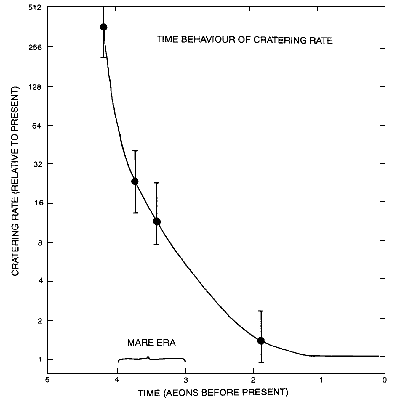
Figure 10. Cratering history of the moon (adapted from Taylor200). An aeon represents a billion years on the evolutionists’ time scale, while the vertical bar represents the error margin in the estimation of the cratering rate at each data point on the curve.
Following suitable calibration, a relative crater chronology has been established, which then allows for the cratering rate through lunar history to be estimated and then plotted, as it is in Figure 10.200 There thus appears to be a general correlation between crater densities across the lunar surface and radioactive “age” dates. However, the crater densities at the various sites cannot be fitted to a straightforward exponential decay curve of meteorites or asteroid populations.201 Instead, at least two separate groups of objects seem to be required. The first is believed to be approximated by the present-day meteoritic flux, while the second is believed to be that responsible for the intense early bombardment claimed to be about four billion years ago. This intense early bombardment recorded by the crater-saturated surface of the lunar highland areas could thus explain the presence of the thicker regolith (up to 10 metres) in those areas.
It follows that this period of intense early bombardment resulted from a very high influx of meteorites and thus meteoritic dust, which should now be recognisable in the regolith. Indeed, Taylor202 lists three types of meteoritic debris in the highlands regolith- the micrometeoritic component, the debris from the large-crater-producing bodies, and the material added during the intense early bombardment. However, the latter has proven difficult to quantify. Again, the use of trace element ratios has enabled six classes of ancient meteoritic components to be identified, but these do not correspond to any of the currently known meteorite classes, both iron and chondritic. It would appear that this material represents the debris from the large projectiles responsible for the saturation cratering in the lunar highlands during the intense bombardment early in the moon’s history. It is this early intense bombardment with its associated higher influx rate of meteoritic material that would account for not only the thicker regolith in the lunar highlands, but the 12% of meteoritic component in the thinner regolith of the maria that we have calculated (above) would take up to 30 billion years to accumulate at the current meteoritic influx rate. Even though the maria are believed to be younger than the lunar highlands and haven’t suffered the same saturation cratering, the cratering rate curve of Figure 10 suggests that the meteoritic influx rate soon after formation of the maria was still almost 10 times the current influx rate, so that much of the meteoritic component in the regolith could thus have more rapidly accumulated in the early years after the maria’s formation. This then removes the apparent accumulation timespan anomaly for the evolutionists’ timescale, and suggests that the meteoritic component in the maria regolith is still consistent with its presumed 3 billion year age if uniformitarian assumptions are used. This of course is still far from satisfactory for those young earth creationists who believed that uniformitarian assumptions applied to moon dust could be used to deny the evolutionists’ vast age for the moon.
Given that as much as 10% of the maria regolith may have been contributed by the large crater-forming meteorites,203 impact erosion by these large crater-producing meteorites may well have had a significant part in the development of the regolith, including the generation of dust, particularly if the meteorites strike bare lunar rock. Furthermore, any incoming meteorite, or micrometeorite for that matter, creates a crater much bigger than itself,204 and since most impacts are at an oblique angle the resulting secondary cratering may in fact be more important205 in generating even more dust. However, to do so the impacting meteorite or micrometeorite must strike bare exposed rock on the lunar surface. Therefore, if bare rock is to continue to be available at the lunar surface, then there must be some mechanism to move the dust off the rock as quickly as it is generated, coupled with some transport mechanism to carry it and accumulate it in lower areas, such as the maria.
Various suggestions have been made apart from the obvious effect of steep gradients, which in any case would only produce local accumulation. Gold, for example, listed five possibilities,206 but all were highly speculative and remain unverified. More recently, McDonnell207 has proposed that electrostatic charging on dust particle surfaces may cause those particles to levitate across the lunar surface up to 10 or more metres. As they lose their charge they float back to the surface, where they are more likely to settle in a lower area. McDonnell gives no estimate as to how much dust might be moved by this process, and it remains somewhat tentative. In any case, if such transport mechanisms were in operation on the lunar surface, then we would expect the regolith to be thicker over the maria because of their lower elevation. However, the fact is that the regolith is thicker in the highland areas where the presumed early intense bombardment occurred, the impact-generated dust just accumulating locally and not being transported any significant distance.
Having considered the available data, it is inescapably clear that the amount of meteoritic dust on the lunar surface and in the regolith is not at all inconsistent with the present meteoritic dust influx rate to the lunar surface operating, over the multi-billion year time framework proposed by evolutionists, but including a higher influx rate in the early history of the moon when intense bombardment occurred producing many of the craters on the lunar surface. Thus, for the purpose of “proving” a young moon, the meteoritic dust influx as it appears to be currently known is at least two orders of magnitude too low. On the other hand, the dust influx rate has, appropriately enough, not been used by evolutionists to somehow “prove” their multi-billion year timespan for lunar history. (They have recognised some of the problems and uncertainties and so have relied more on their radiometric dating of lunar rocks, coupled with wide- ranging geochemical analyses of rock and soil samples, all within the broad picture of the lunar stratigraphic succession.) The present rate of dust influx does not, of course, disprove a young moon.
Attempted Creationist Responses
Some creationists have tentatively recognised that the moon dust argument has lost its original apparent force. For example, Taylor(Paul)208 follows the usual line of argument employed by other creationists, stating that based on published estimates of the dust influx rate and the evolutionary timescale, many evolutionists expected the astronauts to find a very thick layer of loose dust on the moon, so when they only found a thin layer this implied a young moon. However, Taylor then admits that the case appears not to be as clear cut as some originally thought, particularly because evolutionists can now point to what appear to be more accurate measurements of a smaller dust influx rate compatible with their timescale. Indeed, he says that the evidence for disproving an old age using this particular process is weakened, but that furthermore, the case has been blunted by the discovery of what is said to be meteoritic dust within the regolith. However, like Calais,209,210 Taylor points to the NASA report211 that supposedly indicated a very large amount of cosmic dust in the vicinity of the earth and moon (a claim which cannot be substantiated by a careful reading of the papers published in that report, as we have already seen). He also takes up DeYoung’s comment212 that because all evolutionary theories about the origin of the moon and the solar system predict a much larger amount of incoming dust in the moon’s early years, then a very thick layer of dust would be expected, so it is still missing. Such an argument cannot be sustained by creationists because, as we have seen above, the amount of meteoritic dust that appears to be in the regolith seems to be compatible with the evolutionists’ view that there was a much higher influx rate of meteoritic dust early in the moon’s history at the same time as the so-called “early intense bombardment”.
Indeed, from Figure 10 it could be argued that since the cratering rate very early in the moon’s history was more than 300 times today’s cratering rate, then the meteoritic dust influx early in the moon’s history was likewise more than 300 times today’s influx rate. That would then amount to more than 3 million tons of dust per year, but even at that rate it would take a billion years to accumulate more than six metres thickness of meteoritic dust across the lunar surface, no doubt mixed in with a lesser amount of dust and rock debris generated by the large-crater-producing meteorite impacts. However, in that one billion years, Figure 10 shows that the rate of meteoritic dust influx is postulated to have rapidly declined, so that in fact a considerably lesser amount of meteoritic dust and impact debris would have accumulated in that supposed billion years. In other words, the dust in the regolith and the surface layer is still compatible with the evolutionists’ view that there was a higher influx rate early in the moon’s history, so creationists cannot use that to shore up this considerably blunted argument.
Coupled with this, it is irrelevant for both Taylor and DeYoung to imply that because evolutionists say that the sun and the planets were formed from an immense cloud of dust which was thus obviously much thicker in the past, that their theory would thus predict a very thick layer of dust. On the contrary, all that is relevant is the postulated dust influx after the moon’s formation, since it is only then that there is a lunar surface available to collect the dust, which we can now investigate along with that lunar surface. So unless there was a substantially greater dust influx after the moon formed than that postulated by the evolutionists (see Figure 10 and our calculations above), then this objection also cannot be used by creationists.
De Young also adds a second objection in order to counter the evolutionists’ case. He maintains that the revised value of a much smaller dust accumulation from space is open to question, and that scientists continue to make major adjustments in estimates of meteors and space dust that fall upon the earth and moon.213 If this is meant to imply that the current dust influx estimate is open to question amongst evolutionists, then it is simply not the case, because there is general agreement that the earlier estimates were gross overestimates. As we have seen, there is much support for the current figure, which is two orders of magnitude lower than many of the earlier estimates. There may be minor adjustments to the current estimate, but certainly not anything major.
While De Young hints at it, Taylor (Ian)214 is quite open in suggesting that a drastic revision of the estimated meteoritic dust influx rate to the moon occurred straight after the Apollo moon landings, when the astronauts , observations supposedly debunked the earlier gross over-estimates, and that this was done quietly but methodically in some sort of deliberate way. This is simply not so. Taylor insinuates that the Committee for Space Research (COSPAR) was formed to work on drastically downgrading the meteoritic dust influx estimate, and that they did this only based on measurements from indirect techniques such as satellite-borne detectors, visual meteor counts and observations of zodiacal light, rather than dealing directly with the dust itself. That claim does not take into account that these different measurement techniques are all necessary to cover the full range of particle sizes involved, and that much of the data they employed in their work was collected in the 1960s before the Apollo moon landings. Furthermore, that same data had been used in the 1960s to produce dust influx estimates, which were then found to be in agreement with the minor dust layer found by the astronauts subsequently. In other words, the data had already convinced most scientists before the Apollo moon landings that very little dust would be found on the moon, so there is nothing “fishy” about COSPAR’s dust influx estimates just happening to yield the exact amount of dust actually found on the moon’s surface. Furthermore, the COSPAR scientists did not ignore the dust on the moon’s surface, but used lunar rock and soil samples in their work, for example, with the study of lunar microcraters that they regarded as representing a record of the historic meteoritic dust influx. Attempts were also made using trace element geochemistry to identify the quantity of meteoritic dust in the lunar surface layer and the regolith below.
A final suggestion from De Young is that perhaps there actually is a thick lunar dust layer present, but it has been welded into rock by meteorite impacts.215 This is similar and related to an earlier comment about efforts being made to re-evaluate dust accumulation rates and to find a mechanism for lunar dust compaction in order to explain the supposed absence of dust on the lunar surface that would be needed by the evolutionists’ timescale216 For support, Mutch217 is referred to, but in the cited pages Mutch only talks about the thickness of the regolith and the debris from cratering, the details of which are similar to what has previously been discussed here. As for the view that the thick lunar dust is actually present but has been welded into rock by meteorite impacts, no reference is cited, nor can one be found. Taylor describes a “mega-regolith” in the highland areas218 which is a zone of brecciation, fracturing and rubble more than a kilometre thick that is presumed to have resulted from the intense early bombardment, quite the opposite to the suggestion of meteorite impacts welding dust into rock. Indeed, Mutch,219 Ashworth and McDonnell220 and Taylor221 all refer to turning over of the soil and rubble in the lunar regolith by meteorite and micrometeorite impacts, making the regolith a primary mixing layer of lunar materials that have not been welded into rock. Strong compaction has occurred in the regolith, but this is virtually irrelevant to the issue of the quantity of meteoritic dust on the lunar surface, since that has been estimated using trace element analyses.
Parks222 has likewise argued that the disintegration of meteorites impacting the lunar surface over the evolutionists’ timescale should have produced copious amounts of dust as they fragmented, which should, when added to calculations of the meteoritic dust influx over time, account for dust in the regolith in only a short period of time. However, it has already been pointed out that this debris component in the maria regolith only amounts to 10%, which quantity is also consistent with the evolutionists, postulated cratering rate over their timescale. He then repeats the argument that there should have been a greater rate of dust influx in the past, given the evolutionary theories for the formation of the bodies in the solar system from dust accretion, but that argument is likewise negated by the evolutionists having postulated an intense early bombardment of the lunar surface with a cratering rate, and thus a dust influx rate, over two orders of magnitude higher than the present (as already discussed above). Finally, he infers that even if the dust influx rate is far less than investigators had originally supposed, it should have contributed much more than the 1.5%’s worth of the 1-2 inch thick layer of loose dust on the lunar surface. The reference cited for this percentage of meteoritic dust in the thin loose dust layer on the lunar surface is Ganapathy et al.223 However, when that paper is checked carefully to see where they obtained their samples from for their analytical work, we find that the four soil samples that were enriched in a number of trace elements of meteoritic origin came from depths of 13-38 cms below the surface, from where they were extracted by a core tube. In other words, they came from the regolith below the 1-2 inch thick layer of loose dust on the surface, and so Parks’ application of this analytical work is not even relevant to his claim. In any case, if one uses the current estimated meteoritic dust influx rate to calculate how much meteoritic dust should be within the lunar surface over the evolutionists’ timescale one finds the results to be consistent, as has already been shown above.
Parks may have been influenced by Brown, whose personal correspondence he cites. Brown, in his own publication,224 has stated that
“if the influx of meteoritic dust on the moon has been at just its present rate for the last 4.6 billion years, then the layer of dust should be over 2,000 feet thick.”
Furthermore, he indicates that he made these computations based on the data contained in Hughes225 and Taylor.226 This is rather baffling, since Taylor does not commit himself to a meteoritic dust influx rate, but merely refers to the work of others, while Hughes concentrates on lunar microcraters and only indirectly refers to the meteoritic dust influx rate. In any case, as we have already seen, at the currently estimated influx rate of approximately 10,000 tons per year a mere 2 cm thickness of meteoritic dust would accumulate on the lunar surface every billion years, so that in 4.6 billion years there would be a grand total of 9.2 cm thickness. One is left wondering where Brown’s figure of 2,000 feet (approximately 610 metres) actually came from? If he is taking into account Taylor’s reference to the intense early bombardment, then we have already seen that, even with a meteoritic dust influx rate of 300 times the present figure, we can still comfortably account for the quantity of meteoritic dust found in the lunar regolith and the loose surface layer over the evolutionists’ timescale. While defence of the creationist position is totally in order, baffling calculations are not. Creation science should always be good science; it is better served by thorough use of the technical literature and by facing up to the real data with sincerity, as our detractors have often been quick to point out.
Conclusion
So are there any loopholes in the evolutionists’ case that the current apparent meteoritic dust influx to the lunar surface and the quantity of dust found in the thin lunar surface dust layer and the regolith below do not contradict their multi-billion year timescale for the moon’s history? Based on the evidence we currently have the answer has to be that it doesn’t look like it. The uncertainties involved in the possible erosion process postulated by Lyttleton and Gold (that is, radiation erosion) still potentially leaves that process as just one possible explanation for the amount of dust in a young moon model, but the dust should no longer be used as if it were a major problem for evolutionists. Both the lunar surface and the lunar meteoritic influx rate seem to be fairly well characterised, even though it could be argued that direct geological investigations of the lunar surface have only been undertaken briefly at 13 sites (six by astronauts and seven by unmanned spacecraft) scattered across a portion of only one side of the moon.
Furthermore, there are some unresolved questions regarding the techniques and measurements of the meteoritic dust influx rate. For example, the surface exposure times for the rocks on whose surfaces microcraters were measured and counted are dependent on uniformitarian age assumptions. If the exposure times were in fact much shorter, then the dust influx estimates based on the lunar microcraters would need to be drastically revised, perhaps upwards by several orders of magnitude. As it is, we have seen that there is a recognised discrepancy between the lunar microcrater data and the satellite-borne detector data, the former being an order of magnitude lower than the latter. Hughes227 explains this in terms of the meteoritic dust influx having supposedly increased by a factor of four in the last 100,000 years, whereas Gault et al.228 admit that if the ages are accepted at face value then there had to be an increase in the meteoritic dust influx rate by a factor of 10 in the past few tens of years! How this could happen we are not told, yet according to estimates of the past cratering rate there was in fact a higher influx of meteorites, and by inference meteoritic dust, in the past. This is of course contradictory to the claims based on lunar microcrater data. This seems to leave the satellite-borne detector measurements as apparently the more reliable set of data, but it could still be argued that the dust collection areas on the satellites are tiny, and the dust collection timespans far too short, to be representative of the quantity of dust in the space around the earth-moon system.
Should creationists then continue to use the moon dust as apparent evidence for a young moon, earth and solar system? Clearly, the answer is no. The weight of the evidence as it currently exists shows no inconsistency within the evolutionists’ case, so the burden of proof is squarely on creationists if they want to argue that based on the meteoritic dust the moon is young. Thus it is inexcusable for one creationist writer to recently repeat verbatim an article of his published five years earlier,229,230 maintaining that the meteoritic dust is proof that the moon is young in the face of the overwhelming evidence against his arguments. Perhaps any hope of resolving this issue in the creationists, favour may have to wait for further direct geological investigations and direct measurements to be made by those manning a future lunar surface laboratory, from where scientists could actually collect and measure the dust influx, and investigate the characteristics of the dust in place and its interaction with the regolith and any lunar surface processes.
Conclusions
Over the last three decades numerous attempts have been made using a variety of methods to estimate the meteoritic dust influx to both the earth and the moon. On the earth, chemical methods give results in the range of 100,000-400,000 tons per year, whereas cumulative flux calculations based on satellite and radar data give results in the range 10,000-20,000 tons per year. Most authorities on the subject now favour the satellite data, although there is an outside possibility that the influx rate may reach 100,000 tons per year. On the moon, after assessment of the various techniques employed, on balance the evidence points to a meteoritic dust influx figure of around 10,000 tons per year.
Although some scientists had speculated prior to spacecraft landing on the moon that there would be a thick dust layer there, there were many scientists who disagreed and who predicted that the dust would be thin and firm enough for a manned landing. Then in 1966 the Russians with their Luna 9 spacecraft and the Americans with their five successful Surveyor spacecraft accomplished soft-landings on the lunar surface, the footpads of the latter sinking no more than an inch or two into the soft lunar soil and the photographs sent back settling the argument over the thickness of the dust and its strength. Consequently, before the Apollo astronauts landed on the moon in 1969 the moon dust issue had been settled, and their lunar exploration only confirmed the prediction of the majority, plus the meteoritic dust influx measurements that had been made by satellite-borne detector systems which had indicated only a minor amount.
Calculations show that the amount of meteoritic dust in the surface dust layer, and that which trace element analyses have shown to be in the regolith, is consistent with the current meteoritic dust influx rate operating over the evolutionists’ timescale. While there are some unresolved problems with the evolutionists’ case, the moon dust argument, using uniformitarian assumptions to argue against an old age for the moon and the solar system, should for the present not be used by creationists.
Acknowledgements
Research on this topic was undertaken spasmodically over a period of more than seven years by Dr Andrew Snelling. A number of people helped with the literature search and obtaining copies of papers, in particular, Tony Purcell and Paul Nethercott. Their help is acknowledged. Dave Rush undertook research independently on this topic while studying and working at the Institute for Creation Research, before we met and combined our efforts. We, of course, take responsibility for the conclusions, which unfortunately are not as encouraging or complimentary for us young earth creationists as we would have liked.
References
- Pettersson, H., 1960. Cosmic spherules and meteoric dust. Scientific American, 202(2):123-132.
- Morris, H. M. (ed.), 1974. Scientific Creationism, Creation-Life Publishers, San Diego, pp. 151-152.
- Phillips, P. G., 1978. Meteoritic influx and the age of the earth.
In: Origins and Chance: Selected Readings from the Journal
or the
American Affiliation, D. L. Willis (ed.), American Scientific Affiliation, Eigin, Illinois, pp. 74-76. - Awbrey, F. T., 1983. Spacedust, the moon’s surface, and the age of the cosmos. Creation/Evolution, XIII:21-29.
- Shore, S. N., 1984. Footprints in the dust: the lunar surface and creationism. Creation/Evolution, XIV:32-35.
- Miller, K. R., 1984. Scientific creationism versus evolution: the mislabelled debate. In: Science and Creationism, A. Montagu(ed.), Oxford University Press, England, pp. 18-63.
- Bridgstock, M. W., 1985. Creation science: you’ve got to believe it to see it! Ideas In Education, 4(3):12-17.
- Bridgstock, M. W., 1986. Dusty arguments. In: Creationism: An Australian Perspective, M. W. Bridgstock and K. Smith (eds), 2nd edition, Australian Skeptics, Melbourne, pp. 18-19.
- Van Till, H. J., Young, D. A. and Menninga, C., 1988. Footprints on the dusty moon. In: Science Held Hostage, Inter Varsity Press, Downers Grove, Illinois, chapter 4, pp. 67-82.
- Pettersson, Ref. 1, p. 132.
- Pettersson, Ref. 1, p. 132.
- Pettersson, Ref. 1, p. 132.
- Phillips, Ref. 3, p. 75.
- Awbrey, Ref. 4, p. 22.
- Bridgstock, Ref. 8, p. 18.
- Bridgstock, Ref. 7, p. 16.
- VanTill et al.,Ref. 9, p.71.
- Pettersson, Ref. 1, p. 132.
- Asimov, I., 1959. 14 million tons of dust per year. Science Digest, 45(1):33-36.
- Asimov, Ref. 19, p. 34.
- Asimov, Ref. 19, p. 35.
- Bridgstock, Ref. 8, p. 18.
- Phillips, Ref. 3, p. 74.
- Parkin, D. W. and Tilles, D., 1968. Influx measurements of extraterrestrial material. Science, 159:936-946.
- Pettersson, Ref. 1, p. 132.
- Barker,J. L. and Anders, E., 1968. Accretion rate of cosmic matter from iridium and osmium contents of deep-sea sediments. Geochimica et Cosmochimica Acta, 32:627-645.
- Ganapathy, R., 1983. The Tunguska explosion of 1908: discovery of meteoritic debris near the explosion site and at the South Pole. Science, 220:1158-1161.
- Kyte, F. and Wasson, J. T., 1982. Lunar and Planetary Science, 13:411ff.
- Miller, Ref. 6, p. 44.
- Bridgstock, Ref. 8, p. 18.
- Bridgstock, Ref. 7, p. 16.
- Bridgstock, Ref. 8, p. 18.
- Bradley, J. P., Brownlee, D. E. and Veblen, D. R., 1983. Pyroxene whiskers and platelets in interplanetary dust: evidence of vapour phase growth. Nature,301:473-477.
- Dixon, D., McDonnell, T. and Carey, B., 1985. The dust that lights up the Zodiac. New Scientist, January 10, 1985:26-29.
- Bridgstock, Ref. 7, p. 16.
- Dixon et al., Ref. 34, p. 27.
- Dixon et al., Ref. 34, p. 27.
- Dixon et al., Ref. 34, pp. 26-27.
- Millman, P. M., 1975. Dust in the solar system. In: The Dusty Universe, G. B. Field and A. G. W. Cameron (eds), Smithsonian Astrophysical Observatory and Neale Watson Academic Publications, New York, pp. 185-209.
- Millman, Ref. 39.
- Dohnanyi, J. S., 1972. Interplanetary objects in review: statistics of their masses and dynamics. Icarus, 17:1-48. 42.
- Millman, Ref. 39, p. 191.
- Bridgstock, Ref. 8, p. 18.
- Millman, Ref. 39, p. 191.
- McCrosky, R. E., 1968. Distributions of large meteoric bodies. Smithsonian Astrophysical Observatory, Special Report 280.
- Millman, Ref. 39, p. 191.
- Dohnanyi, Ref. 41.
- Barker and Anders, Ref. 26.
- Kyte and Wasson, Ref. 28.
- Schmidt,R. A. and Cohen, T. J., 1964. Particle accretion rates: variation with latitude. Science, 145:924-926.
- Singer, S. F. and Banderrnann, L. W., 1967. Nature and origin of zodiacal dust. In: The Zodiacal Light and the Interplanetary Medium, National Aeronautics and Space Administration, USA, pp. 379-397.
- Hughes, D. W., 1974. Interplanetary dust and its influx to the earth’s surface. Space Research XIV (COSPAR), Akademie-Verlag, Berlin, pp.789-791.
- Hughes, D. W.,1975. Cosmic dust influx to the earth. Space Research XV (COSPAR), Akademie-Verlag, Berlin, pp. 531-539.
- Hughes, D. W., 1976. Earth -an interplanetary dustbin. New Scientist, 8 July 1976;64-66.
- Millman, Ref. 39.
- Dohnanyi, Ref. 41.
- Hughes, Ref. 53, p. 537.
- Hughes, D. W.,1978. Meteors. In: Cosmic Dust, J. A. M.McDonnell (ed.), John Wiley and Sons, Chichester, England, pp. 123-185.
- Wetherill, G. W., 1976. Where do the meteorites come from? A re-evaluation of the Earth-crossing Apollo objects as sources of chondritic meteorites. Geochimica et Cosmochimica Acta, 40: 1297-1317.
- Hughes, Ref. 53.
- Barker and Anders, Ref. 26.
- Kyte and Wasson, Ref. 28.
- Singer and Bandermann, Ref. 51.
- Ganapathy, Ref. 27.
- Hartmann, W. K.,1983. Moons and Planets, 2nd Edition, Wadsworth Publishing Company, Belmont, California, pp. 161-164.
- Grün, E., Zook, H. A., Fechtig, H. and Giese, R. H., 1985. Collisional balance of the meteoritic complex. Icarus, 62;244-272.
- Hughes, Ref. 53, p. 537.
- Olsson-Steel, D. I., 1988. The near-earth flux of microgram dust. In: Dust in the Universe, M. E. Bailey and D. A. Williams (eds), Cambridge University Press, England, pp. 187-192.
- Hughes, Ref. 53, p. 537. 70.
- Hughes, Ref. 58.
- Thomas, R. M., Whitham, P. S. and Elford, W. G., 1986. Frequency dependence of radar meteor echo rates. Proceedings of the Astronomical Society of Australia, 6;303-306.
- Maurette, M., Jehanno, C., Robin, E. and Hammer, C.,1987. Characteristics and mass distribution of extraterrestrial dust from the Greenland ice cap. Nature, 328;699-702.
- Grün et al., Ref. 66.
- Tuncel, G. and Zolier, W. H., 1987. Atmospheric iridium at the South Pole as a measure of the meteoritic component. Nature, 329:703-705.
- Maurette, M., Olinger, C., Michel-Levy, M. C., Kurate, G., Pourchet, M., Brandstatter, F. and Bourot-Denise, M., 1991. A collection of diverse micrometeorites recovered from 100 tonnes of Antarctic blue ice. Nature,351;44-47.
- Dodd, R. T., 1981. Meteorites: A Petrologic-Chemical Synthesis. Cambridge University Press, Cambridge, England, pp. 1-3.
- Hartmann, Ref. 65, p.161.
- Henbest, N., 1991. Dust in space. New Scientist, 18 May 1991, Inside Science supplement no.45, pp. 1-4.
- Henbest, Ref. 78, p. 4.
- Van Till et al., Ref. 9, p. 71.
- Hartmann, Ref. 65, p. 161.
- Hartmann, W. K.,1980. Dropping stones in magma oceans. Proceedings of the Conference on the Lunar Highlands Crust, Pergamon Press, New York, pp. 162-163.
- Keays, R. R., Ganapathy, R., Laul, J. C., Anders, E., Herzog, G. F. and Jeffrey, P. M., 1970. Trace elements and radioactivity in lunar rocks: implications for meteorite infall, solar-wind flux, and formation conditions of moon. Science, 167:490-493.
- Ganapathy, R., Keays, R. R., Laul, J. C. and Anders, E., 1970. Trace elements in Apollo 11 lunar rocks; implications for meteorite influx and origin of moon. Proceedings of the Apollo 11 Lunar Science Conference, Vol. 2, pp.1117-1142.
- Ganapathy, R., Keays, R. R. and Anders, E., 1970. Apollo 12 lunar samples: trace element analysis of a core and the uniformity of the regolith. Science,170;533-535.
- Ganapathy et al., Ref. 85, p. 535.
- Ganapathy et al., Ref. 85, p. 533.
- Dohnanyi, Ref. 41, p. 8.
- Dohnanyi, J. S., 1971. Flux of micrometeoroids: lunar sample analyses compared with flux model. Science, 173:558.
- Nazarova,T. N., Rybakov, A. K., Bazazyants, S. I. and Kuzmich, A. I., 1973. Investigations of meteoritic matter in the vicinity of the earth and the moon from the orbiting station Salyut and the moon satellite Luna 19. Space Research XIII (COSPAR), Akademie-Verlag,Berlin, pp. 1033 - 1036.
- Hughes,Ref. 53, p. 532.
- Dohnanyi, Ref. 41, pp. 7-8.
- Jaffe, L. D., 1970. Lunar surface: changes in 31 months and micrometeoroid flux. Science,170:1092-1094.
- Hartung, 1. B., Hörz, F. and Gault, D.E., 1972. Lunar microcraters and interplanetary dust. Proceedings of the Third Lunar Science Conference, Vol. 3, pp. 2735-2753.
- Schneider, E., Storzer, D., Hartung, J. B., Fechtig, H. and Gentner, W., 1973. Microcraters on Apollo 15 and 16 samples and corresponding cosmic dust fluxes. Proceedings of the Fourth Lunar Science Conference, Vol. 3, pp. 3277-3290.
- Hartung et al., Ref. 94, p. 2738.
- Morrison, D. A. and Zinner, E., 1975. Studies of solar flares and impact craters in partially protected crystals. Proceedings or the Sixth Lunar Science Conference, Vol. 3, pp. 3373-3390.
- Hartung et al., Ref. 94, p. 2751.
- Fechtig, H., Hartung, J. B., Nagel K. and Neukum, G., 1974. Lunar microcrater studies, derived meteoroid fluxes, and comparison with satellite-borne experiments. Proceedings or the Fifth Lunar Science Conference, Vol. 3, pp. 2463-2474.
- Schneider et al., Ref. 95, pp. 3277-3281.
- Mandeville, J. C., 1975. Microcraters observed on 15015 breccia and micrometeoroid flux. Proceedings or the Sixth Lunar Science Conference, Vol. 3, pp. 3403-3408.
- Schneider et al., Ref. 95, pp. 3284-3285.
- Hartung et al., Ref. 94.
- Morrison and Zinner, Ref. 97.
- Cour-Palais, B. G., 1974. The current micrometeoroid flux at the moon for masses s10-7g from the Apollo window and Surveyor 3 TV camera results. Proceedings or the Fifth Lunar Science Conference, Vol. 3, pp.2451-2462.
- Hughes, D. W., 1974. The changing micrometeoroid influx. Nature, 251:379-380.
- Hörz, F., Brownlee, D. E., Fechtig, H., Hartung, J. B., Morrison, D. A., Neukum, G.,Schneider, E.,Vedder, J. F. and Gault, D. E., 1975. Lunar microcraters: implications for the micrometeoroid complex. Planetary and Space Science, 23:151-172.
- Gault, D. E., Hörz, F. and Hartung, J. B., 1973. Abrasion and catastrophic rupture of lunar rocks: some implications to the micrometeoroid flux at 1 AU. Space Research XIII (COSPAR), Akademie-Verlag, Berlin, pp. 1085-1093.
- Gault, D. E., Hörz, F. and Hartung, J. B., 1972. Effects of microcratering on the lunar surface. Proceedings or the Third Lunar Science Conference, Vol. 3, pp. 2713-2734.
- Gault et al., Ref. 108, p. 1087.
- Gault et al., Ref. 108, p. 1092.
- Gault et al., Ref. 108, p. 1092.
- Cadogan, P., 1981. The Moon -Our Sister Planet, Cambridge University Press, Cambridge, England, p. 237.
- Hörz et al., Ref. 107, p. 168.
- Taylor, S. R., 1975. Lunar Science: A Post-Apollo View, Pergamon Press Inc., New York, p. 92.
- Hörz et al., Ref. 107, pp. 168-169.
- Van Till et al.,Ref. 9, p.71.
- Van Till et al., Ref. 9, p. 80.
- Van Till, et al.,Ref. 9, p.82.
- Asimov, Ref. 19, pp. 35-36.
- Peal, S. E., 1897. The dark tints of the lunar maria. Journal of the British Astronomical Association, VII(7):400-401.
- Buddhue, J. D., 1950. Meteoritic Dust, University of New Mexico Press, Albuquerque.
- Öpik, E. J.,1956. Interplanetary dust and terrestrial accretion of meteoritic matter. Irish Astronomical Journal, 4:84-135.
- Watson, F. G., 1956. Between the Planets, Harvard University Press, Cambridge, Massachusetts.
- Whipple, F. L., 1959. On the lunar dust layer. In: Vistas In Astronautics, Pergamon Press, New York, Vol. 2.
- Baldwin, R. R., 1949. The Face of the Moon, University of Chicago Press, Chicago.
- Lyttleton, R. A., 1956. The Modern Universe, Harper and Brolhers, New York, p. 72.
- Gold, T., 1955. The lunar surface. Monthly Notices of the Royal Astronomical Society, 115:585.
- Whipple, Ref. 125.
- Moore, P ., 1963. Survey of the Moon, Eyre and Spottiswoode, London, p.120.
- Sharanov, V. V., 1960. In: The Moon -a Russian View, A. V. Markov (ed), The University of Chicago Press, pp. 354-357.
- Green, J., 1962. Geosciences applied to lunar exploration. In: The Moon, Z. Kopal and Z. K. Michailov (eds), International Astronomical Union Symposium No.14, Academic Press, London, p. 199.
- Fielder, G., 1961. Structure of the Moon’s Surface, Pergamon Press, New York, p. 125.
- Kopal, Z., 1964. Introduction. In: The Lunar Surface Layer- Materials and Characteristics, J. W. Salisbury and P. E. Glaser(eds), Academic Press, New York, p. xviii.
- McCracken, C. W. and Dubin, M., 1964. Dust bombardment on the lunar surface. In: The Lunar Surface Layer- Materials and Characteristics, J. W. Salisbury and P. E. Glaser (eds), Academic Press, New York, p. 203.
- McCracken and Dubin, Ref. 135, p. 204.
- Salisbury,J. W.and Smalley,V. G., l964. The lunar surface layer. In: The Lunar Surface Layer -Materials and Characteristics, J. W. Salisbury and P. E. Glaser(eds), Academic Press, New York, p. 411.
- Salisbury and Smalley, Ref. 137, p. 431.
- Hapke, B. W., 1964. Photometric and other laboratory studies relating to the lunar surface. In: The Lunar Surface Layer -Materials and Characteristics, J .W .Salisbury and P. E. Glaser (eds), Academic Press, New York, p. 332.
- Hapke, Ref. 139, p. 333.
- Hapke, B. W., 1965. Optical properties of the moon’s surface. In: The Nature of the Lunar Surface, W. N. Hess (ed.), Proceedings of The 1965 International Astronomical Union -National Aeronautics and Space Administration Symposium, Johns Hopkins Press, Baltimore, p.141.
- Hawkins, G. S. (ed.), 1967. Meteor Orbits and Dust: The Proceedings of a Symposium, National Aeronautics and Space Administration, Washington, D.C., Publication SP-135 and Smithsonian Institution, Cambridge, Massachusetts, Smithsonian Contribution 10 Astrophysics Vol.11.
- Ackerman, P.D., l986. Moon dust and the question of time. In: It’s A Young World After All -Exciting Evidences for Recent Creation, Baker Book House, Grand Rapids, Michigan, chapter 1, p. 23.
- Calais, R., 1987. Cleaning up the dust on the moon. Bible-Science Newsletter, 25(10):2.
- Calais, R., 1992. Proof that the moon is young! Bible-Science News, 30(8):2.
- Weaver, K. F., 1969. The moon -man’s first goal in space. National Geographic, 135(2):218.
- Shoemaker, E. M., 1965. Preliminary analysis of the fine structure of the lunar surface. Ranger VII, Part II Experimenters Analyses and Interpretations, Jet Propulsion Laboratory Technical Report 32-700, p.75.
- Hartmann, W. K., 1972. Moons and Planets, 1st Edition, Bogden and Quigley, Inc., Publishers, Belmont, California, p. 280.
- Whitcomb, J. C. and DeYoung, D. B., 1978. The Moon -Its Creation, Form and Significance, BMH Books, Winona Lake, Indiana, p. 95.
- Moore, P ., 1981. The Moon, Mitchell Beazley Publishers, London, p. 15.
- Weaver. Ref. 146, p. 219.
- Pasachoff, J. M., 1977. Contemporary Astronomy, W. B. Saunders Company, Philadelphia, p. 295.
- Moore, Ref. 150, p. 15.
- Moore, Ref. 150, p. 18.
- Slusher, H. S., 1980. Age of the Cosmos, Institute for Creation Research, San Diego, ICR Technical Monograph No.9, pp. 41- 42.
- Taylor, I. T., 1984. In the Minds of Men -Darwin and the New World Order, TFE Publishing, Toronto, Canada, pp. 328-329,460.
- Taylor, I. T., 1988. An interview. Bible-Science Newsletter, 26(8):9.
- Calais, Ref. 144, pp. 1-2. 159.
- Calais, Ref. 145, pp. 1-2.
- Morris, Ref. 2, p. 152.
- Dixon, R. T., 1971. Dynamic Astronomy, Prentice-Hall, Inc., Englewood Cliffs, New Jersey, p. 149.
- Rand McNally, 1978. New Concise Atlas of the Universe, Mitchell Beazley Publishers Ltd, London, p. 41.
- Whipple, F. L., 1961. The dust cloud about the earth. Nature, 189(4759):127-128.
- Armstrong, N. A., Aldrin, E. E. and Collins, M., 1969. Man walks on another world. In: First explorers on the moon -the incredible story of Apollo 11, National Geographic, 136(6):739.
- Armstrong et a1., Ref. 164, p. 746.
- Taylor, Ref. 156, p. 329.
- Taylor, Ref. 157, p. 9.
- Morris, Ref. 2, p. 152.
- Ackerman, Ref. 143, pp. 19, 22.
- Bible-Science Newsletter, 20(1) (January, 1982).
- Interview with Bill Overn, Ex Nihilo, 6(1):13-15 (July, 1983).
- Ref. 171, p. 14.
- Taylor, Ref. 115, pp. 57-58.
- Taylor, Ref. 115, pp. 60-61.
- Ashworth, D. G. and McDonnell, J. A. M., 1973. Lunar surface micro-erosion related to interplanetary dust particle distributions. Space Research XIII (COSPAR), Akademie-Verlag, Berlin, p. 1071.
- Eglinton, G., Maxwell, J. R. and Pillinger, C. T., 1972. The carbon chemistry of the moon. Scientific American, 227(4):81-90.
- Zook, H. A., 1975. The state of meteoritic material on the moon. Proceedings of the Sixth Lunar Science Conference, pp. 1653- 1672.
- Grün et a1., Ref. 66, pp. 247-248.
- McDonnell, J. A. M., 1978. Microparticle studies by space instrumentation. In: Cosmic Dust, J. A. M. McDonnell (ed.), John Wiley and Sons, Chichester, England, pp. 370-372.
- Hörz, F., Hartung, J. B. and Gault, D. E., 1971. Micrometeorite craters on lunar rock surfaces. Journal of Geophysical Research. 76(23): 5770- 5798.
- McDonnell,J. A. M.and Ashworth,D. G.,1972. Erosion phenomena on the lunar surface and meteorites. Space Research XII (COSPAR), Akademie-Verlag, Berlin, pp. 333-347.
- Ashworth and McDonnell, Ref. 175, p. 1071.
- Gault et a1., Ref. 108, pp. 1089-1090.
- McCracken and Dubin, Ref. 135, p. 203.
- Wehner, G. K., 1964. Sputtering effects on the lunar surface. In: The Lunar Surface Layer -Materials and Characteristics, J. W. Salisbury and P. E. Glaser (eds), Academic Press, New York, p. 318.
- Wehner, Ref. 185, p. 318.
- McDonnell and Ashworth, Ref. 181, p. 338.
- Ashworth and McDonnell, Ref. 175, p. 1072.
- McDonnell, J. A. M. and Flavill, R. P ., 1974. Solar wind sputtering on the lunar surface: equilibrium crater densities related to past and present microparticle influx rates. Proceedings of the Fifth Lunar Science Conference, Vol. 3, pp. 2441-2449.
- Hughes, Ref. 106, p. 380.
- McDonnell,J. A. M. and Carey, W. C., 1975. Solar-wind sputter erosion of microcrater populations on the lunar surface. Proceedings of the Sixth Lunar Science Conference, pp. 3391-3402.
- Zook, Ref. 177, p. 1669.
- McDonnell and Carey, Ref. 191, p. 3393.
- Ashworth and McDonnell, Ref. 175, pp. 1071-1072.
- McDonnell and Flavill, Ref. 189, p. 2441.
- Lyttleton, Ref. 127. 42
- Gold, Ref. 128.
- Taylor, Ref. 115, p. 171.
- Taylor, Ref. 115, p. 83.
- Taylor, Ref. 115, p. 86.
- Taylor, Ref. 115, p. 85.
- Taylor, Ref. 115, p. 259.
- Taylor, Ref. 115, p. 171.
- Gault et al., Ref. 108, p. 1086.
- Grün et al., Ref. 66, pp. 249-250.
- Sharonov, Ref. 131, p. 356.
- McDonnell, J. A. M., 1979. Lunar surface grain motion: electrostatic charging, supercharging (electret effects) and mechanical bonding. Space Research XIX (COSPAR), Pergamon Press, Oxford, pp. 455-457.
- Taylor, P. S., 1989. The Illustrated Origins Answer Book, Films for Christ Association, Inc., Mesa, Arizona, p. 17.
- Calais, Ref. 144, p. 2.
- Calais, Ref. 145, p. 2.
- Hawkins, Ref. 142.
- DeYoung, D. B., 1989. Questions and Answers on Astronomy and the Bible, Baker Book House, Grand Rapids, Michigan, p. 33.
- DeYoung, Ref. 212, p. 33.
- Taylor,Ref. 157, p. 9.
- DeYoung, Ref. 212, p. 34.
- Whitcomb and DeYoung, Ref. 149, p. 95.
- Mutch, T., 1972. Geology or the Moon, Princeton University Press, New Jersey, pp.256-257.
- Taylor, Ref. 115, p. 83.
- Mutch, Ref. 217, pp. 256-257.
- Ashworth and McDonnell, Ref. 175, p. 1082.
- Taylor, Ref. 115, p. 61.
- Parks, W. S., 1991. Moondust: response to Kuban. Creation Research Society Quarterly, 28(2):75-76.
- Ganapathy et al., Ref. 85.
- Brown, W. T., 1989. In the Beginning, Fifth Edition, Center for Scientific Creation, Phoenix, Arizona, pp. 17, 54.
- Hughes, Ref. 106.
- Taylor, Ref. 115, pp. 84-92. 227.
- Hughes, Ref.106.
- Gault et al., Ref. 108, p. 1092.
- Calais, Ref. 144.
- Calais, Ref. 145.
Support the creation/gospel message by donating or getting involved!

Answers in Genesis is an apologetics ministry, dedicated to helping Christians defend their faith and proclaim the good news of Jesus Christ.
- Customer Service 800.778.3390
- Available Monday–Friday | 9 AM–5 PM ET
- © 2026 Answers in Genesis