
Dino Dinner Hard to Swallow?
A Preliminary Analysis
A recent fossil discovery in China has evolutionists scratching their heads over a mammal’s last meal.
The fossilized remains of a small dinosaur (psittacosaur) have been found in the belly of a dog-like mammal named Repenomamus robustus. Researchers have also found a second fossil that they have named Repenomamus giganticus. This second fossil has been described as “breathtaking” and “about the size of a modern dog.”1 This is a real surprise for evolutionists because evolutionary assumptions say that mammals living during the so-called “age of the dinosaurs” couldn’t possibly have been that big; rather, they had to be small to better avoid the huge reptiles. It has some evolutionary scientists quite concerned, for it challenges what they have believed for years.
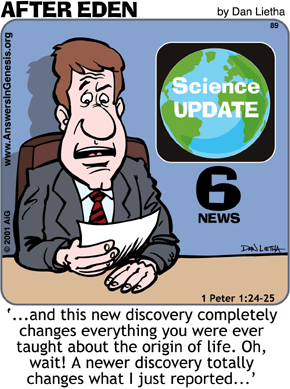
While the discovery is a particular shock (from an evolutionary standpoint) because one part of the evolution model may need to be drastically changed, it isn’t shocking for creationists. Creationists believe that man, mammals and dinosaurs originally lived at the same time.
The fossils of these mammals found in “Lower Cretaceous” rock helps confirm the creationist assertion that even some mammals were buried quickly in lower depths of the fossil record; mammals are usually found higher in the fossil record (i.e. many mammals and humans would have retreated to higher ground during the beginning of the global catastrophe of Noah’s Flood—see Where Are All the Human Fossils?).
Comments regarding this find in China such as “It dispels the conventional wisdom” and “articulated three-dimensional skeletons of vertebrates, suggesting a single, catastrophic, mass mortality event probably induced by volcanic activities”2 excite creationists. They are statements of what we would expect from the biblical account of Noah’s Flood.
While it is encouraging to hear evolutionists admit discoveries like this which challenge their way of thinking, the photos of the fossils and the description given in articles raise a caution flag. The dinosaur bones may only appear to be in the stomach of the dog-like creature when they really may just illustrate how the Flood waters would have buried one on top of the other.
Already, speculation is rampant that this find supports the dino-to-bird stories of animal evolution. The statement by Duke University paleontologist Anne Weil that “Maybe small dinosaurs got larger—or got off the ground—to avoid rapacious mammals” shows how the evolutionary bias drives their interpretation of the evidence.3 So, expect a rash of articles both popular and scientific which hail this discovery as evidence that dinosaurs evolved into birds because of hunting pressures from mammals.
Such a find in the fossil record, regardless of the cautionary flag raised with this discovery, still provides an excellent confirmation of the biblical model of a global catastrophe, which left billions of fossils in the rock layers all over the world.
Footnotes
- Verrengia, J., “Mammal ate dinosaur, to scientists’ surprise,” Cincinnati Enquirer, A5, January 13, 2005.
- Hu, Y., Meng, J., Wang, Y. & Li, C. “Large Mesozoic mammals fed on young dinosaurs,” Nature 433:149–152, January 13, 2005.
- Weil, A. “Living large in the Cretaceous,” Nature 433:116–117, January 13, 2005.
Support the creation/gospel message by donating or getting involved!

Answers in Genesis is an apologetics ministry, dedicated to helping Christians defend their faith and proclaim the good news of Jesus Christ.
- Customer Service 800.778.3390
- Available Monday–Friday | 9 AM–5 PM ET
- © 2026 Answers in Genesis